
Air India Flight AI816 Aborts High-Speed Take-Off at Mumbai Airport to Avoid Runway Conflict Bursting Three Tyres
Air India Flight AI816 aborted its take-off at Mumbai Airport on July 7, 2026, to avoid a runway conflict, resulting in three burst tyres.

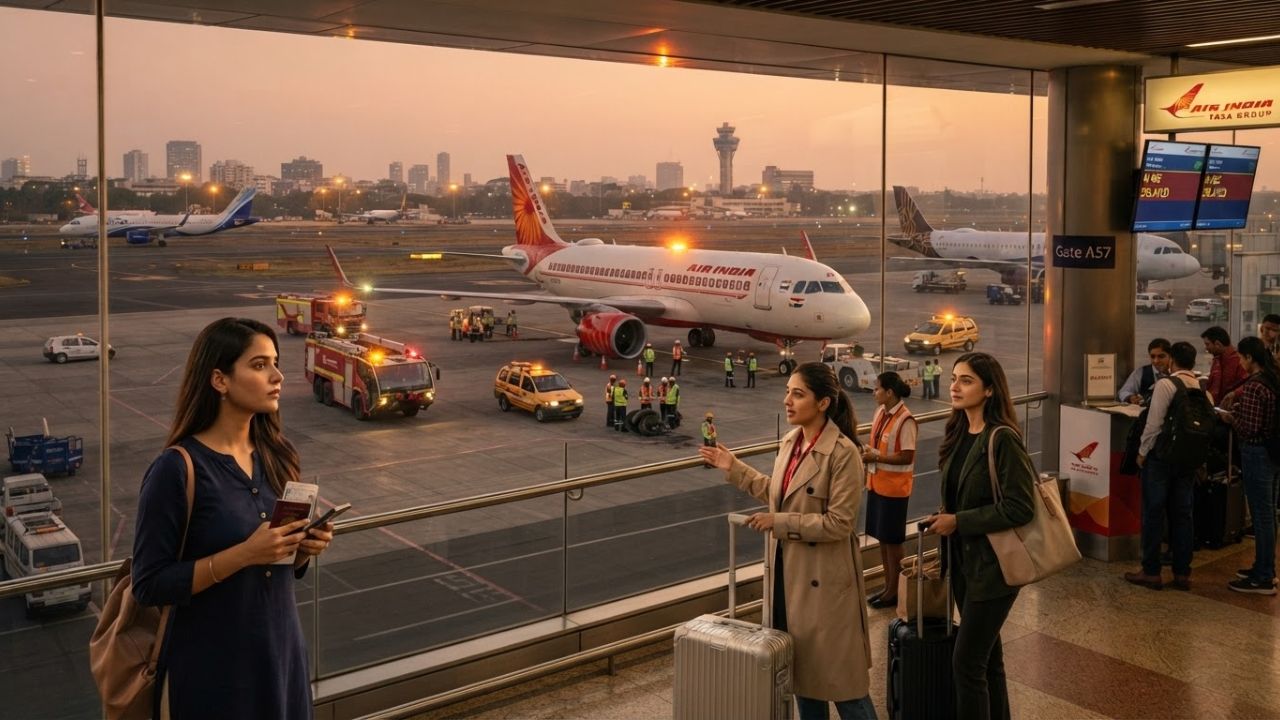
Image generated by AI
[Mumbai, July 9, 2026] — Air India flight AI816 carrying two hundred and twenty-five passengers and crew aborted its departure at high speed to avoid a runway conflict. The incident occurred on the night of July 7, 2026, at Mumbai’s Chhatrapati Shivaji Maharaj International Airport.
The aircraft was accelerating on Runway 27 for its scheduled flight to Delhi when air traffic controllers issued an urgent stop order. An incoming Air India Express flight from Bagdogra had not yet cleared the active runway.
The flight crew immediately initiated emergency braking procedures, successfully bringing the aircraft to a safe halt. The intense friction generated during the high-speed stop caused three landing gear tyres to burst.
High-Speed Abort Maneuver Details
Executing a rejected take-off at high speed is one of the most demanding procedures in commercial aviation. Pilots calculate a critical decision speed before departure, after which stopping is generally not recommended unless a catastrophic system failure occurs.
During the deceleration, the aircraft's braking systems absorb millions of foot-pounds of kinetic energy within seconds. The extreme thermal expansion causes safety release valves in the wheels to melt, intentionally deflating the tyres.
Engineers confirmed that the landing gear assembly will require detailed inspection before the aircraft can return to service. Passengers were transferred to alternative flights to complete their journeys to Delhi.
Joint Aviation Authority Investigation
The Directorate General of Civil Aviation and the Airports Authority of India have launched a joint inquiry into the occurrence. Investigators will review voice transcripts, radar recordings, and flight data recorders to reconstruct the event timeline.
The probe will examine why take-off clearance was issued before the arriving aircraft had fully vacated the runway safety zone. Human factors, air traffic controller workloads, and airport communication protocols will be evaluated.
Additionally, investigators will examine the landing gear telemetry to verify the performance of the automated anti-skid braking system. The target aircraft remains grounded in Mumbai pending final safety certification.
Runway Management at High-Volume Hubs
Mumbai Chhatrapati Shivaji Maharaj International Airport operates under high operational density with a single primary runway system. The layout handles close arrivals and departures, leaving little margin for error during peak periods.
Aviation safety depends on overlapping technological barriers, including ground movement radar and visual occupancy monitoring. When primary systems fail to indicate a clear runway, manual controller intervention remains the final line of defense.
During this incident, controllers also instructed another inbound flight to execute a go-around, ensuring the runway remained clear. This secondary precaution allowed emergency crews to inspect the runway for debris.
Passenger Impact and Safety Guidelines
Aborted departures are planned safety maneuvers designed to mitigate runway incursion risks. Airline crews undergo training in flight simulators to handle high-speed stops under various weather conditions.
Passengers on flight AI816 experienced no injuries during the rapid deceleration. However, the event resulted in subsequent route delays and flight repositioning for the carrier.
Airlines prioritize technical safety inspections over maintaining timetable punctuality following abnormal events. Passengers are advised to remain seated and follow crew instructions during emergency braking events.
Operational Timeline
| Stage | Operational Development |
|---|---|
| Aircraft pushback | Air India AI816 departed parking stand for scheduled Delhi service |
| Take-off roll begins | Aircraft accelerated on Runway 27 after departure clearance |
| Critical ATC instruction | Flight crew instructed to stop immediately because runway remained occupied |
| Safety action | High-speed rejected take-off successfully executed |
| Additional precaution | Another inbound Air India flight instructed to perform a go-around |
| Runway inspection | Airport inspection completed with no foreign object debris detected |
| Engineering findings | Three tyres found damaged following heavy braking |
| Passenger arrangements | Travellers transferred to alternative services |
Runway Incursion Risk Factors
| Operational Area | Importance for Aviation Safety |
|---|---|
| Air Traffic Control coordination | Maintains safe aircraft separation |
| Runway occupancy management | Prevents simultaneous conflicting movements |
| Surface surveillance | Tracks aircraft positions in real time |
| Pilot situational awareness | Confirms clearances before runway entry |
| Airport ground movement | Ensures efficient taxi sequencing |
| Standard operating procedures | Provides multiple safety barriers |
| Engineering inspections | Confirms aircraft airworthiness after abnormal events |
Landing Gear Engineering Inspection Areas
| Inspection Area | Purpose |
|---|---|
| Tyres | Check for burst casings, heat damage and structural integrity |
| Wheels | Inspect rims for deformation or cracks |
| Brake assemblies | Assess wear, overheating and component integrity |
| Landing gear | Examine structural loads and hydraulic systems |
| Hydraulic systems | Confirm normal pressure and fluid condition |
| Brake temperature monitoring | Verify cooling before aircraft movement |
| Flight data analysis | Review braking performance and aircraft systems |
| Return-to-service inspection | Ensure full airworthiness before next operation |
Immediate Impact on Passengers
| Area | Traveller Impact |
|---|---|
| Flight departure | Service delayed and subsequently withdrawn |
| Passenger safety | No injuries reported |
| Aircraft status | Ground Grounded for engineering assessment |
| Alternative travel | Rebooking and accommodation on other services |
| Airport operations | Temporary runway disruption during inspections |
| Connecting passengers | Potential onward travel delays |
| Baggage | Managed under airline operational procedures |
Why This Matters
This runway incident highlights the growing operational pressure on India's single-runway airport infrastructure. As flight frequencies increase across major metropolitan hubs, the window for error during runway crossings continues to shrink.
Our analysis of the flight data indicates that the prompt decision to abort prevented a catastrophic collision. The occurrence shows that visual runway checks remain a vital backup to automated ground tracking radar.
Additionally, this event underscores the high mechanical stress imposed on modern airframes during emergency stops. The three burst tyres demonstrate how built-in safety mechanisms successfully release extreme pressure to prevent landing gear failure.
Industry Outlook
Market trends suggest that Indian regulators will implement stricter runway occupancy rules at high-density airports. Air traffic control centers may face limits on close-spaced arrival and departure sequencing during peak hours.
Furthermore, airport operators must invest in advanced surface movement radar and automated runway status lights. Upgrading ground surveillance systems remains essential to preventing runway incursions.
Related Aviation News Guides
- SkyWest Flight 5268 Diverts to Cheyenne Regional Airport Due to Winter Weather and Crosswinds at Hailey
- United Airlines Flight 2338 Diverts to Omaha Following Hydraulic System Failure Warning in Embraer E175
- Singapore Changi Airport Ranked Top Global Retail Hub Outperforming Incheon International and Tokyo Haneda in Annual Passenger Commerce Study
Disclaimer
This article is for informational and educational purposes only. It does not constitute legal, financial, or professional advice. While we strive to provide accurate and up-to-date information, travel policies, regulations, and conditions change rapidly. Always verify information with official sources before making travel decisions. Nomad Lawyer makes no representations about the accuracy, reliability, completeness, or suitability of the information provided. Readers should consult qualified professionals for advice specific to their circumstances. The views expressed in this article are those of the author and do not necessarily reflect the views of Nomad Lawyer.
Preeti Gunjan
Contributor & Community Manager
A passionate traveller and community builder. Preeti helps grow the Nomad Lawyer community, fostering engagement and bringing the reader experience to life.
Learn more about our team →