
Vietnam Airlines Boeing 787-9 Overruns Munich Runway 26R and Suffers Tail Strike in 2026
A Vietnam Airlines Boeing 787-9 operating flight VN34 from Munich to Hanoi suffered a runway overrun and tail strike on August 15, 2026, necessitating an emergency return landing.

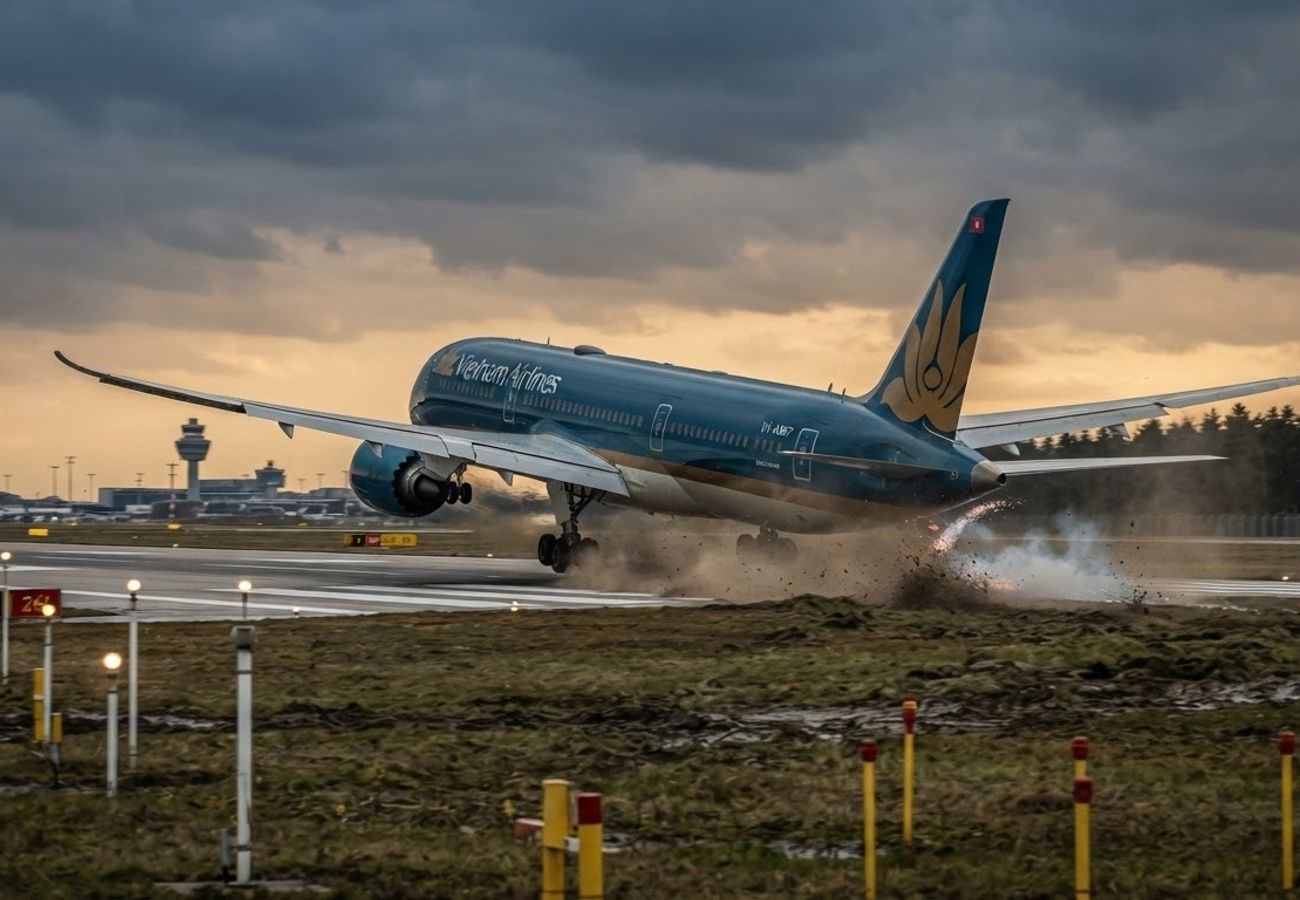
Image generated by AI
A Vietnam Airlines Boeing 787-9 operating flight VN34 from Munich to Hanoi overran the end of Runway 26R on August 15, 2026, suffering a tail strike before returning for an emergency landing that destroyed multiple main-gear tires.
The incident occurred during the takeoff phase of a long-haul flight. Video evidence shows the widebody aircraft, registration VN-A867, exhibiting an unusually long ground roll. The aircraft failed to lift off before the paved surface ended, with the main landing gear entering the overrun area and generating a cloud of dust and debris. At the moment of rotation, the rear fuselage contacted the ground, resulting in a pronounced tail scrape.
Following the takeoff, the aircraft remained in the vicinity of Munich Airport for approximately two hours. The crew executed a racetrack holding pattern to dump fuel, reducing the aircraft's weight for a safer emergency return. Before landing, the flight conducted at least one low pass over the airfield to allow ground crews to visually inspect the structural integrity of the fuselage and landing gear.
The subsequent emergency landing on the northern runway was characterized by visible smoke and sparks. Post-landing inspections revealed multiple destroyed main-gear tires and damaged wheel assemblies, attributed to the high-energy touchdown and the stress sustained during the initial overrun. Emergency services were pre-positioned along the runway, and all passengers and crew deplaned via mobile stairs without injury.
Flight and Infrastructure Specifications
| Parameter | Detail |
|---|---|
| Flight Number | VN34 |
| Aircraft Model | Boeing 787-9 |
| Registration | VN-A867 |
| Departure Airport | Munich Airport (MUC) |
| Departure Runway | 26R |
| Runway Length | Approximately 4,000 meters |
| Destination | Hanoi (HAN) |
| Incident Date | August 15, 2026 |
Traveler Logistics Guide: Navigating Airport Disruptions
From a ground-level perspective, the best way to navigate sudden runway closures at major hubs like Munich is to monitor the airport's official digital signage and mobile app immediately upon any reported "ground stop." When a primary runway is closed due to an emergency—as seen in this event where both runways were briefly halted—cascading delays affect not just the involved flight, but all arrivals and departures.
For those booking connections through European hubs in 2026:
- Optimal Layover Windows: Maintain a minimum of three hours for international-to-international transfers. In the event of a runway closure, aircraft are often diverted to alternates (e.g., Frankfurt or Dusseldorf), which can turn a short layover into a missed connection.
- Digital Transit Policies: Ensure your travel documents are updated in the airline's app. During emergency diversions, airlines use digital manifests to re-route passengers; having a verified digital profile speeds up the re-booking process.
- Customs and Re-routing: If diverted to a different city, check if you need to clear customs at the diversion airport or if the airline has arranged a "sterile" transit to your original hub.
Infrastructure and Safety Impact Assessment
The closure of the northern runway at Munich caused significant disruption across Southern Germany's air traffic during the peak summer holiday period. Arriving flights were forced into holding patterns or diverted to other German hubs, while departing flights faced mounting delays. The presence of foreign object debris (FOD)—specifically shredded tire fragments—required a full sweep and inspection of the runway surface before operations could resume.
Aviation analysts are currently focusing on takeoff performance calculations. Early theories suggest a possible mismatch between the aircraft's assumed weight, thrust settings, and the required takeoff distance. In aviation safety protocols, once an aircraft passes the critical decision speed (V1), continuing the takeoff is often safer than attempting a high-speed rejected takeoff that could lead to a more severe excursion.
The damage to the composite rear fuselage of VN-A867 is expected to require extensive repairs. Given the nature of Boeing 787 composite structures, this aircraft will likely remain out of service for a prolonged period. National and European investigation bodies are now reviewing the flight data recorder (FDR) and cockpit voice recorder (CVR) to determine the exact cause of the late rotation.
A stark reminder that aviation safety layers function even when multiple systems fail.
Related Travel Guides
Disclaimer
This article is for informational and educational purposes only. It does not constitute legal, financial, or professional advice. While we strive to provide accurate and up-to-date information, travel policies, regulations, and conditions change rapidly. Always verify information with official sources before making travel decisions. Nomad Lawyer makes no representations about the accuracy, reliability, completeness, or suitability of the information provided. Readers should consult qualified professionals for advice specific to their circumstances. The views expressed in this article are those of the author and do not necessarily reflect the views of Nomad Lawyer.
Raushan Kumar
Founder & Lead Developer
Full-stack developer with 11+ years of experience and a passionate traveller. Raushan built Nomad Lawyer from the ground up with a vision to create the best travel and law experience on the web.
Learn more about our team →