
Venice Shirtless Running Fine: American Tourists Julia Latoff and Mike Naccarella Expose Italy's €250 Dress Code Rules
American tourists Julia Latoff and Mike Naccarella narrowly avoided a €250 fine (around US$290–$300) after running shirtless through Venice's historic streets, triggering a wider international debate over Italy's tightening visitor behaviour regulations — including Varenna's €50–€200 swimwear fines and Venice's complete ban on canal swimming, canal-side eating, and bird feeding.

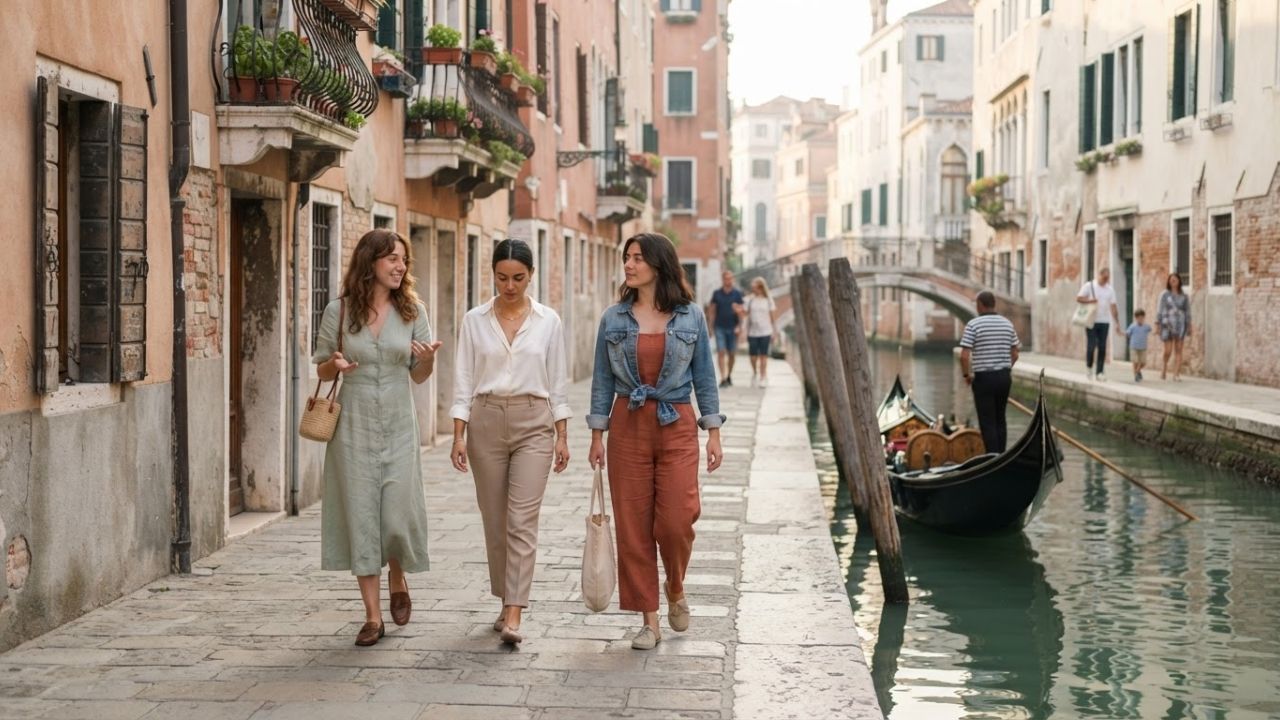
Image generated by AI
A shirtless summer run through Venice almost cost American tourists Julia Latoff and her boyfriend Mike Naccarella up to €250 — roughly US$290–$300 — after local residents reacted with open hostility to behaviour the New York couple considered entirely ordinary, exposing a fundamental gap between what international visitors assume is acceptable and what Italy's historic city rules actually permit. The couple avoided the formal fine after stopping their run and sourcing a shirt, but their experience has become a widely shared warning that Venice's visitor regulations — covering dress codes, canal swimming, eating at monuments, and bird feeding — are being actively enforced rather than left as symbolic guidance.
What Happened: Julia Latoff and Mike Naccarella's Shirtless Run Through Venice
VENICE, August 21, 2026 — The incident began as a routine morning run during hot summer weather. Julia Latoff and Mike Naccarella, a couple from New York, set out through Venice's historic street network without shirts — a practice they described as completely normal in their home city and one they had observed without issue in other parts of Italy during the same trip.
The reaction from Venetian residents made the problem immediately clear. Locals responded negatively to the bare-chested presence in the historic centre, and after noticing the hostility, the couple looked up the regulation and discovered that Venice prohibits bare-chested appearances and swimwear in public streets, piazzas, and urban areas throughout the historic city. The maximum penalty: €250, equivalent to approximately US$290–$300.
No fine was issued. Naccarella obtained a shirt, the couple covered up, and they later shared the experience publicly as a direct caution to other international visitors about the specificity of Venice's rules.
The episode's significance lies not in the penalty — which was ultimately not applied — but in what it reveals about the assumption gap that creates friction between international visitors and European historic destinations. Latoff and Naccarella were not being deliberately disrespectful. They were operating under a set of behavioural norms exported from one urban environment into a very different one.
Venice's Full List of Visitor Rules: What Carries a Fine in 2026
The shirtless regulation is one component of a comprehensive visitor behaviour framework that Venice has built around protecting its historic centre. Each rule addresses a specific pressure point that high visitor volumes create:
Bare-Chested and Swimwear Prohibition Walking through Venice streets, squares, and historic areas without adequate clothing — which means shirts for all genders, no swimwear — carries a potential fine of up to €250. The restriction applies to the historic city centre and distinguishes clearly between beach and boat areas (where casual swimwear is accepted) and the urban fabric of Venice itself (where it is not). The rule specifically covers proximity to religious sites and cultural landmarks.
Canal Swimming Ban Venice's canals are among the world's most photographed waterways, but they are not recreational swimming zones. Swimming, diving, or entering the canals is prohibited on grounds of safety, hygiene, and environmental impact. The canals carry significant water traffic, and the prohibition exists to protect both the visitors themselves and the canal infrastructure.
Sitting, Eating, and Blocking Historic Spaces Penalties also apply to sitting, eating, or drinking at sensitive locations including monument steps, bridges, canal-side infrastructure, and certain piazzas. The rule exists to prevent the deterioration of historic stonework and to reduce the crowd bottlenecks that form when thousands of visitors treat heritage structures as informal rest stops.
Feeding Birds Feeding pigeons and seagulls is prohibited across Venice due to the damage bird accumulations cause to historic buildings and the cleanliness issues that arise in narrow streets and public squares. Authorities regard bird feeding as one of the more persistent anti-social behaviours that visitor education has failed to eliminate through guidance alone.
Varenna on Lake Como: Italy's Smaller Villages Are Enforcing the Same Standards
The regulatory tightening extends well beyond Venice. Varenna, a village on Lake Como with a permanent population of approximately 650 residents, has introduced its own dress code enforcement targeting visitors who walk through the village without shirts or in swimwear outside of beaches, piers, and boat areas.
Fines in Varenna range from €50 to €200 — lower than Venice's maximum but significant enough to function as a genuine deterrent rather than a symbolic gesture. The village draws hundreds of thousands of visitors annually, a ratio of visitors to permanent residents that creates intense pressure on public spaces and the daily lives of local people.
Varenna's measures demonstrate that Italy's visitor regulation movement is not a Venice-specific response to an exceptionally famous city. It is a nationwide pattern emerging wherever the combination of historic identity and tourism volume creates tension between visitor behaviour and community standards.
The scale difference matters. Venice is a global brand capable of sustaining millions of visitors. Varenna, with 650 permanent residents, has no corresponding institutional infrastructure for absorbing visitor misbehaviour. A shirtless visitor strolling through Venice is an inconvenience; the same behaviour repeated by thousands of visitors through Varenna's narrow lanes is a different challenge entirely for a community that size.
Why American Travellers Specifically Are Encountering These Rules
The experience of Julia Latoff and Mike Naccarella points to a specific dynamic in American international travel: the confident exportation of domestic norms into very different regulatory environments.
Shirtless running is legally and socially unremarkable in most US cities during summer. New York, where the couple are based, has no ordinance against it. Many American cities with similar climates — Miami, Los Angeles, Chicago — operate the same way. The assumption that this norm travels is understandable.
What American visitors to Italy are discovering is that historic European cities define public space differently. For Venice, the historic centre is not equivalent to Central Park or the National Mall. It is an inhabited urban environment that happens to contain some of the world's most significant heritage buildings. The resident community inside Venice's island has always treated public space standards as a matter of civic identity, not a tourism guideline.
For American travellers — who represent one of Europe's largest international visitor groups — this creates a practical preparation challenge. Pre-trip research about local regulations has historically focused on entry requirements, currency, and tipping conventions. Italy's expanding enforcement framework now adds behavioural rules to that list.
Italy's Responsible Tourism Strategy: Economic Growth Without Sacrificing Community Identity
Italy's official position on visitor regulation is not anti-tourism. Authorities in Venice, Varenna, Florence, and other heavily visited destinations consistently frame their rules as tools for sustaining tourism's long-term viability rather than restricting it in the short term.
The argument is coherent: the qualities that make Venice worth visiting — its preserved historic fabric, its canal network, its neighbourhood character — exist only because the city has been managed over centuries. Permitting unrestricted visitor behaviour that damages stonework, overloads narrow streets, and erodes the social fabric of residential communities risks the very asset base that generates tourism revenue.
For the resident communities in Venice's historic island and in villages like Varenna, the enforcement of visitor rules is also a quality-of-life matter. A permanent population of 650 people in Varenna experiencing hundreds of thousands of annual visitors has limited tolerance for the residual disorder that unmanaged tourism generates in small, intimate public spaces.
What the Venice Rules Mean for Every International Traveller Planning Italy in 2026
For the traveller, the practical implications of Italy's regulatory environment in 2026 are specific and actionable.
Research destination-specific rules before arrival, not after. Venice's regulations are publicly available and well-documented, but the Latoff-Naccarella incident shows that many visitors arrive without knowing them. A five-minute search of Venice municipality guidance before departure would have identified the shirtless rule entirely.
Do not assume that behaviour observed in one Italian city is permitted in another. The couple noted they had seen similar behaviour elsewhere in Italy without incident. Italy's major coastal resort areas and beach towns operate under significantly more relaxed standards than Venice or Varenna. The historic inland and canal city context is categorically different.
Swimwear boundaries matter specifically. Italy broadly distinguishes between environments where swimwear and casual beach clothing is appropriate (beaches, boat areas, piers, lakeside resort zones) and environments where it is not (historic city centres, village streets, religious sites, monuments). The boundary is not always visually obvious when walking from a waterfront area into a town centre.
Fines are real and increasingly applied. Italian destinations that have introduced these regulations are enforcing them — not uniformly on every infraction, as the Latoff-Naccarella case shows, but with sufficient frequency that the deterrent is operational. Assuming that a rule exists only on paper is a miscalculation in 2026 Italian tourism.
FAQ: Venice and Italy Tourist Rules 2026
What is the fine for walking shirtless in Venice? Appearing bare-chested or in swimwear in Venice's public streets, squares, and historic areas carries a potential fine of up to €250, equivalent to approximately US$290–$300.
Who are Julia Latoff and Mike Naccarella and what happened in Venice? Julia Latoff and Mike Naccarella are an American couple from New York who were running shirtless through Venice during summer heat. After local residents reacted negatively, they discovered the city's €250 regulation, stopped their run, and avoided a formal fine. They later shared the experience as a warning to other international visitors.
What are Varenna's tourist fines on Lake Como? Varenna, a Lake Como village with approximately 650 permanent residents, enforces fines of between €50 and €200 for walking through the village shirtless or in swimwear outside beach, pier, and boat areas.
What other activities are banned in Venice for tourists? Venice prohibits swimming or diving in canals, sitting or eating at monuments, bridges, and canal-side areas, and feeding pigeons or seagulls. Each rule carries its own penalty structure and reflects the city's effort to protect historic infrastructure and public cleanliness.
Related Travel Guides
Disclaimer
This article is for informational and educational purposes only. It does not constitute legal, financial, or professional advice. While we strive to provide accurate and up-to-date information, travel policies, regulations, and conditions change rapidly. Always verify information with official sources before making travel decisions. Nomad Lawyer makes no representations about the accuracy, reliability, completeness, or suitability of the information provided. Readers should consult qualified professionals for advice specific to their circumstances. The views expressed in this article are those of the author and do not necessarily reflect the views of Nomad Lawyer.
Raushan Kumar
Founder & Lead Developer
Full-stack developer with 11+ years of experience and a passionate traveller. Raushan built Nomad Lawyer from the ground up with a vision to create the best travel and law experience on the web.
Learn more about our team →