
US Air Travel Disrupted by 4,633 Delays and 124 Cancellations Across Chicago, Detroit, and Boston Hubs
Thunderstorms, FAA ground stops, and runway construction trigger 4,633 flight delays and 124 cancellations across Chicago O’Hare, Detroit, Boston, and Reagan National.

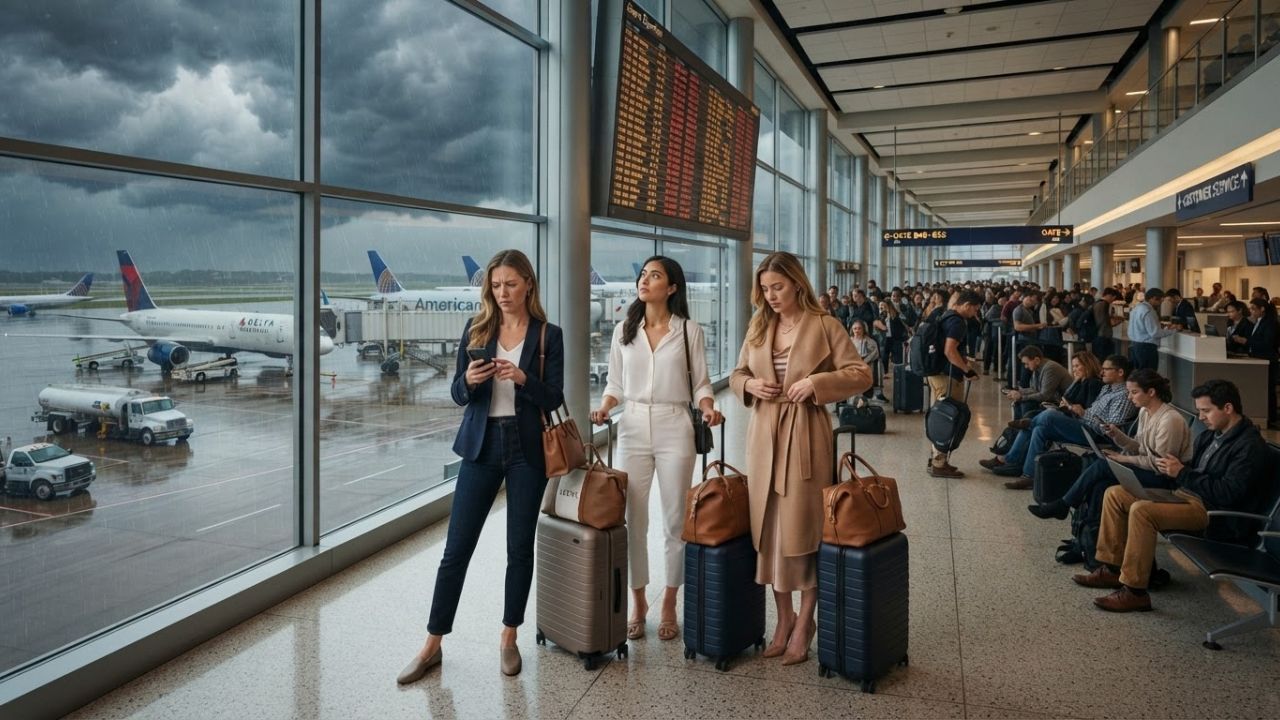
Image generated by AI
Severe summer thunderstorms, FAA ground stops, and major runway construction have unleashed widespread travel chaos across the United States, with 4,633 flights delayed and 124 canceled at key hubs including Chicago O'Hare, Detroit, and Reagan National.
A volatile wave of severe convective weather, compounded by active terminal construction and tight air traffic management initiatives, has paralyzed major aviation corridors across the Midwest, Mid-Atlantic, and Northeast. Verified operational data recorded by FlightAware on September 4, 2026 at 2:33 PM ET confirmed that 4,633 flights within, into, or out of the United States were delayed, while 124 flights were canceled outright. With the Federal Aviation Administration (FAA) instituting ground stops and departure holding programs, travelers transiting through primary connecting hubs face cascading schedule interruptions and rolling missed connections.
The Local Trend Revealed: Midwest and East Coast Hubs Under Pressure
The disruption wave reflects severe pressure across the nation’s busiest commercial airports. When high-volume connecting facilities absorb prolonged weather holds, the resulting aircraft rotation deficits rapidly ripple across cross-country flight networks.
- Chicago O’Hare International (ORD): The nation’s primary mid-continent hub was the most severely impacted airport, tallying 912 delays and 9 cancellations. The FAA instituted ground delay programs with departure delays averaging 30 minutes and climbing due to fast-moving thunderstorm cells. O'Hare recorded a 29% delay rate for originating departures and a 28% delay rate for inbound flights.
- Detroit Metro Wayne County (DTW): Serving as a primary northern connecting fortress, Detroit suffered 464 delays and 22 cancellations. Originating flights experienced a staggering 53% delay rate alongside a 1% cancellation rate, while arriving aircraft logged a 44% delay rate and a 2% cancellation rate.
- Boston Logan International (BOS): Active runway construction combined with regional air traffic control constraints led to 434 delays and 6 cancellations, with the FAA reporting average gate holding delays of 43 minutes. Boston experienced a 25% originating delay rate and a 30% inbound delay rate (with parallel runway works also creating delays at San Francisco International).
- Reagan Washington National (DCA): Severe thunderstorms over the capital region triggered an FAA ground delay program averaging 64 minutes, resulting in 326 delays and 47 cancellations—the highest cancellation count of any single airport in the nation. DCA registered a 2% cancellation and 28% delay rate for departures, and a 3% cancellation and 24% delay rate for arrivals.
- New York Metro Gateways: LaGuardia (LGA) faced an immediate FAA ground stop due to local storm cells, posting 232 delays and 4 cancellations (17% originating delay rate), while John F. Kennedy International (JFK) recorded 184 delays and 4 cancellations (13% departure delay rate).
- Mid-Atlantic and Southern Hubs: Hartsfield-Jackson Atlanta International (ATL) recorded 233 delays and 7 cancellations. Philadelphia International (PHL) posted 176 delays and 7 cancellations, with the FAA reporting average departure delays of 45 minutes due to traffic-management initiatives and weather. In Florida, Orlando International (MCO) recorded 150 delays and 1 cancellation following an FAA storm ground stop, while Washington Dulles International (IAD) absorbed 105 delays and 8 cancellations (11% inbound delay rate).
Airport Disruption Index: Major U.S. Gateways
| Airport Gateway | Total Delays | Total Cancellations | Origin Delay / Cancel % | Destination Delay / Cancel % | Primary FAA Operational Constraints |
|---|---|---|---|---|---|
| Chicago O’Hare (ORD) | 912 | 9 | 29% / 0% | 28% / 0% | Severe thunderstorm cells, 30+ min departure holds |
| Detroit Metro (DTW) | 464 | 22 | 53% / 1% | 44% / 2% | Severe fleet rotation backlogs, weather holds |
| Boston Logan (BOS) | 434 | 6 | 25% / 0% | 30% / 0% | Active runway construction, 43 min average delays |
| Reagan Washington (DCA) | 326 | 47 | 28% / 2% | 24% / 3% | Severe storms, FAA ground delay averaging 64 min |
| Atlanta Hartsfield (ATL) | 233 | 7 | 8% / 0% | 9% / 0% | Southeastern regional connecting saturation |
| LaGuardia (LGA) | 232 | 4 | 17% / 0% | 8% / 0% | FAA ground stop due to thunderstorms |
| John F. Kennedy (JFK) | 184 | 4 | 13% / 0% | 11% / 0% | Congested Northeast arrival corridors |
| Philadelphia (PHL) | 176 | 7 | 13% / 0% | 14% / 0% | Traffic management initiatives, 45+ min holds |
| Orlando Int'l (MCO) | 150 | 1 | — / — | — / — | FAA convective weather ground stop |
| Washington Dulles (IAD) | 105 | 8 | 5% / 0% | 11% / 1% | Regional thunderstorm ground stop |
Airline Reliability Breakdown: Southwest and American Lead Delays
The operational strain was spread across mainline legacy carriers and regional feeder operators. Point-to-point carriers and airlines with dense domestic schedules experienced compounding rotational delays:
- Southwest Airlines recorded the highest delay total in the nation, posting 767 delays and 2 cancellations, as schedule disruptions rippled through Chicago Midway, Baltimore, and southern connecting points.
- American Airlines logged 521 delays and 6 cancellations, with its regional affiliate PSA Airlines absorbing an additional 201 delays and 26 cancellations, heavily impacting regional flights across the East Coast.
- Delta Air Lines posted 501 delays and 9 cancellations, primarily concentrated around its Detroit and Atlanta mega-hubs.
- United Airlines recorded 418 delays and 10 cancellations, reflecting severe weather holds at Chicago O'Hare and Washington Dulles.
- SkyWest Airlines, operating regional partner flights for United, Delta, and American, logged 393 delays and 17 cancellations, creating widespread connection gaps for travelers departing smaller regional airports.
Airline Impact Summary
| Carrier | Total Delays | Total Cancellations | Core Operational Focus & Hub Vulnerabilities |
|---|---|---|---|
| Southwest Airlines | 767 | 2 | Nationwide point-to-point network rotation holds |
| American Airlines | 521 | 6 | Severe Mid-Atlantic and East Coast weather bottlenecks |
| Delta Air Lines | 501 | 9 | Detroit Metro saturation & Atlanta connecting banks |
| United Airlines | 418 | 10 | Chicago O'Hare storm delays & Dulles ground stops |
| SkyWest Airlines | 393 | 17 | Regional feeder disruptions across Midwest & West |
| PSA Airlines (AAL) | 201 | 26 | Highest regional cancellations; DCA and East Coast routes |
Cultural & Environmental Value: Mitigating Fuel Waste During Tarmac Holds
Extended air traffic delays inflict a heavy environmental toll. When dozens of aircraft are held in low-altitude holding stacks or idle on taxiways awaiting takeoff clearance, auxiliary power units and jet engines consume hundreds of thousands of pounds of jet fuel.
Under airport environmental frameworks overseen by the Chicago Department of Aviation (CDA) and Massport, airports utilize gate electrification infrastructure and Collaborative Decision Making (CDM) software. By metering departures at terminal gates rather than releasing planes into long taxi queues, airport operators significantly curb ground-level carbon emissions and noise pollution.
Travelers can support regional environmental goals while avoiding highway gridlock caused by severe summer rainstorms:
- Rail-to-Terminal Transit: Connecting to Chicago O'Hare via the CTA Blue Line, to Reagan National via the Metrorail Blue and Yellow Lines, or to Boston Logan via the MBTA Silver Line or Boston Harbor water taxis bypasses flooded terminal expressways while lowering per-passenger carbon emissions.
Visitor Insider Tips: Navigating Airport Ground Stops
If your travel itinerary traverses Chicago, Detroit, Boston, or the Washington D.C. area during severe summer weather, apply these practical transit rules:
- Decode FAA Ground Stops vs. Ground Delays: If the FAA issues a "Ground Stop" for your destination (e.g., LaGuardia or Orlando), inbound planes cannot take off from their departure cities until the weather clears. Check real-time airspace status directly at nasstatus.faa.gov to anticipate arrival delays before your airline updates its departure board.
- Chicago O’Hare (ORD) Terminal Maneuvers: If delayed in Terminals 1, 2, or 3, walk through the pedestrian tunnels to reach quieter gates or visit the peaceful Terminal 3 yoga room near the rotunda. If your flight is canceled and you require overnight accommodations, avoid terminal rideshare lines by taking the Airport Transit System (ATS) to the Multi-Modal Facility (MMF) for hotel shuttles and rental cars.
- Reagan National (DCA) Cancellation Protocol: With DCA recording 47 cancellations, terminal customer service lines can stretch past two hours. Rather than waiting in line, use the airline mobile app (American or Delta) to claim automated alternate itineraries, or call the carrier's international customer service line (such as their UK or Canadian toll-free number) for instant agent access.
- Boston Logan (BOS) Water Taxi Alternative: During peak runway construction slowdowns, roadway congestion around Logan’s tunnels can add over an hour to taxi trips. Walk to the Logan Airport Water Transportation Dock and take the MBTA or Boston Water Taxi across the harbor straight to downtown Boston in under 15 minutes.
- U.S. DOT Refund Guarantees: Under federal Department of Transportation rules, if your flight is canceled or significantly altered (more than three hours for domestic travel), you are entitled to a full cash refund to your original payment method if you choose not to accept the airline's alternative flight offer.
Tourism Outlook: Strengthening Climate Resilience in Aviation
The recurring disruption of thousands of domestic flights underscores the urgent need for climate-resilient infrastructure at the nation’s primary transit nodes. As severe summer thunderstorms become more volatile and passenger volumes operate near peak terminal capacity, the aviation sector must accelerate digital air traffic sequencing, expand high-speed intercity rail alternatives, and complete runway upgrades.
Until nationwide airspace capacity expands, travelers must build generous layover buffers into holiday journeys, monitor live radar developments, and leverage airport rail networks to navigate unpredictable weather disruptions.
Related Travel Guides
Disclaimer
This article is for informational and educational purposes only. It does not constitute legal, financial, or professional advice. While we strive to provide accurate and up-to-date information, travel policies, regulations, and conditions change rapidly. Always verify information with official sources before making travel decisions. Nomad Lawyer makes no representations about the accuracy, reliability, completeness, or suitability of the information provided. Readers should consult qualified professionals for advice specific to their circumstances. The views expressed in this article are those of the author and do not necessarily reflect the views of Nomad Lawyer.
Preeti Gunjan
Contributor & Community Manager
A passionate traveller and community builder. Preeti helps grow the Nomad Lawyer community, fostering engagement and bringing the reader experience to life.
Learn more about our team →