
Sudden Travel Chaos Hits United Airlines Flight UAL1494 as Boeing 737 MAX 8 Diverts from Newark to Tulsa Amidst US Airport Disruptions: Airline News
United Airlines Flight UAL1494 triggers sudden travel chaos, diverting its Boeing 737 MAX 8 from Newark to Tulsa International Airport in an unexpected mid-air route disruption.

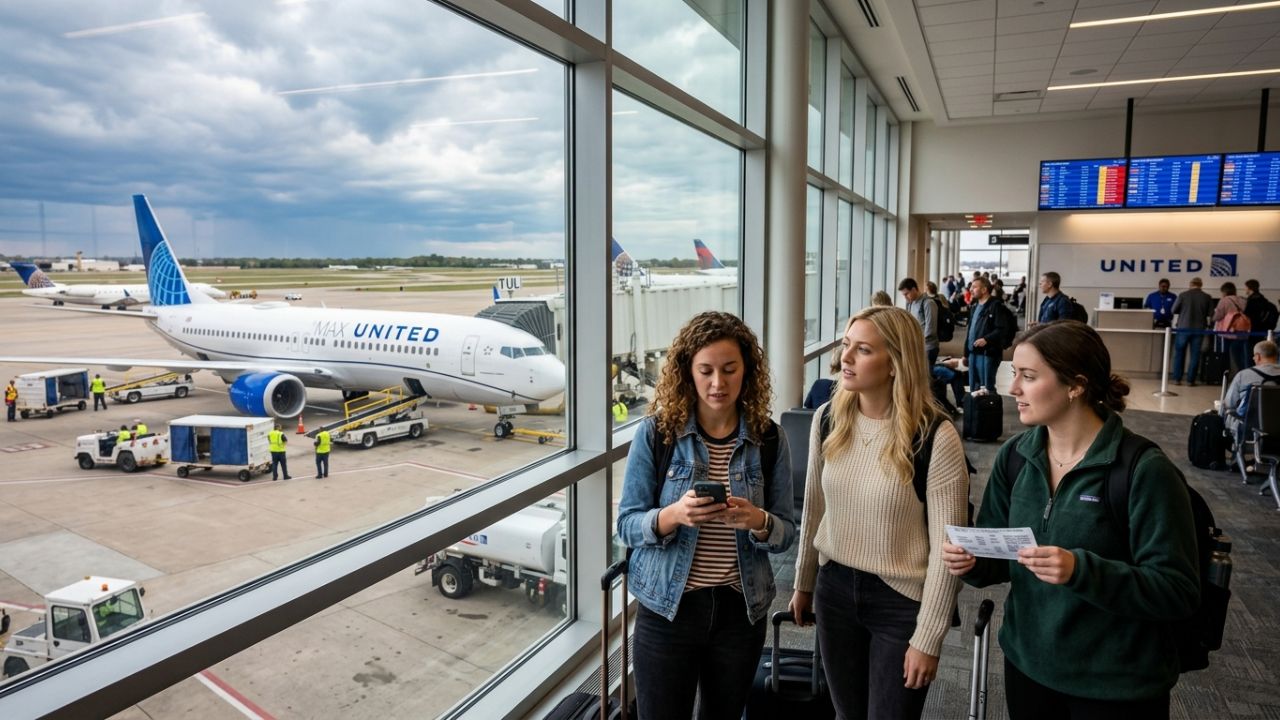
Image generated by AI
In a startling operational incident that triggered sudden, mid-air travel chaos, United Airlines Flight UAL1494 violently abandoned its primary flight path, executing an unscheduled diversion to Oklahoma. Reported on June 20, 2026, as anxious passengers desperately monitored the latest airline news for an official explanation, the Boeing 737 MAX 8 departed from Newark Liberty International Airport on June 19, originally bound for the massive mega-hub of Dallas/Fort Worth. Instead of completing its scheduled route, the aircraft abruptly diverted and landed at Tulsa International Airport. While commercial aviation frequently experiences rolling delays and localized flight cancellations, mid-air diversions immediately trigger intense scrutiny and massive logistical airport disruptions. With aviation authorities actively assessing the exact catalyst for the route change, this sudden maneuver by United Airlines represents today's most crucial headline in breaking aviation updates and passenger safety protocols.
By introducing direct passenger coordination and dynamic scheduling backups, the regional aviation hubs target growing passenger demand across vital commerce sectors. The choice to coordinate flight departures in phases helps to manage gate capacity, supporting the country's broader regional transportation network.
Context: The Unscheduled Diversion of UAL1494
For the US aviation network, the sudden diversion of United Airlines Flight UAL1494 exposes the complex, highly sensitive safety parameters that govern modern commercial flight paths.
On the morning of June 19, 2026, the Boeing 737 MAX 8 (B38M), officially registered as N37353, departed Newark Liberty International Airport. Flight logs confirm the aircraft pushed back from Gate A24 strictly on schedule, initially proceeding under completely normal operating conditions toward the massive Dallas connecting hub. However, mid-flight, the flight deck crews made the critical operational decision to abandon the Texas destination entirely. The aircraft was aggressively rerouted, remaining airborne for approximately three hours and seventeen minutes before touching down safely in Tulsa at 8:52 AM CDT. The exact reason behind the diversion remains under assessment because United Airlines has not publicly disclosed the specific mechanical, medical, or weather-related circumstances. While passengers frequently perceive diversions as terrifying emergencies, aviation experts emphasize that airlines intentionally prioritize absolute safety above rigid scheduling commitments, meaning even minor technical anomalies can trigger immediate flight path alterations.
To view live flight schedules, verify the active departure status of your specific United Airlines itinerary, or to track potential route restorations prior to heading to the airport, travelers must consult official aviation directories. For direct updates regarding how these sudden operational failures might impact your current flight cancellations out of Newark or Dallas, travelers should aggressively utilize the official digital portals of their respective airlines. To explore live flight tracking and monitor the exact severity of the cascading bottlenecks paralyzing the broader US airspace, passengers can consult the official FlightAware tracking service.
Section-Wise Breakdown: Dissecting the Route Change
The Catalyst for Rerouting
While United Airlines has not issued a final operational report, several routine, highly critical factors force a Boeing 737 MAX 8 to abandon its destination. Aviation analysts note that mechanical alerts inside the cockpit, rapidly degrading weather developments along the flight path, strict crew operational duty requirements, or sudden passenger medical situations are the primary catalysts that trigger a diversion.
Tulsa as the Tactical Alternate
Tulsa International Airport was not chosen randomly. It frequently serves as an incredibly effective tactical diversion point due to its centralized geographic location and massive infrastructure. The airport possesses the immediate capacity to accommodate large commercial aircraft, offering immediate access to heavy maintenance facilities and emergency medical responders. Dispatch teams and flight crews actively coordinate with air traffic control authorities to select an alternate airport that offers immediate operational advantages.
Expert Perspective on Operational Flexibility
Anup Kumar Keshan, Founder and Editor-in-Chief of Travel And Tour World, summarized the incident: “United Airlines Flight UAL1494’s diversion from Newark to Tulsa instead of Dallas demonstrates how quickly operational conditions can change in modern aviation. While the unplanned landing has travellers asking questions, such decisions reflect the industry’s strong focus on safety, operational resilience, and ensuring passengers reach their destinations under the safest possible circumstances.”
Technical Roster: Flight UAL1494 Incident Matrix
To ensure absolute factual accuracy regarding the specific aircraft, the exact route involved, and the precise operational terminology defining this event, the following matrix details the strictly verified flight data:
Official Flight Diversion Data: United Airlines UAL1494
| Operational Parameter | Verified Flight Data |
|---|---|
| Operating Carrier | United Airlines |
| Flight Number | UAL1494 |
| Aircraft Type | Boeing 737 MAX 8 (B38M) |
| Aircraft Registration | N37353 |
| Origin Airport | Newark Liberty International Airport (Gate A24) |
| Scheduled Destination | Dallas/Fort Worth |
| Diversion Airport | Tulsa International Airport (Oklahoma) |
| Airborne Duration | 3 Hours, 17 Minutes |
| Arrival Time | 8:52 AM CDT |
| Incident Date | June 19, 2026 |
Data accurately reflects the verified diversion metrics recorded for Flight UAL1494 on June 19, 2026. The incident highlights the strict precautionary safety parameters governing United Airlines' flight operations.
Passenger Impact: The Logistical Nightmare in Oklahoma
For the passengers physically trapped aboard Flight UAL1494, the immediate impact of this mid-air diversion was severe logistical exhaustion and the total destruction of their onward travel itineraries.
When a fully loaded Boeing 737 MAX 8 unexpectedly lands in a different state, the resulting travel chaos is instantaneous. Passengers attempting to reach Dallas to catch critical connecting flights were instantly stranded in Tulsa. Once the aircraft landed, multiple complex procedures immediately began. Ground staff coordinate with flight crews, customer service teams, and operations personnel to manage aircraft positioning, crew schedules, and passenger transfers. Because a single diverted aircraft destroys downstream flight schedules, United Airlines operations teams were forced to rapidly arrange alternative travel solutions, subjecting the exhausted passengers to massive uncertainty regarding their arrival schedules and baggage arrangements.
Industry Analysis: The Hidden Mechanics of Diversions
Aviation analysts monitoring the operational status of Flight UAL1494 note that passengers must urgently understand the hidden mechanics of flight diversions to navigate this specific travel chaos.
Analysts consistently emphasize that diversions represent a proactive safety tool rather than a failure of operations. Every commercial flight operates within a constantly changing environment shaped by weather systems, airport conditions, and air traffic management requirements. Airlines make diversion decisions because continuing toward the intended destination may no longer represent the safest statistical option. The Boeing 737 MAX 8 diversion demonstrates the strength of aviation safety systems designed to manage unexpected developments efficiently, ensuring that flights conclude under the safest available conditions rather than risking a larger disruption.
Actionable Advice for Surviving Mid-Air Diversions
If you are currently trapped on a diverted aircraft, or find yourself stranded at an alternate airport during an operational breakdown, you must execute this strategic survival checklist immediately:
- Exploit the Digital Alternatives: As soon as the pilot announces the diversion, do not panic. Use the aircraft's Wi-Fi or your cellular data the moment you land to check the United Airlines app. You must attempt to secure a rebooked flight out of the diversion airport (Tulsa) before you even deplane, completely bypassing the massive physical line that will form at the customer service desk.
- Audit Your Connecting Itinerary: If you were supposed to connect through Dallas/Fort Worth, your downstream flight is already gone. Immediately contact your airline's customer service via online chat to verify connection protection and demand alternative routing to your final destination from the diversion airport.
- Understand Hotel Accommodation Rules: If the diversion involves a carrier-controlled technical issue that strands you overnight, the airline is legally obligated to provide hotel accommodations. However, if the diversion was caused by sudden airspace weather or a passenger medical emergency, the airline is not financially liable for your hotel room.
FAQ: United Airlines Flight UAL1494 Diversion
Why did United Airlines Flight UAL1494 divert?
The exact cause remains officially undisclosed by United Airlines. However, standard operational diversions are typically triggered by mechanical alerts, passenger medical emergencies, or sudden weather developments.
Which aircraft was operating Flight UAL1494?
The flight was operated by a Boeing 737 MAX 8 (B38M), officially registered as N37353, which departed from Newark's Gate A24.
Where did Flight UAL1494 originate and where was it heading?
The aircraft departed from Newark Liberty International Airport on June 19, 2026, and was originally scheduled to land at Dallas/Fort Worth before suddenly diverting to Tulsa, Oklahoma.
The Reality of Precautionary Aviation Safety
The sudden diversion of United Airlines Flight UAL1494 proves definitively that commercial airlines will ruthlessly prioritize safety over passenger convenience. By effectively abandoning the route to Dallas and landing a Boeing 737 MAX 8 in Tulsa, the flight crew instantly stranded passengers and destroyed connecting itineraries. Yet, as exhausted travelers frantically attempt to rebook their flights or secure alternative transit in Oklahoma, they must accept a critical new reality: a diversion is the ultimate safety net. Surviving this level of unexpected travel chaos now demands extreme psychological adaptability, a complete refusal to panic, and the tactical discipline to instantly exploit digital rebooking platforms the exact second the aircraft's wheels touch down at the alternate airport.
Key Takeaways
- Unscheduled Diversion: United Airlines Flight UAL1494 unexpectedly diverted to Tulsa International Airport on June 19, 2026.
- Aircraft Details: The flight was operated by a Boeing 737 MAX 8 (Registration N37353), flying from Newark to Dallas.
- Flight Duration: The aircraft remained airborne for exactly 3 hours and 17 minutes before landing in Tulsa at 8:52 AM CDT.
- Undisclosed Catalyst: United Airlines has not officially disclosed the exact reason (e.g., mechanical, medical, or weather) for the route change.
- Passenger Strategy: Stranded travelers must immediately utilize airline mobile applications to secure rebookings and avoid massive customer service queues.
Related Travel Guides
Massive Travel Chaos Paralyzes Chicago O'Hare with 1,425 Disruptions
Disclaimer
This article is for informational and educational purposes only. It does not constitute legal, financial, or professional advice. While we strive to provide accurate and up-to-date information, travel policies, regulations, and conditions change rapidly. Always verify information with official sources before making travel decisions. Nomad Lawyer makes no representations about the accuracy, reliability, completeness, or suitability of the information provided. Readers should consult qualified professionals for advice specific to their circumstances. The views expressed in this article are those of the author and do not necessarily reflect the views of Nomad Lawyer.
Kunal K Choudhary
Co-Founder & Contributor
A passionate traveller and tech enthusiast. Kunal contributes to the vision and growth of Nomad Lawyer, bringing fresh perspectives and driving the community forward.
Learn more about our team →