Luxury Hotels Reshape Travel Costs And Stay Choices


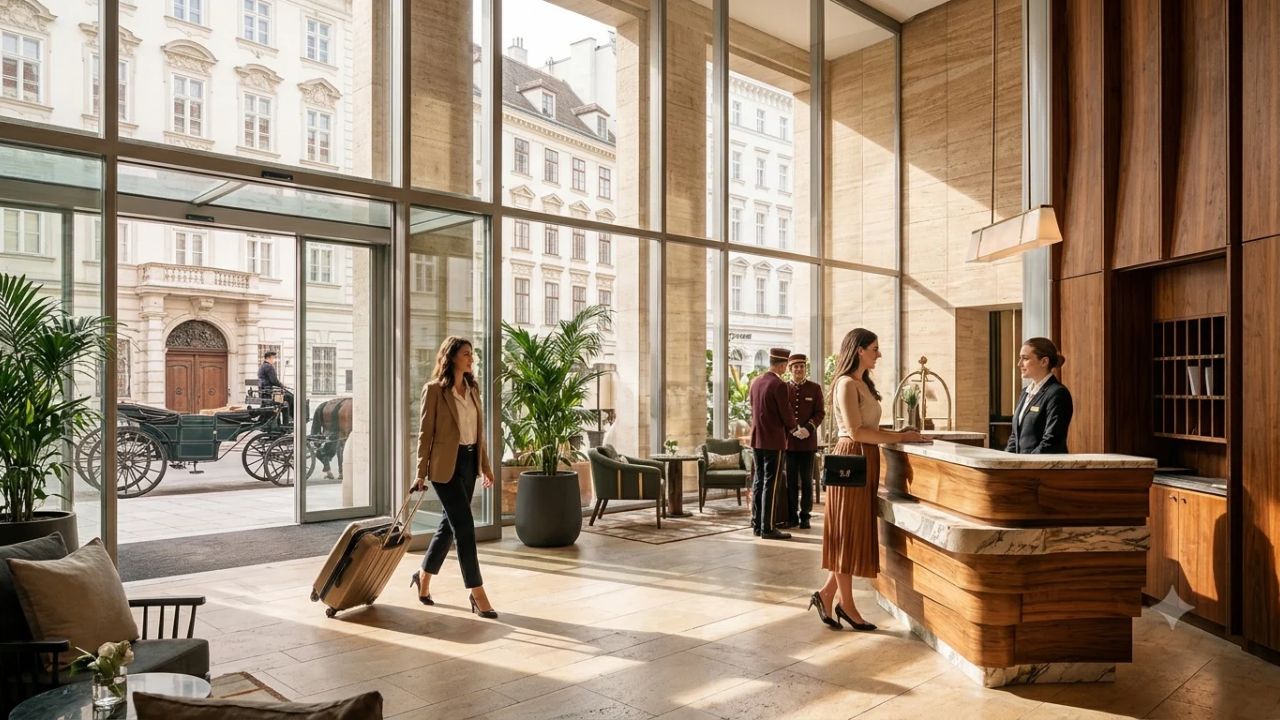
Image generated by AI
[New York, June 2026] — The United States hospitality sector is witnessing a stark financial divide as luxury hotels surge in profitability while economy properties suffer declines across all primary performance metrics. New data reveals a fragmented recovery in the first half of 2026, where high-net-worth spending is insulating premium brands from the economic pressures currently squeezing budget-conscious travelers.
This divergence in the American hotel market is characterized by a growing gap in occupancy rates and revenue generation. While the broader industry recorded a trailing 12-month Revenue Per Available Room (RevPAR) increase of 1.8%—the strongest performance since May 2025—this growth is not evenly distributed. The recovery is heavily weighted toward the top tier of the market, leaving economy operators to battle falling rates and dwindling occupancy.
The Luxury-Economy Performance Gap
The immediate cause of this market split is a shift in consumer spending patterns. High-income travelers continue to prioritize premium, all-inclusive experiences, whereas price-sensitive consumers are slashing discretionary spending. This trend has created a "K-shaped" recovery where the luxury segment thrives on resilient demand for wellness facilities, personalized service, and prime locations, while the budget sector struggles with the rising cost of travel.
According to analysis from Colliers, the disparity is evident in the hard data from the first half of 2026:
| Hotel Category | Occupancy | Average Daily Rate | RevPAR |
|---|---|---|---|
| Luxury | 72.5% | $419.39 | $290.42 |
| Economy | 58.3% | $82.18 | $47.94 |
The data confirms that luxury hotels are not only filling more rooms but are doing so at a massive premium. The average daily rate for a luxury room is now more than five times that of an economy room. Conversely, the economy segment is the only highlighted category to record simultaneous declines in occupancy, average daily rates, and RevPAR.
Impacted Markets and Brand Portfolios
The impact of these trends is most visible in major tourism hubs including New York, Las Vegas, Miami, and Los Angeles. In these cities, the cost of accommodation is fluctuating wildly based on the hotel's market positioning. While luxury properties maintain pricing power, economy hotels are facing increased pressure from new room supply entering the market, which intensifies competition and forces rates downward.
Beyond the traditional luxury/economy binary, "lifestyle" and experience-driven brands are emerging as high-growth outliers. These properties, which blend boutique design with destination-specific social spaces, are seeing significant RevPAR gains.
Top Performing Lifestyle Brands (RevPAR Growth):
- Atwell Suites (IHG): 22.7%
- Kimpton: 15.0%
- LXR Hotels & Resorts: 12.9%
- The Unbound Collection by Hyatt: 12.0%
- W Hotels: 10.8%
Large-scale operators with diversified portfolios are seeing modest, steady growth. The Hyatt system-wide RevPAR grew by 5.7%, followed by IHG Hotels & Resorts Americas at 4.8%, Hilton US operations at 4.7%, and Marriott US and Canada at 4.6%.
Practical Traveler Advisory and Strategic Insights
For the average traveler, this data signals a shift in how to budget for US-based trips. The "middle" of the market is shrinking, and the cost of entry for premium experiences remains high and stable.
For the Budget Traveler: You may find more leverage to negotiate or find deep discounts in the economy sector. With occupancy sitting at a low 58.3%, budget hotels are desperate to fill rooms. However, be cautious: falling RevPAR often leads to reduced staffing or deferred maintenance, which could impact the quality of your stay.
For the Luxury Traveler: Expect prices to remain elevated. The 72.5% occupancy rate suggests that premium properties are operating near capacity during peak periods. Early booking is now essential for high-end properties in cities like Las Vegas or Miami to avoid inflated last-minute rates.
For the "Experience" Seeker: The growth of brands like Atwell Suites and Kimpton suggests a market shift toward "lifestyle" hotels. Travelers are increasingly willing to pay a premium for design and atmosphere over traditional luxury. These properties currently offer a middle ground between the austerity of economy hotels and the formality of five-star resorts.
The Road to 2027
The hospitality industry is now entering a phase where "positioning" is everything. The ability of a hotel to categorize itself as a "lifestyle" or "experience" brand is currently the most reliable driver of revenue growth.
Moving forward, the economy sector must find ways to attract a more resilient customer base or risk a prolonged slump. Factors that will determine the trajectory of the market over the next 12 months include:
- Interest Rates and Household Debt: If price-sensitive consumers continue to face financial pressure, the economy segment's decline will accelerate.
- Inventory Absorption: The market must determine if the influx of new room supply in major cities is being met with a corresponding increase in visitor demand.
- Corporate Travel Recovery: While leisure luxury is booming, the full return of high-spend corporate travel will be the final catalyst for a total industry recovery.
FAQ: US Hotel Trends 2026
Why are luxury hotel prices staying high while budget hotels are struggling? High-income travelers are less affected by inflation and are prioritizing "premium" experiences. Meanwhile, budget travelers are cutting trips shorter or choosing cheaper destinations due to rising transport costs and household financial pressures.
What is RevPAR and why does it matter to me? RevPAR (Revenue Per Available Room) measures a hotel's ability to fill rooms at a high price. For travelers, a falling RevPAR in a specific segment usually means more vacancies and lower prices, while rising RevPAR indicates higher costs and lower availability.
Which hotel brands are currently seeing the most growth? Experience-focused and lifestyle brands are leading. Atwell Suites (IHG) is the top performer with 22.7% growth, followed by Kimpton and LXR Hotels & Resorts.
Will it be cheaper to stay in a budget hotel in 2026? Likely yes. Because economy hotels are seeing declines in average daily rates and occupancy, there is more downward pressure on pricing compared to the luxury sector.
The American hotel market is no longer recovering as one—it is splitting in two.
Related Travel Guides
This article is for informational purposes. Flight routes, passenger regulations, visa rules, and transit advisories are subject to change by airlines and aviation authorities. Readers are advised to verify schedules and travel documentation with relevant carriers and border agencies before departure.
Related Stories
EU Probes Booking.com Under Digital Services Act Over Fake Hotel Listings, Hijacked Reservations, and Search Ranking Transparency