United Kingdom’s St Pancras Railway Capacity Takes Centre Stage as Virgin Builds London–Paris Travel Plans

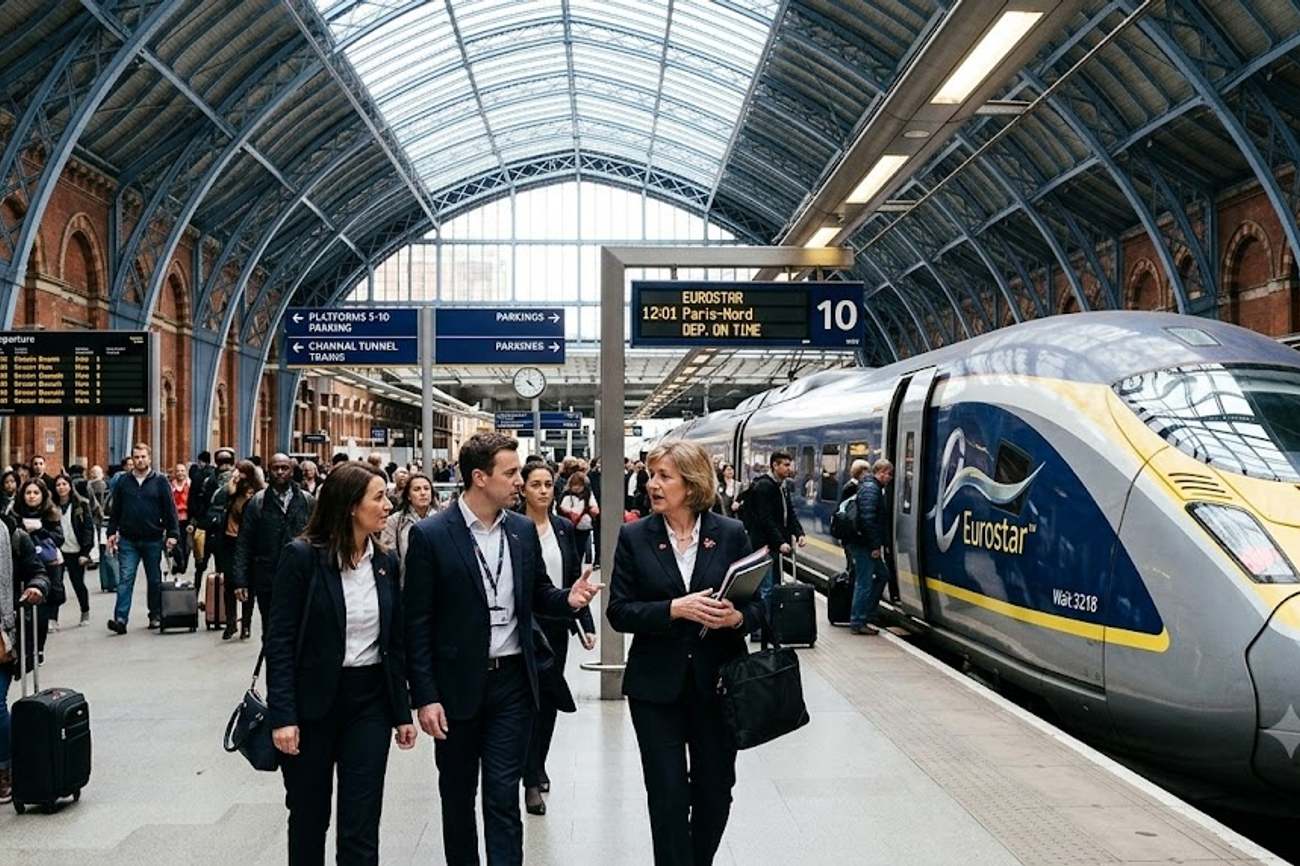
Image generated by AI
[London, May 2024] — Virgin’s ambitious expansion into the international rail market is facing a critical regulatory bottleneck at London St Pancras International, where a "42-departure rule" could strip the operator of its planned services to Amsterdam.
Official documents from the UK's Office of Rail and Road (ORR) reveal that while Virgin has secured a framework for up to 20 daily return services across Europe, its rights to the Amsterdam route are "contingent." This means if the total number of outward international departures from St Pancras exceeds 42 in a single day, Virgin’s Amsterdam paths may be revoked to prevent the terminal from collapsing under passenger volume.
The St Pancras Capacity Trigger
The conflict centers on the distinction between "track capacity"—the physical ability of a train to move on rails—and "terminal capacity"—the ability of a station to process human beings. The Office of Rail and Road (ORR) has confirmed that the High Speed 1 (HS1) lines and the platforms themselves are currently underutilized compared to other UK main lines. Physically, there is plenty of room for more trains.
However, the terminal's "International Zone" is a different story. Every international departure requires a rigorous sequence of security screenings, border controls, and customs procedures. The ORR has determined that once the station hits 42 outward departures per day, the infrastructure for passenger processing reaches a tipping point.
Because "firm" access rights take precedence over "contingent" rights, Virgin’s Amsterdam service is the most vulnerable part of its expansion strategy. If other operators increase their frequency or if Eurostar expands its footprint, Virgin's Amsterdam trains are the first to be cut.
Affected Travelers, Airlines and Logistics: Virgin’s Expansion Timeline
Virgin's entry into the market is not an overnight event but a phased rollout beginning in 2030. The following table outlines the specific paths secured and their regulatory status:
| Route | Start Date | Outward Paths/Day | Inward Paths/Day | Status |
|---|---|---|---|---|
| London–Paris | Oct 2030–Mar 2031 | 6 | 6 | Firm |
| London–Paris | Apr–Sep 2031 | 10 | 10 | Firm |
| London–Paris | From Oct 2031 | 13 | 13 | Firm |
| London–Brussels | From Feb 2031 | 4 | 4 | Firm |
| London–Amsterdam | From Sep 2031 | 3 | 3 | Contingent (if total > 42) |
| Total Max | From Oct 2031 | 20 | 20 | Amsterdam at risk |
The Paris market is the cornerstone of Virgin's strategy, representing the bulk of its requested capacity. While the Paris and Brussels routes are guaranteed "firm" rights, the three daily paths to Amsterdam remain precarious.
Practical Traveler Advisory and Strategic Insights
For the average passenger, this regulatory battle translates into a high risk of timetable instability and potential "ghost" bookings for the Amsterdam route.
1. Reliability Risks for Amsterdam Bookings If you are booking a trip to Amsterdam for late 2031, be aware that these services are not guaranteed. If the Eurostar or another new entrant increases its daily departures, Virgin's Amsterdam slots could be cancelled by the regulator to maintain station safety and flow.
2. Increased Terminal Congestion The "42-departure rule" exists because the station's International Zone—which includes platforms 5 through 10—has a finite capacity to handle security and border checks. As Virgin scales up to 20 daily services, passengers should expect significantly longer queues at border controls and security screening, regardless of which operator they fly with.
3. Competitive Pricing on Paris Routes Because the London–Paris paths are "firm," travelers can expect a genuine price war between Virgin and Eurostar starting in October 2030. Unlike the Amsterdam route, the Paris service is regulatory-secure, meaning Virgin can invest in the route with confidence, likely leading to more aggressive fare competition.
The Pressure on High Speed 1
The urgency of this capacity issue is underscored by the fact that international rail traffic is already surging. Data from the 2025–26 Annual Report on London St Pancras Highspeed shows that international services have risen by 4% year-on-year.
Currently, there are 17,746 international services annually, which is approximately 1% higher than the pre-pandemic levels of 2019–20. With 65,734 total trains timetabled across HS1, the infrastructure is performing well—infrastructure-attributed delays for international trains are remarkably low at just 0.54%.
The bottleneck is not the train; it is the border. The implementation of the EU Entry/Exit System (EES), which launched on October 12, 2025, has fundamentally changed how passengers move through St Pancras. Every departure is now a complex passenger-processing exercise involving digital biometric checks, making the "42-departure" threshold a hard ceiling rather than a flexible guideline.
The Numerical Margin: Virgin vs. Eurostar
To understand why the number 42 is so critical, one must look at Eurostar's current firm rights. For the period ending September 21, 2026, Eurostar's daily outward entitlements are:
- Monday–Thursday: 24 paths
- Friday: 25 paths
- Saturday: 22 paths
- Sunday: 23 paths
The "headroom" between Eurostar's current maximum (25) and the regulator's limit (42) is only 17 paths. Virgin is seeking 20 paths. This means that if Eurostar maintains its current volume, Virgin's full program cannot physically fit within the terminal's processing capacity without triggering the "contingent" clause that would kill the Amsterdam route.
FAQ: London International Rail Competition 2031
When will Virgin start running trains from London to Europe? Virgin is scheduled to begin its phased rollout in October 2030, starting with six daily return services to Paris. Brussels services follow in February 2031, and Amsterdam services are slated for September 2031.
Why is the Amsterdam route "contingent" while Paris is "firm"? The ORR has capped total outward departures from St Pancras at 42 per day to avoid overcrowding at border and security controls. Since Paris and Brussels paths were granted first, the Amsterdam slots are the "overflow" and will be removed if the 42-train limit is hit.
Will this lead to shorter wait times at St Pancras? No. The introduction of more services, combined with the EU's Entry/Exit System (EES), is expected to increase pressure on the International Zone. Passengers should anticipate more crowded boarding areas and longer processing times.
Does this mean the trains themselves are delayed? Not necessarily. High Speed 1 (HS1) infrastructure is performing efficiently with a delay rate of only 0.54%. The issue is "terminal capacity" (people moving through the building), not "track capacity" (trains moving on the line).
The battle for the Channel is no longer about who has the fastest train, but who has the most room at the gate.
Related Travel Guides
This article is for informational purposes. Flight routes, passenger regulations, visa rules, and transit advisories are subject to change by airlines and aviation authorities. Readers are advised to verify schedules and travel documentation with relevant carriers and border agencies before departure.
Related Stories

Amtrak Expands Loyalty Reach With Bilt Partnership Bringing Housing-Based Rewards to Rail Travellers
The World’s Most Beautiful Train Journeys Revealed: Australia’s Ghan Takes Top Spot in 2026 Index