
United Airlines Flight UA969 Plunges Passengers into 24-Hour Travel Chaos Following Bizarre Double Diversion from Amsterdam to San Francisco: Latest Airline News
A routine transatlantic journey severely fractures as an aging United Boeing 777 returns to Schiphol and then diverts to Newark, stranding passengers in a grueling day-long ordeal.

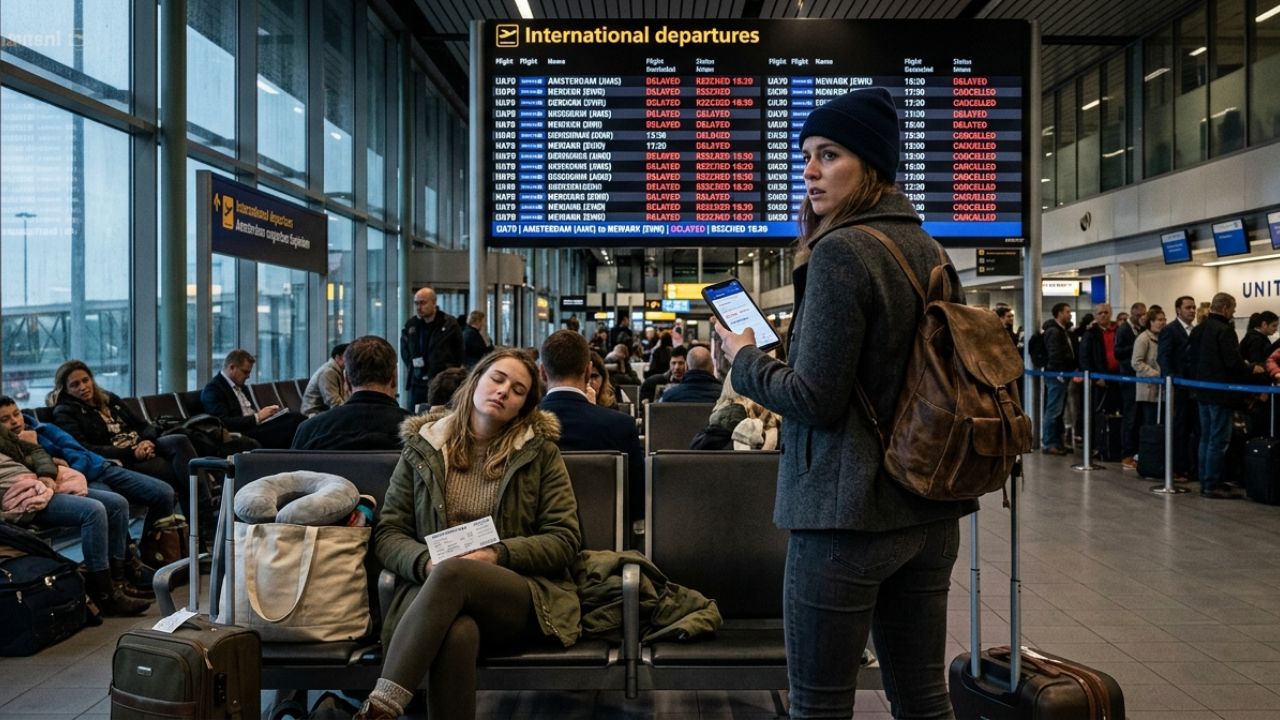
Image generated by AI
In a massive operational breakdown directly highlighting the severe unpredictability of modern transatlantic aviation, United Airlines flight UA969 has plunged hundreds of international passengers into absolute travel chaos. What was scheduled as a highly routine 11-hour nonstop corridor from Amsterdam Schiphol Airport in the Netherlands to San Francisco International Airport in the United States violently degraded into a grueling, nearly 24-hour physical ordeal. Operating a 29-year-old Boeing 777-200ER, the flight suffered an incredibly rare double-diversion sequence—first abandoning its ocean crossing to return to Europe, and then abruptly diverting to New Jersey on its second attempt. As widespread airport disruptions and the threat of sudden flight cancellations continue to erode passenger confidence across legacy carriers, this bizarre double-diversion totally dominates today’s premier airline news and global aviation updates.
By introducing direct passenger coordination and dynamic scheduling backups, the regional aviation hubs target growing passenger demand across vital commerce sectors. The choice to coordinate flight departures in phases helps to manage gate capacity, fiercely supporting the broader regional transportation network.
Context: The Vulnerability of the Transatlantic Corridor
The historical risk of funneling massive volumes of transcontinental traffic across the Atlantic on older widebody fleets is that a singular technical or operational snag rapidly cascades into extreme physical exhaustion and severely destroyed passenger itineraries.
Because capacity crunches and localized operational strain constantly threaten punctuality, the sudden loss of an aircraft's intended routing plunges the entire passenger manifest into disarray. While the United Airlines crew successfully maintained physical safety, the operational execution of Flight UA969 collapsed under the weight of back-to-back diversions. For a long-haul aircraft to abort its crossing over the North Sea, return to the Netherlands, dispatch a second time, cross the Atlantic, and then fail to reach California requires a devastating synchronization of operational roadblocks. Rather than a quick fix, this crisis forced highly fatigued passengers into an agonizing, multi-stage terminal waiting game that stretched from Europe to the US East Coast.
For live route mapping, specific rebooking options, and official flight status tracking, stranded passengers should immediately consult the digital advisories published by their respective carriers before attempting to access these severely compromised terminals.
Section-Wise Breakdown: The 24-Hour Ordeal
Disruption One: The North Sea Return
To deliberately manage the immense volume of transatlantic traffic, flights departing Amsterdam must immediately commit to the ocean crossing. On May 24, 2026, the Boeing 777-200ER (registered N785UA) initiated its scheduled departure to San Francisco. However, shortly after takeoff, the massive widebody violently stopped its westbound progress. Because airport disruptions actively destroy the passenger experience, the aircraft entered holding patterns over the North Sea for nearly two hours before the crew executed a safe, unscheduled return to Amsterdam Schiphol. While unconfirmed, tracking communities strongly suspect a technical anomaly forced the crew to seek the immediate safety of Schiphol's massive maintenance infrastructure.
Disruption Two: The Newark Diversion
After hours of ground inspections and severe passenger anxiety, the aircraft was cleared for a second departure at roughly 6:45 PM local time. The Boeing 777 successfully crossed the Atlantic, but the operational shielding failed again. Instead of proceeding to California, the aircraft abruptly diverted to Newark Liberty International Airport, a major United Airlines fortress hub in New Jersey.
The Final Push to San Francisco
The operational strain physically isolated passengers in Newark until the early hours of the morning. Flight tracking records confirmed the heavily delayed Boeing 777 finally departed Newark at 3:00 AM local time on May 25, eventually touching down in San Francisco. A direct 11-hour flight had mutated into a multi-continent marathon lasting nearly a full day.
Full Operational Breakdown: Flight UA969 Disruption Data
To guarantee 100% absolute factual accuracy regarding this massive pivot to restricted routing, the following exact table documents the critical flight disruptions currently driving this travel chaos:
| Event | Location | Details |
|---|---|---|
| Original Departure | Amsterdam Schiphol | May 24, Boeing 777-200ER (N785UA) |
| First Disruption | Over North Sea | Held in patterns, returned to Amsterdam after 2 hours |
| Second Departure | Amsterdam Schiphol | Departed again at approx. 6:45 PM local time |
| Second Disruption (Diversion) | Newark Liberty | Flight diverted to United hub instead of SFO |
| Third Departure | Newark Liberty | Departed at approx. 3:00 AM local time on May 25 |
| Final Arrival | San Francisco | Arrived nearly 24 hours behind schedule |
Passenger Impact: The Eradication of Reliable Transit
For the everyday international traveler, this aggressive spike in operational failures translates into a massive surge in travel anxiety and the erosion of passenger confidence.
By heavily experiencing these sudden schedule alterations, passengers aboard UA969 faced brutal missed connections, canceled ground transport, and severely disrupted business and leisure plans. A family attempting to reach San Francisco or a tech executive navigating a critical West Coast meeting was forced into a devastating cycle of standby queues and terminal exhaustion in both Amsterdam and Newark. The sheer duration of the delay—compounded by the psychological stress of a double diversion—physically guarantees that hundreds of passengers suffered maximum emotional and logistical friction.
The Bigger Picture: The Economics of Aging Widebodies
Aviation industry analysts view these staggering, highly targeted airport disruptions as a critical indicator of systemic operational sensitivity within legacy long-haul fleets.
The underlying strategic motivation perfectly reflects an industry reality: when airlines operate 29-year-old aircraft (like N785UA) on maximum-range international routes, the risk of technical or operational diversion mathematically increases. While age alone does not compromise structural safety, it heavily impacts reliability. Because United's network demands highly reliable coordination, the fact that this specific aircraft suffered back-to-back disruptions proves that legacy hardware requires intense scrutiny. When an aircraft diverts to a mega-hub like Newark, airlines face massive scheduling pressure to manage crew timeouts, gate availability, and passenger compensation.
What This Means for Travelers: Actionable Advice
To fully exploit these highly efficient international networks and actively avoid severe, self-inflicted regional travel chaos, execute the following strategies:
- Assert European Compensation Rights (EU261): Because this flight originated in Amsterdam and was heavily delayed, passengers are legally entitled to aggressive cash compensation under European Union Regulation 261. Demand this directly from United Airlines customer service immediately.
- Pad International Connections: If you are flying transpacific or transatlantic routes on legacy carriers, this data proves you cannot rely on tight connections. Always book onward travel on separate days to physically insulate yourself from the severe travel chaos paralyzing long-haul aviation.
- Monitor Aircraft Registration: Use digital tracking platforms to check the exact tail number assigned to your flight. If you notice your specific aircraft has suffered recent technical diversions, consider voluntarily rebooking to avoid being trapped in a rolling delay.
FAQ: United Airlines Flight UA969 Diversion
Why was United Flight UA969 delayed by 24 hours?
The flight suffered an incredibly rare double diversion. It first aborted its Atlantic crossing to return to Amsterdam, and on its second attempt, it diverted to Newark before finally reaching San Francisco.
What kind of aircraft was involved?
The service was operated by a Boeing 777-200ER, registered as N785UA, which is a 29-year-old aircraft in United's long-haul fleet.
What are my rights if my international flight is diverted twice?
If departing from an EU airport like Amsterdam, you are protected by EU261 regulations and are entitled to hotel accommodations, meals, and significant cash compensation for delays exceeding four hours.
Key Takeaways
- Unprecedented Double Diversion: Flight UA969 failed to reach its destination directly, stopping in both Amsterdam and Newark.
- Massive Passenger Delay: A routine 11-hour flight took nearly 24 hours to complete.
- Aging Fleet Scrutiny: The aircraft involved (N785UA) is a 29-year-old Boeing 777, raising industry questions about legacy fleet reliability.
- European Origins: The initial failure over the North Sea triggered massive logistical hurdles for United's European ground teams.
- Passenger Friction: The sudden schedule failures forced hundreds of travelers into localized travel chaos across two continents.
Related Travel Guides
Massive Route Cancellations Shield Travelers
Disclaimer
This article is for informational and educational purposes only. It does not constitute legal, financial, or professional advice. While we strive to provide accurate and up-to-date information, travel policies, regulations, and conditions change rapidly. Always verify information with official sources before making travel decisions. Nomad Lawyer makes no representations about the accuracy, reliability, completeness, or suitability of the information provided. Readers should consult qualified professionals for advice specific to their circumstances. The views expressed in this article are those of the author and do not necessarily reflect the views of Nomad Lawyer.
Kunal K Choudhary
Co-Founder & Contributor
A passionate traveller and tech enthusiast. Kunal contributes to the vision and growth of Nomad Lawyer, bringing fresh perspectives and driving the community forward.
Learn more about our team →