Uzbekistan Ministry of Internal Affairs Proposes Unprecedented State Bodyguard Services for Foreign Tourists as Russian Arrivals Surge 30 Percent

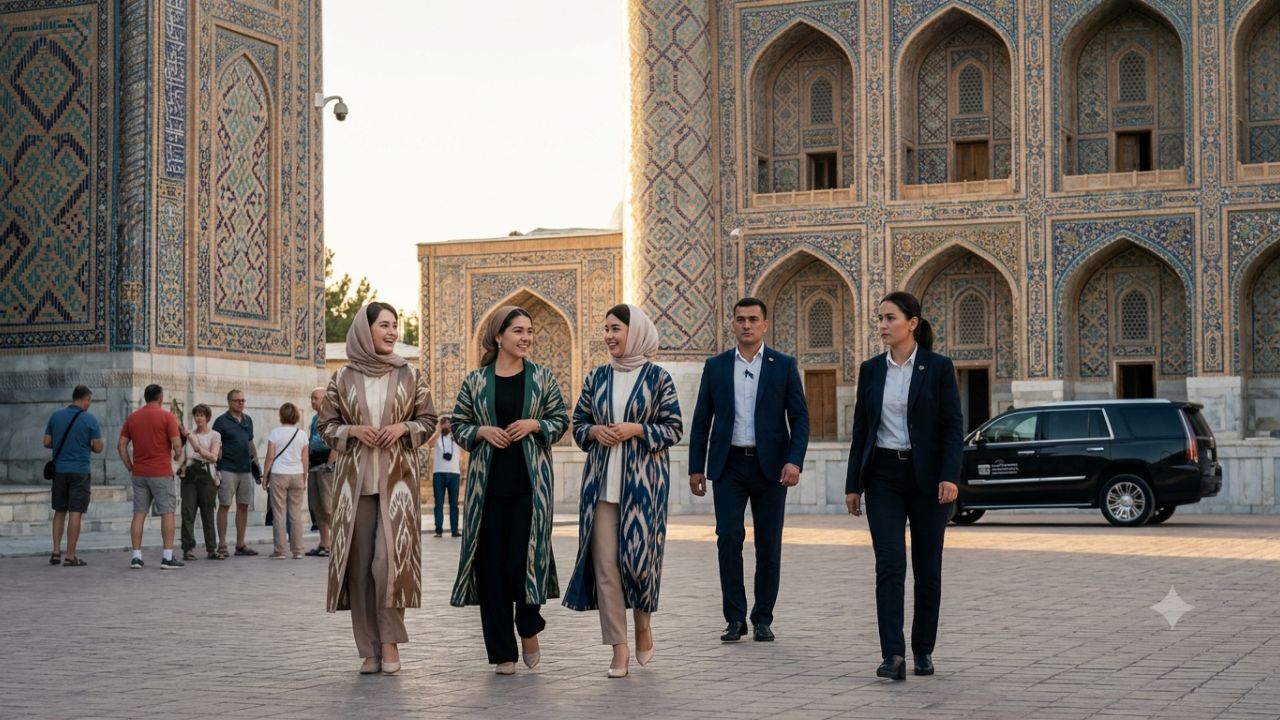
Image generated by AI
The Protection Department of the Ministry of Internal Affairs of Uzbekistan, in partnership with the Tourism Committee of Uzbekistan, has drafted a government-backed security framework offering state close-protection bodyguards to regular international tourists and business travelers.
The proposal represents an unprecedented shift in global travel security, broadening state-provided close protection beyond official diplomatic delegations to include standard holidaymakers, corporate executives, and high-net-worth visitors. Supported by a 30% year-on-year surge in foreign tourist arrivals—including 465,800 Russian visitors recorded since early 2026—the Central Asian nation aims to establish a highly secure environment for international travel along the historic Silk Road.
Uzbekistan Ministry of Internal Affairs Drafts Unprecedented State Close-Protection Framework
Under the proposed framework, foreign travelers will be able to request trained state security operatives to accompany private itineraries across major cultural landmarks in Samarkand, Bukhara, Khiva, and Tashkent. The initiative integrates human protection operatives with advanced technical infrastructure, including landmark video surveillance and a 24/7 multilingual emergency hotline (the 1173 Call Centre).
Security analysts note that while safety is recognized by the UN World Tourism Organization (UNWTO) as a primary factor governing international destination choice, offering government bodyguards to non-diplomatic tourists marks a departure from standard international security practices.
Comparative Global Tourist Security Matrix
The table below contrasts Uzbekistan’s proposed state-backed bodyguard scheme with security models operating across the United Kingdom, United States, France, Thailand, and Egypt:
Travelers planning a visit to Central Asia can find official destination guides and entry requirements via the Tourism Committee of Uzbekistan.
| Nation / Region | Security Framework | Target Beneficiary | Operative Source | Primary Protection Function |
|---|---|---|---|---|
| Uzbekistan | State-Backed Close Protection | Foreign tourists, business VIPs, holidaymakers | Ministry of Internal Affairs Operatives | Dedicated personal bodyguard for private itineraries |
| Thailand / Egypt / Greece | Dedicated Tourist Police Divisions | General public, sightseers, tour groups | Uniformed Tourist Police Officers | Area patrols, scam prevention, dispute resolution |
| United Kingdom / France | Licensed Private Security Sector | High-net-worth private travelers | SIA-licensed private security firms | Commercial close protection (State issues licenses only) |
| United States | Federal Diplomatic Protection | Heads of state, visiting royalty, cabinet members | US Secret Service / Diplomatic Security | Elite protection restricted exclusively to official state guests |
Detail of Uzbekistan’s State-Backed Security Program
Pre-Journey Risk Assessments and Operative Deployment
The formal proposal outlines a multi-tiered security protocol:
- Logistical Security Mapping: Prior to a visitor's arrival, state security teams conduct pre-journey risk assessments, mapping secure transit corridors between airports, high-speed rail lines, and heritage sites.
- Dedicated Operative Assignment: Qualified personnel from the Ministry of Internal Affairs are assigned to accompany visitors during private excursions, providing rapid response capabilities during medical or physical emergencies.
Technical Surveillance and 1173 Hotline Integration
Human protection assets are reinforced by expanded municipal technology:
- Landmark Video Monitoring: Modern high-definition surveillance networks have been deployed across major Silk Road historical monuments.
- 1173 Multilingual Call Centre: The Ministry launched a dedicated 24/7 hotline (1173) operating in multiple languages, allowing foreign tourists to connect directly with law enforcement dispatchers.
Comparative Analysis: Tourist Police vs. Private Security vs. State Protection
Tourist Police Divisions (Thailand, Egypt, Greece)
Nations like Thailand (under the Ministry of Tourism and Sports), Egypt, and Greece utilize specialized Tourist Police units. However, these officers provide general area security—patrolling public squares, preventing local scams, and enforcing fair commercial practices—rather than accompanying individual travelers on private itineraries.
Private Security Regulation (UK, US, France)
In Western nations such as the UK, US, and France, personal protection is strictly delegated to the private sector. Governments issue operational credentials—such as the UK Home Office Security Industry Authority (SIA) license—but never deploy state police or military personnel to act as private bodyguards for commercial tourists.
For global standards on travel safety and destination competitiveness, refer to the guidelines provided by the UN World Tourism Organization (UNWTO).
Elite Diplomatic Units (UK RaSP, US Secret Service)
Government close-protection assets—such as the UK’s Royalty and Specialist Protection (RaSP) or the US Secret Service—are reserved exclusively for heads of state, visiting royalty, and high-ranking diplomats. High-net-worth commercial travelers cannot hire these state units under any circumstances, highlighting the unique nature of Uzbekistan's proposal.
Traveler Logistics Guide: Booking Protection and Utilizing Emergency Services
International travelers and luxury tour operators planning journeys to Uzbekistan in 2026 can utilize national safety resources through standardized procedures:
-
Accessing the 1173 Multilingual Hotline
- Direct Assistance: Dial 1173 from any domestic or international mobile phone within Uzbekistan for immediate English, Russian, or Uzbek assistance from law enforcement operators.
- Emergency Reporting: Use the 1173 hotline to report lost travel documentation, transit disputes, or medical emergencies while visiting historical monuments.
-
Requesting State-Backed Close Protection
- Official Application Channels: Submit security requests through accredited Tourism Committee portal channels prior to arrival, providing complete itinerary details, accommodation bookings, and arrival dates.
- Pre-Arrival Itinerary Verification: Ensure travel itineraries between Tashkent, Samarkand, and Bukhara are finalized early to allow the Ministry of Internal Affairs to complete pre-journey security mapping.
-
Private Security versus State Clearance
- Licensing Requirements: Luxury travel management companies bringing external private security detail into Central Asia must secure formal import permits for communication equipment and official state clearance through the Ministry of Foreign Affairs.
Economic and Central Asian Tourism Infrastructure Assessment
Monitored by organizations like the World Travel and Tourism Council (WTTC), Uzbekistan’s security initiative reflects a strategic economic investment designed to capture high-spending luxury and business travel segments. By establishing state-guaranteed physical security, Uzbekistan seeks to reinforce visitor confidence, support its 30% tourist arrival growth rate, and pioneer a distinct model for Central Asian heritage tourism.
Visitors should monitor current travel advisories and safety protocols through the U.S. Department of State.
FAQ: Uzbekistan Ministry of Internal Affairs 2026
Can regular tourists hire state bodyguards in Uzbekistan? Yes, under the new proposal, state close-protection services are being expanded beyond diplomats to include standard international tourists, business travelers, and high-net-worth individuals.
How does this differ from standard Tourist Police? Unlike Tourist Police who perform general area patrols and scam prevention, this program provides dedicated personal security operatives to accompany individuals on their specific private itineraries.
Which cities are covered by the security framework? The proposed security services will be available across Uzbekistan's major cultural and urban hubs, specifically in Tashkent, Samarkand, Bukhara, and Khiva.
How can tourists access emergency help in Uzbekistan? The government provides a 24/7 multilingual emergency hotline via the 1173 Call Centre to assist international visitors with urgent security or safety needs.
Related Travel Guides
- Six Flight Cancellations Disrupt Baghdad and Erbil Airports — Fly Baghdad, Air Arabia, Royal Jordanian Services Grounded
- Timor-Leste Partners with Portugal, Angola, and Mozambique to Boost Sustainable Tourism in 2026: Everything You Need to Know
- United States Holiday Congestion: Peak Fourth of July Travel Demand Sparks Severe Highway Traffic Across Florida, Los Angeles, and East Coast Cities: New Travel Alert
This article is for informational purposes. Flight routes, passenger regulations, visa rules, and transit advisories are subject to change by airlines and aviation authorities. Readers are advised to verify schedules and travel documentation with relevant carriers and border agencies before departure.
Related Stories
US State Department Worldwide Caution Alert 2026: Impact on Middle East Aviation and Travel Insurance
FCDO Tightens Travel Advice for 13 States Including Turkey and Egypt in October 2026