Beyond the Gorillas: How Uganda's UGX 5.8 Trillion Tourism Surge and Kenya Alliance Are Redefining East African Safaris

While mountain gorilla trekking in Bwindi has long anchored Uganda's global identity, international visitors are now staying longer and spending more across the country, lifting tourism receipts by 25.6 percent in the first half of 2026 to reach UGX 2.3 trillion. Official statistics released by the Ministry of Tourism, Wildlife and Antiquities and the Uganda Tourism Board confirm that Uganda’s tourism comeback has surpassed pre-pandemic benchmarks. The nation welcomed 1,642,215 international arrivals in 2025—a 19.7 percent rise over 2024 and 106 percent of its 2019 baseline—generating record receipts of UGX 5.829 trillion (approximately US$1.62 billion) while directly sustaining 876,512 Ugandan livelihoods.
The structural transformation in Uganda's visitor economy is driven by a deliberate shift from volume recovery to value creation. Average visitor stays climbed from 7.4 nights to 8.3 nights during the first six months of 2026, which recorded 739,815 international arrivals. Supported by strong cross-border travel from neighboring Kenya, Rwanda, and South Sudan, alongside expanding long-haul markets across India, the United States, China, the United Kingdom, and Canada, the Pearl of Africa is successfully broadening its appeal to include river adventure, savannah game drives, and ancestral heritage.
Performance Metrics & Regional Growth Corridors
| Metric / Economic Indicator | Recorded 2024 / 2025 Value | H1 2026 Performance (Jan–Jun) | Strategic Impact on Traveler Itineraries |
|---|---|---|---|
| Annual Visitor Arrivals | 1,371,895 (2024) to 1,642,215 (2025) | 739,815 visitors (+3.7% YoY) | Surpassed pre-pandemic 2019 levels at 106% benchmark |
| National Tourism Earnings | UGX 5.829 Trillion (~US$1.62B, +21.3%) | ~UGX 2.3 Trillion (+25.6% YoY) | Surge in high-yield lodge bookings, guided circuits, and park fees |
| Average Duration of Stay | 8.8 nights (2025 full-year average) | 8.3 nights (up from 7.4 nights) | Multi-region circuits combining primates, savannahs, and the Nile |
| Direct Sector Employment | 876,512 registered jobs (2024) | Expanding regional guide rosters | Tourism revenue directly supporting community conservation ranger programs |
| Primary Regional Markets | Kenya, Rwanda, South Sudan, Burundi | Overland & short-haul flights | Seamless cross-border road trips and joint East African itineraries |
| Priority Global Corridors | India, US, China, UK, Canada, Spain | Targeted at POATE & OTM 2026 | New direct bookings via hosted buyer networks across 40 nations |
Why the East African Travel Alliance Expands Safari Circuits
The deepening tourism synergy between Uganda and Kenya serves as the bedrock of regional travel growth. Because Kenya and Uganda share interconnected borders, well-maintained highway corridors, and daily short-haul flights between Jomo Kenyatta International Airport (NBO) in Nairobi and Entebbe International Airport (EBB), travelers increasingly treat both countries as a single unified safari circuit.
Rather than choosing between Kenya's Great Migration in the Maasai Mara and Uganda's endangered primates, international travelers utilize the unified East Africa Tourist Visa. This single-entry visa allows seamless, borderless travel between Kenya, Uganda, and Rwanda for up to 90 days.
At the annual Pearl of Africa Tourism Expo (POATE 2026), where more than 350 Ugandan exhibitors engaged 120 hosted international buyers from 40 countries, the government designated China, Turkey, Egypt, and Canada as priority growth corridors. Concurrently, promotional campaigns at OTM 2026 in India and FITUR in Madrid have accelerated demand for specialized adventure and wildlife itineraries across Southern Europe and Asia.
Expanding Beyond Primate Trekking: The Source of the Nile and Savannahs
While the mist-shrouded ridges of Bwindi Impenetrable National Park, inscribed as a UNESCO World Heritage Centre site, remain a once-in-a-lifetime encounter with half of the world's remaining mountain gorillas, Uganda is actively diversifying its experiential portfolio.
At Jinja, the historic Source of the River Nile is undergoing comprehensive master-planned redevelopment to create world-class visitor boardwalks, cultural storytelling pavilions, and low-impact eco-lodges overlooking the river rapids. Jinja has consolidated its reputation as East Africa's adventure capital, offering grade-five white-water rafting, kayaking, mountain biking, and horseback riding through rural sugarcane plantations.
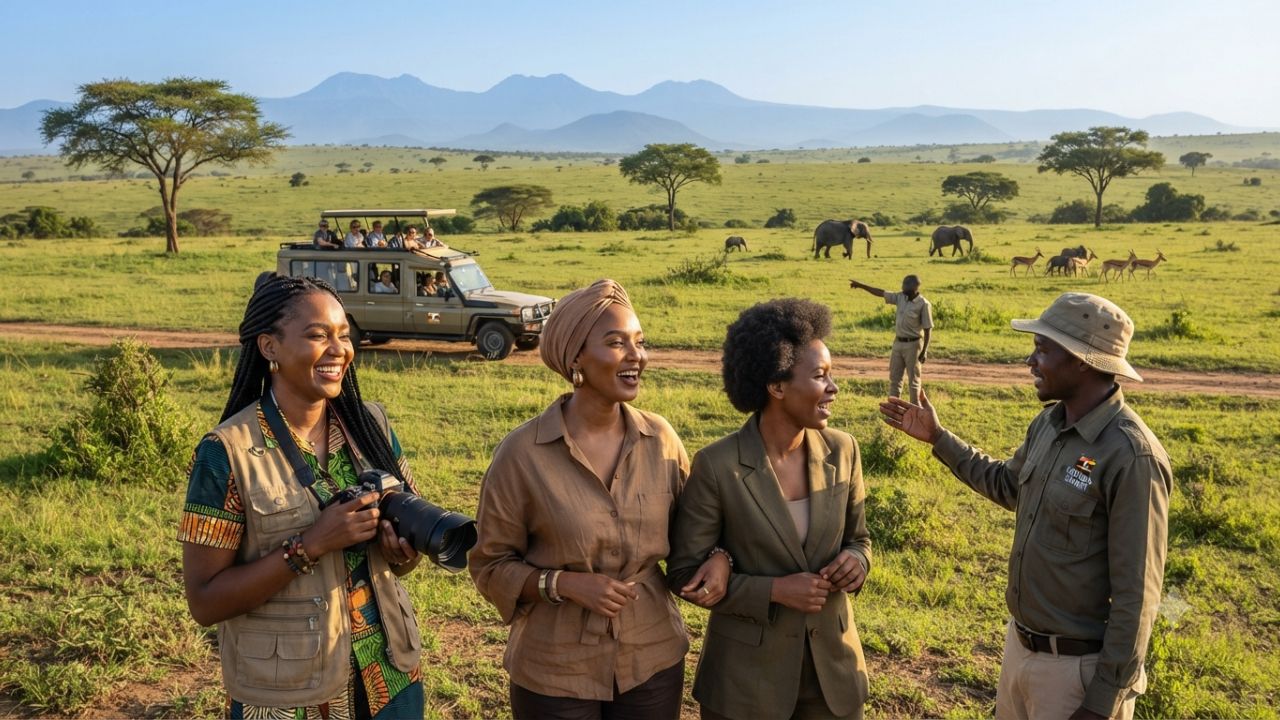
Further west, wildlife safaris managed by the Uganda Wildlife Authority in Queen Elizabeth National Park feature tree-climbing lions in the Ishasha sector and boat cruises along the Kazinga Channel, where herds of hippos and forest elephants gather. To the north, Murchison Falls National Park showcases the power of the Nile squeezing through an eight-meter gorge, while Kibale National Park provides premier chimpanzee habituation experiences in equatorial rainforests.
Visitor Insider Tips
- Secure the Unified East Africa Tourist Visa: If your journey includes Kenya, Rwanda, and Uganda, apply online for the US$100 East Africa Tourist Visa through the issuing authority of your first port of entry, saving significant visa fees compared to separate national entry permits.
- Book Primate Permits Months in Advance: Mountain gorilla trekking permits in Bwindi ($800 for foreign non-residents) and chimpanzee habituation passes in Kibale sell out months ahead during dry seasons (June to August and December to February). Book through licensed local operators registered with UTB.
- Try Uganda's Iconic Street Food—The Rolex: When exploring Kampala or roadside stops in Jinja, order a freshly prepared Rolex—a warm, pan-fried chapati rolled around an omelette of eggs, diced tomatoes, onions, and cabbage, costing under 3,000 Ugandan shillings (less than $1).
- Time Entebbe to Kampala Highway Transfers: Utilize the Entebbe–Kampala Expressway toll road when moving between Entebbe International Airport (EBB) and the capital, bypassing hours of traffic congestion along the old Entebbe road for a nominal 5,000 UGX toll.
- Support Community Crafts in Rubuguri: When trekking gorillas in the southern Rushaga sector of Bwindi, purchase hand-carved wooden walking sticks and woven grass baskets directly from women's cooperatives in Rubuguri village to ensure your spending directly benefits local families.
Cultural and Environmental Context
Uganda's tourism model ties wildlife conservation directly to community development. Under Uganda Wildlife Authority statutes, 20 percent of all national park entry fees are legally remitted to surrounding parish communities. This revenue-sharing framework funds local primary schools, medical dispensaries, gravity-fed clean water systems, and agricultural crop-raiding barriers around protected boundaries.
Furthermore, community-based cultural tourism initiatives empower the Indigenous Batwa people—the ancestral forest dwellers of Bwindi and Mgahinga—to share their ancient botanical knowledge, hunting traditions, and traditional folk music on their own terms. By prioritizing community-managed lodges and hiring local certified birding and tracking guides, travelers actively support rainforest preservation and anti-poaching initiatives across the Albertine Rift.
FAQ: Visiting Uganda in 2026
What is the best time of year to visit Uganda for gorilla trekking?
The optimal dry season windows for gorilla trekking in Bwindi and wildlife game drives occur from June to August and December to February, when forest trails are less muddy.
Can I travel between Kenya and Uganda on a single visa?
Yes. The East Africa Tourist Visa costs US$100 and permits multiple entries between Kenya, Uganda, and Rwanda for up to 90 days.
How much did Uganda earn from tourism in 2025?
Uganda generated record tourism receipts of UGX 5.829 trillion (approximately US$1.62 billion) in 2025, an increase of 21.3 percent over 2024.
Is Uganda safe for independent and solo travelers?
Uganda is widely considered one of the friendliest and safest destinations in East Africa; travelers should exercise standard urban precautions in Kampala and follow national park ranger instructions during wildlife treks.
By weaving primate encounters with the rapids of the Nile and the warmth of community homestays, Uganda proves that the greatest journeys are defined not just by the places you visit, but by the lives you touch along the way.
Related Travel Guides
- The Sovereign Pivot: Energy Megaprojects Financing Global Tourism Frontiers
- The South American Tourism Shift: How Argentina Powers Brazil's Record Growth
- Canada's Middle East Travel Advisory Update: What Heightened Risk Tiers Mean for Transit Hubs
- Abu Dhabi's 37km Coastal Expressway: Al Hudayriyat to Al Dhafra Highway Guide
This article is for informational purposes. Flight routes, passenger regulations, visa rules, and transit advisories are subject to change by airlines and aviation authorities. Readers are advised to verify schedules and travel documentation with relevant carriers and border agencies before departure.
Related Stories

Unlocking Africa's Skies: 60M Arrivals Spark Call to Dismantle Air and Visa Barriers

Saudi Arabia Maintains Ebola Travel Ban on Kenya Despite Africa CDC Plea for Lift