
Trier Teams Up With Mérida and More Take Centre Stage for an Unforgettable Ancient Roman Wonders
Trier Teams Up With Mérida and More Take Centre Stage for an Unforgettable Ancient Roman Wonders

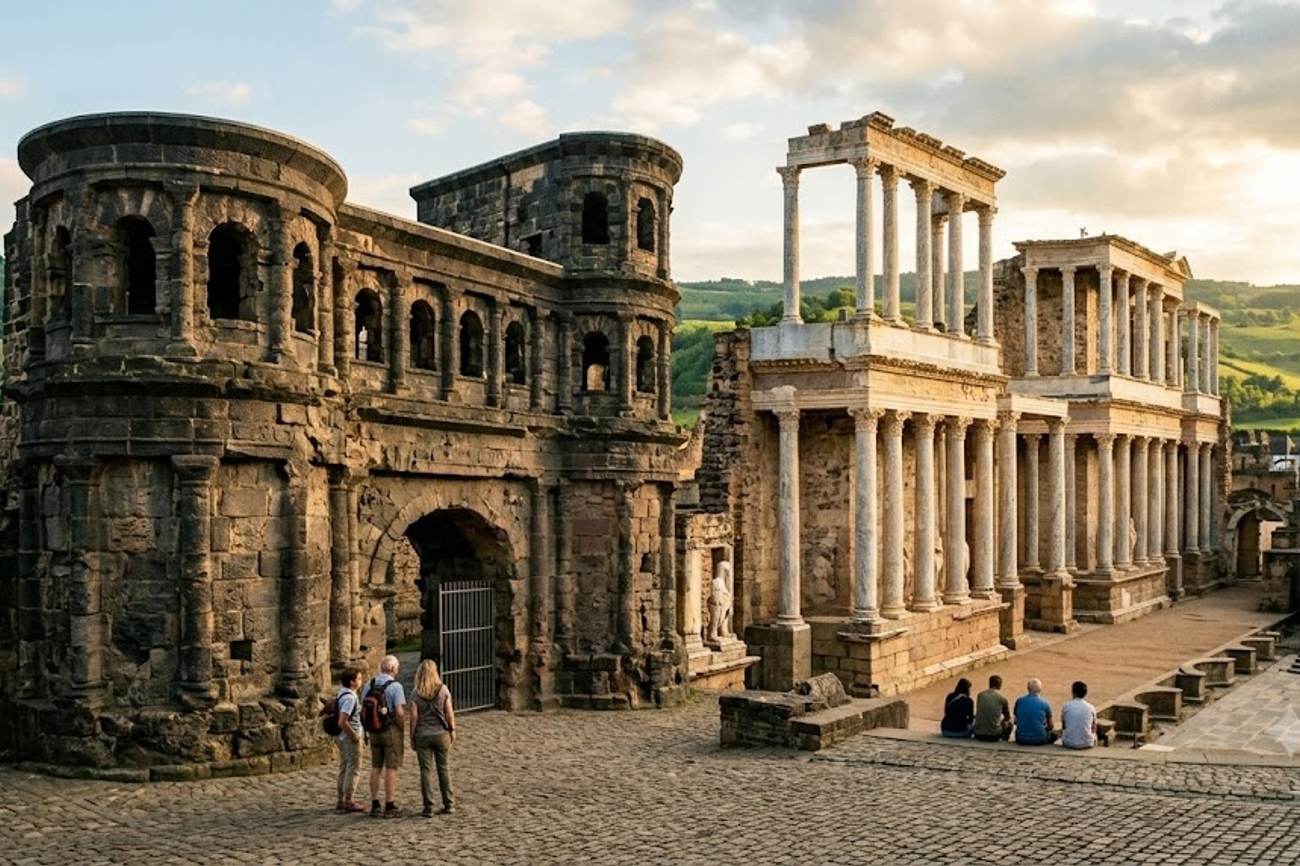
Image generated by AI
[Trier, May 2025] — Trier and Mérida are spearheading a strategic push to redirect global tourism traffic away from the saturated landmarks of Rome toward the "second capitals" of the ancient Roman Empire. This initiative highlights a growing trend of "authentic history" travel, where tourists prioritize lesser-known provincial hubs over the primary Italian capital to avoid overcrowding and experience Roman heritage integrated into living modern cities.
The movement centers on six primary destinations across Europe and North Africa: Trier in Germany, Mérida in Spain, Conímbriga in Portugal, Dougga in Tunisia, Volubilis in Morocco, and Nîmes in France. By emphasizing the infrastructure of the former empire—including roads, theaters, and trading centers—these cities are positioning themselves as essential nodes for a diversified Roman itinerary.
The Shift Toward Provincial Romanism
The immediate catalyst for this travel shift is the saturation of central Rome, which has led heritage travelers to seek sites where archaeology intersects with local gastronomy and rural landscapes. Rather than visiting a single concentrated urban center, travelers are now utilizing regional hubs to understand how Roman power was projected across the Alps and into North Africa.
The focus is specifically on the "provincial capital" experience. For example, Trier served as a center of the Tetrarchy and was historically dubbed the "second Rome," while Mérida functioned as the capital of Lusitania. This strategic positioning allows these cities to capture a market of high-value cultural tourists who prefer walking routes and museum-integrated city centers over the high-density queues of the Colosseum.
Impacted Markets and Visitor Metrics
The impact of this trend is visible in the recent visitor data, though reporting methods vary significantly between city-level accommodation and specific site admissions.
| Destination | Country | Key Attraction | Latest Visitor Data | Data Type |
|---|---|---|---|---|
| Trier | Germany | Porta Nigra | 467,804 | 2025 Accommodation Arrivals |
| Nîmes | France | Maison Carrée | 702,324 | 2024 Combined Monument Visits |
| Mérida | Spain | Roman Theatre | 224,890 | 2025 MNAR Museum Visitors |
| Conímbriga | Portugal | Roman Forum | 86,590 | 2025 Site Visitors |
| Dougga | Tunisia | Capitol/Theatre | 42,639 | 2023 Site Visitors |
| Volubilis | Morocco | Monumental Arches | Not Published | Annual Series Inconsistent |
In Trier, the growth of accommodation arrivals has remained steady, climbing from 243,545 in 2021 to 467,804 in 2025. The average stay in the city is approximately 1.9 nights, suggesting that the destination is increasingly viewed as a short-stay stopover within a broader European circuit.
In Mérida, the National Museum of Roman Art (MNAR) has seen a sharp recovery, with 2025 figures reaching 224,890 visitors—a nearly 22% increase over 2024. Total city travel in Mérida reached 271,962 individuals in 2025, representing a 13.31% increase in traveler volume compared to the previous year.
What This Means for Travelers
For those planning a trip, the shift toward these "secondary" Roman sites changes the logistical approach to heritage tourism. Travelers are no longer tethered to a single city but are encouraged to build multi-country itineraries.
Booking and Logistics: Travelers should expect a more integrated experience. In Trier, for instance, the Roman heritage is concentrated, allowing for a two-day walking itinerary that covers the Porta Nigra and the Imperial Baths without the need for extensive transit. In Mérida, the 31-hectare archaeological ensemble requires a minimum of two full days to properly navigate the theater, amphitheater, and the bridge across the Guadiana.
Financial and Entry Considerations: Unlike the centralized ticketing often found in Rome, these destinations utilize a mix of city-wide passes and individual site admissions. Travelers should note that "visitor numbers" in these regions often refer to specific museums (like the MNAR in Spain) rather than total city arrivals, meaning site-specific crowds may be lower than overall city tourism data suggests.
Cultural Integration: The experience is now designed to be holistic. A visit to the UNESCO World Heritage sites in these cities is paired with regional culinary experiences—such as Moselle wines and Rhineland cooking in Germany, or Iberian pork and Extremaduran cheeses in Spain.
Future Heritage Itineraries
The trajectory for 2025 and beyond suggests a move toward "corridor travel." Trier is being marketed as a gateway for a Germany-Luxembourg-France circuit, while Mérida serves as the anchor for exploration into the Iberian Peninsula.
The focus is shifting toward the "living city" model. Rather than isolated ruins, the goal is to showcase how Roman infrastructure—such as the water systems in Mérida or the trading hubs in Trier—still informs the layout of modern European towns. This approach is expected to sustain the growth in overnight stays, which in Mérida rose by 4.96% in 2025.
Travelers are advised to monitor site-specific admission data rather than general city statistics to gauge the best times for visits. The disparity in data—where some cities report "accommodation arrivals" and others report "museum admissions"—means that a "busy" city may still have relatively quiet archaeological sites.
FAQ: Roman Heritage Travel 2025
Which city is the best alternative to Rome for a short trip? Trier, Germany, is highly efficient for short visits. With a concentrated center and an average stay of 1.9 nights, travelers can see the Porta Nigra and Imperial Baths via a two-day walking circuit.
How does Mérida differ from other Roman sites? Mérida offers one of the most complete provincial capital experiences. Its World Heritage property covers 31 hectares and includes 22 different components, including a theater, circus, and extensive water infrastructure.
Is it better to visit these sites in the off-season? Yes. While Nîmes and Trier see high volumes (over 700,000 and 460,000 respectively), visiting outside peak summer months allows for better access to the National Museum of Roman Art and other concentrated monuments.
What is the most efficient way to visit multiple Roman sites? The most effective method is a regional circuit. For example, combining Trier (Germany) with Nîmes (France) and Mérida (Spain) allows travelers to see the evolution of Roman power from the northern frontiers to the Iberian capital.
The empire may have fallen, but the infrastructure remains the ultimate blueprint for the modern European road trip.
#Trier2025 #MeridaSpain #RomanHeritage #UNESCO_Europe #MNAR #LusitaniaTravel
Related Travel Guides
- Beyond the Metropolises: How Vietnam, Klook, and Regional Creators Are Reshaping Southeast Asian Travel
- The Modern Silk Road Takes Flight: How Uzbekistan Airways and Lufthansa Technik Elevate Central Asian Travel
- The Bosphorus Engine Standoff: How Turkish Airlines’ High-Stakes Fleet Talks Reshape Travel Across Istanbul
Disclaimer
This article is for informational and educational purposes only. It does not constitute legal, financial, or professional advice. While we strive to provide accurate and up-to-date information, travel policies, regulations, and conditions change rapidly. Always verify information with official sources before making travel decisions. Nomad Lawyer makes no representations about the accuracy, reliability, completeness, or suitability of the information provided. Readers should consult qualified professionals for advice specific to their circumstances. The views expressed in this article are those of the author and do not necessarily reflect the views of Nomad Lawyer.
Preeti Gunjan
Contributor & Community Manager
A passionate traveller and community builder. Preeti helps grow the Nomad Lawyer community, fostering engagement and bringing the reader experience to life.
Learn more about our team →