
Toronto Pearson International Airport Disruption: 26 Flights Suspended and 162 Delayed Across North America and Europe in 2026
Massive operational delays at Toronto Pearson International Airport have resulted in 26 suspended flights and 162 delays, impacting travel corridors across Canada, the US, and Europe.

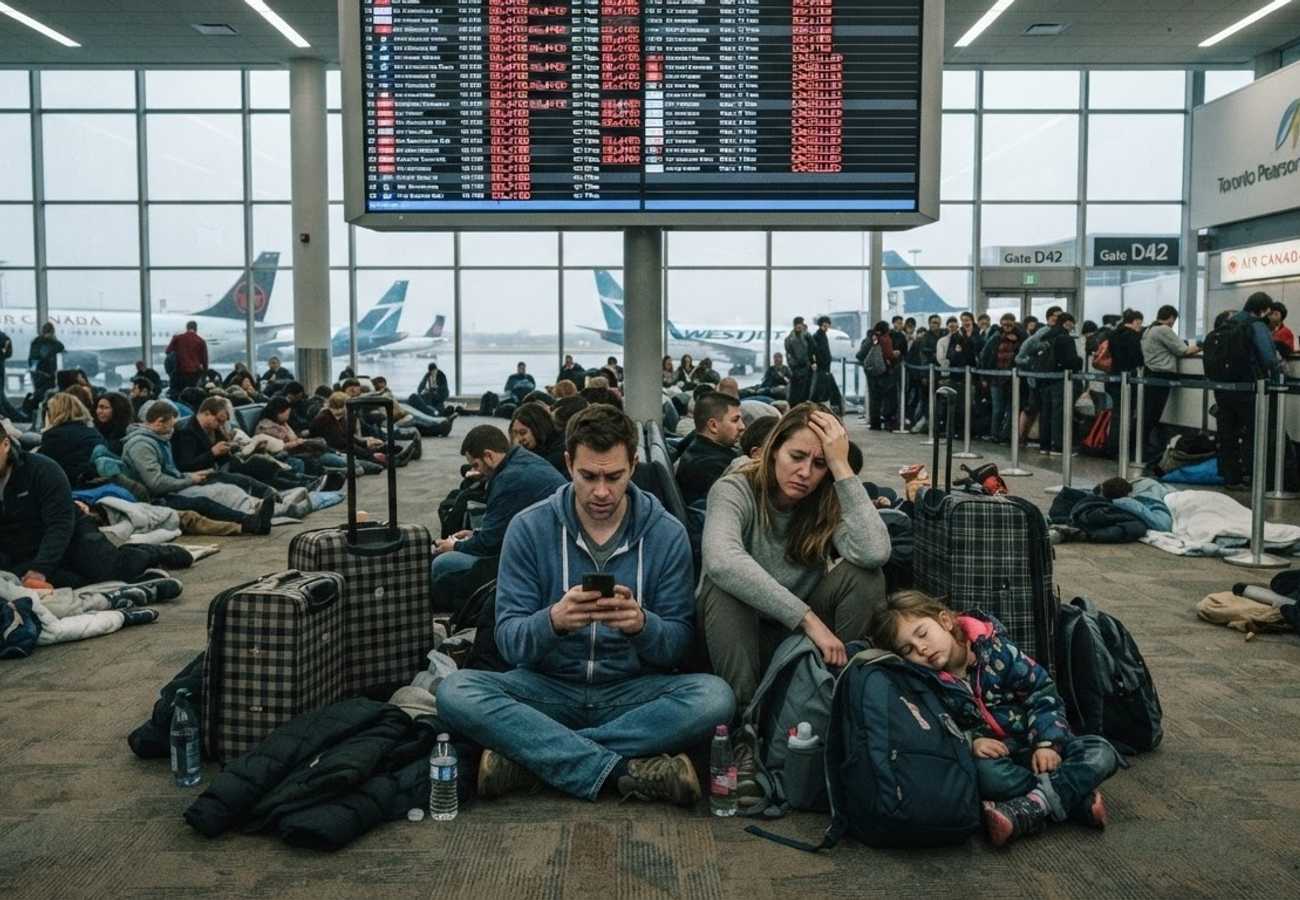
Image generated by AI
[Toronto, July 9, 2026] — Severe operational challenges at Toronto Pearson International Airport have triggered widespread travel chaos, with 26 flights suspended and 162 others delayed. The disruption is currently impacting critical flight paths connecting Canada to the United States, Mexico, Costa Rica, Portugal, and several other international destinations.
The scale of the instability has led to significant passenger congestion, missed flight connections, and a general state of uncertainty for thousands of travelers utilizing one of North America's primary aviation gateways. Aviation officials and airlines are currently attempting to stabilize schedules, though the ripple effects continue to touch domestic, transborder, and long-haul international services.
Global Reach of Toronto Pearson Operational Failures
The logistical fallout from the Toronto hub has extended far beyond Canadian borders, affecting a massive network of global cities. Flight tracking data indicates that the delays have resonated across major metropolitan areas including London, Montreal, Houston, Calgary, Chicago, and Philadelphia. In the United States, hubs such as Newark, Dallas, Detroit, Indianapolis, New York, and San Francisco have felt the impact of the scheduling shifts.
European travel has been similarly affected, with reports of disruptions reaching Berlin, Frankfurt, Helsinki, Dublin, Warsaw, Stockholm, Paris, Venice, Rome, Vienna, and Lisbon. The instability has even stretched into Asia and the Middle East, impacting routes to Abu Dhabi, Doha, Incheon, Manila, and Hong Kong. In the Caribbean and Central America, cities such as Punta Cana, Guanacaste, Bridgetown, and Mexico City have seen altered arrival and departure windows.
Within Canada, the disruption is felt most acutely in regional centers such as Moncton, Sault Ste. Marie, Sudbury, Timmins, Winnipeg, Saskatoon, Victoria, Edmonton, Halifax, Kelowna, Ottawa, Quebec City, St. John’s, Fredericton, and Regina.
Detailed Breakdown of Airline Cancellations and Delays
The concentration of the disruption is most evident when analyzing the specific carriers affected. While the overall pressure is centered at the Toronto Pearson hub, the burden of cancellations and delays has fallen disproportionately on a few key operators.
According to flight tracking data, Jazz (ACA) has borne the brunt of the suspensions, recording the highest number of both cancelled and delayed services. Porter Airlines and Air Canada Rouge also faced significant setbacks, while the main Air Canada fleet and Endeavor Air (DAL) reported fewer cancellations but still dealt with substantial delay volumes.
| Airline | Cancelled Flights | Delayed Flights |
|---|---|---|
| Jazz (ACA) | 15 | 49 |
| Air Canada Rouge (ACA) | 4 | 15 |
| Porter Airlines | 4 | 17 |
| Air Canada | 2 | 35 |
| Endeavor Air (DAL) | 1 | 2 |
Industry observers note that while the primary bottleneck remains at Toronto Pearson, "pockets" of cancellations have appeared at connecting airports. These include Montreal-Trudeau, Chicago O’Hare, Houston Bush, and St. Louis Lambert, suggesting that the disruption is not merely a local airport issue but a systemic network failure affecting cross-border corridors.
Passenger Protocols for Managing Flight Cancellations
With the volatility of current flight schedules, aviation experts recommend that passengers remain proactive. The current environment at Toronto Pearson necessitates a higher level of vigilance, as flight times are subject to rapid changes.
Travelers are advised to prioritize digital communication channels. Monitoring email, SMS notifications, and official airline mobile applications is the fastest way to receive rebooking confirmations. Those already at the terminal should seek out airline service desks, while those at home are encouraged to use online chat systems to bypass the lengthy phone queues typically associated with mass disruptions.
Understanding passenger rights is also paramount. Depending on the jurisdiction—such as the European Union's strict passenger protections or Canadian aviation regulations—travelers may be entitled to financial compensation or mandatory hotel accommodations if the cancellation was within the airline's control.
For those unable to secure a timely rebooking, industry sources suggest exploring alternative transport methods, including rail services or bus lines for domestic routes, or seeking out alternative carriers for international legs.
Systemic Impact on International Aviation Corridors
The current situation underscores the fragility of the "hub-and-spoke" aviation model. When a primary node like Toronto Pearson experiences a failure, the resulting "ripple effect" creates a cascading series of delays across multiple continents. The suspension of 26 flights may seem small in isolation, but the 162 delays create a backlog of aircraft and crew that cannot be resolved instantly.
Because crews are often tied to specific aircraft and routes, a delay in Toronto can lead to a cancelled flight in Mexico City or a delayed departure in London hours later. This interconnectedness means that operational recovery is rarely instantaneous; it requires a coordinated reset of crew rotations and aircraft positioning.
Why This Matters: The Fragility of Global Transit Hubs
This event serves as a critical case study in aviation vulnerability. The fact that a localized disruption in Toronto can simultaneously affect flights in Zagreb, Manila, and Bridgetown demonstrates the extreme interdependence of modern air travel.
From a journalistic perspective, this highlights a growing trend in 2026: the decreasing margin for error in airport operations. As passenger volumes return to or exceed pre-pandemic peaks, any technical or operational glitch at a "Super Hub" like Pearson doesn't just delay a few planes—it destabilizes an entire regional network. For the travel industry, this emphasizes the urgent need for better contingency planning and more robust real-time communication tools to prevent passengers from becoming stranded during these systemic failures.
Passengers are urged to verify all flight statuses via official channels before departing for the airport to avoid further congestion.
Related Travel Guides
Disclaimer
This article is for informational and educational purposes only. It does not constitute legal, financial, or professional advice. While we strive to provide accurate and up-to-date information, travel policies, regulations, and conditions change rapidly. Always verify information with official sources before making travel decisions. Nomad Lawyer makes no representations about the accuracy, reliability, completeness, or suitability of the information provided. Readers should consult qualified professionals for advice specific to their circumstances. The views expressed in this article are those of the author and do not necessarily reflect the views of Nomad Lawyer.
Kunal K Choudhary
Co-Founder & Contributor
A passionate traveller and tech enthusiast. Kunal contributes to the vision and growth of Nomad Lawyer, bringing fresh perspectives and driving the community forward.
Learn more about our team →