
Typhoon Champi Paralyzes Asian Skies: 1,090 Flight Cancellations and 4,878 Delays Strike Shanghai, Taipei, and Okinawa
Typhoon Champi battered East Asian aviation hubs on 23-24 October 2026, triggering 1,090 cancellations and 4,878 delays across Shanghai, Taipei, Hong Kong, and Okinawa alongside Middle Eastern route suspensions.

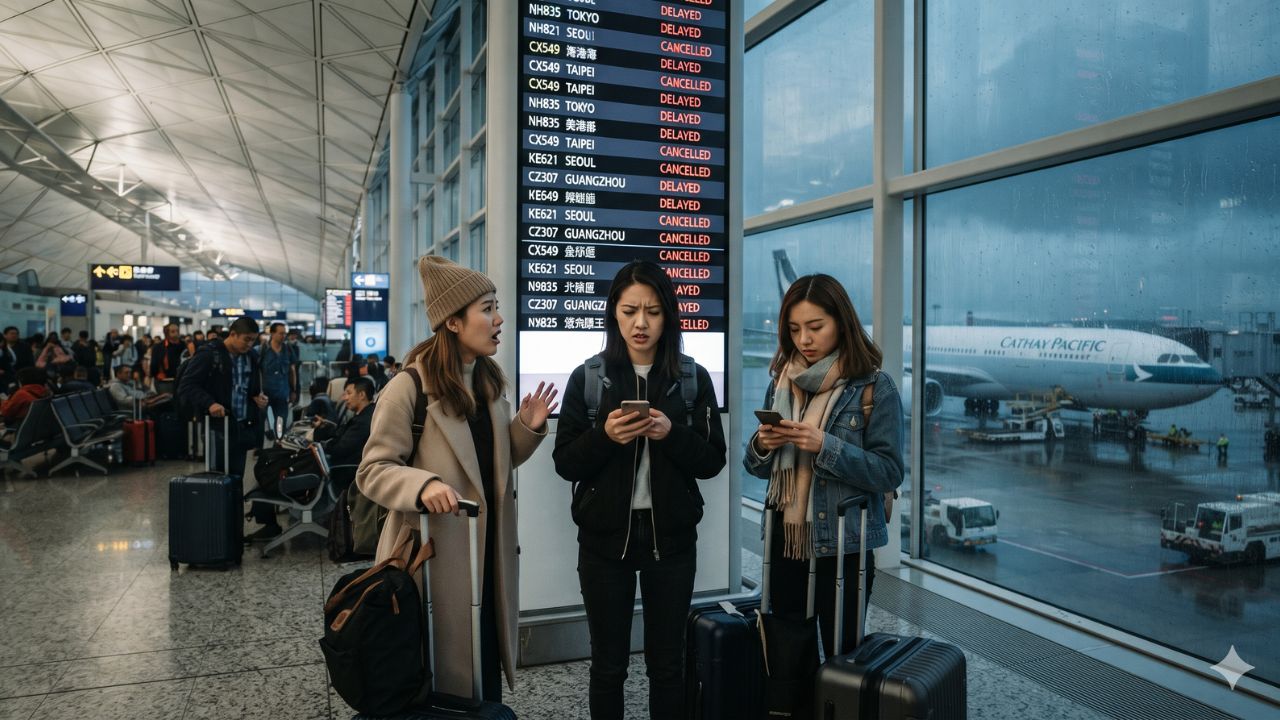
Even as Typhoon Champi's gale-force wind field churned across the East China Sea, its outer rainbands triggered a compounding crisis across Asian airspace, generating 1,090 flight cancellations and 4,878 delays that left tens of thousands of travelers stranded from Shanghai to the Ryukyu Islands. Aviation records captured on 23 October 2026 at 3:08 pm US Eastern Time (4:08 am Japan Standard Time on 24 October) reveal an interconnected schedule breakdown across China, Taiwan, and southwestern Japan. The maritime disruption was further compounded by distinct geopolitical tensions in the Middle East, where route suspensions following an attack at King Fahd International Airport in Dammam fractured long-haul itineraries connecting India, the United Arab Emirates, and Saudi Arabia.
From the coastal mega-terminals of Shanghai Pudong and Taiwan Taoyuan to the isolated coral runways of Ishigaki and Miyako, international airlines spent 23 and 24 October reworking flight schedules. With weather advisories issued by the Hong Kong Observatory and regional civil aviation bodies warning of torrential rainfall and crosswinds exceeding operational limits, carriers including China Eastern Airlines, EVA Air, and All Nippon Airways were forced to ground regional rotations and scramble aircraft parking stands to protect ground crews and passengers.
The Dual Anatomy of Asia's Airspace Disruption
The operational crisis unfolded along two distinct geographic fronts: the maritime path of Typhoon Champi and ongoing security reroutings in the Persian Gulf.
On the weather front, China Eastern Airlines issued an emergency operations alert on 23 October at 22:30, warning that Champi’s advancing storm bands would severely restrict flight movements on 24 October at Shanghai Pudong, Ningbo, Taizhou, Hefei, and Taipei. Meteorological bureaus across Shanghai forecast heavy precipitation and gale-force wind shears beginning Friday evening and continuing into Saturday, forcing air traffic control to reduce landing slots.
Across the Taiwan Strait, Taiwan was hit by extensive flight halts. International news reports confirmed hundreds of domestic and international flights were grounded on 23 October as Champi bore down on the island. China Airlines warned that flights serving Taiwanese airports through midday Saturday could be advanced, delayed, or canceled, while EVA Air announced cancellations across both Taoyuan and Taipei Songshan. Budget carrier AirAsia similarly confirmed schedule cuts into Taipei and Kaohsiung on 23 and 24 October, severing vital leisure links with Japan, Vietnam, Indonesia, and South Korea.
In Japan’s southern Nansei archipelago, the storm brought island aviation to a complete standstill. All Nippon Airways (ANA) grounded all flights into Miyako and Ishigaki on 23 October, carrying cancellations over into 24 October while warning of disruptions at Naha Airport in Okinawa. Japan Airlines (JAL) issued matching warnings for Okinawa, Miyako, Ishigaki, and Tokunoshima, leaving remote island communities physically cut off from the mainland.
Simultaneously, a separate crisis challenged westbound flights. Security fallout from the King Fahd International Airport attack in Dammam prompted airlines to suspend or curtail services connecting the Gulf with South Asia. Indian carrier IndiGo extended its flight cancellations to Riyadh through 31 October and suspended routes to Jeddah, Dammam, and Madinah until 27 October, generating long passenger queues and delays at major Indian transit hubs.
Hub-by-Hub Disruption: Cancellations and Delays Breakdown
Analyzing live flight data across Asian airports shows the heaviest concentration of cancellations centered on Shanghai and Taiwan, while high delays rippled across China's interior and Japan's primary gateways.
| Airport / Hub Facility | Recorded Cancellations | Recorded Flight Delays | Regional Context & Operational Drivers |
|---|---|---|---|
| Nationwide & Regional Asia Total | 1,090 cancellations | 4,878 delays | Captured live at 3:08 pm US ET (4:08 am JST) |
| Shanghai Pudong (PVG) | 150 cancellations | 317 delays | Highest cancellation total in Asia; coastal exposure |
| Shanghai Hongqiao (SHA) | 37 cancellations | 208 delays | Domestic trunk route bottlenecks |
| Ningbo Lishe (NGB) | 42 cancellations | 25 delays | Severe coastal weather in Zhejiang province |
| Taiwan Taoyuan (TPE) | 104 cancellations | 67 delays | Primary international island gateway grounded |
| Naha Airport, Okinawa (OKA) | 70 cancellations | 31 delays | Tropical storm-force gusts hitting island terminal |
| Hong Kong International (HKG) | 31 cancellations | 151 delays | Knock-on effects from canceled Taiwan corridors |
| Ishigaki Airport (ISG) | 23 cancellations | 0 delays | Total regional flight shutdown |
| Miyako Airport (MMY) | 22 cancellations | 0 delays | 100% schedule cancellation on remote island |
| Kaohsiung International (KHH) | 19 cancellations | 16 delays | Southern Taiwan coastal weather halts |
| Tokyo Haneda (HND) | 18 cancellations | 199 delays | Air traffic volume delays from weather reroutings |
| Taipei Songshan (TSA) | 17 cancellations | 3 delays | City-center airport international and island suspensions |
| Guangzhou Baiyun (CAN) | 14 cancellations | 187 delays | Flow-control holds on northward departures |
| Hangzhou Xiaoshan (HGH) | 14 cancellations | 108 delays | Rainbands slowing East China departure flows |
| Beijing Daxing (PKX) | 12 cancellations | 114 delays | Schedule adjustments on coastal feeder flights |
| Kansai International (KIX) | 11 cancellations | 57 delays | Offshore artificial island weather precautions |
| Beijing Capital (PEK) | 10 cancellations | 163 delays | Airspace flow restrictions connecting coastal routes |
| Tokyo Narita (NRT) | 10 cancellations | 99 delays | Transpacific and Asian connecting delays |
| Shenzhen Bao'an (SZX) | 6 cancellations | 170 delays | Ground holds and southern airspace congestion |
Airline Performance: Carriers Under Severe Operating Strain
The flight disruption data reveals striking differences in how individual carriers managed the storm:
- China Eastern Airlines: Bore the brunt of mainland disruption, logging 176 cancellations (7% of total scheduled operations) and 373 delays (15%).
- Spring Airlines & Regional Chinese Carriers: Budget operator Spring Airlines recorded 52 cancellations (8%) and 73 delays (12%), while Shanghai Airlines registered 14 cancellations (4%) and 71 delays (21%). China Express experienced five cancellations (1%) alongside an extraordinary 157 delays, representing 37% of its daily schedule. Air China logged 27 cancellations (1%) and 168 delays (9%), while China Southern recorded 16 cancellations and 277 delays (12%).
- Taiwanese Carriers: EVA Air canceled 33 flights, representing 13% of its schedule, while holding delays to 12 (4%). China Airlines recorded eight cancellations (3%) and 51 delays (24%).
- Japanese Island Airlines: Japan Transocean Air suffered the highest proportional cancellation rate in the region, grounding 30 flights—36% of its entire operation—with four delays (4%). Skymark logged 26 cancellations (12%) and 14 delays (6%). Major carriers Japan Airlines (13 cancellations, 107 delays) and ANA Wings (14 cancellations, 27 delays) also faced severe southern network disruption.
- South Asian and Southeast Asian Lines: In India, Akasa Air recorded 29 cancellations (11%) and 13 delays (5%), while SpiceJet logged 15 cancellations (15%) and 45 delays (46%). IndiGo posted three cancellations alongside a staggering 315 delays (14%). Vietnam Airlines recorded five cancellations and 112 delays (28%), Cathay Pacific registered 16 cancellations (3%) and 64 delays (15%), and Korean Air logged three cancellations and 114 delays (27%).
What Makes These East Asian Transit Corridors Vulnerable
East Asian aviation relies on some of the densest air corridors in the world. The airspace connecting Tokyo, Seoul, Shanghai, Taipei, and Hong Kong operates near maximum capacity daily. When an autumn typhoon tracks north through the Taiwan Strait and into the East China Sea, it acts as an immovable atmospheric barricade.
Unlike continental airspaces where flights can deviate hundreds of miles inland, commercial flights between Taiwan, the Ryukyu Islands, and mainland China are hemmed in by restricted military flight zones and strict oceanic control sectors. When wind shear thresholds are breached at Shanghai Pudong or Taoyuan, diversion airports like Hangzhou, Ningbo, and Hong Kong rapidly run out of gate capacity. Aircraft that divert quickly consume apron parking, leaving long-haul flights from Europe and North America circling in holding patterns before being forced to return to their origin.
Visitor Insider Tips
When extreme weather paralyzes East Asian travel corridors, local transit knowledge provides vital protection:
- Pivot to High-Speed Rail Networks Promptly: If your domestic flight across eastern China (such as Shanghai to Hangzhou, Nanjing, or Beijing) is delayed or canceled, do not wait at Pudong or Hongqiao. High-speed bullet trains (Gaotie) operate on dedicated ballast rail beds designed to withstand heavy rainfall and operate normally during weather that grounds aircraft. Secure tickets directly through the official China Railway 12306 portal. Similarly, travelers stranded in Taipei can take the Taiwan High Speed Rail south to Kaohsiung in under two hours.
- Monitor Airline Severe Weather Waivers: During major typhoons, carriers including China Eastern, EVA Air, JAL, and ANA issue special ticketing policies permitting free date changes, route alterations, or full refunds without cancellation penalties. Check the airline's official Chinese or Japanese language customer notices, which frequently update hours before English-language alerts appear.
- Secure Airport Transit Hotels Immediately: When cancellations hit Shanghai Pudong or Taipei Taoyuan, nearby terminal hotels book out within 30 minutes. If your flight is canceled after 16:00, use local booking mini-programs to reserve accommodations inside the airport perimeter before joining the rebooking line.
- Account for Island Supply and Ferry Halts: If traveling in Okinawa, Ishigaki, or Miyako, remember that maritime ferry services halt hours before airports close. Ensure you maintain adequate cash reserves, prescription medications, and verified hotel reservations, as island accommodations often become storm shelters for several days.
Cultural and Environmental Context
Autumn typhoons in the western Pacific are natural ecological events that local communities have adapted to for millennia. In the Ryukyu archipelago of Japan, traditional stone-walled houses and low-slung red-tile roofs were specifically engineered to survive typhoon-strength gales. On mainland China's coastal deltas, extensive mangrove restoration projects and seawall barrier networks protect low-lying agricultural plains against storm surges.
However, modern mass aviation exposes the vulnerability of hyper-connected global economies. When island tourism stops, the economic ripple is felt immediately by family-owned guesthouses, fishing cooperatives, and local dive shops. By understanding regional storm seasons and showing patience with airline gate staff and airport ground crews, travelers honor the resilience of East Asian communities who have lived alongside the seasonal rhythms of the Pacific for centuries.
FAQ: Asia Typhoon Champi Flight Disruptions October 2026
What caused the widespread flight disruptions across Asia on 23-24 October 2026?
Disruptions were driven primarily by gale-force winds and torrential rains from Typhoon Champi affecting Shanghai, Taiwan, and Okinawa, alongside Middle East flight suspensions following security incidents in Dammam.
Which airport recorded the highest number of cancellations?
Shanghai Pudong International Airport recorded the highest total with 150 cancellations and 317 delays, followed by Taiwan Taoyuan with 104 cancellations and 67 delays.
Are airlines offering free rebooking for Typhoon Champi?
Yes. Major regional airlines, including China Eastern, EVA Air, China Airlines, ANA, and JAL, have introduced severe weather ticketing waivers allowing free rebooking or refunds on affected routes.
How can travelers travel between Shanghai and nearby cities when flights are grounded?
China's high-speed rail network connects Shanghai Hongqiao to cities across eastern China with frequent departures that continue running safely through rain and wind conditions that halt air traffic.
When the western Pacific unleashes its autumn storms, the wise traveler yields to the wind and finds wonder in the resilience of those who call these coasts home.
Related Travel Guides
- SWISS Opens Summer 2027 Gateway to Toulouse: Direct Flights to France's Aerospace Capital and Pyrenean Trails
- Cascading Airspace Delays Grip US Hubs: Chicago, Austin, and San Francisco Hit by 3,287 Flight Disruptions
- New US Air Travel Mandate Enforces 21-Day Health Declaration for All Inbound Flights Starting November 3
- Beyond the Departure Desk: How Travelers Can Safely Experience China Under the 2026 US Advisory
Disclaimer
This article is for informational and educational purposes only. It does not constitute legal, financial, or professional advice. While we strive to provide accurate and up-to-date information, travel policies, regulations, and conditions change rapidly. Always verify information with official sources before making travel decisions. Nomad Lawyer makes no representations about the accuracy, reliability, completeness, or suitability of the information provided. Readers should consult qualified professionals for advice specific to their circumstances. The views expressed in this article are those of the author and do not necessarily reflect the views of Nomad Lawyer.
Raushan Kumar
Founder & Lead Developer
Full-stack developer with 11+ years of experience and a passionate traveller. Raushan built Nomad Lawyer from the ground up with a vision to create the best travel and law experience on the web.
Learn more about our team →