
Tokyo Haneda Airport Terminal 2 Expands Capacity with New Connected Gates in 2026
Tokyo Haneda Airport has upgraded Terminal 2 with a new enclosed connection to the north satellite, significantly reducing bus transfers and increasing gate flexibility for domestic and international flights.

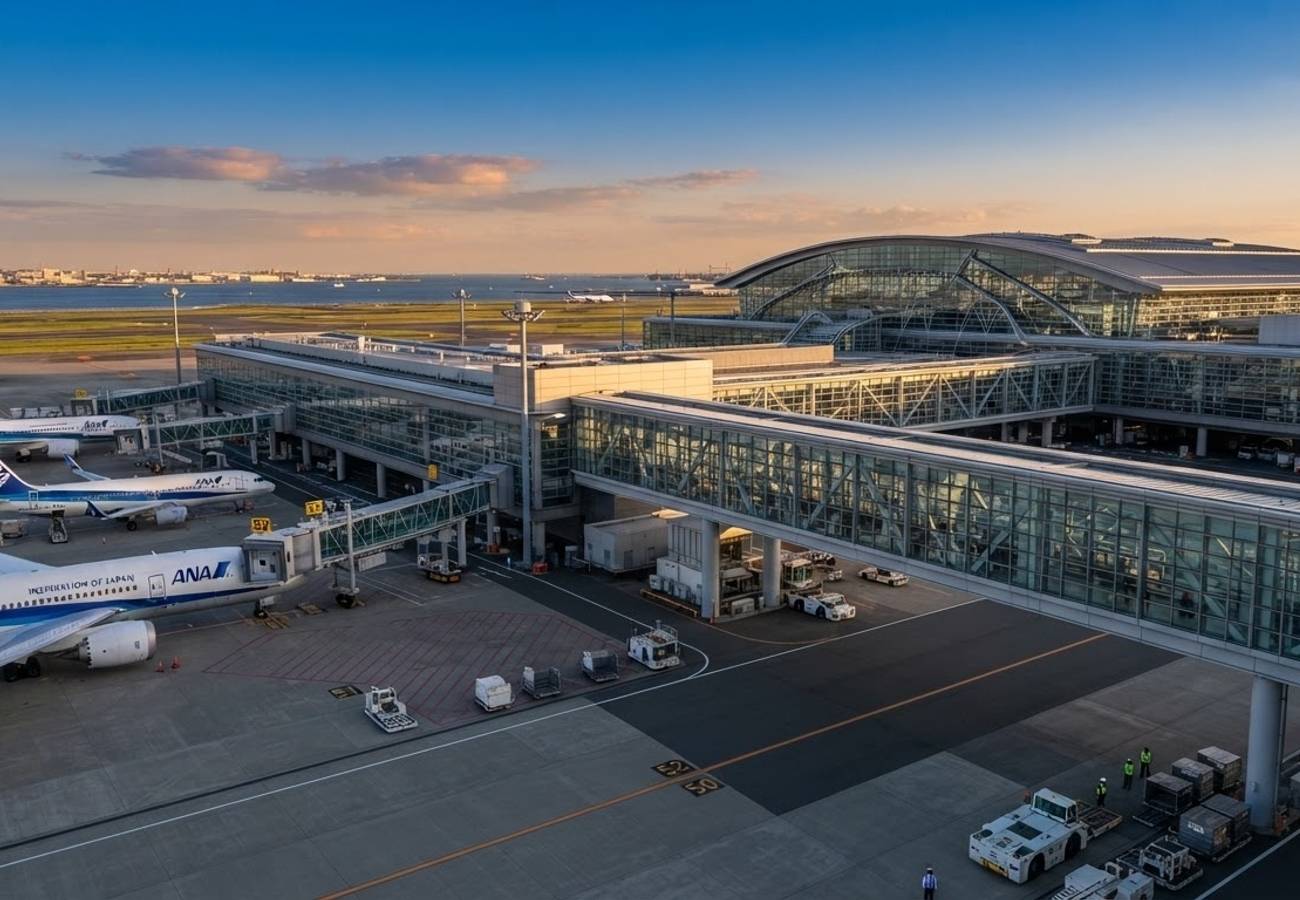
Image generated by AI
Haneda Airport has effectively eliminated a major passenger bottleneck by replacing tedious bus transfers with a fully enclosed walkway to its Terminal 2 north satellite. This infrastructure shift is projected to halve the reliance on bus boarding for domestic departures.
The expansion represents a strategic move by Japan Airport Terminal Co. to scale capacity without the need for immediate runway construction. By optimizing how aircraft are parked and how passengers move, Haneda is positioning itself to handle a surge in both domestic and international tourism.
Streamlining the Passenger Journey at Terminal 2
The core of the upgrade is a new connecting structure that bridges the main Terminal 2 building and the north satellite. Previously, passengers on many domestic routes were required to board buses to reach their aircraft at remote stands. The new facility, which became operational in early 2025, allows travelers to move from check-in to boarding entirely indoors.
This transition is not merely about comfort; it is a calculated operational shift. The project introduces three fixed boarding bridges, designated as Gates 50, 51, and 52. To maximize efficiency, two of these are configured as multi-spot stands. This design allows the airport to serve two smaller aircraft simultaneously at a single gate, bringing the total usable spots in this specific zone to five.
The impact on daily operations is substantial. Data indicates a sharp decline in the necessity of remote boarding:
- Previous Bus Boarding Rate: Approximately 40% of daily departures and arrivals.
- Projected Bus Boarding Rate: Approximately 20% of daily departures and arrivals.
By reducing the reliance on busing, Haneda minimizes the risk of last-minute gate changes and reduces congestion during the high-traffic morning and evening banks.
Operational Gains for All Nippon Airways and Partners
As the primary user of Terminal 2, All Nippon Airways (ANA) is the chief beneficiary of these improvements. The added gate positions and improved passenger circulation have allowed the carrier to refine its flight schedules and increase the volume of international departures operating out of the terminal.
From a ground-handling perspective, the shift to contact gates creates more predictable turnaround patterns. Ground crews are no longer as dependent on vehicle dispatch timings or the congestion associated with ramp busing, which directly contributes to better on-time performance.
Parallel Expansion: The Terminal 1 Satellite Project
While Terminal 2 is now seeing the benefits of its new connection, Terminal 1—the primary hub for Japan Airlines (JAL)—is undergoing a similar evolution. Construction began in May 2024 on a new north satellite facility.
This upcoming addition is distinct in its architectural approach, utilizing a hybrid timber and steel structure. Scheduled to open around the summer of 2026, the Terminal 1 satellite will provide six additional aircraft spots.
Beyond adding capacity, this project serves as a "showcase" for future terminal design, incorporating:
- Enhanced natural lighting and energy-efficient systems.
- Sustainable building materials to align with the "World Best Airport" vision.
- Upgraded retail and passenger waiting zones.
Long-Term Strategy and Regional Connectivity
The current gate expansions are part of a broader master plan to maximize Haneda's existing airfield footprint. Rather than focusing solely on runway expansion, the airport is prioritizing "throughput"—the speed and efficiency with which passengers and aircraft move through the system.
This airside efficiency is being paired with massive landside investments. The most significant upcoming project is the JR East Haneda Airport Access Line. Planned for completion in the early 2030s, this rail link will connect Terminals 1 and 2 directly to central Tokyo, reducing the pressure on existing monorail and private rail corridors.
Haneda Infrastructure Evolution Summary
| Feature | Terminal 2 Upgrade | Terminal 1 Satellite (Upcoming) |
|---|---|---|
| Primary Goal | Reduce bus transfers / Increase flow | Add contact spots / Sustainable design |
| Key Addition | Gates 50-52 (incl. multi-spot) | 6 new aircraft spots |
| Status | Operational (Completed early 2025) | Targeted for Summer 2026 |
| Impact | Bus boarding dropped from 40% to 20% | Increased JAL/Partner capacity |
| Design Focus | Enclosed connectivity | Hybrid timber and steel |
Key Takeaways
- Reduced Friction: The new Terminal 2 connection slashes bus boarding reliance by half, improving the passenger experience and on-time performance.
- Flexible Capacity: Multi-spot gates (50-52) allow Haneda to pivot between serving one large aircraft or two smaller jets based on real-time demand.
- Sustainable Growth: The upcoming Terminal 1 satellite (2026) emphasizes eco-friendly construction and hybrid materials.
- Future-Proofing: The combination of new gates and the future JR East Access Line ensures Haneda can scale with rising tourism without requiring immediate new runways.
Frequently Asked Questions
Will the new gates at Terminal 2 affect international flights? Yes. While the connection significantly aids domestic flow, the increased gate flexibility has allowed airlines like ANA to expand international departures from Terminal 2.
When will the Terminal 1 expansion be open to passengers? The north satellite facility at Terminal 1 is currently targeted for opening around the summer of 2026.
How does the "multi-spot" gate system work? Multi-spot stands are designed with flexible boarding areas that can accommodate two smaller narrow-body aircraft at once, effectively doubling the capacity of a single gate position during peak periods.
Haneda's shift toward contact-gate dominance signals a new era of efficiency for Japan's primary gateway.
Related Travel Guides
Disclaimer
This article is for informational and educational purposes only. It does not constitute legal, financial, or professional advice. While we strive to provide accurate and up-to-date information, travel policies, regulations, and conditions change rapidly. Always verify information with official sources before making travel decisions. Nomad Lawyer makes no representations about the accuracy, reliability, completeness, or suitability of the information provided. Readers should consult qualified professionals for advice specific to their circumstances. The views expressed in this article are those of the author and do not necessarily reflect the views of Nomad Lawyer.
Raushan Kumar
Founder & Lead Developer
Full-stack developer with 11+ years of experience and a passionate traveller. Raushan built Nomad Lawyer from the ground up with a vision to create the best travel and law experience on the web.
Learn more about our team →