Spain Nationwide Rail Strike Disrupts AVE, Cercanías, and Rodalies Services as Renfe Cancels 24% of High-Speed Trains

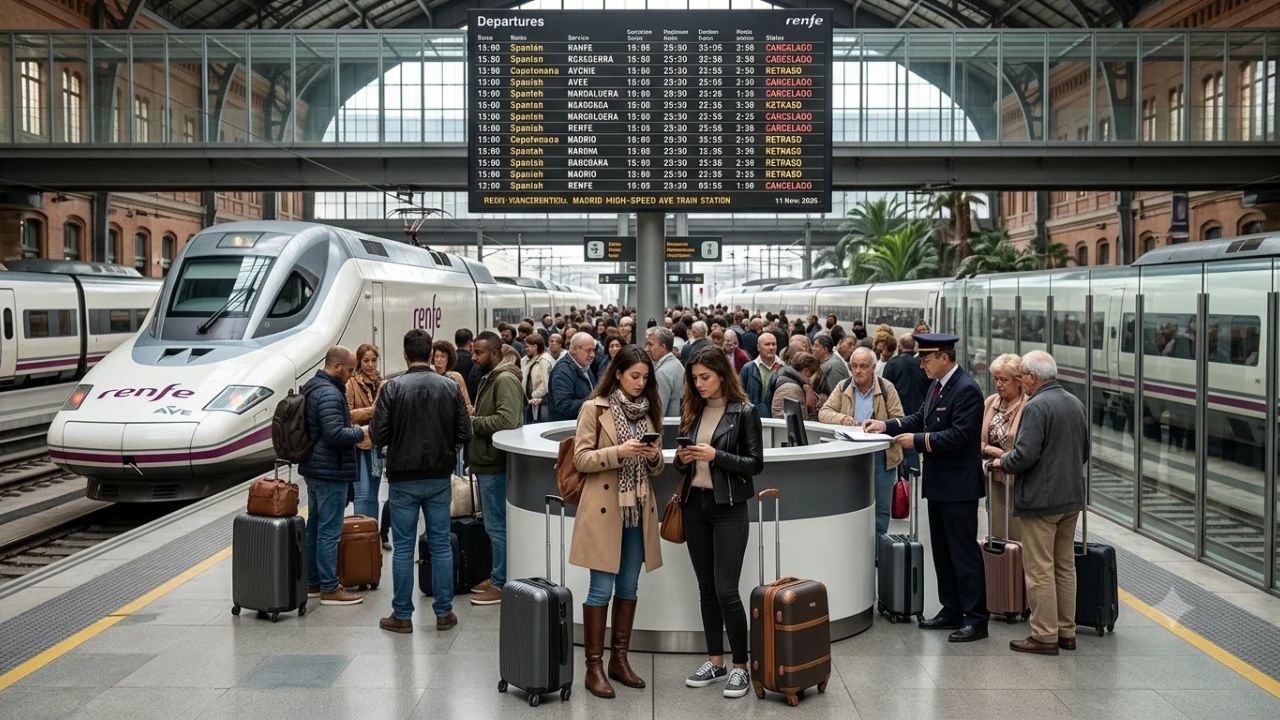
MADRID, Spain — Nationwide railway industrial action disrupted travel across Spain on Wednesday, November 11, 2026, forcing the cancellation of nearly 24% of commercial high-speed train services and triggering widespread delays across Madrid’s Cercanías, Barcelona’s Rodalies, and regional rail corridors.
The 24-hour walkout, coordinated by major transport labour unions following formal decrees published in the Official State Gazette (Boletín Oficial del Estado, BOE), disrupted operations across the national rail network. State rail operator Renfe reported cancellations across its flagship AVE, Avlo, Alvia, Euromed, and Intercity routes, while private high-speed competitors Ouigo and Iryo similarly adjusted schedules to comply with government-mandated minimum service requirements (servicios mínimos). Daily commuters, business travelers, and international tourists experienced extended wait times, platform overcrowding, and intermodal transport bottlenecks connecting major metropolitan centers with coastal holiday destinations and international airport terminals.
          SPAIN NATIONAL RAILWAY STRIKE OPERATIONAL NETWORK

     [ NORTH / NORTHWEST CORRIDORS ]
     Galicia • Asturias • Cantabria • Basque Country
                          \
                           \ (Alvia & Media Distancia Reductions)
                            v
               [ MADRID CENTRAL RAILWAY AXIS ]
    • Puerta de Atocha-Almudena Grandes & Chamartín-Clara Campoamor
    • Cercanías Madrid: 75% Peak / 50% Off-Peak Minimum Service
    • 24% Commercial High-Speed Departures Cancelled
                          /  |  \
                         /   |   \
   +--------------------+    |    +--------------------+
   |                         |                         |
   v                         v                         v
[ NORTHEAST CORRIDOR ]  [ MEDITERRANEAN AXIS ]   [ SOUTHERN ANDALUSIA ]
• Barcelona Sants       • Valencia Joaquín       • Seville Santa Justa
• Rodalies: 22.5% cut     Sorolla & Nord         • Málaga María Zambrano
• Girona & Figueres     • Alicante & Murcia      • Córdoba & Granada
The Legal and Regulatory Framework: Official State Gazette Decrees
Under Spanish constitutional law, the right to strike is balanced against the fundamental public necessity for essential mobility. In response to the strike notice called across the railway sector, the Ministry of Transport and Sustainable Mobility (Ministerio de Transportes y Movilidad Sostenible) issued a formal regulatory order published in the Official State Gazette (Decree BOE-A-2026-23371).
The ministerial decree established mandatory minimum operating percentages designed to guarantee basic connectivity while recognizing workers' legal right to withdraw labor. These thresholds imposed legally binding operational quotas across all train operating companies using the infrastructure managed by Adif (Administrador de Infraestructuras Ferroviarias):
- Commercial High-Speed and Long-Distance Rail: A minimum operating guarantee of 73% of scheduled timetables, ensuring that primary intercity links between autonomous communities retained core transport capacity.
- Commuter Services (Cercanías and Rodalies): A tiered requirement mandating 75% operational frequency during designated morning and evening rush hours (06:00–09:00, 14:00–16:00, and 18:30–20:30), dropping to 50% during off-peak daytime and late-night windows.
- Medium-Distance Regional Rail (Media Distancia): A 65% operational floor intended to prevent rural provincial capitals from becoming completely isolated.
- High-Speed Regional Shuttles (Avant): Designated under public service obligations (OSP), operating at 65% minimum frequency.
- Rail Freight Transport (Mercancías): A restrictive 26% minimum service threshold, prioritized almost exclusively for dangerous industrial goods, essential food supply chains, and perishable agricultural consignments.
While these regulatory minimums established a theoretical baseline, operational realities diverged on the ground. Staff absenteeism, picketing at depot exits, rolling stock turnaround delays, and dispatch bottlenecks resulted in higher effective cancellation rates across specific high-density corridors.
| Railway Service Category | Mandated Minimum Service (BOE Decree) | Actual Operating Reality (Nov 11) | Primary Travel Impact |
|---|---|---|---|
| AVE & Long-Distance Commercial | 73% of regular timetable | ~24% of scheduled trains cancelled | Seat shortages on Madrid–Barcelona, Valencia, and Seville |
| Cercanías Madrid (Peak Hours) | 75% frequency (06:00–09:00 / 18:30–20:30) | Severe platform crowding, 15–30m delays | Suburban commuters forced onto metro and road buses |
| Cercanías Madrid (Off-Peak) | 50% frequency | Irregular headways, cancelled branch lines | Long mid-day platform waits across Chamartín and Atocha |
| Rodalies de Catalunya | Standard commuter minimum decree | 22.5% of regional departures cancelled | Significant disruption across Barcelona commuter belt |
| Media Distancia (Regional) | 65% of regular timetable | Selective line cancellations | Rural connections in Castile, Andalusia, and Galicia cut |
| Avant High-Speed Regional | 65% of regular timetable | Reduced commuter shuttle frequencies | Toledo–Madrid and Valladolid–Madrid capacity reduced |
| Freight Rail (Mercancías) | 26% of regular timetable | Heavy industrial freight halted | Industrial supply chain delays at major sea ports |
High-Speed Rail Corridors Under Pressure: Impact on AVE, Avlo, Ouigo, and Iryo
Spain boasts Europe’s most extensive high-speed rail network, covering over 4,000 kilometres of dedicated standard-gauge track. Over the past four years, the liberalization of the passenger rail market has introduced intense private competition, with France’s SNCF subsidiary Ouigo and Italian-backed Iryo challenging Renfe’s legacy AVE and low-cost Avlo brands.
During the November 11 industrial action, the entire high-speed ecosystem felt the strain:
          HIGH-SPEED ARTERIAL CAPACITY ON NOVEMBER 11, 2026

  [ MADRID <================ 76% OPERATING ================> BARCELONA ]
  • Normal Daily Frequency: ~54 Departures Each Way (AVE, Avlo, Iryo, Ouigo)
  • Cancelled Trains: ~13 Departures (Reduced Mid-Day & Evening Runs)
  • Impact: Heavy Peak Passenger Consolidation; Sold-Out Evening Trains

  [ MADRID <================ 74% OPERATING ================> VALENCIA ]
  • Normal Daily Frequency: ~32 Departures Each Way
  • Cancelled Trains: ~8 Departures Across Renfe & Ouigo
  • Impact: Coastal Business Travelers Rerouted to Morning Services

  [ MADRID <================ 72% OPERATING ================> SEVILLE / MÁLAGA ]
  • Normal Daily Frequency: ~38 Departures Each Way
  • Cancelled Trains: ~10 Departures Across AVE & Iryo
  • Impact: Tourist Travel Bottlenecks in Andalusia
1. The Madrid–Barcelona Corridor
As Spain's busiest commercial artery, linking Madrid Puerta de Atocha with Barcelona Sants, the corridor normally sees departures every 15 to 30 minutes during peak hours. On November 11, rail operators cancelled approximately 13 round-trip departures. While 76% of services operated under minimum requirements, the loss of nearly a quarter of daily capacity led to fully booked replacement departures, preventing walk-up bookings and stranding business travelers.
2. The Eastern Mediterranean Axis: Madrid to Valencia and Alicante
Connecting the capital with the Valencian Community and the Costa Blanca, this corridor experienced substantial cancellations across both Renfe and Ouigo. Ouigo formally notified passengers of selective cancellations on its double-decker Euroduplex trainsets between Madrid Chamartín and Valencia Joaquín Sorolla, requiring travelers to rebook onto earlier morning or later evening departures.
3. The Southern Andalusian Artery: Seville, Málaga, and Córdoba
High-speed links to southern Spain experienced notable reductions, affecting AVE and Iryo connections serving Seville Santa Justa, Málaga María Zambrano, Córdoba Central, and Granada. With Andalusia serving as a primary cultural tourism draw, international leisure travelers faced disrupted itineraries, missed hotel check-ins, and tight connections to regional tour groups.
4. Northwestern Cross-Country Services: Galicia, Asturias, and Basque Country
Long-distance Alvia services—which use variable-gauge wheelsets to transition from high-speed lines onto conventional Iberian-gauge tracks—suffered significant cancellations. Travel times into Galicia (Ourense, Santiago de Compostela, A Coruña) and Asturias (Oviedo, Gijón) were severely impacted, as fewer daily frequencies left stranded passengers with limited same-day alternatives.
| High-Speed Corridor | Key Hub Stations | Operating Operators | Estimated Cancelled Services |
|---|---|---|---|
| Madrid – Barcelona | Atocha, Zaragoza Delicias, Camp de Tarragona, Sants | Renfe (AVE/Avlo), Iryo, Ouigo | ~12 to 14 departures cancelled |
| Madrid – Valencia / Alicante | Chamartín, Cuenca Fernando Zóbel, Joaquín Sorolla | Renfe (AVE/Avlo), Iryo, Ouigo | ~7 to 9 departures cancelled |
| Madrid – Seville / Málaga | Atocha, Ciudad Real, Puertollano, Córdoba, Santa Justa | Renfe (AVE/Avlo), Iryo | ~9 to 11 departures cancelled |
| Madrid – Galicia / Asturias | Chamartín, Zamora, Ourense, Santiago, Oviedo | Renfe (Alvia / Intercity) | ~5 to 7 departures cancelled |
| Mediterranean Corridor | Barcelona Sants, Tarragona, Castellón, Valencia Nord | Renfe (Euromed / Intercity) | ~4 to 6 departures cancelled |
Commuter Networks: Metropolitan Strain in Madrid and Barcelona
While long-distance intercity travelers could adjust their schedules with advance notice, daily metropolitan commuters bore the brunt of the strike’s operational disruptions. Spain's two largest urban rail systems—Cercanías Madrid and Rodalies de Catalunya—faced heavy crowding, delayed headways, and bottlenecked interchanges.
Madrid Cercanías: The Capital’s Transit Gridlock
In the Community of Madrid, the Cercanías suburban rail network normally transports over 900,000 passengers daily across ten lines. Despite the mandated 75% peak-hour minimum service, the system experienced acute congestion:
- Major Interchanges Bottlenecked: Key central transit nodes—including Atocha, Chamartín, Nuevos Ministerios, and Méndez Álvaro—saw platforms overflow with commuters waiting for delayed services.
- Branch Line Cuts: High-frequency trunk lines through the central rail tunnels (Túneles de la Risa) operated with irregular 15- to 20-minute headways instead of standard 4- to 6-minute frequencies. Peripheral branch lines serving suburban communities in Fuenlabrada, Parla, and Alcalá de Henares saw off-peak service fall to 50%, forcing thousands of commuters into regional interurban buses (autobuses interurbanos) and the Madrid Metro network.
       CERCANÍAS MADRID VS RODALIES CATALUNYA CANCELLATIONS
 +-------------------------------------------------------------+
 | CERCANÍAS MADRID COMMUTER SYSTEM                            |
 | Peak Minimum: 75% | Off-Peak Minimum: 50%                   |
 | High Congestion: Lines C-2, C-3, C-4, C-5                   |
 | Result: 15–30 Minute Delays, Station Platform Metering      |
 +------------------------------+------------------------------+
                                |
                                v
 +-------------------------------------------------------------+
 | RODALIES DE CATALUNYA (BARCELONA COMMUTER NETWORK)          |
 | Overall Cancellations: ~22.5% of Scheduled Services         |
 | Severe Disruptions: Lines R1 (Coast), R2 Nord, R4 (Interior)|
 | Result: Metropolitan Highway Gridlock on AP-7 and C-31      |
 +-------------------------------------------------------------+
Rodalies de Catalunya: Regional Interruption Across Catalonia
In Catalonia, the Rodalies commuter rail network, operated by Renfe under the administrative authority of the Generalitat de Catalunya, reported that roughly 22.5% of scheduled daily trains were cancelled. The industrial action exacerbated long-standing passenger frustrations regarding network reliability:
- Coastal and Inland Corridors Disrupted: Line R1 along the Maresme coast and Line R4 through Terrassa and Manresa operated with reduced timetables, stranding commuters and forcing heavy traffic onto the C-31, C-32, and AP-7 motorways.
- Information Gaps: Automated station displays and public address systems struggled to provide real-time cancellation notices, leading to confusion at major Barcelona terminals such as Sants, Plaça de Catalunya, and Passeig de Gràcia.
Airport Intermodal Connections: Transit Pressure on Madrid-Barajas and Barcelona-El Prat
The railway strike created immediate complications for international travelers connecting between central railway stations and international airport hubs.
              AIRPORT RAIL CONNECTIONS DURING THE STRIKE

  [ MADRID-BARAJAS AIRPORT (MAD) - TERMINAL T4 ]
  • Normal Rail Access: Cercanías Lines C-1 and C-10
  • Strike Impact: Reduced 30-Minute Headways, Platform Delays
  • Viable Alternatives: Metro Line 8 (Nuevos Ministerios), Exprés Aeropuerto Bus 203

  [ BARCELONA-EL PRAT AIRPORT (BCN) - TERMINAL T2 ]
  • Normal Rail Access: Rodalies Line R2 Nord from Sants / Passeig de Gràcia
  • Strike Impact: 22.5% Cancellation Rate, Overcrowded Carriages
  • Viable Alternatives: Metro Line L9 Sud, Aerobús A1/A2 from Plaça de Catalunya
1. Madrid-Barajas Airport (MAD)
Madrid’s airport rail connection links Chamartín and Atocha directly to Terminal 4 via Cercanías lines C-1 and C-10. During the strike, reduced frequencies and cancellations caused passengers with heavy luggage to experience extended waits on platforms. Many travelers abandoned the suburban train in favor of Madrid Metro Line 8 (departing from Nuevos Ministerios) or the 24-hour municipal express bus (Línea Exprés Aeropuerto 203), resulting in heavy vehicle queues at terminal drop-off points.
2. Barcelona-El Prat Airport (BCN)
In Barcelona, Rodalies line R2 Nord provides direct rail connections between Terminal 2 and central stations including Sants and Passeig de Gràcia. Because R2 Nord was subject to the 22.5% regional cancellation schedule, international tourists faced missed train connections, forcing a surge toward the Aerobús shuttle service departing from Plaça de Catalunya and Plaça d'Espanya, as well as municipal taxis.
Passenger Rights, Ticket Flexibility, and European Protections
To mitigate passenger hardship, Renfe implemented extraordinary commercial measures for all customers holding tickets on services affected by the November 11 industrial action:
       RENFE PASSENGER PROTECTION POLICIES (STRIKE ACTIONS)
 +-------------------------------------------------------------------+
 | 1. 100% FREE CANCELLATIONS: Full refund issued via original payment|
 | 2. NO-FEE REBOOKING: Change departure date/time without penalty   |
 | 3. ALTERNATIVE OPERATING TRAIN: Re-seat on nearest available train |
 | 4. SMS & EMAIL NOTIFICATIONS: Automated alerts for cancelled runs |
 | 5. EU REGULATION 2021/782: Mandatory duty of care & rerouting     |
 +-------------------------------------------------------------------+
Under Renfe’s operational guidelines:
- Free Ticket Cancellations and Refunds: Passengers whose trains were cancelled were entitled to claim a 100% refund of their ticket price without cancellation fees, processed automatically through digital purchase channels, ticket counters, or travel agencies.
- Penalty-Free Date and Time Changes: Customers holding tickets for affected departures were permitted to change their booking to any alternative service operating before or after the strike window at no additional cost, subject to seat availability.
- Duty of Care and Rerouting: Under European Union Regulation (EU) 2021/782 on rail passengers' rights and obligations, operators are legally obligated to provide passengers whose journeys face delays of over 60 minutes with complimentary refreshments, hotel accommodation if an overnight stay becomes necessary, and alternative transportation to their final destination at the earliest opportunity.
Private operators Ouigo and Iryo provided comparable commercial accommodations, allowing passengers whose trains were cancelled under the minimum-service quotas to request full refunds or select alternate travel dates through their respective mobile applications.
Strategic Advice for Navigating Spanish Rail Strikes
Industrial actions remain a recurring feature of European transport networks. For business travelers, tour operators, and independent tourists, proactive itinerary management is essential to minimize disruption during nationwide strike actions:
       PRACTICAL TRAVELER CHECKLIST FOR SPANISH RAIL STRIKES
 +-------------------------------------------------------------------+
 | [ ] Check Renfe / Ouigo / Iryo mobile apps for specific train status|
 | [ ] Download the BOE minimum services list to verify active routes|
 | [ ] Switch to Metro or dedicated airport bus shuttles for flights |
 | [ ] Book high-speed departures 48 hours outside strike windows    |
 | [ ] Allow a minimum 90-minute buffer for intermodal connections   |
 +-------------------------------------------------------------------+
- Verify Individual Train Numbers, Not Just Generic Schedules: Minimum-service decrees indicate percentage floors across broad categories, but they do not confirm whether an individual departure is operating. Travelers must input their specific train number (número de tren) into the Renfe, Iryo, or Ouigo app to confirm its real-time operating clearance.
- Utilize Underground Metro Systems: During suburban rail strikes, municipal metro systems—such as Metro de Madrid and Transports Metropolitans de Barcelona (TMB)—are generally not covered by the railway strike and operate regular, high-frequency services across urban centers.
- Use Intercity Coach Networks: Spain possesses an extensive, comfortable intercity coach network operated by private carriers such as ALSA, Avanza, and Socibus. Long-distance express buses offer dependable backup routing between Madrid, Bilbao, Valencia, Seville, and Granada when high-speed rail lines face severe capacity constraints.
- Account for Post-Strike Recovery Delays: Rail strikes rarely end instantaneously at midnight. On the morning following a 24-hour strike (November 12), trainsets and operating crews are frequently displaced outside their normal home depots. Travelers should anticipate residual morning delays, rolling stock swaps, and rolling recovery schedules.
Frequently Asked Questions
When did the Spanish railway strike take place, and which operators were involved?
The nationwide railway strike took place on Wednesday, November 11, 2026, lasting for a full 24-hour cycle. The industrial action primarily impacted state rail operator Renfe—including its high-speed AVE and Avlo services, long-distance Alvia and Euromed trains, Media Distancia regional services, and Cercanías commuter networks. Private open-access high-speed operators Ouigo and Iryo also adjusted their schedules to comply with government-mandated minimum service quotas.
Were all trains cancelled in Spain on November 11?
No. Under Spanish constitutional law and Ministry of Transport decrees published in the Official State Gazette (BOE-A-2026-23371), mandatory minimum operating services (servicios mínimos) were enforced. Approximately 76% of commercial high-speed trains operated, while commuter networks maintained a minimum of 75% during peak hours and 50% off-peak. However, roughly 24% of commercial high-speed trains and 22.5% of Barcelona Rodalies services were cancelled, causing significant congestion and localized delays.
Can passengers get a refund or change their tickets if their train was cancelled?
Yes. Renfe, Ouigo, and Iryo introduced flexible commercial measures allowing affected passengers to change their tickets to an alternative departure or cancel their booking for a 100% full refund without fees or penalty deductions. Passengers whose services were delayed by more than 60 minutes or cancelled are protected under European Union Rail Passenger Rights Regulation (EU) 2021/782, which mandates duty of care, re-routing, and compensation where applicable.
How did the strike impact airport transfers in Madrid and Barcelona?
The strike affected suburban rail lines connecting central stations to airport terminals—specifically Cercanías lines C-1 and C-10 to Madrid-Barajas Airport (Terminal 4) and Rodalies line R2 Nord to Barcelona-El Prat Airport (Terminal 2). Travelers were advised to budget substantial extra travel time or use alternative transit options, such as Metro Line 8 or the 24-hour Exprés Aeropuerto bus in Madrid, or the Aerobús and Metro Line L9 Sud in Barcelona.
Related Travel Guides
- Norway Gjøvik Railway Suspends Train Services Between Roa and Gjøvik Following Signalling Communication Fault as Vy Deploys Buses
- Newcastle Coordinates Hunter Valley Rail Possession Around Robbie Williams Concert to Protect Australia Event Tourism Economy
- Taiwan Breaks Ground on NT$6.04 Billion Banxin Station Metro Development as Asia Accelerates Transit-Oriented Rail Hubs
- Albania Euro Exchange Rate Plummets 35% Against Lek Since 2016 as Tourism Inflows and Property Boom Reshape Travel Costs
This article is for informational purposes. Flight routes, passenger regulations, visa rules, and transit advisories are subject to change by airlines and aviation authorities. Readers are advised to verify schedules and travel documentation with relevant carriers and border agencies before departure.
Related Stories

VIA Rail Canada Updates Guide Dog and Service Animal Documentation Rules with 48-Hour Verification and 5-Year Approval Validity
Norway Gjøvik Railway Suspends Train Services Between Roa and Gjøvik Following Signalling Communication Fault as Vy Deploys Buses