VIA Rail Canada Updates Guide Dog and Service Animal Documentation Rules with 48-Hour Verification and 5-Year Approval Validity

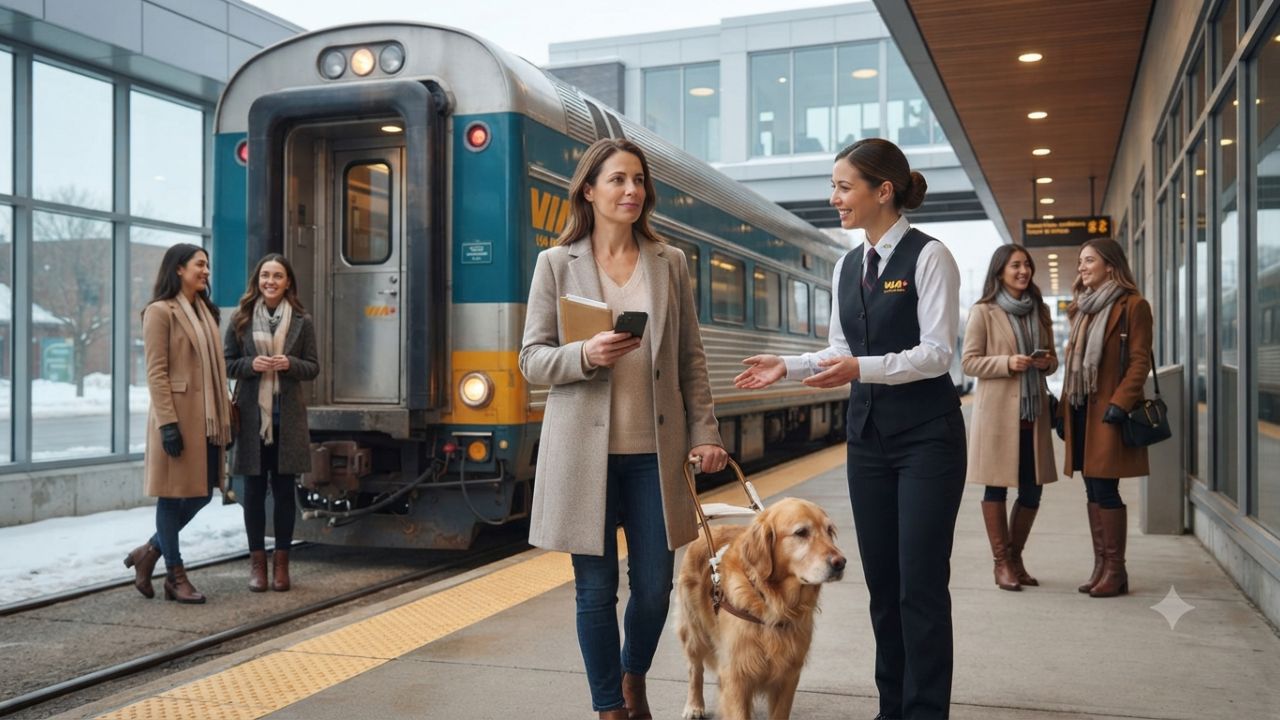
OTTAWA, Canada — National passenger rail operator VIA Rail Canada will enforce updated documentation rules for passengers traveling with guide dogs and service animals beginning November 18, 2026, establishing a mandatory 48-hour advance verification window paired with a five-year approval validity on passenger profiles.
The policy overhaul modernizes accessible rail travel across Canada’s 12,500-kilometre passenger rail network. Under the updated framework, passengers accompanied by certified guide dogs must submit qualifying training credentials or identification cards issued by recognized professional training institutions at least 48 hours prior to train departure. Once vetted and approved by VIA Rail’s specialized customer support team, the traveler’s documentation remains registered on their passenger profile for five consecutive years, eliminating the burdensome requirement to resubmit paperwork for subsequent journeys.
Importantly, the procedural update preserves essential passenger accommodations, including the complimentary allocation of an adjacent second seat in Economy and Business Class to ensure adequate floor space for working animals. The revision also introduces distinct documentation protocols separating certified guide dogs, medical service dogs, and emotional support animals, ensuring full alignment with federal accessibility regulations established by the Canadian Transportation Agency (CTA).
         VIA RAIL CANADA GUIDE DOG VERIFICATION ARCHITECTURE
 +-------------------------------------------------------------------+
 | 48-HOUR ADVANCE SUBMISSION | 5-YEAR PROFILE VALIDITY | ZERO FEES  |
 +---------------------------------+---------------------------------+
                                   |
       +---------------------------+---------------------------+
       |                                                       |
       v                                                       v
+-----------------------------+         +-----------------------------+
|    QUALIFYING CREDENTIALS   |         |    ONBOARD ACCOMMODATION    |
| • Joint ID: Handler & Dog   |         | • Free Adjacent Extra Seat  |
| • Accredited Training Body  |         | • Economy & Business Class  |
| • Moncton Processing Center |         | • Dedicated Floor Clearance |
| • Secure Digital Profile    |         | • Physical Document Carriage|
+-----------------------------+         +-----------------------------+
                                   |
                                   v
+---------------------------------------------------------------------+
| NETWORK APPLICABILITY: Québec City–Windsor Corridor • The Canadian  |
| The Ocean (Halifax) • Regional Remote Lines (Jasper–Prince Rupert)  |
+---------------------------------------------------------------------+
The 48-Hour Advance Submission Mandate: Timelines and Channels
The cornerstone of the November 18, 2026 update is the requirement that passengers traveling with guide dogs complete documentation verification at least 48 hours prior to their scheduled departure. This procedural timeline enables VIA Rail’s operations and station personnel to verify training credentials, adjust coach seating allocations, and assign appropriate onboard space before passenger manifests are finalized.
Rail travel advocates have noted that the 48-hour requirement applies specifically to the administrative submission and review of guide dog paperwork, rather than acting as a blanket ban on short-notice rail bookings. Travelers whose documentation has already been approved and registered on file can book tickets on shorter notice, provided appropriate accessible seating remains unreserved on the selected departure.
Passengers can submit qualifying documentation through three designated administrative channels:
- Digital Processing Desk: Secure electronic submission via VIA Rail’s dedicated accessibility support email desk ([email protected] / [email protected]), allowing digital scans of training certificates and identification cards.
- Facsimile Transmission: Direct transmission to VIA Rail Customer Services via dedicated toll-free fax.
- Postal Submission: Physical mail addressed directly to the centralized VIA Rail Customer Centre located in Moncton, New Brunswick.
| Submission Channel | Contact / Routing Destination | Recommended Processing Buffer | Suitable Document Formats |
|---|---|---|---|
| Electronic Support Desk | Dedicated Specialized Services Portal | 48 to 72 hours prior to departure | High-resolution PDF, JPEG, PNG scans |
| Centralized Facsimile | VIA Rail Moncton Customer Operations | 4 to 5 business days in advance | Clear, high-contrast photocopies |
| Physical Mail Delivery | Customer Centre, Moncton, New Brunswick | 10 to 14 business days in advance | Certified copies of training credentials |
| Telephone Assistance | VIA Rail Dedicated Accessibility Line | Real-time guidance on requirements | Verbal guidance and profile cross-checking |
The Five-Year Approval Protocol: Eliminating Bureaucratic Friction
A major enhancement introduced in the 2026 regulations is the five-year record retention policy. Historically, travelers with disabilities often faced repetitive administrative hurdles, being asked to produce certificates or submit forms repeatedly when booking trips across different operational quarters or through disparate booking channels.
Under the new procedure, once a passenger’s guide dog credentials pass compliance checks, VIA Rail attaches an accredited accessibility endorsement to the traveler's centralized customer profile. This digital clearance remains active for five full years (60 months) from the approval date:
- Zero Repetitive Filings: During the five-year active window, passengers can book travel online via viarail.ca, through mobile applications, via telephone reservation agents, or at station ticketing counters without resubmitting paperwork.
- Grandfathering of Existing Approvals: Passengers whose guide dog documentation was formally vetted and recorded in VIA Rail’s database prior to November 18, 2026, are automatically transitioned into the five-year registry. They will not be required to reapply unless their contact details, disability accommodation needs, or service animal partnerships change.
- Trigger Conditions for Record Updates: Re-verification is required only if the handler transitions to a successor guide dog, if identifying information on the handler’s credential changes, or upon the natural expiration of the 60-month registration period.
       5-YEAR RECORD RETENTION LIFECYCLE FOR ACCREDITED HANDLERS

  [ INITIAL SUBMISSION ] =====> [ COMPLIANCE AUDIT ] =====> [ 5-YEAR PROFILE ENDORSEMENT ]
  48h Before First Journey      Moncton Service Desk        Direct Booking Across System
                                                                    |
  +-----------------------------------------------------------------+
  |
  v
  [ TRAVEL YEARS 1 THROUGH 5 ]
  • Reserve Economy or Business Class with zero document resubmission
  • Automatic adjacent seat block assigned at zero additional fare
  • Carry physical joint credential onboard for visual inspection
  |
  v
  [ MONTH 60: SIMPLE RENEWAL ]
  • Submit updated training validation or certified handler credential
Document Certification Standards: What Qualifies as Valid Proof
A critical element of the updated policy is the strict evidentiary standard governing acceptable documentation. To ensure passenger safety, prevent fraud, and maintain calm train car environments, VIA Rail enforces precise criteria defining valid certification.
Under the published rules, qualifying documentation must be formally issued by an accredited organization or professional individual specializing in guide dog or service dog training (such as organizations accredited by the International Guide Dog Federation, Assistance Dogs International, or recognized provincial training bodies).
Importantly, the documentation must explicitly identify both the individual with a disability and the specific guide dog accompanying them:
                  ANATOMY OF A COMPLIANT GUIDE DOG CREDENTIAL
 +-------------------------------------------------------------------------+
 |                      ACCREDITED TRAINING INSTITUTION                    |
 |                   Official Letterhead / Identification Card             |
 +-------------------------------------------------------------------------+
 | HANDLER IDENTITY: Full Legal Name of Person with Disability             |
 | ANIMAL IDENTITY:  Dog Name, Breed, Microchip / Tattoo ID, Micro-Photo   |
 | ATTESTATION:      Certified Trained to Guide a Person with Blindness /  |
 |                   Visual Impairment in Public Transportation            |
 | ACCREDITATION:    ADI / IGDF Member Registry or Provincial Certificate  |
 +-------------------------------------------------------------------------+
 | [!] INVALID: Documentation naming only the animal without handler link  |
 | [!] INVALID: Unregulated commercial online "instant certification" tags |
 +-------------------------------------------------------------------------+
VIA Rail emphasizes that generic pet passports, municipal dog licenses, rabies vaccination certificates, or self-issued online registry certificates that identify only the animal do not satisfy verification requirements. The document must establish the recognized working partnership between the disabled passenger and the assistance animal.
| Assistance Animal Category | Core Regulatory Definition | Documentation Required (Nov 18, 2026) | Advance Notice & Validity |
|---|---|---|---|
| Guide Dogs (Chiens-guides) | Specifically trained to guide individuals who are blind or visually impaired | Official ID card or training certificate naming both handler and dog | 48 hours advance submission; valid for 5 years on file |
| Service Dogs (Chiens d'assistance) | Trained to perform tasks assisting individuals with physical/medical disabilities | Specialized Service Dog Medical Authorisation Form + training credentials | 48 hours advance submission; valid for 5 years on file |
| Emotional Support Dogs (Soutien émotionnel) | Provide comfort/support without specialized disability task training | Regulated under separate pet travel policies or specialized medical rules | Variable rules; subject to standard pet fees/carrier rules |
| Companion Pets (Animaux de compagnie) | Domestic pets traveling with non-disabled passengers | Standard pet reservation; must remain in approved carriers under seat | Booked in advance; pet fare applies; carrier restricted |
Onboard Accommodations: Complimentary Adjacent Seating
A distinctive protection preserved under the updated policy is VIA Rail’s commitment to providing adequate physical space aboard passenger trains. Unlike standard commercial aviation, where service dogs are often confined to cramped footwells beneath the seat in front of the traveler, VIA Rail allocates generous space on its rail fleet.
Under existing accessibility guidelines affirmed in the November 2026 update:
- Complimentary Adjacent Seat Allocation: Passengers traveling with an approved guide dog in Economy Class or Business Class are provided a second, adjacent seat at no additional charge.
- Floor Space Integrity: The adjacent seat allocation ensures that large working breeds (such as Golden Retrievers, Labradors, and German Shepherds) can lie comfortably at the handler’s feet on the carriage floor without obstructing passenger aisles, emergency evacuation paths, or adjacent passengers.
- Fleet-Wide Application: This seating policy applies across VIA Rail’s entire rolling stock inventory, including the state-of-the-art Siemens Charger (Venture) trainsets operating in the Québec City–Windsor Corridor, legacy stainless-steel HEP equipment on long-distance routes, and Renaissance coaches.
       ONBOARD SEATING & FLOOR CLEARANCE GEOMETRY

  [ STANDARD ECONOMY ROW ]                   [ ACCESSIBLE GUIDE DOG ROW ]
  +--------+   +--------+                    +--------+   +--------+
  | Seat A |   | Seat B |                    | Seat A |   | Seat B |
  | Pass.  |   | Other  |                    | HANDLER|   | COMPL. |
  +--------+   +--------+                    +--------+   +--------+
  | Foot   |   | Foot   |                    |        DOG FLOOR        |
  | Well   |   | Well   |                    |        CLEARANCE        |
  +--------+   +--------+                    +-------------------------+
  | Aisle Flow Obstructed                    | AISLE FULLY CLEAR (SAFE)
Passengers are reminded that while the documentation approval is recorded electronically in VIA Rail’s reservation system, handlers must carry physical or digital copies of their approved credentials while traveling. Onboard train conductors and service managers retain the operational right to inspect documentation during ticket checks to confirm that the animal presented matches the registered clearance.
Regulatory Alignment: The Canadian Transportation Agency (CTA) Framework
VIA Rail’s policy modernization operates within the overarching federal legal structure governed by the Canadian Transportation Agency (CTA). In 2020, the CTA enacted the Accessible Transportation for Persons with Disabilities Regulations (ATPDR), establishing binding accessibility standards across federally regulated transportation sectors, including passenger rail, marine ferries, and commercial aviation.
The ATPDR mandates that passenger carriers accommodate persons with disabilities up to the point of undue hardship, specifically recognizing the legal right of passengers with disabilities to be accompanied by certified service dogs without paying extra transportation fees.
         CANADIAN FEDERAL ACCESSIBILITY GOVERNANCE MATRIX

  [ CANADIAN TRANSPORTATION AGENCY (CTA) ]
  • Enforces Accessible Transportation for Persons with Disabilities Regulations (ATPDR)
  • Prohibits extra fares or fees for service animal carriage
  • Mandates reasonable verification standards to prevent transportation safety hazards
                       |
                       v
  [ VIA RAIL OPERATIONAL ACCESSIBILITY IMPLEMENTATION ]
  • 48-Hour Advance Document Screening Desk (Prevents Boarding Bottlenecks)
  • 5-Year Master Profile Registration (Removes Repetitive Filings)
  • 100% Free Adjacent Seat Block in Economy and Business Classes
  • Reasonable Short-Notice Efforts for Urgent Medical Travel
While the ATPDR permits carriers to establish reasonable documentation screening windows—such as the 48-hour pre-travel verification rule—it also includes critical passenger safeguards:
- Short-Notice Travel Considerations: If an accredited handler must travel on short notice due to an urgent family or medical emergency, VIA Rail’s customer service charter commits staff to make "reasonable efforts" to verify credentials and arrange appropriate seating even if the 48-hour submission deadline cannot be met.
- Service Dogs vs Emotional Support Animals: The CTA framework strictly distinguishes between trained task-performing service animals (which are legally entitled to free carriage and space accommodation) and emotional support animals (which are not universally protected under federal rail regulations and remain subject to individual carrier commercial rules).
Network Reach: Corridor Trains, The Canadian, and Remote Routes
The updated guide dog regulations apply uniformly across VIA Rail’s diverse passenger network, spanning commuter business corridors, cross-country transcontinental lines, and remote wilderness routes:
            VIA RAIL NATIONAL ROUTE PROFILE & ACCESSIBILITY

  [ QUÉBEC CITY – WINDSOR CORRIDOR ]
  • High-frequency commuter and intercity business trains
  • Siemens Venture fleet with wide accessible aisles and universal washrooms
  • 2-hour to 5-hour journey windows; high volume of guide dog travelers
                         |
  [ TRANSCONTINENTAL ROUTES: THE CANADIAN & THE OCEAN ]
  • Toronto to Vancouver (4 nights) & Montréal to Halifax (1 night)
  • Dedicated service dog relief stops at scheduled station service halts
  • Accessible cabin accommodations and dining car accessibility
                         |
  [ REGIONAL & REMOTE NETWORK ]
  • Jasper–Prince Rupert, Winnipeg–Churchill, Senneterre routes
  • Essential lifeline transportation for northern and Indigenous communities
  • Coordination with station attendants at unstaffed flag stops
1. The Québec City–Windsor Corridor
Generating over 80% of VIA Rail’s annual passenger volume, the high-density Corridor connects Montréal, Ottawa, Toronto, and regional hubs. On modern Siemens Venture trainsets, accessible seating zones are equipped with wide power-operated vestibules, braille seat numbering, level boarding ramps, and spacious universal washrooms, providing an optimal operating environment for guide dog handlers.
2. Transcontinental Services: The Canadian and The Ocean
On long-distance transcontinental routes—such as The Canadian (operating between Toronto and Vancouver across four nights) and The Ocean (connecting Montréal and Halifax)—traveling with a guide dog requires extended logistical coordination. Train crews coordinate scheduled exercise and relief stops (pet stops) at major service stations along the route, including Sudbury, Hornepayne, Winnipeg, Saskatoon, Edmonton, and Moncton. Handlers traveling in Sleeper Plus or Prestige classes can reserve accessible private cabins designed with floor space to accommodate large assistance dogs.
3. Remote Lifeline Services
On northern and remote routes—such as the Winnipeg–Churchill line serving northern Manitoba and the Jasper–Prince Rupert line traversing northern British Columbia—trains function as vital social lifelines. Stations on these lines are frequently unstaffed flag stops. Handlers traveling on remote routes are advised to contact the specialized support desk early to ensure that train crews receive advance manifest notations regarding assistance dog boarding.
| Route Network | Key Rail Hubs | Rolling Stock Deployed | Guide Dog Travel Characteristics |
|---|---|---|---|
| Corridor Network | Toronto, Montréal, Ottawa, Québec, Windsor | Siemens Venture Trainsets & LRC | High frequency, day trips, business travel, level boarding |
| The Canadian | Toronto, Winnipeg, Edmonton, Jasper, Vancouver | Stainless Steel HEP-1 Transcontinental | Multi-day journeys, scheduled outdoor relief stops, accessible cabins |
| The Ocean | Montréal, Sainte-Foy, Moncton, Halifax | Renaissance & Stainless Steel Cars | Overnight maritime transit, scheduled station stops at Moncton |
| Regional Lines | Winnipeg–Churchill, Jasper–Prince Rupert | Stainless Steel HEP-2 Remote Trains | Wilderness lifeline, unstaffed stops, outdoor winter conditions |
Step-by-Step Guide for Travelers with Guide Dogs
To ensure smooth travel under the new regulations taking effect on November 18, 2026, passengers planning to travel on VIA Rail should follow this checklist:
       PASSENGER PRE-TRAVEL VERIFICATION CHECKLIST
 +-------------------------------------------------------------------+
 | [ ] Step 1: Gather credentials naming BOTH handler and dog        |
 | [ ] Step 2: Email documents to VIA Rail at least 48h before travel|
 | [ ] Step 3: Receive 5-year profile registration confirmation code  |
 | [ ] Step 4: Book ticket and confirm adjacent free seat allocation |
 | [ ] Step 5: Pack physical ID card and harness for train journey   |
 +-------------------------------------------------------------------+
- Audit Documentation Early: Verify that your guide dog identification card or graduation certificate clearly displays the name of the accredited training facility, your full legal name, the dog’s name, and identification details. If you only possess documents naming the dog, contact your training school for an updated joint certificate.
- Submit Paperwork Prior to the Deadline: Send electronic scans of your credentials to [email protected] at least 48 hours before your first planned trip. Travelers with existing approved profiles should log into their VIA Rail accounts or call customer support to confirm that their clearance is active.
- Confirm Seat Reservations: When purchasing tickets online, ensure the "Service Dog / Guide Dog" box is checked, or complete your booking via telephone with an accessibility agent to guarantee that the adjacent complimentary seat has been properly blocked out.
- Prepare for Boarding and Station Navigation: Arrive at staffed stations (such as Toronto Union, Montréal Gare Centrale, or Ottawa Station) 30 to 45 minutes ahead of departure. Inform station check-in staff if you require pre-boarding assistance to settle your guide dog comfortably before general boarding commences.
- Pack Working Gear and Essentials: Keep your working dog harnessed or leashed with official identification vests throughout the station and onboard train cars. Carry a compact collapsible water dish, waste disposal bags, and a hard copy of your approval documentation.
Frequently Asked Questions
What changes are taking effect for guide dogs on VIA Rail on November 18, 2026?
Beginning November 18, 2026, VIA Rail requires passengers traveling with guide dogs to submit qualifying identification or training documentation at least 48 hours prior to train departure. Once approved, the documentation will remain registered on the passenger's profile for five years, eliminating the need to resubmit paperwork for subsequent journeys during that timeframe. Existing approved passengers do not need to resubmit unless their circumstances change.
What documentation is required to travel with a guide dog on VIA Rail?
Acceptable documentation must be issued by a recognized training organization or professional specializing in guide dog instruction. The credential must explicitly identify both the person with a disability and the specific guide dog accompanying them. Documentation that names only the animal without identifying the handler will not be accepted.
Does VIA Rail charge an extra fee for guide dogs or additional seating?
No. VIA Rail does not charge any additional fee for certified guide dogs traveling with passengers with disabilities. In addition, passengers accompanied by an approved guide dog traveling in Economy or Business Class are provided with a second adjacent seat free of charge to guarantee adequate floor space for the working animal.
What is the difference between rules for guide dogs, service dogs, and emotional support dogs?
Under VIA Rail's updated framework, guide dogs require accredited training credentials identifying handler and animal with a 48-hour submission rule and 5-year validity. Other medical service dogs must submit a dedicated service dog authorization form alongside training records under a similar 48-hour/5-year model. Emotional support dogs are not classified as task-trained service animals and remain subject to separate carrier pet travel regulations, carrier restrictions, or specialized medical documentation policies.
Related Travel Guides
- Spain Nationwide Rail Strike Disrupts AVE, Cercanías, and Rodalies Services as Renfe Cancels 24% of High-Speed Trains
- Norway Gjøvik Railway Suspends Train Services Between Roa and Gjøvik Following Signalling Communication Fault as Vy Deploys Buses
- Newcastle Coordinates Hunter Valley Rail Possession Around Robbie Williams Concert to Protect Australia Event Tourism Economy
- Taiwan Breaks Ground on NT$6.04 Billion Banxin Station Metro Development as Asia Accelerates Transit-Oriented Rail Hubs
This article is for informational purposes. Flight routes, passenger regulations, visa rules, and transit advisories are subject to change by airlines and aviation authorities. Readers are advised to verify schedules and travel documentation with relevant carriers and border agencies before departure.
Related Stories

Taiwan Breaks Ground on NT$6.04 Billion Banxin Station Metro Development as Asia Accelerates Transit-Oriented Rail Hubs

Spain Nationwide Rail Strike Disrupts AVE, Cercanías, and Rodalies Services as Renfe Cancels 24% of High-Speed Trains