Newcastle Coordinates Hunter Valley Rail Possession Around Robbie Williams Concert to Protect Australia Event Tourism Economy

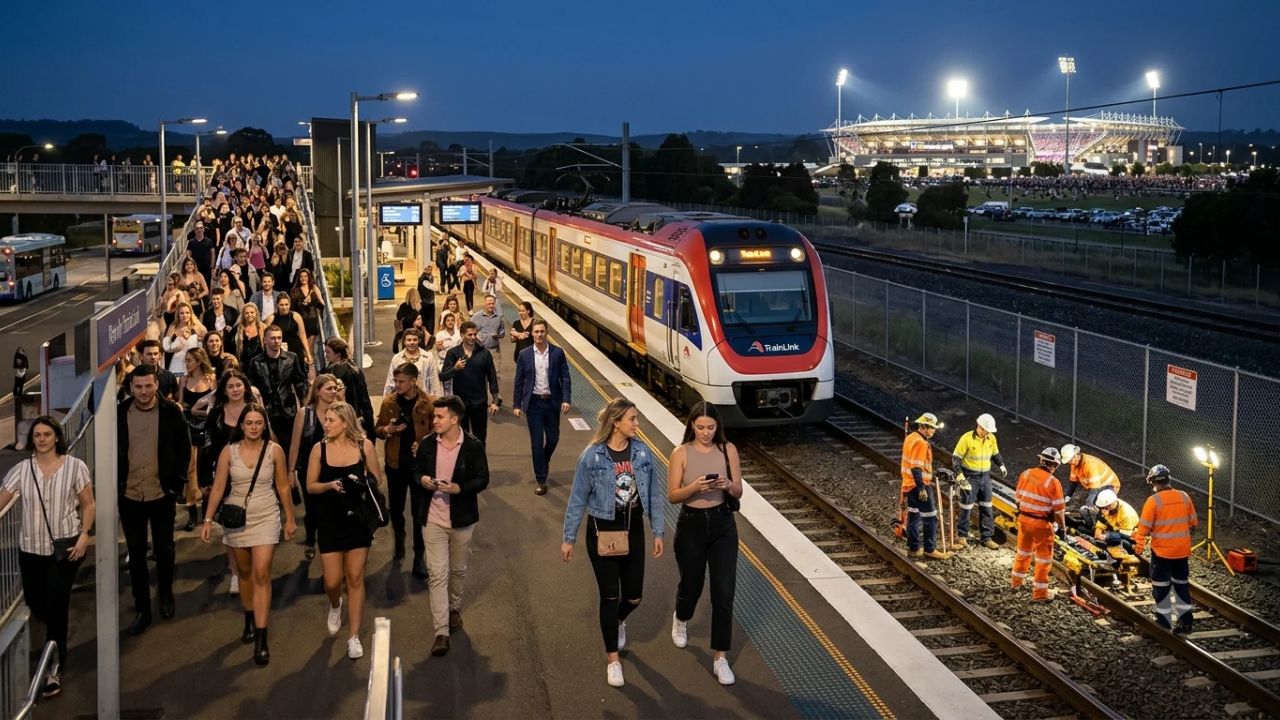
NEWCASTLE, Australia — Transport authorities in New South Wales have successfully executed a calibrated rail possession model across the Hunter Valley rail network, keeping passenger services active for 30,000 concertgoers at McDonald Jones Stadium while completing a massive 72-hour engineering blitz across 158 worksites to safeguard regional freight and visitor economies.
The operational breakthrough, orchestrated jointly by the Australian Rail Track Corporation (ARTC), NSW TrainLink, and Transport for NSW, resolves one of regional infrastructure's most persistent dilemmas: how to overhaul heavy-haul industrial railway lines without crippling regional event tourism. By replacing traditional blanket network shutdowns with a dynamically phased operational window, rail managers preserved direct passenger transit between Newcastle, Broadmeadow, and inland communities for an international headline concert by pop icon Robbie Williams, while simultaneously lifting ten speed restrictions and renewing track across the Hunter Valley rail corridor.
          HUNTER VALLEY RAIL CORRIDOR: DUAL-SPINE GEOGRAPHY

  [ INLAND AGRICULTURAL & MINING BASINS ]
  Ulan • Gunnedah • Turrawan • Muswellbrook • Singleton • Maitland
                        |
                        | (Heavy Coal & Agricultural Freight Spine)
                        | (Shared with NSW TrainLink Regional Passenger Services)
                        v
          [ BROADMEADOW JUNCTION & STADIUM HUB ]
  • McDonald Jones Stadium (30,000 Capacity Event Arena)
  • Planned New Newcastle Indoor Arena & Entertainment Precinct
  • Broadmeadow Intermodal Station & Shuttle Interchange
                        |
                        | (Light Rail & Bus Connectors)
                        v
          [ PORT OF NEWCASTLE & URBAN WATERFRONT ]
  • Kooragang Island Bulk Export Berths (Global Coal & Grain Terminal)
  • Newcastle Coastal Leisure, Beachfront Hotels & Hospitality Core
The Dual-Spine Paradox: Industrial Supply Chains and Leisure Tourism
Regional economic corridors outside Australia's tier-one capital cities face an operational challenge that metropolitan networks rarely experience. While major state capitals like Sydney, Melbourne, and Brisbane operate segregated underground commuter grids, suburban passenger lines, and dedicated freight bypass routes, secondary economic regions depend on shared rail corridors to handle fundamentally competing transport demands.
In the Hunter region of New South Wales, this infrastructure convergence creates continuous operational tension:
- Heavy-Haul Export Spine: The rail network functions as Australia’s primary bulk export corridor, funneling millions of tonnes of thermal coal, grain, and agricultural produce from inland basins—including Ulan, Gunnedah, Narrabri, and Turrawan—down toward the deepwater berths of Kooragang Island and Carrington at the Port of Newcastle.
- Regional Passenger Transit Spine: Operating over the exact same tracks, NSW TrainLink runs scheduled regional passenger services connecting the city of Newcastle with expanding suburban and rural communities across Maitland, Singleton, Muswellbrook, and Scone.
- Event Tourism Influx: Concurrently, state initiatives backed by Destination NSW and the City of Newcastle have aggressively positioned regional hubs as high-yield lifestyle and entertainment destinations. World-class sporting fixtures, NRL matches, and international stadium concert tours at McDonald Jones Stadium draw tens of thousands of visitors from regional hinterlands and interstate capitals, retaining significant hospitality spending within the local economy.
The physical coexistence of heavy freight and passenger transit generates severe mechanical wear. The unrelenting movement of 30-tonne axle-load coal trains subjects steel rails, underlying ballast stones, and civil formations to extreme mechanical forces, inducing rolling contact fatigue, ballast pulverization, and alignment micro-cracking. To maintain track safety, ARTC enforces periodic network closedowns—termed "possessions"—during which commercial rail movements are suspended for 48 to 72 continuous hours to allow heavy track-laying machinery, tamping locomotives, and civil engineering crews full access to the alignment.
Historically, when an engineering possession coincided with a major stadium event, authorities faced an uncompromising choice: cancel the maintenance works and accept accelerating track degradation, or shut down the railway entirely and force tens of thousands of event ticket holders onto replacement highway buses, triggering severe gridlock along the M1 Pacific Motorway and New England Highway.
| Operating Network Demands | Heavy-Haul Freight Transport | Regional Passenger Transit | High-Yield Event Tourism |
|---|---|---|---|
| Primary Route Users | Bulk coal, grain, and agricultural exporters | Daily commuters, regional families, students | Concertgoers, sports fans, weekend leisure travelers |
| Operating Axle Loads | Up to 30 tonnes per axle (Heavy Haul) | 14 to 18 tonnes per axle (Light Passenger) | Transit-dependent pedestrian crowds |
| Primary Corridors | Ulan / Gunnedah to Port of Newcastle | Newcastle to Scone / Dungog / Sydney | Broadmeadow Station to McDonald Jones Stadium |
| Disruption Sensitivity | Lost port berth capacity and demurrage costs | Travel delays, missed work, connection failures | Severe highway congestion, stranded event attendees |
| Maintenance Need | Continuous ballast tamping and steel replacement | Timetable line speeds and smooth ride quality | Peak weekend access without bus replacement bottlenecks |
The November 2026 Breakthrough: Phasing Around Robbie Williams
An operational benchmark was achieved in mid-November 2026, when transport planners successfully decoupled civil maintenance from event access during an international stadium concert by British pop superstar Robbie Williams at Newcastle’s McDonald Jones Stadium. The concert formed the centerpiece of a five-week regional sporting and entertainment showcase that brought an estimated 120,000 ticket holders into the Greater Newcastle area.
With a crowd of 30,000 spectators attending the Saturday evening performance, an estimated 35% of attendees relied on regional passenger rail arriving at Broadmeadow Station—located within walking distance of the stadium gates. Cancelling train services in favor of road replacement buses would have overwhelmed the surrounding street grid, causing bus queues, missed concert start times, and vehicle congestion extending across the Hunter River crossings.
       CALIBRATED 4-PHASE RAIL POSSESSION ARCHITECTURE

 [ PHASE 1: EVENT TRANSIT WINDOW ]
 Saturday Afternoon & Late Evening
 • Newcastle – Muswellbrook Passenger Rail ACTIVE
 • Direct Broadmeadow Station Stadium Footpath Open
 • Dedicated Event Shuttles, Light Rail & Ferries Synchronized
 • Heavy Freight Diverted to Inland Staging Tracks
                     |
                     v
 [ PHASE 2: MIDWEEK OVERNIGHT BLITZ ]
 Deferred Primary Engineering Closedown
 • Full Mainline Track Possession Engaged (Overnight)
 • Heavy Rail Replacement, Re-ballasting & Laser Tamping
 • Road Coaches Bridging Low-Volume Night Passenger Routes
                     |
                     v
 [ PHASE 3: TARGETED TESTING WINDOW ]
 Late-Week Secondary Engineering Window
 • Daytime Rail Service Preserved for Business Commuters
 • Evening Signal Testing, Ultrasonic Rail Flaw Inspections
 • Dedicated Highway Shuttles Bridging Specific Branch Lines
                     |
                     v
 [ PHASE 4: FULL NETWORK RECOMMISSIONING ]
 Return to Full Commercial Operations
 • 10 Temporary Speed Restrictions Lifted Across Corridor
 • Full Line Speeds Restored for Freight and Passenger Trains
 • 100% Timetable Reliability Re-established
Rather than executing a blunt 72-hour network closure, ARTC engineers restructured more than twelve months of maintenance planning into a four-stage calibrated possession model:
- Phase 1 (Concert Window Protection): All mainline passenger services between Newcastle Interchange, Broadmeadow, Maitland, and Muswellbrook were preserved throughout the afternoon, evening, and late-night return windows of the concert. Freight trains were temporarily held at inland sidings or routed along secondary industrial loops, allowing high-capacity passenger trains to clear the stadium precinct safely.
- Phase 2 (Deferred Midweek Blitz): Heavy track maintenance requiring total line possession—including primary rail replacement, ballast undercutters, and civil formation reconstruction—was shifted into dedicated midweek overnight windows when passenger demand was minimal.
- Phase 3 (Targeted Secondary Window): Specialized electronic signaling overhauls, turnout refurbishments, and structural bridge inspections were scheduled during controlled, short evening windows later in the week, supported by dynamic bus bridges for low-density commuter runs.
- Phase 4 (Full Network Recommissioning): Following structural sign-off, the corridor returned to full freight and passenger operation, with ten historical temporary speed restrictions lifted immediately.
| Possession Phase | Active Corridor Window | Rail Operating Status | Multi-Modal Transit Strategy |
|---|---|---|---|
| Phase 1: Event Transit Window | Saturday Afternoon through Midnight | Passenger rail fully active between Newcastle and Muswellbrook | Dedicated stadium shuttles deployed; Newcastle Light Rail and ferry frequencies doubled |
| Phase 2: Deferred Primary Closedown | Midweek Overnight Windows (72h Spread) | Full track possession on heavy freight sectors; rerailing active | Express replacement coaches coordinated via real-time Transport for NSW apps |
| Phase 3: Targeted Secondary Window | Late-Week Evening Intervals | Corridor closed for signaling overhauls and ultrasonic flaw tests | Local road shuttles bridging short regional stations between Maitland and Singleton |
| Phase 4: Network Recommissioning | Following Final Civil Certification | Full network reopened; 10 temporary speed restrictions lifted | Resumption of full scheduled freight and passenger timetables |
Engineering Precision: Managing 158 Simultaneous Worksites
The engineering effort executed during the November 2026 possession represents one of the most concentrated civil rail infrastructure campaigns in regional Australian history. Specialist crews and heavy rail plant machinery were mobilized across the network to execute track work across 158 distinct locations between Newcastle, Kooragang, Maitland, Muswellbrook, and inland branch line junctions.
The technical requirements of the campaign directly targeted the physical wear imposed by heavy freight trains:
           ANATOMY OF A HIGH-AXLE RAIL OVERHAUL

     [ LASER-GUIDED DYNAMIC TAMPING ]
    +--------------------------------+
    | Heavy tamping tines vibrate    | ===> Compacts stone ballast,
    | deep ballast beneath sleepers  |      restores track geometry
    +--------------------------------+
                   |
                   v
     [ CONTINUOUS WELDED RAIL REPLACEMENT ]
    +--------------------------------+
    | Removal of fatigue-worn steel  | ===> Prevents rail micro-fractures,
    | Installation of premium alloy  |      eliminates click-clack joints
    +--------------------------------+
                   |
                   v
     [ FORMATION & DRAINAGE RENEWAL ]
    +--------------------------------+
    | Deep geotextile sub-drainage   | ===> Stops water saturation, prevents
    | Geotechnical formation capping |      mud-pumping track washouts
    +--------------------------------+
Key engineering milestones completed during the campaign included:
- Corridor Rerailing: Technicians replaced several linear kilometers of worn steel track with premium wear-resistant continuous welded rail (CWR), completely eradicating rolling contact fatigue micro-cracking and reducing mechanical wear on passing wheelsets.
- Formation and Drainage Reconstruction: Sub-surface drainage systems, culverts, and civil formation capping layers were rebuilt at vulnerable flood-prone locations to protect track geometry against intense subtropical storms and soil erosion.
- Laser-Guided Ballast Tamping: Heavy computerized tamping machines and ballast regulators traversed tens of track kilometers, utilizing laser-guided alignment sensors to pack stone ballast beneath concrete sleepers, restoring millimeter-precise track geometry.
- Signaling and Switch Refurbishment: Advanced electronic signaling interlockings, track circuits, and mechanical turnout switches were overhauled to support automated train monitoring and bidirectional running.
- Lifting of Ten Speed Restrictions: The successful execution of these works enabled ARTC track inspectors to remove ten temporary speed restrictions that had forced passenger and freight trains to decelerate to 40 km/h or 60 km/h over degraded segments, instantly restoring scheduled line speeds of up to 120 km/h for passenger express services.
| Engineering Milestone | Technical Asset Volume | Operational Impact on Rail Operations |
|---|---|---|
| Total Worksites Managed | 158 distinct civil engineering locations | Complete corridor overhaul from port berths to inland junctions |
| Track Rerailing | Multiple linear kilometers of heavy steel rail | Eliminates micro-fissures and rolling contact surface fatigue |
| Laser Ballast Tamping | Over 45 kilometers of track geometry alignment | Eliminates track vibration, improves ride quality and stability |
| Sub-Surface Drainage Renewal | Rebuilt geotechnical beds and culvert systems | Prevents track bed saturation, washouts, and formation failure |
| Switch & Crossing Overhauls | 24 critical mainline turnout points serviced | Restores smooth switching between parallel tracks and sidings |
| Speed Restrictions Removed | 10 permanent and temporary speed restrictions lifted | Restores full passenger line speeds (up to 120 km/h) |
Economic Counter-Cyclical Hedging: Maintenance as a Regional Hospitality Stabilizer
Track possessions are traditionally treated by regional businesses as economic disruptions that depress trade by halting passenger arrivals. However, when managed strategically, large-scale civil rail maintenance campaigns act as an economic stabilizer for regional hospitality and commercial sectors.
Regional communities throughout the Upper Hunter—such as Maitland, Singleton, Muswellbrook, and Denman—regularly contend with severe fluctuations in visitor demand. On weekends, regional accommodations experience high occupancy rates driven by leisure tourism, vineyard getaways in the Pokolbin wine country, weddings, and local sporting tournaments. Conversely, midweek trade often drops sharply, creating cash-flow volatility for independent hotels, family-owned motels, cafes, and retail suppliers.
       REGIONAL HOSPITALITY ECONOMIC BALANCING MODEL

  [ COASTAL REGIONAL CORE: NEWCASTLE ]
  • Weekend Surge: 30,000 Stadium Concert Attendees
  • Luxury Hotels, Waterfront Dining & Nightlife at Capacity
  • Peak Event Hospitality Spend Retained in Inner City
                         ^
                         | COMPLEMENTARY ECONOMIC DISTRIBUTION
                         v
  [ INLAND HINTERLAND TOWNS: MAITLAND • SINGLETON • MUSWELLBROOK ]
  • Midweek Surge: Hundreds of Rail Engineers & Civil Contractors
  • Regional Motels, Pubs, Service Stations & Caterers Booked Out
  • Off-Peak Commercial Slump Neutralized Across Regional Towns
During the November 2026 possession, the mobilization of technical crews delivered a substantial counter-cyclical economic stimulus across regional New South Wales:
- Contractor Lodging Influx: Hundreds of specialist engineers, machine operators, signaling electricians, and civil contractors booked hundreds of room nights across inland motels and guesthouses throughout Maitland, Singleton, Muswellbrook, and Aberdeen, sustaining high occupancy during traditional midweek slumps.
- Direct Commercial Spend: Maintenance crews injected substantial direct spending into local bakeries, service stations, supermarkets, and equipment rental suppliers along the New England Highway.
- Spatial Commercial Equity: This dual-wave economic dynamic balanced regional prosperity. While coastal Newcastle captured peak weekend consumer spending from concertgoers attending the Robbie Williams show, inland rural municipalities captured steady corporate trade from the maintenance workforce, ensuring that regional development benefits were shared across the entire Hunter Valley basin.
| Economic Dimension | Newcastle Coastal Event Economy | Inland Rail Maintenance Economy | Combined Regional Synergy |
|---|---|---|---|
| Primary Economic Base | 30,000 concert ticket holders | Hundreds of rail engineers and technicians | Dual consumer and commercial capital flows |
| Peak Demand Period | Weekend nights (Friday to Sunday) | Midweek working intervals (Monday to Thursday) | Full seven-day regional accommodation stability |
| Key Spending Beneficiaries | Waterfront hotels, pubs, bars, taxis, retail | Inland motels, family cafes, caterers, fuel hubs | Equitable wealth distribution across Hunter Valley |
| Average Per Diem Spend | ~$280–$350 per leisure visitor | ~$220–$280 per contractor lodging day | High aggregate regional economic retention |
Decarbonisation and Modal Shift: The Value of Line Speed Reliability
The coordination of railway possessions and major event transit is directly connected to regional climate objectives and transportation emissions. In regional Australia, the vast majority of event travel has historically been dominated by private passenger vehicles. Thousands of cars driving simultaneously along the M1 Pacific Motorway and New England Highway generate substantial carbon emissions, elevated accident risks, and severe parking congestion around suburban stadium precincts.
Shifting regional travelers from private motorcars to public passenger rail requires two non-negotiable factors: timetable speed and arrival reliability. When rail corridors suffer from deferred maintenance, track defects accumulate, compelling rail operators to impose conservative speed limits. A passenger rail journey that takes 45 minutes under normal conditions can stretch to 75 minutes when multiple 40 km/h speed restrictions are enforced, causing travelers to abandon public transit in favor of private vehicles.
              MODAL EFFICIENCY COMPARISON: STADIUM TRANSIT

  [ PRIVATE MOTOR VEHICLE TRAVEL (M1 MOTORWAY) ]
  • Capacity: 1.4 Passengers per Vehicle Average
  • Congestion: 45–90 Minute Bottlenecks at Newcastle Arterials
  • Parking: Severe On-Street Scramble, 20–30 Minute Walking Detours
  • Carbon Footprint: High (Approx. 170g CO2 per Passenger-Kilometre)

  [ REGIONAL PASSENGER RAIL (NSW TRAINLINK + ARTC) ]
  • Capacity: 800+ Passengers per 8-Car Intercity Train
  • Speed: Restored 100–120 km/h Express Line Speeds
  • Access: Direct Step-Free Walkway from Broadmeadow to Stadium Gates
  • Carbon Footprint: Low (Approx. 40g CO2 per Passenger-Kilometre)
By completing 158 simultaneous track renewals and lifting ten speed restrictions, ARTC restored passenger trains to full operating speeds. Passengers boarding at Muswellbrook, Singleton, and Maitland enjoyed fast, punctual travel directly to Broadmeadow Station. This reliability builds long-term public trust, encouraging travelers to choose trains over private vehicles for subsequent sporting and entertainment events.
Future Outlook: The Broadmeadow Entertainment Precinct Renewal
The successful transport integration validated during the November 2026 concert provides a blueprint for upcoming urban renewal projects in the region. The New South Wales Government has allocated dedicated planning and capital funding for the master-planned modernization of the Broadmeadow precinct, anchored by the proposed New Newcastle Arena.
Planned adjacent to McDonald Jones Stadium, the entertainment complex will create an integrated sporting, concert, and residential precinct connected directly to Broadmeadow Station. Master-plan specifications envision:
- World-Class Indoor Venue: A state-of-the-art 11,000-seat multi-purpose entertainment arena hosting international music tours, basketball tournaments, and major exhibition conferences.
- Transit-Oriented Residential Community: Development of high-density sustainable housing, communal parklands, and commercial retail precincts on surplus government railway land surrounding the station.
- Active Transport Spine: Elevated, weather-protected pedestrian bridges and dedicated cycle paths linking Broadmeadow Station directly with the stadium concourse, eliminating road-level pedestrian crossings.
       FUTURE BROADMEADOW TRANSIT-ORIENTED PRECINCT MAP
 +-------------------------------------------------------------------+
 |                   BROADMEADOW RAILWAY STATION                     |
 |        Direct Interchange: Intercity Trains • Shuttles • Buses    |
 +---------------------------------+---------------------------------+
                                   |
                                   v (Weather-Protected Active Walkway)
 +---------------------------------+---------------------------------+
 |                     NEW NEWCASTLE ARENA                           |
 |               11,000-Seat Indoor Entertainment Hub                |
 +---------------------------------+---------------------------------+
                                   |
                                   v (Pedestrian Overpass)
 +---------------------------------+---------------------------------+
 |                    MCDONALD JONES STADIUM                         |
 |                30,000-Seat Regional Outdoor Stadium               |
 +-------------------------------------------------------------------+
As the Broadmeadow entertainment precinct expands, the ability to coordinate high-frequency passenger train movements with heavy-haul industrial freight traffic will be essential. The phased possession model executed in late 2026 proves that essential infrastructure maintenance and vibrant event tourism can thrive side by side.
Strategic Playbook: Policy Framework for Secondary Regional Destinations
The operational success in the Hunter Valley offers valuable policy lessons for regional transport planners, municipal governments, and rail infrastructure owners across the globe handling overlapping industrial and tourism demands.
       REGIONAL EVENT-INFRASTRUCTURE RESILIENCE PLAYBOOK
 +-------------------------------------------------------------------+
 | 1. SYNCHRONIZED ASSET & EVENT MATRICES: 12-Month Joint Scheduling |
 | 2. DYNAMIC CORRIDOR PHASING: Carve Out Event Windows on Rail Lines|
 | 3. REAL-TIME TRAVEL INFORMATION: Integrated Digital Transit Apps  |
 | 4. INLAND PROCUREMENT SYNERGY: Book Local Motels for Work Crews   |
 | 5. SPEED RESTRICTION ERADICATION: Protect Transit Competitiveness |
 +-------------------------------------------------------------------+
1. Synchronized Asset and Event Matrices
Infrastructure operators and tourism agencies must merge their planning schedules over a rolling 12-month horizon. While major concert tours and international sporting matches require six to twelve months of advance marketing and stadium ticketing, heavy rail possessions also demand extended lead times to book high-capacity machinery and specialist contractors. Establishing unified planning committees allows authorities to identify scheduling conflicts early and design phased possession windows well before tickets go on sale.
2. Multi-Modal Transit Redundancy
When track sections must undergo maintenance, alternative passenger transit must operate smoothly. Transport agencies should coordinate with regional bus companies to establish high-frequency express shuttles that mirror rail routes without getting caught in localized traffic. Real-time updates delivered through public transit apps (such as AnyTrip and Transport for NSW Trip Planner) ensure that passengers receive clear, timely information regarding platform departures, bus boarding bays, and connection times.
3. Local Contractor Procurement and Regional Retention
Municipal councils should partner with business chambers to formalize preferred accommodation and catering registers for visiting rail maintenance personnel. By steering infrastructure contractors into regional motels, pubs, and family restaurants during off-peak weekdays, regional destinations can turn necessary engineering interruptions into dependable revenue drivers for local businesses.
Frequently Asked Questions
What was the conflict between rail maintenance and the Robbie Williams concert in Newcastle?
In mid-November 2026, Newcastle hosted an international concert by pop star Robbie Williams at McDonald Jones Stadium, drawing approximately 30,000 attendees to the venue. Concurrently, the Australian Rail Track Corporation (ARTC) had scheduled a major 72-hour network maintenance possession across 158 sites along the Hunter Valley rail line. A standard blanket rail shutdown would have forced thousands of concertgoers onto replacement buses, triggering massive traffic gridlock on the M1 Pacific Motorway and New England Highway.
How did transport authorities resolve the rail disruption for concertgoers?
Rather than closing the rail line completely, ARTC, NSW TrainLink, and Transport for NSW introduced a calibrated, phased possession model. Regular passenger rail services between Newcastle Interchange, Broadmeadow Station, and Muswellbrook were kept active throughout the afternoon, evening, and late-night return hours of the concert, allowing fans to reach the stadium easily. Heavy maintenance work requiring full line closures was shifted into overnight midweek windows and targeted off-peak periods later in the week.
What engineering works were completed across the 158 worksites?
Specialist maintenance crews completed comprehensive track overhauls across 158 locations between Newcastle, Kooragang, Muswellbrook, and inland branch lines. Works included replacing several linear kilometers of fatigue-worn steel rail, rebuilding sub-surface drainage systems to prevent water washouts, laser-guided ballast tamping across tens of kilometers of track, and overhauling mechanical signaling switches. Importantly, the maintenance campaign enabled track engineers to lift ten temporary speed restrictions, restoring full line speeds of up to 120 km/h for passenger express trains.
How does rail track maintenance stimulate the regional economy in the Hunter Valley?
While leisure travelers and concertgoers filled waterfront hotels and dining venues in coastal Newcastle over the weekend, hundreds of engineers, machine operators, and contractors working on the rail lines booked hotel rooms, motels, and guesthouses across inland towns like Maitland, Singleton, Muswellbrook, and Denman. This influx of technical personnel supported independent accommodation providers, service stations, bakeries, and cafes during off-peak midweek periods, ensuring that economic benefits were shared across the entire region.
Related Travel Guides
- Taiwan Breaks Ground on NT$6.04 Billion Banxin Station Metro Development as Asia Accelerates Transit-Oriented Rail Hubs
- Albania Euro Exchange Rate Plummets 35% Against Lek Since 2016 as Tourism Inflows and Property Boom Reshape Travel Costs
- Madrid Unveils 14 Million Christmas Lights, Giant Walk-Through Snowman, and 250 Urban Illuminations Across 21 Districts for 2026–2027 Season
- Spain Experiential Tourism Drive: Rural Heritage and Cultural Travel Across Spanish Regions
This article is for informational purposes. Flight routes, passenger regulations, visa rules, and transit advisories are subject to change by airlines and aviation authorities. Readers are advised to verify schedules and travel documentation with relevant carriers and border agencies before departure.
Related Stories
VIA Rail Canada Updates Guide Dog and Service Animal Documentation Rules with 48-Hour Verification and 5-Year Approval Validity
Spain Nationwide Rail Strike Disrupts AVE, Cercanías, and Rodalies Services as Renfe Cancels 24% of High-Speed Trains