South Korea Chinese Group Tours Plunge to $45 as Beijing Embassy Issues Severe Warning Over Forced Shopping and Itinerary Cuts

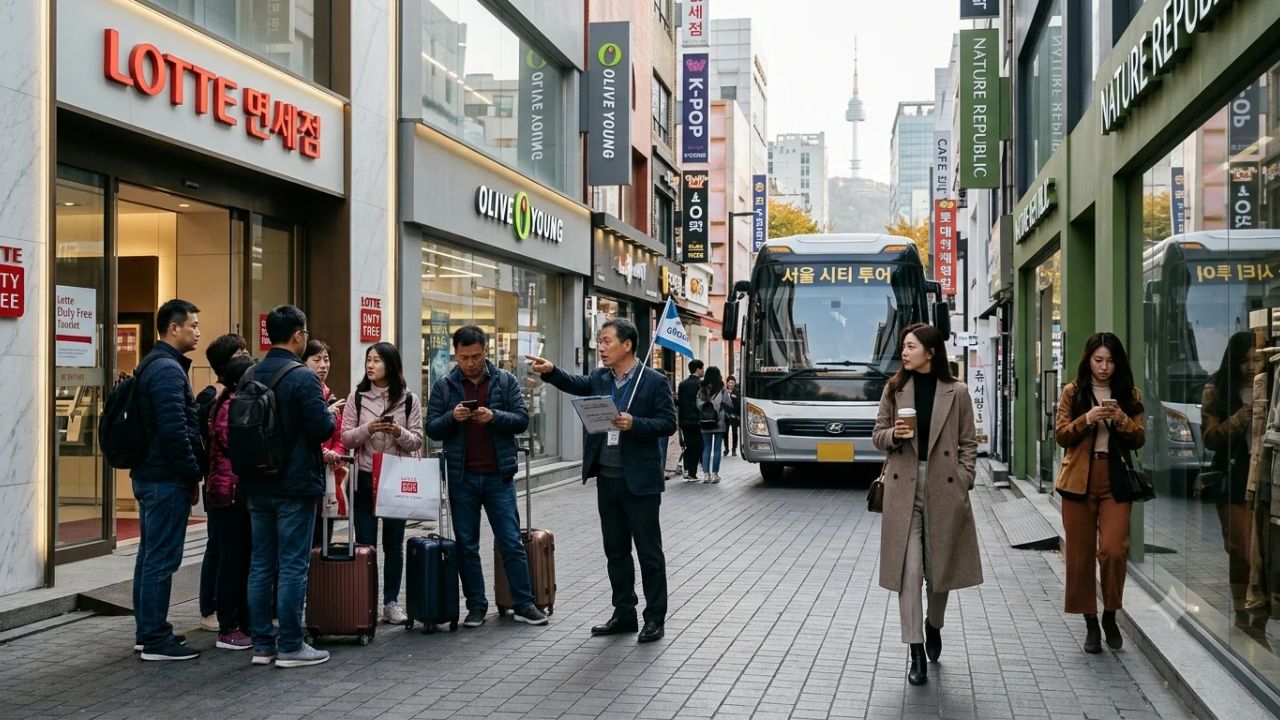
SEOUL, South Korea — An aggressive price war across South Korea’s booming Chinese group tourism sector has triggered official diplomatic intervention, after multi-day holiday packages plummeted to advertised rates as low as US$45 and initial booking deposits fell to RMB 199 (approximately US$30). The dramatic price collapse has exposed widespread commercial exploitation, prompting the Embassy of the People’s Republic of China in Seoul to issue an urgent public warning advising prospective travelers to exercise extreme caution against predatory, below-cost travel packages. The consular alert follows a wave of formal consumer complaints involving compulsory retail detours, high-pressure spending demands, verbal intimidation by tour guides, and retaliatory itinerary cancellations when tourists fail to meet arbitrary shopping quotas.
The pricing controversy emerges amidst an otherwise historic surge in Chinese inbound travel to South Korea. Official immigration statistics confirm that approximately 5.47 million mainland Chinese visitor trips were recorded between January and September 2026—a substantial 29.2 percent increase compared to the corresponding nine-month period in 2025. Yet behind these impressive arrival figures lies a destabilizing business model known throughout East Asia as "dumping tours" (chudae or "zero-dollar tourism"). In response, the Seoul Metropolitan Government conducted sweeping investigations into digital booking platforms, revealing that 85 out of 100 sampled low-cost tour packages operated under predatory commercial structures that rely almost entirely on retail commissions to cover basic operating deficits.
SOUTH KOREA-CHINA GROUP TOUR CRISIS: KEY METRICS
| LOWEST ADVERTISED PACKAGE PRICE: ~US$45 (Multi-Day Flight & Hotel Itinerary) |
|---|
| MINIMUM ONLINE BOOKING DEPOSIT: RMB 199 (~US$30 via Mainland Chinese OTA Platforms) |
| NINE-MONTH CHINESE ARRIVALS: 5.47 Million Trips (January–September 2026, +29.2% YoY) |
| SEOUL MUNICIPAL AUDIT RESULT: 85 of 100 Sampled Low-Cost Online Packages Flagged as Dumping Tours |
| PRIMARY REGULATORY CONCERNS CITED BY CHINESE EMBASSY: |
| * Below-cost pricing masking hidden mandatory retail spending quotas |
| * Inbound Korean agencies paying 'head fees' to Chinese agencies to acquire tour groups |
| * Coercive confinement in designated duty-free, cosmetic, and traditional medicine outlets |
| * Unilateral truncation or cancellation of cultural sightseeing when spending targets are missed |
| * Resurgence of unlicensed guiding and non-transparent commission kickback networks |
The Anatomy of a Dumping Tour: How Zero-Dollar Travel Operates
To understand how an international flight, multi-night hotel stay, chartered motorcoach transport, and daily meals can be packaged for less than the price of a single dinner in downtown Seoul, one must examine the inverted economics of the "zero-dollar" group travel system.
In conventional international group tourism, an outbound travel agency in the origin country collects a comprehensive fee from travelers that covers international flights, ground transport, hotel accommodation, meals, entrance fees, and a reasonable profit margin. The origin agency then pays a local destination management company (DMC) in the host country to deliver the promised services.
In a dumping tour model, this financial relationship is completely inverted:
- Aggressive Digital Discounting: Outbound travel agencies in China advertise packages on online travel platforms (OTAs) and live-streaming commerce channels at headline rates ranging from US$45 to US$100, or collect nominal deposits of RMB 199. These prices do not even cover the airport taxes, let alone round-trip airfare or four-star lodging.
- Negative Bidding and Head Fees: Rather than receiving payment for handling the travelers, competing inbound travel agencies in South Korea engage in cut-throat bidding wars, actively paying the Chinese outbound agency an upfront "head fee" or bounty (often US$20 to $50 per tourist) simply for the right to receive the tour group.
- Severe Operational Deficit: The moment the group lands at Incheon International Airport or Gimpo Airport, the Korean receiving operator is carrying an immense financial loss—having paid for the group’s arrival while receiving zero revenue from the initial package price.
- Coercive Retail Extortion: The receiving DMC’s sole mechanism for recovering this deficit and generating profit is through massive retail commissions. The itinerary is systematically constructed around designated shopping establishments: tax-free cosmetics emporiums, red ginseng cooperatives, traditional liver-health supplement centers (Hovenia dulcis or Hogae fruit extract), duty-free jewelry stores, and branded fashion outlets.
- High Commission Rebates: Participating retailers pay kickbacks ranging between 30 percent and 50 percent of total customer spending back to the Korean travel agency and tour guide. If a tour group purchases $10,000 worth of luxury skincare and dietary supplements, the agency recoups its operating loss and splits the surplus with the guide.
CONVENTIONAL VS DUMPING TOUR FINANCIAL MODELS
| Entity / Route | Metrics | Operational Status |
|---|---|---|
| Structural Dimension | Standard Certified Group Tour | Zero-Dollar Dumping Tour |
| Initial Package Price Paid | Fair Market Rate ($600 - $1,200) | Below Cost ($45 - $100) |
| Financial Flow to Local DMC | Origin Agency Pays Local DMC | Local DMC Pays Origin Agency |
| Guide Compensation Model | Professional Daily Salary + Tips | Zero Base Salary; 100% Comm |
| Sightseeing vs Shopping Balance | 80% Culture & History / 20% Free | 70% Retail Confinement / 30% |
| Retail Purchase Policy | Strictly Voluntary & Disclosed | Highly Coercive & Mandated |
| Itinerary Reliability | Guaranteed Contract Fulfillment | Truncated if Spending Low |
The Diplomatic Warning: Chinese Consular Action in Seoul
The escalation of coercive retail practices prompted the Chinese Embassy in Seoul to release a formal travel advisory on its official digital channels. The diplomatic mission underscored that while affordable tourism is legitimate, packages priced conspicuously below reasonable operating thresholds represent an immediate consumer hazard.
The embassy highlighted several direct grievances documented by distressed Chinese citizens:
- Confinement and High-Pressure Sales: Tourists reported being escorted into private retail demonstration rooms in suburban districts of Gyeonggi Province and downtown Seoul, where store representatives conducted aggressive multi-hour sales pitches. In multiple instances, travelers reported that exit doors were monitored, and tour coaches refused to depart until minimum collective sales thresholds were met.
- Retaliatory Itinerary Truncation: When groups resisted purchasing expensive herbal remedies or luxury beauty packages, tour guides reportedly retaliated by cancelling scheduled visits to iconic cultural landmarks. Advertised excursions to UNESCO World Heritage monuments like Changdeokgung Palace, scenic walks through Bukchon Hanok Village, and evening skyline tours to N Seoul Tower were abruptly struck from the schedule, with guides claiming "traffic congestion" or "administrative delays."
- Verbal Harassment and Hostility: Unpaid tour guides, facing direct personal financial losses when commissions failed to materialize, subjected tour groups to open hostility, public shaming, and verbal abuse inside tour buses.
The Chinese Embassy’s advisory urged citizens to examine travel contracts meticulously, verify that shopping frequency and duration are explicitly enumerated in writing, and firmly reject packages that fail to provide transparent breakdowns of accommodation standards and transport arrangements.
THE 2026 CHINESE INBOUND TOURISM SURGE IN NUMBERS
| Metric Category | Jan–Sep 2025 Volume | Jan–Sep 2026 Volume | Growth Rate & Impact |
|---|---|---|---|
| Total Mainland Trips | 4.23 Million Trips | 5.47 Million Trips | +29.2% YoY Surge |
| Market Share Rank | #1 Inbound Source Market | #1 Inbound Source Mkt | Over 35% of All Foreign |
| Aviation Capacity | ~850 Weekly Direct Flights | 1,180 Weekly Flights | Restored Short-Haul Air |
| Visa Facilitation | Group Visa Processing Fees | Fee Waivers & E-Visas | Reduced Entry Friction |
| Destination Pivot | Balanced with Japan/Thailand | Shift Away from Japan | Currency & Sentiment |
Behind the Surge: 5.47 Million Arrivals and Shifting Geopolitics
The resurgence of predatory tour pricing is directly tied to the explosive recovery of Chinese travel to South Korea throughout 2026. Data from the Korea Tourism Organization (KTO) and the Ministry of Justice shows that mainland Chinese visitors completed 5.47 million trips during the first three quarters of 2026, marking a 29.2 percent year-on-year increase and cementing China’s status as South Korea's largest international tourism source market.
Several structural catalysts converged to drive this dramatic influx:
- Visa Facilitation and Group Waivers: The South Korean government expanded electronic group visa processing and waived administrative processing fees for accredited tour groups, lowering entry friction for travelers from regional Chinese cities.
- Rapid Expansion of Aviation Connectivity: Direct flight frequencies between regional Chinese metropolises (including Qingdao, Hangzhou, Wuhan, and Chengdu) and South Korean gateways (Incheon, Gimpo, and Jeju International Airport) expanded by more than 35 percent, providing ample seat inventory for wholesale tour operators.
- Reorientation from Competing Asian Markets: South Korea benefited significantly from shifting outbound consumer sentiment in China. In Japan, currency volatility, steep lodging inflation in Tokyo and Kyoto, and localized tensions surrounding overtourism prompted many Chinese holidaymakers to seek alternative short-haul destinations. South Korea, with its cultural affinity for K-pop, Korean television dramas, and world-class beauty shopping, emerged as the primary beneficiary.
However, the rapid influx of demand outpaced regulatory oversight. Hundreds of newly licensed and small-scale agencies rushed to capture market share, resorting to extreme price slashing to fill chartered airline seats and hotel allotments.
SEOUL METROPOLITAN GOVERNMENT ONLINE AUDIT FINDINGS
| Category / Entity | Details / Impact |
|---|---|
| Investigation Scope | 100 Low-Price South Korea Tour Packages Advertised on Chinese Online Platforms |
| Suspected Violations | 85 out of 100 Packages (85%) Flagged as Suspected Dumping Tours |
| Primary Infractions | * Absence of itemized pricing breakdowns |
| * Mandatory retail visits omitted from pre-booking disclosures | |
| * Disproportionate retail scheduling (Exceeding 4 Hours of Daily Shopping) | |
| * Ambiguous accommodation classifications ('Or Equivalent 4-Star') | |
| Administrative Step | Referred to Ministry of Culture, Sports and Tourism for Sanctions & Delisting |
The Seoul City Investigation: Unmasking the 85 Percent Failure Rate
To quantify the prevalence of predatory tour products, the Seoul Metropolitan Government’s Tourism and Sports Bureau partnered with the Seoul Tourism Organization (STO) to conduct an exhaustive digital audit of Chinese online travel platforms and social media booking channels.
Investigators analyzed 100 deeply discounted South Korea travel packages actively marketed to Chinese consumers. The findings were staggering: 85 out of the 100 examined packages were classified as suspected dumping tours, exhibiting clear indicators of illegal price manipulation, undisclosed retail mandates, and high risks of consumer exploitation.
City officials noted that while this 85 percent violation rate specifically reflects the targeted sample of ultra-cheap online products—and should not be generalized across the entire South Korean tourism industry—it confirms that the discount end of the digital booking market is thoroughly compromised by predatory operators.
Specific irregularities identified during the municipal audit included:
- Packages that advertised luxurious five-star accommodations but housed guests in unrated, distant motels located two hours outside Seoul in outer Gyeonggi Province.
- Daily itineraries that allocated up to five hours to three mandatory shopping stops while reserving less than 45 minutes for major historical sites like Gyeongbokgung Palace.
- Failure to disclose mandatory service tips, driver gratuities, and optional excursion fees that were subsequently demanded under duress upon arrival.
The Seoul Metropolitan Government submitted its findings to the Ministry of Culture, Sports and Tourism (MCST), demanding formal administrative investigations, financial penalties, and the immediate revocation of business licenses for non-compliant DMCs.
Echoes of the Past: Why Previous Regulatory Interventions Failed
The current crisis represents a troubling recurrence of an institutional challenge that has plagued South Korea’s tourism sector for over a decade. During the mid-2010s, similar explosive growth in Chinese arrivals led to an identical proliferation of zero-dollar tours, resulting in widespread consumer outrage and diplomatic friction.
In March 2016, the South Korean government launched a major regulatory purge, revoking the specialized operational licenses of 68 travel agencies dedicated to handling Chinese group tours (jung-guk jeondam yeohaengsa). The authorities established strict biennial renewal audits, required agencies to pay tour guides fair baseline salaries, and implemented tracking systems to monitor commission structures.
Why, then, did the dumping tour phenomenon re-emerge with even greater intensity in 2026? Tourism economists point to several systemic factors:
- The Rise of Digital Super-Apps and Livestream Selling: In the mid-2010s, group tours were predominantly booked through physical brick-and-mortar travel agencies. In 2026, tours are marketed through sophisticated algorithmic super-apps, short-video platforms, and e-commerce live streams in China. Algorithms inherently reward the lowest headline price, driving an hyper-competitive race to the bottom that rewards deceptive operators.
- Post-Pandemic Industry Turnover: The prolonged hiatus in international travel between 2020 and 2023 decimated experienced bilingual guide networks. Many veteran, certified Chinese-speaking guides (gwangwang tongyeok an-naesa) left the industry, replaced in 2025 and 2026 by temporary, commission-dependent workers who rely entirely on sales quotas to survive.
- Corporate Shell Networks: Unscrupulous operators circumvent regulatory bans by operating networks of paper companies. When a travel license is revoked by the MCST, the same management team frequently purchases an existing licensed entity or registers a new corporate vehicle, resuming identical commercial practices within weeks.
REGULATORY & ENFORCEMENT FRAMEWORK IN SOUTH KOREA
| Entity / Facility | Delays | Cancellations | Details |
|---|---|---|---|
| Agency / Body | Regulatory Jurisdiction | Active Enforcement Action | Penalties & Sanctions |
| Ministry of Culture, | National Tourism Licensing | Biennial Agency Audits | Permanent Revocation of |
| Sports & Tourism | Group Travel Accreditations | Tracking Head-Fee Flow | Specialized DMC License |
| Seoul Metropolitan | Local Market Oversight | Undercover Taskforce | Business Suspensions, |
| Government (SMG) | Retail & Guiding Inspections | Joint Police Patrols | Fines for Forced Sales |
| Korea Tourism | Visitor Support & Brand | 1330 24/7 Helpline in | Real-Time Mediation, |
| Organization (KTO) | Dispute Resolution Channels | Chinese & English | Consumer Rights Alerts |
| Korea Consumer | Cross-Border Dispute | Bilateral Arbitration | Mandated Restitution, |
| Agency (KCA) | Financial Restitution Claims | With China CCA | Credit Card Chargebacks |
Regulatory Countermeasures: Clean Tourism Taskforces and License Bans
Confronted with mounting diplomatic pressure and severe reputational damage to South Korea’s national brand, central and municipal authorities have initiated aggressive enforcement campaigns.
The Ministry of Culture, Sports and Tourism announced that it will permanently revoke the designated Chinese group travel licenses of any agency caught paying head fees to foreign operators or subjected to repeated forced-shopping complaints. Under revised tourism operating ordinances, receiving agencies must demonstrate that package prices cover at least baseline accommodation, transport, and meal expenditures before groups are granted entry clearance.
Concurrently, the Seoul Metropolitan Government deployed specialized "Clean Tourism Inspection Teams" to patrol major commercial retail corridors throughout Myeongdong, Dongdaemun, Insadong, and specialized shopping centers in Mapo and Gangnam. Operating alongside municipal police officers, these inspectors verify:
- That all practicing tour guides carry government-issued, certified tourist interpretation credentials.
- That retail visits match pre-approved contracts filed with the municipal tourism registry.
- That retail outlets do not lock doors, restrict passenger movements, or impose minimum purchase requirements.
To empower travelers directly, the KTO expanded its 24/7 1330 Korea Travel Helpline, providing immediate, multilingual interpretation and dispute mediation in Mandarin Chinese, English, Japanese, and Korean. Travelers encountering coercive guiding or altered itineraries can contact the helpline directly from tour buses or retail stores, prompting immediate intervention by tourist police officers.
PRACTICAL CHECKLIST: HOW TO SPOT A DUMPING TOUR
| Column 1 |
|---|
| 1. THE AIRFARE REALITY CHECK: If the entire package costs less than standard economy round-trip |
| airfare between your departure city and Seoul, the tour is guaranteed to be a predatory dump. |
| 2. AUDIT THE ITINERARY RATIO: Avoid itineraries listing more than two retail establishments per |
| day, or schedules detailing vague entries like 'Government Ginseng Center' or 'Cosmetic Hub.' |
| 3. SCRUTINIZE HOTEL SPECIFICATIONS: Reject contracts using ambiguous wording such as '4-star or |
| similar.' Insist on named properties and verify their location via digital map services. |
| 4. CONFIRM GUIDE REMUNERATION: Inquire whether daily guide gratuities are included, or ensure that |
| written terms explicitly state shopping is voluntary without penalties for zero purchases. |
| 5. SECURE DIGITAL EVIDENCE: In the event of coercive sales, discreetly document store locations, |
| photograph bus license plates, retain itemized receipts, and contact the 1330 Travel Helpline. |
Psychological Coercion and the Closed-Door Retail Circuit
The operational reality inside these dumping tours involves a carefully orchestrated psychological script designed to wear down tourist resistance. Investigative reports from consumer advocacy organizations and Seoul municipal inspectors highlight that shopping visits do not resemble standard, leisurely retail excursions. Instead, they operate as captive-audience demonstrations conducted in specialized facilities located outside prime tourist corridors.
Typically, tour coaches transport groups to unmarked commercial buildings in districts like Yeongdeungpo, Mapo, or suburban Gyeonggi Province, as well as secluded compounds in Jeju Island. Once inside, groups are ushered into private demonstration rooms where sales representatives, frequently donning laboratory coats to project clinical authority, deliver high-pressure lectures on traditional medicine.
The sales pitches exploit health anxieties, targeting senior travelers with expensive packages of fermented red ginseng, pine needle oil, and Hovenia dulcis (oriental raisin tree) extract marketed as miraculous liver-detoxifying remedies, with price tags frequently exceeding US$1,000 to US$2,000 per bundle.
THE ZERO-DOLLAR RETAIL COMMISSION PIPELINE
| Entity / Facility | Delays | Cancellations | Details |
|---|---|---|---|
| Retail Sector | Primary Products Promoted | Average Package Price | Kickback to Agency/Guide |
| Health Supplements | Red Ginseng, Hovenia Extract | $500 – $2,500 USD | 40% – 50% Commission |
| Duty-Free Beauty | Unbranded Cosmetic Bundles | $300 – $1,200 USD | 30% – 45% Commission |
| Specialty Gems | Amethyst, Jade, Korean Pearl | $400 – $1,800 USD | 35% – 50% Commission |
| Local Food Goods | Seaweed, Confectionery Sets | $50 – $200 USD | 20% – 30% Commission |
When tourists hesitate to make purchases, the dynamic shifts from persuasive salesmanship to emotional coercion and intimidation. Unsalaried tour guides—whose personal income depends entirely on exceeding baseline sales quotas—openly confront passengers inside the tour bus.
Guides have been documented using emotional manipulation, berating travelers for enjoying heavily subsidized travel while refusing to support their hosts, or warning that hotel room assignments will be downgraded if retail performance remains inadequate. In extreme scenarios, tour buses remain parked with engines idling for hours outside shopping centers, with guides refusing to drive to the next sightseeing stop until the collective manifest generates a predetermined sales volume.
Economic Distortion: Why Dumping Tours Damage the Host Economy
The proliferation of dumping tours creates severe economic distortions that undermine South Korea's legitimate hospitality industry. While macroeconomic headlines celebrate the arrival of 5.47 million Chinese visitors as a triumphant post-pandemic recovery, the quality of economic yield generated by zero-dollar tourism is remarkably poor.
In a healthy tourism ecosystem, visitor expenditure disperses organically across diverse local businesses: family-owned traditional restaurants, neighborhood cafes, independent fashion boutiques, public transit systems, museums, and municipal heritage sites. In sharp contrast, dumping tours operate as closed-loop economic monopolies. Almost every dollar extracted from tourists through coercive shopping flows directly back into a narrow syndicate of collusive actors: the receiving travel agency, the tour guide, and the specialized commission-paying retail emporiums.
Independent Korean small businesses—including traditional market vendors in Namdaemun, heritage artisans in Insadong, and neighborhood hoteliers—are effectively bypassed. In addition, because tourists are trapped in multi-hour sales sessions, their opportunity to explore and spend money in the wider urban economy is extinguished.
The reputational damage to South Korea’s national tourism brand is catastrophic. First-time visitors subjected to high-pressure sales pitches and truncated sightseeing return home with negative impressions of Korean culture and hospitality. Word-of-mouth reports on Chinese social media platforms like Weibo, Douyin, and Xiaohongshu deter friends and family from visiting, eroding the destination's long-term competitive appeal against regional rivals like Japan, Thailand, and Singapore.
The Generational Divide: The Rise of Independent Chinese Travelers (FIT)
The controversy over dumping tours also highlights a widening demographic divide within China’s outbound travel market. The travelers most vulnerable to zero-dollar tour scams are predominantly middle-aged and elderly package tourists from secondary and tertiary Chinese cities, who may have limited international travel experience, lower digital literacy, and language barriers that make independent international travel intimidating.
In contrast, younger Chinese travelers—specifically Gen Z and Millennial visitors from Beijing, Shanghai, Guangzhou, and Shenzhen—are overwhelmingly rejecting organized group tours. Instead, they travel as Free Independent Travelers (FIT), utilizing sophisticated digital tools to navigate South Korea autonomously:
- Lifestyle Discovery on Xiaohongshu (RED): Younger travelers plan bespoke itineraries based on viral lifestyle recommendations, seeking authentic culinary and aesthetic experiences in Seoul's trendsetting neighborhoods such as Seongsu-dong, Hannam-dong, Ikseon-dong, and Yeonnam-dong.
- Frictionless Digital Navigation: With major Korean digital map applications like Naver Map expanding Chinese-language search interfaces, and mobile payment ecosystems like Alipay and WeChat Pay integrated into municipal transit cards (such as the Climate Card and T-money), independent visitors easily traverse the subway system and regional KTX high-speed rail lines without tour escorts.
- Direct High-Value Spending: Free independent travelers spend significantly more on authentic cultural experiences, indie designer boutiques, aesthetic dermatology clinics, and fine dining, distributing their economic footprint directly into local communities.
Recognizing this structural transition, the Korea Tourism Organization has accelerated its marketing reorientation toward FIT travelers, providing digital travel guides, multilingual safety alerts, and personalized transit promotions designed to empower visitors to bypass tour agency intermediaries entirely.
Strategic Consumer Advice: Protecting the Quality of Asian Travel
The controversy surrounding ultra-cheap group tours to South Korea highlights a critical lesson for international travelers across the Asia-Pacific region: genuine travel value cannot be measured by headline price tags alone.
When consumers purchase travel products priced far below operating costs, they inevitably surrender control of their holiday experience. The true cost of a $45 tour package is paid not at the checkout counter, but in wasted hours trapped in high-pressure retail outlets, missed cultural landmarks, and acute emotional distress.
For travelers planning trips to South Korea, embracing independent travel (FIT) or booking certified, premium small-group tours offers an incomparably superior experience. South Korea’s world-class public transportation network—encompassing high-speed KTX trains, comprehensive metropolitan subways with multilingual signage, and widespread digital payment infrastructure—makes exploring Seoul, Busan, Gyeongju, and Jeju straightforward and rewarding without organized tour escorts.
By insisting on pricing transparency, rejecting suspiciously cheap tour packages, and supporting licensed, ethical tour operators, travelers protect not only their own hard-earned holiday time, but also the long-term integrity and cultural dignity of international tourism.
Related Travel Guides
- South Korea Medical Tourism Clinics Face Regulatory Crackdown Over Fake Reviews
- Thailand, Japan, and Cambodia Tourism Faces Setback Amid Chinese Group Travel Slump
- Kyoto Hotel Rates Climb as Occupancy Slips: Asia Lodging and Tax Analysis
- Japan Travel Trends: Tokyo and Kyoto Autumn Schedules and Pricing
This article is for informational purposes. Flight routes, passenger regulations, visa rules, and transit advisories are subject to change by airlines and aviation authorities. Readers are advised to verify schedules and travel documentation with relevant carriers and border agencies before departure.
Related Stories
South Korea Medical Beauty Tourism Faces Regulatory Reckoning Over Misleading Claims and Predatory Clinic Contracts

Kenya Leads Uganda Tourism Inbound Growth as Cross-Border Arrivals Cross 790,000 and Revenue Surges to $631 Million