
Breaking Airline News: Severe Hub Overcrowding Sparks Massive Lounge Lockout as Airlines Deploy High-Velocity Grab-and-Go Outposts
Breaking airline news: Amidst a terrifying era of severe terminal congestion, major airlines aggressively dismantle traditional premium lounges to deploy high-velocity grab-and-go survival outposts.

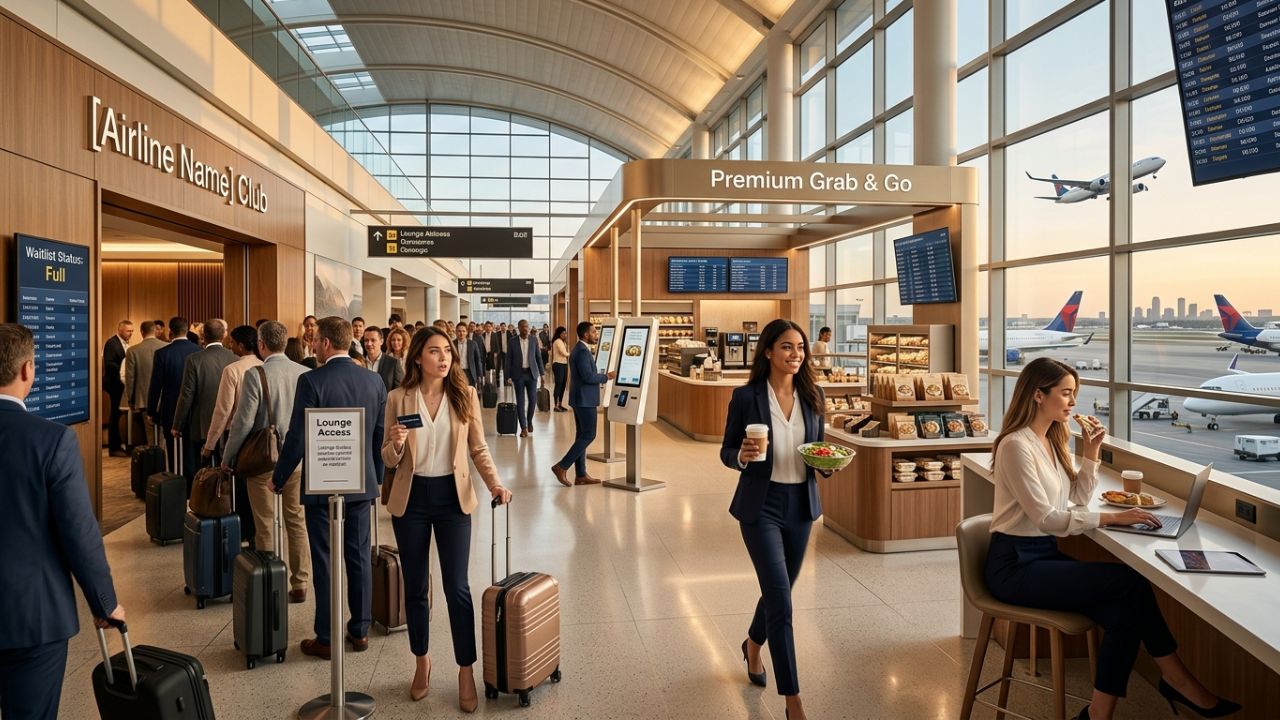
Image representing the intense operational gridlock and massive lounge lockouts aggressively crippling premium travel sanctuaries amidst widespread travel chaos.
Breaking Airline News: Severe Hub Overcrowding Sparks Massive Lounge Lockout as Airlines Deploy High-Velocity Grab-and-Go Outposts
As paralyzing airport disruptions and terrifying waves of passenger congestion violently sweep through domestic terminals, the aviation industry has officially triggered a massive premium lounge lockout. Faced with catastrophic hub overcrowding and severe travel chaos, major airlines are aggressively dismantling expansive luxury retreats to deploy stripped-down, high-velocity grab-and-go outposts, forcefully redefining the modern travel survival strategy.
There is an undeniably sharp, exhausting spike of frustration that completely drains a traveler's energy when they march up to an elite airport sanctuary—having just survived a grueling, hour-long security gauntlet—only to find an impenetrable line of forty furious passengers stretching out into the concourse. For a generation of premium flyers, lounge access was the ultimate, unshakeable promise of terminal tranquility; a guaranteed, highly coveted escape from screaming gate announcements and overpriced terminal food courts. This season, however, that exclusive illusion has violently shattered under the crushing weight of record-breaking passenger volume. To violently combat severe operational bottlenecks, major aviation cartels are aggressively re-engineering premium hospitality. Frantic business travelers are now actively abandoning the fantasy of relaxing sit-down buffets, violently exchanging them for high-speed prepackaged wraps and takeaway cold brews. This massive shift proves that in an era defined by constant flight delays and travel chaos, pure logistical speed has officially eclipsed luxury as the most valuable currency a flyer can hold.
Expanded Overview: Weaponizing the Transit Footprint
The operational layout of elite travel retreats has officially entered an incredibly aggressive restructuring phase. Driven by a massive wave of public backlash against endless wait lines and severely packed seating grids, premier flight carriers are ruthlessly pivoting away from traditional, expansive relaxation architectures. These emerging network adjustments align perfectly with strict capacity control mandates heavily monitored by airport authorities. Instead of housing passengers for hours, major operators are systematically building highly compact, efficiency-first convenience hubs explicitly designed to intercept premium passengers and forcefully move them toward their departure gates at maximum velocity.
Section-Wise Breakdown: The High-Velocity Infrastructure Strategy
The United and American Express Outposts
The structural reality of this massive micro-lounge offensive relies on ruthlessly stripping away the exact perks that once defined the airport sanctuary model. Freshly launched express outposts explicitly lack traditional, space-consuming luxuries like multi-seat dining areas, dedicated baggage restrooms, business workstations, and standalone Wi-Fi routers. United Airlines violently pioneered this spatial compression strategy by deploying its highly optimized United Club Fly layout at Denver International Airport. Following internal research revealing that over half of their premium demographic preferred rapid evasion over lingering, United rapidly expanded this blueprint directly into Houston. Concurrently, American Airlines quickly weaponized its own version, aggressively launching the Provisions by Admirals Club corridor in Charlotte to forcefully funnel ready-to-eat salads and sandwiches to hurried flyers, completely stripping away hot buffets and alcohol networks.
Financial Conglomerates Exploit the Gridlock
Even the most luxury-focused financial institutions are weaponizing this grab-and-go shift to violently sort their exploding, impatient customer bases. To combat chronically congested flagship venues, American Express has aggressively debuted its high-speed Sidecar outposts, immediately launching operations at Harry Reid International Airport in Las Vegas, with a massive expansion already targeting Charlotte. By utilizing rapid QR-code ordering networks, these smaller venues actively satisfy premium cardholders who are simply too frustrated to wait for the full lounge experience.
Transcontinental Deployment
This high-speed passenger sorting strategy has completely infected the global transit hospitality matrix. Delta Air Lines is aggressively embedding dedicated grab-and-go food and beverage channels directly inside its incredibly congested Hartsfield-Jackson Atlanta hubs. Internationally, operators like Air Canada are heavily scaling up curated cafe concepts across Montreal and Vancouver to blend high-speed Wi-Fi charging benches with rapid express pastry cases, violently pivoting the passenger experience toward airborne processing rather than open-ended luxury stays.
Flight Details & Aviation Defense Matrix
To fully comprehend the massive economic pressures forcing airlines into this severe lounge lockout, corporate travel managers must review the exact financial deficit currently suffocating the global aviation sector. The following matrix provides a granular breakdown of the staggering economic reality driving this transition.
| Industry Metric | Massive Economic Impact |
|---|---|
| Baseline Fuel Cost Surge | 100 Billion Dollar Increase |
| Jet Fuel Price Inflation | 70% Annual Increase |
| Total Industry Profit Pool | Sliced by Massive 50% |
| Global Net Rewards | Flattened to Just 23 Billion Dollars |
| International Passenger Traffic | Stable 2% Volume Increase |
Passenger Impact: Surviving the Stripped-Down Terminal
For the everyday traveler dreading the severe physical toll of modern travel chaos, this massive lounge lockout fundamentally alters how they survive the terminal. Ground staff and brand strategists are desperately packing express shelves with premium culinary brands, upscale snacks, and barista-grade lattes to prevent a full-scale terminal mutiny by furious holiday travelers. By violently transforming passive waiting areas into high-performance transit junctions, the aviation sector is forcefully training the flying public to view the pre-flight routine as an exercise in pure logistical speed. For passengers facing sudden flight cancellations, these contactless food desks relieve extreme pressure on overextended lounge attendants, theoretically allowing ground teams to focus exclusively on fixing complex, cascading flight disruptions.
Industry Analysis: The Economics of Terminal Evasion
A deep dive into official financial projections reveals the sheer scale of the economic pressure mounting against international carriers. The tracking data highlights an absolutely staggering 100 billion dollar surge in baseline fuel costs, a catastrophic financial blow that will effectively slice total industry profit pools by an incredible 50 percent, flattening overall net rewards to just 23 billion dollars globally. Furthermore, with jet fuel price inflation tracking at a terrifying 70 percent increase across the year, commercial airlines are operating on razor-thin survival margins. Despite these terrifying economic warning signs, international passenger traffic volumes are managing a stable 2 percent increase as travelers stubbornly refuse to abandon their vacations. Facing exploding crowds and collapsing budgets, airlines are financially forced to heavily optimize their physical footprints, utilizing rapid digital QR codes and automated checkouts to completely dismantle traditional overhead costs.
Conclusion: A Strategic Blueprint for Terminal Efficiency
The massive rollout of express transit outposts proves that the future of premium travel belongs entirely to the efficient. By aggressively stripping away open-ended luxury, global airline alliances are proactively protecting their overextended lounge networks from structural collapse. While the loss of traditional comfort is jarring, these rapid transit amenities actively respect the finite time of modern commuters, violently cutting down on chaotic terminal gate rushes and restoring a vital layer of predictability to long-distance flight days.
Key Takeaways
- Massive Lounge Lockout: Major airlines are actively replacing expansive premium lounges with highly compact, high-velocity grab-and-go convenience hubs.
- Stripped-Down Amenities: The new express outposts explicitly lack multi-seat dining areas, business workstations, and standalone Wi-Fi routers.
- United and American Shift: United expanded its United Club Fly from Denver to Houston, while American Airlines launched the Provisions corridor in Charlotte.
- Financial Conglomerates Pivot: American Express launched its high-speed Sidecar outposts in Las Vegas, bypassing traditional hot buffets.
- Terrifying Financial Pressures: A massive 100 billion dollar surge in baseline fuel costs and a 70% increase in jet fuel prices forced airlines to heavily reduce overhead.
- Traveler Advisory: Passengers must actively embrace high-speed QR-code ordering and contactless checkouts to survive the modern, efficiency-first terminal environment.
Related Travel Guides
Disclaimer
This article is for informational and educational purposes only. It does not constitute legal, financial, or professional advice. While we strive to provide accurate and up-to-date information, travel policies, regulations, and conditions change rapidly. Always verify information with official sources before making travel decisions. Nomad Lawyer makes no representations about the accuracy, reliability, completeness, or suitability of the information provided. Readers should consult qualified professionals for advice specific to their circumstances. The views expressed in this article are those of the author and do not necessarily reflect the views of Nomad Lawyer.
Kunal K Choudhary
Co-Founder & Contributor
A passionate traveller and tech enthusiast. Kunal contributes to the vision and growth of Nomad Lawyer, bringing fresh perspectives and driving the community forward.
Learn more about our team →