
Rajasthan Records 109 Million Tourist Visits in First Half of 2026 Driven by Heritage Circuits
Rajasthan recorded 109,204,101 tourist visits between January and June 2026, with Sikar leading domestic footfall and Jaipur topping international arrivals.

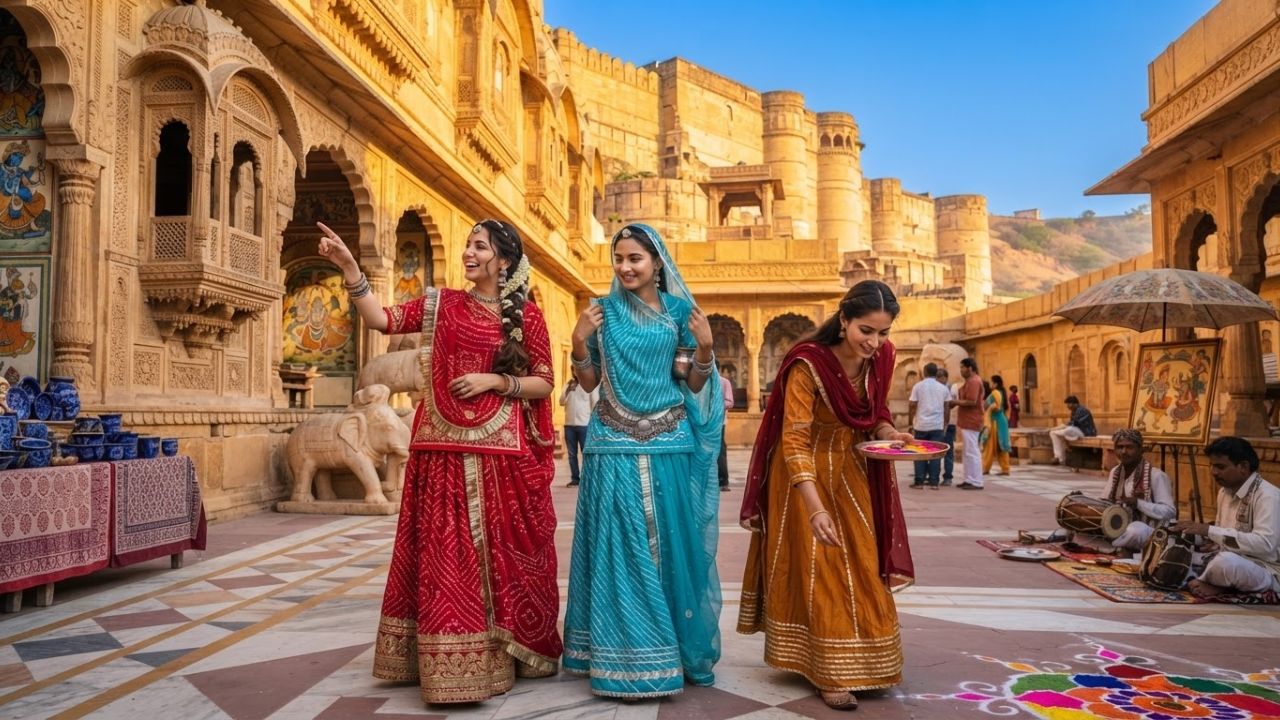
Image generated by AI
Rajasthan recorded 109,204,101 tourist visits during the first six months of 2026, driven by a surge in domestic travel to regional heritage circuits and sustained international arrivals in historic hubs like Jaipur and Udaipur.
[JAIPUR, India] — Official tourism tracking data reveals that Rajasthan welcomed 109,204,101 tourist visits between January and June 2026, cementing its position as India’s top heritage destination. Domestic travelers generated 108,359,405 visits during the six-month period, while international visitors accounted for 844,696 visits across the state's cultural, wildlife, and desert travel zones. The figures highlight a growing demand for decentralized travel routes alongside established royal heritage circuits.
Sikar and Chittorgarh Lead Massive Domestic Tourism Expansion
Domestic travel continues to form the backbone of Rajasthan’s tourism sector, with visitors increasingly exploring destinations beyond traditional capital hubs.
Sikar emerged as the single largest destination for domestic visits between January and June 2026, recording 1,56,18,987 visits. The district outperformed all other travel locations across the state due to strong pilgrimage and cultural movement.
Chittorgarh secured the second position with 1,33,75,121 domestic visits, while the desert hub of Jaisalmer registered 1,18,34,038 domestic tourist visits.
Additional domestic travel contributors included:
- Ajmer: 99,28,270 visits
- Jaipur: 81,49,183 visits
- Karauli: 64,00,913 visits
- Sawai Madhopur: 61,88,159 visits
- Sirohi: 61,13,562 visits
- Udaipur: 47,61,432 visits
- Churu: 34,08,523 visits
The visitor dispersion demonstrates that travel demand is spreading across diverse geographic zones rather than concentrating solely in primary urban centers.
Jaipur and Udaipur Dominate Foreign Visitor Arrivals
International tourist arrivals across Rajasthan reflected steady demand for royal architecture, lake palaces, and historic fortification sites during the first six months of 2026.
Jaipur maintained its position as the premier gateway for international travelers, recording 2,56,293 foreign tourist visits. The state capital's historic palaces, heritage monuments, and museum networks remained primary entry points for overseas itineraries.
Udaipur ranked second for foreign arrivals with 1,84,045 visits, driven by luxury heritage hospitality and lakefront tourism. Jodhpur recorded 82,846 foreign tourist visits, while Jaisalmer logged 66,433 international visitors.
Wildlife and heritage circuits also attracted foreign travelers, with Sawai Madhopur recording 38,542 international visits and Ajmer generating 36,406. Additional international footfall was distributed across Pali, Dausa, Jhunjhunu, and Bikaner.
Kota-Hadoti and Shekhawati Regions Emerge as Cultural Hotspots
Secondary and regional destinations recorded substantial visitor gains between January and June 2026, signaling a shift toward authentic regional exploration and architectural tourism.
Dausa and Jhunjhunu saw elevated foreign tourist movement during the first half of the year. Dausa attracted international interest through its ancient stepwell architecture, while Jhunjhunu drew visitors to the Shekhawati region’s open-air art galleries and painted havelis.
The Kota-Hadoti region—encompassing Kota, Bundi, Baran, and Jhalawar—recorded more than 24 lakh (2,400,000) tourist visits during the six-month period. The region experienced its peak monthly volume in February with 5,14,132 visits, following 4,23,413 visits in January and 4,11,863 visits in March.
Marwar Desert Circuit Sees Early-Year Travel Surge
The Marwar region remained a central driver of regional tourism growth during the first half of 2026. Desert landscapes, fortress architecture, and rural cultural tours brought steady visitor movement across the western districts.
Jodhpur served as the primary international hub for the region with 82,846 foreign visits, while neighboring Pali recorded 28,982 foreign tourist visits. Domestic tourists actively explored circuits linking Jodhpur, Pali, Barmer, Jalore, Nagaur, and Balotra.
Travel tracking shows that the Marwar region recorded its highest overall visitor activity in January 2026, benefiting from favorable winter weather and early-year holiday travel.
Comprehensive H1 2026 Rajasthan Tourism Benchmark Data
The tables below detail the visitor breakdown across top domestic districts and foreign traveler destinations from January to June 2026.
Top Domestic Tourist Destinations (Jan–June 2026)
| Rank | District / Region | Domestic Tourist Visits | Primary Attraction Focus |
|---|---|---|---|
| 1 | Sikar | 15,618,987 | Pilgrimage & Heritage Sites |
| 2 | Chittorgarh | 13,375,121 | Historic Fortresses & Forts |
| 3 | Jaisalmer | 11,834,038 | Desert Architecture & Citadel |
| 4 | Ajmer | 9,928,270 | Spiritual Tourism & Lake Sites |
| 5 | Jaipur | 8,149,183 | Royal Palaces & Museum Network |
| 6 | Karauli | 6,400,913 | Temples & Regional Heritage |
| 7 | Sawai Madhopur | 6,188,159 | Wildlife & National Parks |
| 8 | Sirohi | 6,113,562 | Hill Station & Pilgrimage |
| 9 | Udaipur | 4,761,432 | Lakes & Heritage Palaces |
| 10 | Churu | 3,408,523 | Desert Gateway & Haveli Architecture |
Top Foreign Tourist Destinations (Jan–June 2026)
| Rank | Destination | International Tourist Visits | Primary Travel Draw |
|---|---|---|---|
| 1 | Jaipur | 256,293 | Palaces, Forts & UNESCO Heritage |
| 2 | Udaipur | 184,045 | Lake Luxury & Palace Hospitality |
| 3 | Jodhpur | 82,846 | Fortresses & Desert Gateways |
| 4 | Jaisalmer | 66,433 | Sand Dunes & Citadel Tourism |
| 5 | Sawai Madhopur | 38,542 | Tiger Reserves & Eco-Tourism |
| 6 | Ajmer | 36,406 | Cultural & Historical Monuments |
| 7 | Pali | 28,982 | Heritage Hotels & Temple Complexes |
Regional Hospitality and Travel Infrastructure Impact Analysis
Recording over 109 million tourist visits within six months places increased demands on regional transport networks, hotel capacity, and local infrastructure across Rajasthan.
The heavy concentration of domestic visits in districts like Sikar, Chittorgarh, and Karauli indicates that regional road corridors and rail connectivity are handling significant passenger flows. Domestic travel surges expand economic activity beyond traditional luxury hotel hubs into home-stays, budget accommodations, and regional transport services.
Concurrently, international concentration in Jaipur and Udaipur maintains high occupancy rates for premium heritage properties and boutique hotels. The growth in secondary zones like Shekhawati and Hadoti points toward rising commercial viability for restored heritage properties and rural tourism ventures.
Why This Matters for Travelers, Operators, and Logistics
For the traveler, these visitor figures indicate distinct movement patterns across the state that impact trip planning, crowd levels, and booking timelines:
- Navigating Crowd Patterns: Popular domestic destinations like Sikar and Chittorgarh experience intense weekend and festival footfall. Travelers seeking quieter itineraries will find lower relative crowd density in regions like Churu or Jhalawar.
- International Booking Windows: With Jaipur and Udaipur drawing over 4.4 lakh combined foreign visits in six months, mid-tier and luxury heritage accommodations in these cities require early reservations, especially during peak winter months.
- Offbeat Circuit Logistics: The rise of the Kota-Hadoti circuit (over 24 lakh visits) demonstrates improved regional accessibility. Travelers exploring Bundi or Jhalawar can combine historical fort visits with eco-tourism without the congestion of major metro hubs.
- Seasonal Timing: Data shows regional peaks occurring between January and March. Early-year visits allow travelers to experience desert and heritage routes before summer temperatures rise across Marwar and Jaisalmer.
Related Travel Guides
Disclaimer
This article is for informational and educational purposes only. It does not constitute legal, financial, or professional advice. While we strive to provide accurate and up-to-date information, travel policies, regulations, and conditions change rapidly. Always verify information with official sources before making travel decisions. Nomad Lawyer makes no representations about the accuracy, reliability, completeness, or suitability of the information provided. Readers should consult qualified professionals for advice specific to their circumstances. The views expressed in this article are those of the author and do not necessarily reflect the views of Nomad Lawyer.
Raushan Kumar
Founder & Lead Developer
Full-stack developer with 11+ years of experience and a passionate traveller. Raushan built Nomad Lawyer from the ground up with a vision to create the best travel and law experience on the web.
Learn more about our team →