
Qatar Airways Boeing 777 Intercepted by RAF Typhoons Over England After ATC Communication Failure 2026
Two RAF Typhoon fighter jets intercepted a Qatar Airways Boeing 777-300ER inbound to Manchester Airport on Friday after the aircraft ceased communications with air traffic control.

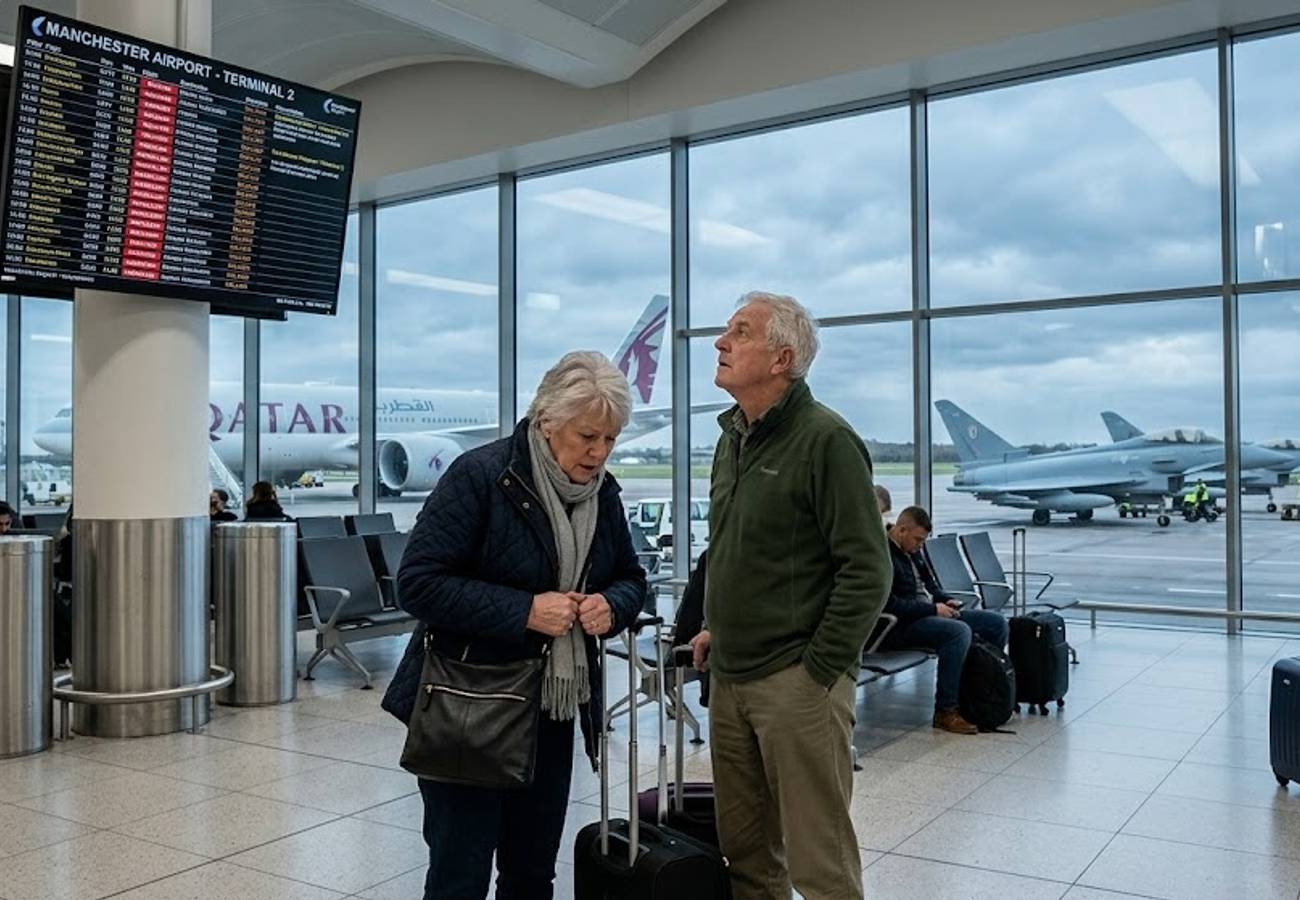
Image generated by AI
[Manchester, July 26, 2026] — Two Royal Air Force (RAF) Typhoon fighter jets were scrambled on Friday evening to intercept a Qatar Airways Boeing 777-300ER after the aircraft stopped responding to air traffic control (ATC) while flying over central England. The flight, identified as QR23 from Doha Hamad International Airport (DOH), was in the final stages of its journey to Manchester Airport (MAN) when the communication failure triggered a high-priority security response.
The UK Ministry of Defence (MoD) confirmed the launch of a Quick Reaction Alert (QRA), a protocol used when an aircraft poses a potential risk or fails to follow established aviation safety procedures. An RAF spokesperson noted that the flight had begun "causing concern to civil authorities," necessitating the immediate deployment of combat aircraft to establish visual contact and ensure the safety of the flight.
RAF Fighter Jets Escort Qatar Airways Flight to Manchester
The interception took place over the skies of Nottingham, where the two Eurofighter Typhoon FGR4s joined the widebody jet. From that point, the fighter jets provided a continuous escort across the Midlands and Yorkshire, monitoring the aircraft until it reached its destination.
The Boeing 777-300ER eventually touched down at Manchester Airport's Terminal 2 shortly before 20:00 BST. According to reports, the aircraft was not met by emergency services upon landing, suggesting that the situation had been stabilized during the escort.
While Qatar Airways acknowledged the incident, the airline's official statement remained brief, stating that the flight was escorted following a "security notification from UK authorities." The carrier did not provide specific details regarding the cause of the communication blackout.
Conflicting Reports on Onboard Security Threats
While the primary explanation for the intercept appears to be a technical failure resulting in lost communications with ATC, other reports suggest a more serious underlying cause. The UK Defence Journal indicated that the RAF response may have been linked to "an incident in which a threat had been made" onboard the aircraft.
Currently, it remains unclear whether this threat was deemed credible or if it was a secondary factor in the decision to launch the QRA. Open-source flight tracking data supported the claim that the aircraft was unresponsive to controllers and had failed to initiate its expected descent into Manchester, which typically signals a loss of cockpit-to-ground coordination.
This is not the first time flight QR23 has been the subject of a military intercept. In August 2014, the same flight number was involved in a QRA incident when a passenger made a hoax bomb threat. On that occasion, RAF Typhoons escorted an Airbus A330 into Manchester, and the individual responsible was arrested. That incident resulted in a 25-minute suspension of all flights entering and exiting Manchester Airport.
Understanding Quick Reaction Alert (QRA) Protocols
A Quick Reaction Alert is a high-readiness state maintained by the RAF, ensuring that fighter jets can be airborne within minutes to intercept unidentified or non-compliant aircraft. These missions are typically triggered by two main scenarios: the detection of an aircraft entering restricted airspace without authorization or a commercial airliner that ceases all radio communication.
The specific aircraft utilized in Friday's operation were Eurofighter Typhoon FGR4s, operating under the callsigns RIGID 11 and RIGID 12. These jets were scrambled from RAF Coningsby in Lincolnshire. While the Typhoon is capable of supersonic speeds, no sonic booms were reported over the Midlands or Yorkshire, indicating the intercept was conducted at subsonic speeds.
Tracking data revealed that both RAF jets were utilizing a transponder code specifically allocated to NATO Air Policing, highlighting the standardized military nature of the operation.
Comparative Impact of RAF Intercepts
Most RAF intercepts involve small private jets or general aviation aircraft. However, intercepts of scheduled commercial flights are treated with extreme caution due to the passenger volume and potential security implications.
| Incident Date | Aircraft Involved | Primary Reason | Outcome |
|---|---|---|---|
| July 2026 | Qatar Airways B777 | Loss of ATC Comms / Alleged Threat | Safe landing at MAN |
| October 2023 | Kenya Airways B787 | Security Concern | Diverted LHR to STN |
| August 2014 | Qatar Airways A330 | Hoax Bomb Threat | Safe landing at MAN; Arrest made |
The October 2023 incident involving a Kenya Airways Boeing 787 Dreamliner serves as a recent precedent, where the aircraft was forced to divert from London Heathrow (LHR) to London Stansted (STN) following a similar military intercept.
Why This Matters: The Passenger and Legal Perspective
For the traveler, an intercept by fighter jets is a high-stress event that signals a breakdown in standard aviation safety. When a cockpit loses communication with ATC, the aircraft becomes "blind" to the controllers who manage the crowded corridors of UK airspace. In the post-9/11 security environment, an unresponsive aircraft is not viewed as a technical glitch but as a potential security breach.
From a logistical and legal standpoint, the use of a QRA ensures that the military can visually inspect the cockpit and use hand signals or other methods to communicate with the crew if the radios are dead. If a "threat" is indeed present onboard, the escort ensures the aircraft is steered away from densely populated urban centers and directed toward a secure landing where police and security forces can take immediate control.
For passengers, these events often result in significant delays and intense questioning upon arrival. If the communication failure was due to a technical fault, it raises questions about the maintenance of long-haul communication systems on widebody aircraft. If the incident was caused by a passenger threat, it reinforces the strict legal penalties associated with aviation security interference.
The incident serves as a stark reminder of the invisible security net protecting international flight paths over the United Kingdom.
Related Travel Guides
Disclaimer
This article is for informational and educational purposes only. It does not constitute legal, financial, or professional advice. While we strive to provide accurate and up-to-date information, travel policies, regulations, and conditions change rapidly. Always verify information with official sources before making travel decisions. Nomad Lawyer makes no representations about the accuracy, reliability, completeness, or suitability of the information provided. Readers should consult qualified professionals for advice specific to their circumstances. The views expressed in this article are those of the author and do not necessarily reflect the views of Nomad Lawyer.
Preeti Gunjan
Contributor & Community Manager
A passionate traveller and community builder. Preeti helps grow the Nomad Lawyer community, fostering engagement and bringing the reader experience to life.
Learn more about our team →