
Ohio’s Dark Sky Sanctuaries: The Rise of Astro-Tourism Across the Buckeye State
Discover Ohio's premier dark sky destinations, from Observatory Park to Hocking Hills, and learn how these protected sites are fighting urban light pollution.

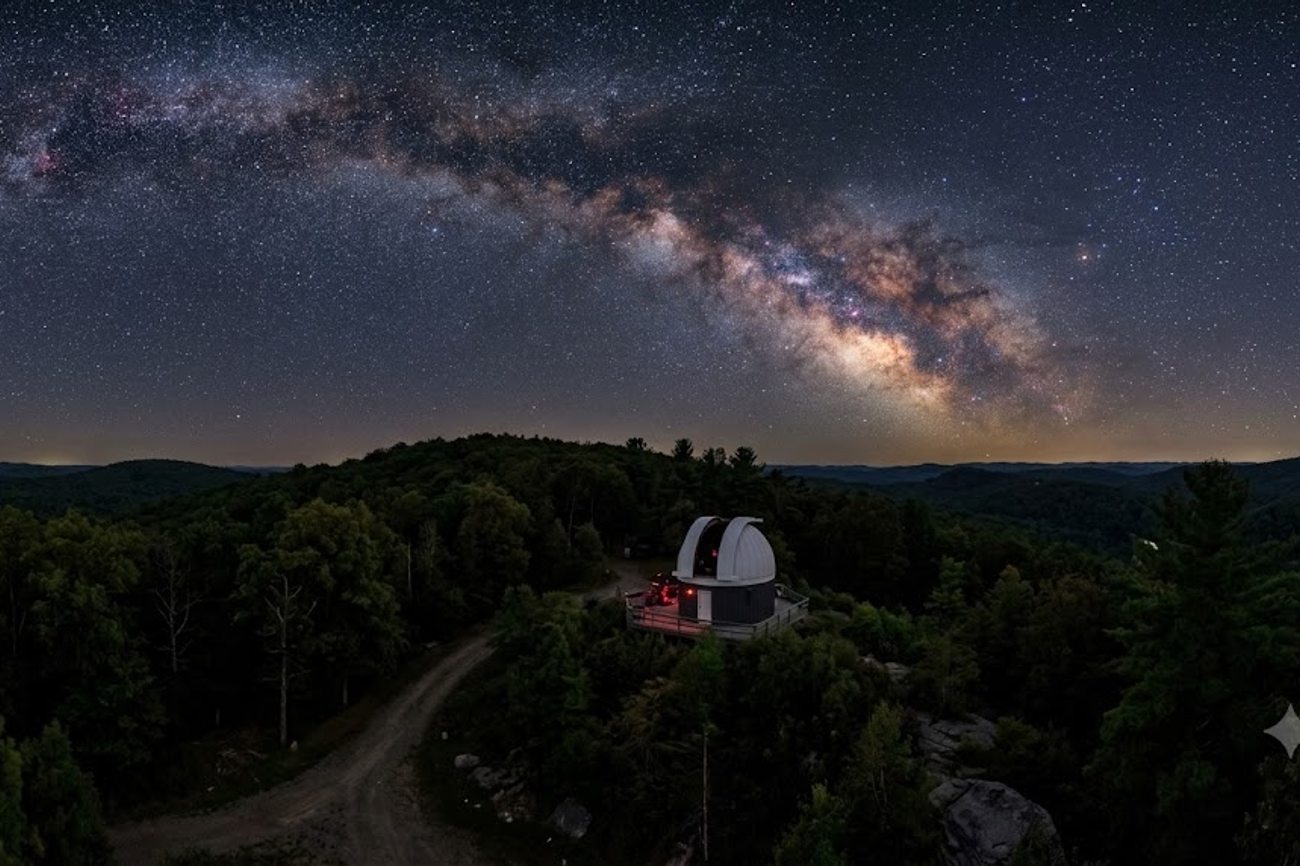
Image generated by AI
[Montville, OH] — For millions of residents in Ohio's urban corridors, the night sky has become a featureless, orange-hued haze. This phenomenon, known as sky glow, is the result of excessive artificial lighting that masks the stars and disconnects city dwellers from the cosmos. However, a growing movement of scientists, conservationists, and tourism boards is working to reverse this trend by establishing protected dark sky sanctuaries across the state.
By implementing strict lighting ordinances and preserving urban wilderness, Ohio is creating a network of celestial hubs. These sites not only protect nocturnal ecosystems but also serve as critical destinations for astrophotographers and casual stargazers looking to escape the light pollution of metropolitan centers like Cleveland, Akron, and Cincinnati.
Montville’s Observatory Park Leads as International Dark Sky Destination
Situated approximately 40 miles east of downtown Cleveland, Observatory Park in Montville Township serves as a primary anchor for celestial observation in Northern Ohio. Managed by the Geauga Park District, this 1,100-acre reserve has earned a Silver-Tier International Dark Sky Park certification.
The park maintains its darkness through the rigorous use of fully shielded, downward-facing outdoor lighting, which prevents light from escaping upward into the atmosphere. At the heart of the reserve is the Oberle Observatory, where visitors can utilize a restored 25-inch Warner & Swasey reflector telescope. Additionally, an on-site planetarium provides educational programming to the public. Because the park is positioned at 41.6° N latitude, it has become a preferred location for astrophotographers attempting to capture the Aurora Borealis during periods of high geomagnetic activity.
Preserving Celestial Visibility in Cuyahoga Valley National Park
Maintaining dark skies is a significant challenge for Cuyahoga Valley National Park, which is sandwiched between the dense population centers of Akron and Cleveland. Despite its proximity to these cities, the park utilizes its natural valley topography to shield visitors from the low-horizon light glow emanating from surrounding suburbs.
Park officials have taken active steps to mitigate light pollution by replacing legacy lighting fixtures with low-impact alternatives that direct light exclusively onto pedestrian pathways. This strategic management allows the park to remain a viable spot for viewing major annual celestial events. Locations such as the Oak Hill Day Use Area, Beaver Marsh, and the Ira Trailhead are recognized as optimal vantage points for observing the Geminids and Perseids meteor showers.
Fry Family Park Sets the Standard for Urban Night Sky Places
In Magnolia, south of Canton, Fry Family Park demonstrates that dark sky preservation is possible even near growing suburban fringes. Spanning more than 330 acres under the management of the Stark County Park District, the park has been designated as an Urban Night Sky Place by DarkSky International.
The park serves as a model for municipal lighting, utilizing 100 percent fully shielded fixtures. To further reduce the impact on the night sky, these lights are rated at warm color temperatures below 2700 K, which is less disruptive to human vision and wildlife than blue-toned LEDs. This environment allows regional photographers to capture high-quality, long-exposure images of deep-sky objects without needing to travel far from the city.
Hocking Hills and the John Glenn Astronomy Park
The unglaciated Allegheny Plateau near Logan provides some of the most profound darkness available in the Midwest. This unique geography is the home of the John Glenn Astronomy Park, a facility specifically engineered to maximize celestial visibility.
The park is equipped with high-end astronomical tools, including hydrogen-alpha solar instruments, a 28-inch telescope housed in a roll-off roof observatory, and an 80-foot open plaza for observers. Due to the exceptionally clear southern horizons, the facility is a hotspot for astrophotographers seeking to document the galactic core during the autumn, summer, and spring months.
Deep Space Observation at Stonelick State Park
For those in the southern part of the state, Stonelick State Park offers a critical dark-sky retreat just 25 miles east of Cincinnati. Located near Bethel, the park consists of a 200-acre lake surrounded by over 1,000 acres of protected forest.
Operated in coordination with the Cincinnati Astronomical Society, the park leverages its geography to enhance viewing. The wide, open beach facing south and east over the water helps reduce thermal air currents—which can cause stars to "twinkle" or blur—and blocks the ground-level light from nearby suburbs. This makes it a premier location for observing star clusters, planetary transits, and seasonal constellations.
Economic Growth Through Sustainable Astro-Tourism
The rise of "astro-travel" is proving to be a significant economic driver for Ohio's rural communities. Unlike traditional tourism, which often peaks during specific seasons, stargazing draws visitors during off-peak evening hours and throughout the winter months.
This influx of visitors benefits local commerce as travelers book overnight stays in cabins, dine at local eateries, and employ specialized astronomy guides. Beyond the immediate financial gain, this trend encourages local governments to adopt "smart" lighting codes. These regulations not only protect the environment and nocturnal wildlife but also reduce municipal energy expenditures.
The Technical Struggle Against Light Pollution
Light pollution is more than a visual nuisance; it is a physical barrier to science and art. In metropolitan areas, artificial light scatters off atmospheric particles, creating a veil of brightness that washes out the faint light of distant galaxies and nebulae.
For astrophotographers, this means a loss of contrast and a struggle to capture detail. By moving to protected reserves, the background "noise" of light pollution is removed. This allows camera sensors to detect the structural details of deep-space targets using standard exposure settings, resulting in vibrant images of galactic formations that would be invisible from a city center.
Ohio Dark Sky Site Comparison
| City / Hub Region | Dark Sky Site Name | Governing Entity | Certification / Status | Primary Celestial Focus |
|---|---|---|---|---|
| Cleveland (Montville) | Observatory Park | Geauga Park District | Silver-Tier IDSP | Aurora Borealis / Deep Sky |
| Akron/Cleveland | Cuyahoga Valley NP | National Park Service | Protected Valley | Meteor Showers (Perseids) |
| Canton (Magnolia) | Fry Family Park | Stark County Park District | Urban Night Sky Place | Long-exposure Photography |
| Logan | John Glenn Astronomy Park | Private/Specialized | High-Darkness Facility | Galactic Core |
| Cincinnati (Bethel) | Stonelick State Park | Ohio State Parks / CAS | Dark Retreat | Planetary Transits |
Why This Matters: The Traveler's Perspective
For the modern traveler, the shift toward dark sky preservation represents a transition from "sightseeing" to "experiencing." In an era of constant screen glare and urban saturation, the ability to see the Milky Way is becoming a luxury good.
From a logistical standpoint, this means that a trip from a city like Akron to a site like Montville is no longer just a drive—it is a transition into a different atmospheric zone. For the visitor, the impact is immediate: the sudden appearance of thousands of stars that were previously invisible creates a psychological shift in perspective, reminding the observer of the scale of the universe. For the local economy, it transforms a "quiet" rural town into a destination for a global community of science enthusiasts.
Related Travel Guides
Disclaimer
This article is for informational and educational purposes only. It does not constitute legal, financial, or professional advice. While we strive to provide accurate and up-to-date information, travel policies, regulations, and conditions change rapidly. Always verify information with official sources before making travel decisions. Nomad Lawyer makes no representations about the accuracy, reliability, completeness, or suitability of the information provided. Readers should consult qualified professionals for advice specific to their circumstances. The views expressed in this article are those of the author and do not necessarily reflect the views of Nomad Lawyer.
Raushan Kumar
Founder & Lead Developer
Full-stack developer with 11+ years of experience and a passionate traveller. Raushan built Nomad Lawyer from the ground up with a vision to create the best travel and law experience on the web.
Learn more about our team →