
New York Airports Face Massive Delays After Rare Radar and Frequency Failures in September 2026
Hundreds of flights across JFK, EWR, and LGA were disrupted on September 20, 2026, due to a rare air traffic control radar anomaly and frequency failure.

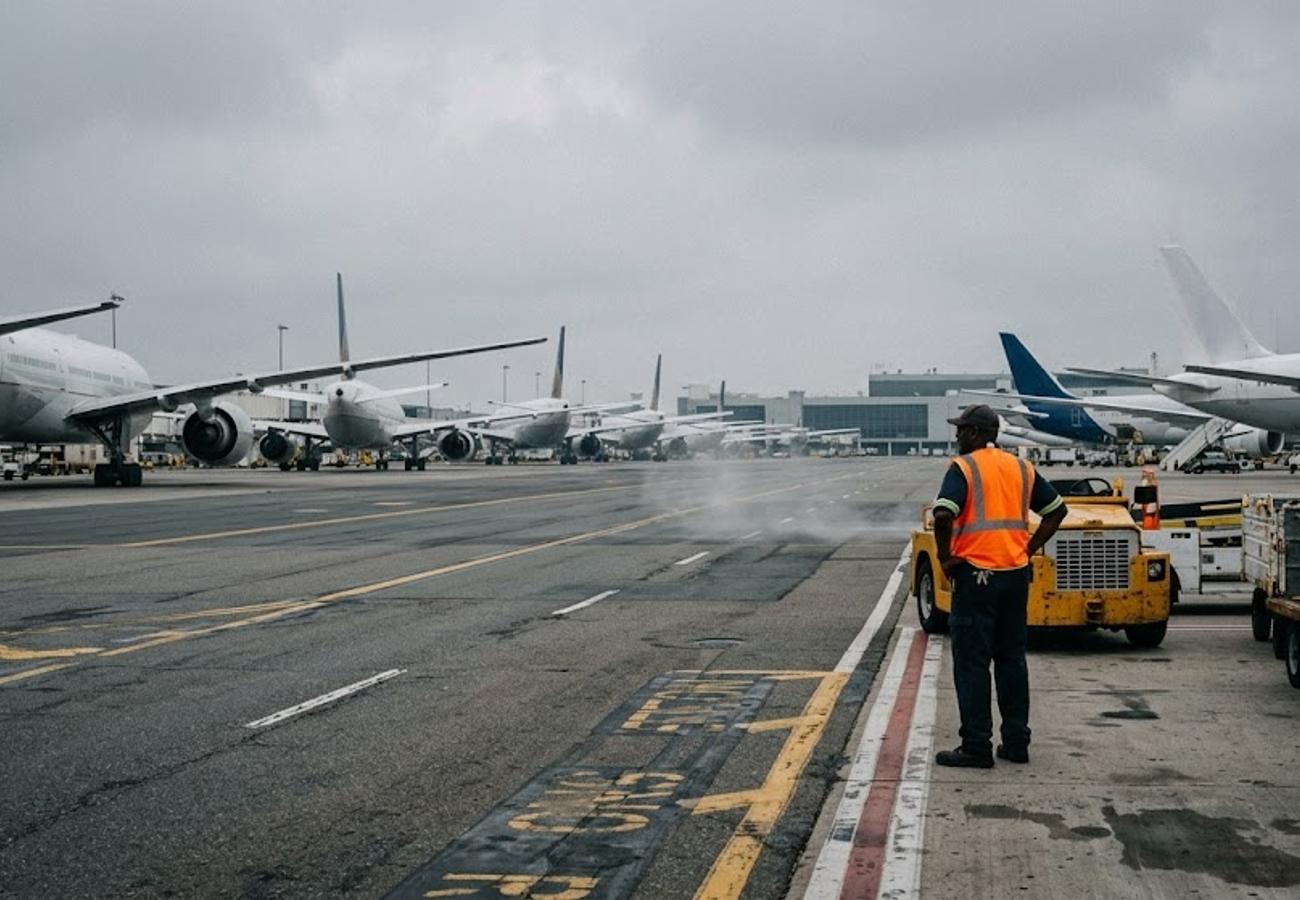
Image generated by AI
A business traveler arriving at John F. Kennedy International Airport on the morning of Sunday, September 20, 2026, likely found themselves trapped in a stationary aircraft on the tarmac, staring at a departure board filled with red delay notices. This was the reality for thousands as a rare technical collapse within the New York air traffic control infrastructure paralyzed one of the world's busiest aviation corridors.
The New York Airspace Technical Collapse
On the morning of September 20, 2026, a series of highly unusual system failures struck the New York metropolitan area's aviation hubs. The disruption centered on the New York Terminal Radar Approach Control (TRACON), which the Federal Aviation Administration (FAA) identified as the source of the equipment trouble.
The failure was not uniform but hit different airports with varying degrees of severity. John F. Kennedy International Airport (JFK) suffered a total radar failure, meaning controllers lost the primary tool used to maintain safe separation between aircraft. Simultaneously, Westchester County Airport (HPN) experienced a total frequency failure, effectively severing the communication link between pilots and air traffic controllers.
Because of the interconnected nature of Northeast airspace, the "anomaly" rippled outward. Both Newark Liberty International Airport (EWR) and LaGuardia Airport (LGA) were forced to implement flight holds and slow their arrival rates to prevent congestion in the skies. By 10:30 a.m. Eastern Time, ground stops were in full effect. While the FAA managed to resolve the issues by 11:01 a.m., the backlog of aircraft created a domino effect that lasted throughout the day.
Affected Routes and Flights
The disruption impacted a vast array of domestic and international flights. While the technical failure was brief, the resulting delays were widespread. Data from FlightAware highlights the scale of the instability across the Northeast corridor on September 20.
| Airport | Delays | Cancellations | Total Disruptions |
|---|---|---|---|
| John F. Kennedy International (JFK) | 247 | 5 | 252 |
| LaGuardia (LGA) | 282 | 3 | 285 |
| Newark Liberty International (EWR) | 229 | 18 | 247 |
| Westchester County (HPN) | 30 | 0 | 30 |
| Boston Logan International (BOS) | 616 | 46 | 662 |
Notably, Boston Logan International Airport saw the highest volume of disruptions, as the FAA implemented broad traffic-management measures to compensate for the chaos in New York airspace. At Newark, passengers faced taxi and gate delays ranging from 31 to 45 minutes.
Your Rights as a Passenger
When a "radar anomaly" or "equipment failure" causes your flight to be delayed or canceled, the legal framework for compensation depends heavily on your jurisdiction and the airline's nationality.
For US-Based Flights and Carriers: Under current US Department of Transportation (DOT) rules, airlines are not legally required to provide monetary compensation for delays caused by air traffic control (ATC) issues, as these are often classified as "outside the airline's control." However, the US DOT has recently tightened rules regarding refunds. If your flight was canceled for any reason—including a radar failure—and you chose not to travel on the alternative offered, you are entitled to a full refund to your original form of payment, not just a travel voucher.
For EU/UK Departures (EU261/2004 and UK261): If you were flying from an EU or UK airport to New York, you are protected by more stringent laws. While ATC failures are often cited as "extraordinary circumstances" to avoid paying cash compensation, the airline is still obligated to provide:
- Duty of Care: Free meals, refreshments, and two phone calls or emails if the delay exceeds a certain threshold (usually 2-4 hours).
- Accommodation: If the delay forces an overnight stay, the airline must provide hotel lodging and transport between the airport and the hotel.
The "Extraordinary Circumstance" Debate: Airlines will likely claim that a TRACON radar failure is an "extraordinary circumstance." However, if the failure was due to poor maintenance of the airline's own onboard equipment (rather than the FAA's ground radar), you may still be eligible for compensation up to €600/£520 depending on the flight distance.
Rebooking Strategy and Alternatives
When the New York airspace freezes, your best move is to act before the crowds reach the customer service desks.
1. Pivot to Alternative Hubs: If you are stuck at JFK or EWR, check for availability at nearby regional airports. While Westchester (HPN) was affected by frequency issues, it may have faster recovery times for smaller regional jets. If you are traveling between New York and Boston, consider the Acela or Northeast Regional trains via Amtrak to bypass the airspace entirely.
2. The Refund vs. Rebooking Trade-off: If the airline offers you a flight 24 hours later, but you can find a seat on a competitor airline (e.g., switching from JetBlue to Delta) for a similar price, request a full refund for the canceled leg under DOT rules and book the competitor. This is often faster than waiting for the airline to clear its own backlog.
3. Monitor Real-Time Status: Avoid relying solely on SMS alerts. Use the official airline disruption pages, such as the British Airways Flight Status page or the specific carrier's app, to see if your aircraft has even departed its origin city. If the incoming plane is still grounded in another state, your "estimated departure" time is likely inaccurate.
FAQ: New York Radar Disruption 2026
Am I entitled to cash compensation for the Sept 20 delays? For US domestic flights, likely no, as ATC failures are generally considered outside the airline's control. For flights departing the EU/UK, you are entitled to "duty of care" (meals/hotels), but cash compensation is unlikely unless the airline's own equipment failed.
Can I get a full refund if my flight was canceled due to the radar anomaly? Yes. Under US DOT regulations, if your flight is canceled for any reason and you choose not to be rebooked, you are entitled to a full refund of the ticket price and any prepaid fees.
What should I do if I am stuck on the tarmac at JFK or EWR? Keep a detailed log of the time spent on the aircraft. US DOT "Tarmac Delay" rules require airlines to provide food and water after two hours and allow passengers to debark after three hours for domestic flights (four for international), unless safety or ATC prevents it.
Why was Boston Logan affected if the problem was in New York? The Northeast corridor is a tightly packed network. When New York TRACON fails, the FAA implements "ground delay programs" across the region to prevent aircraft from entering the airspace and circling, which would create a dangerous safety risk.
When the screens go dark and the planes stop moving, your best asset is a firm understanding of your legal rights.
Related Travel Guides
Disclaimer
This article is for informational and educational purposes only. It does not constitute legal, financial, or professional advice. While we strive to provide accurate and up-to-date information, travel policies, regulations, and conditions change rapidly. Always verify information with official sources before making travel decisions. Nomad Lawyer makes no representations about the accuracy, reliability, completeness, or suitability of the information provided. Readers should consult qualified professionals for advice specific to their circumstances. The views expressed in this article are those of the author and do not necessarily reflect the views of Nomad Lawyer.
Raushan Kumar
Founder & Lead Developer
Full-stack developer with 11+ years of experience and a passionate traveller. Raushan built Nomad Lawyer from the ground up with a vision to create the best travel and law experience on the web.
Learn more about our team →