Kazakhstan Accelerates Silk Road and Adventure Tourism Drive with Free QazETA Digital Entry and Regional Airport Expansion

ASTANA, Kazakhstan — Across the expansive steppe plains, jagged Tian Shan peaks, and ancient Silk Road trading oases of Central Asia, Kazakhstan is orchestrating one of the most comprehensive tourism modernization campaigns in its post-independence history.
Propelled by an unprecedented state commitment exceeding 2.2 trillion tenge in sector investments over a two-year window, the nation is systematically upgrading its regional transport arteries, streamlining digital border entry, and converting its vast geographical scale from a logistical barrier into an adventure travel asset.
The strategic acceleration follows Kazakhstan's high-profile delegation at the World Travel Market (WTM) London 2026, held from 3 to 5 November, where Central Asian travel authorities presented a forward-looking roadmap to global tour operators and aviation planners.
The initiative is anchored in robust cross-border momentum. Official immigration data indicates that Kazakhstan welcomed approximately seven million foreign visitors during the first six months of 2026 alone.
Regional neighbor Uzbekistan emerged as the primary source of inbound movement, generating roughly 2.5 million arrivals, followed by Kyrgyzstan with 1.6 million and Russia with 1.5 million. Concurrently, outbound leisure traffic from China surged by 46.8 percent in 2025 to surpass 960,000 visitors, supported by reciprocal visa-free regimes and expanding direct aviation links to commercial hubs like Shanghai and Guangzhou.
To harness this growing international interest, the Kazakh government has initiated a multi-layered infrastructure offensive.
This includes the phased rollout of the free "QazETA" electronic travel authorization platform, the construction of strategic regional airports in remote ecological havens such as Katon-Karagai and Kenderli, the landmark signing of an EU Horizontal Aviation Agreement with 17 European nations, and a formal partnership with the Adventure Travel Trade Association (ATTA) to position Kazakhstan's national parks, alpine canyons, and UNESCO-listed Timurid monuments before a global audience.
KAZAKHSTAN TOURISM MODERNIZATION & STRATEGY SCORECARD (2026)
| Category / Entity | Details / Impact |
|---|---|
| Strategic Framework | Kazakhstan Tourism Strategy 2026 & National Development Plan |
| Total Sector Investment | Exceeds 2.2 Trillion Tenge Across a Two-Year Implementation Cycle |
| H1 2026 Inbound Foreign Volume | ~7.0 Million Foreign Visitor Arrivals (January–June 2026) |
| Top Source Nation (H1 2026) | Uzbekistan (~2.5 Million Arrivals; Cross-Border & Heritage Travel) |
| Secondary Source Nations (H1) | Kyrgyzstan (~1.6 Million Arrivals); Russia (~1.5 Million Arrivals) |
| Chinese Market Expansion | +46.8% Inbound Growth in 2025 (>960,000 Arrivals; Reciprocal Visa) |
| New European Aviation Accord | EU Horizontal Aviation Agreement Signed 23 June 2026 (17 Nations) |
| Direct European Route Launch | LOT Polish Airlines Warsaw–Almaty (Launched 1 June 2026) |
| Digital Entry Innovation | Free "QazETA" Electronic Travel Authorisation (Phased from 1 Nov) |
| Mandatory QazETA Deadline | 1 July 2027 (Mandatory for Eligible Visa-Free International Guests) |
| Remote Regional Airport Sites | Katon-Karagai (Altai), Zaysan (East), Kenderli (Caspian Sea Coast) |
| Global Adventure Partnership | Kazakh Tourism Accord with Adventure Travel Trade Association (ATTA) |
| National Park Visitation | 3.7 Million Protected Area Visits in 2025 (Up from 2.8M in 2024) |
| Almaty Mountain Cluster Plan | ~30 Planned Cableways & 161 km of Connected Ski/Hiking Trails |
| Anchor Silk Road Monument | Mausoleum of Khoja Ahmed Yasawi, Turkestan (UNESCO World Heritage) |
The Regional Inbound Engine: Uzbekistan, Kyrgyzstan, and Russia Anchor 7 Million Arrivals
At the geographic heart of Eurasia, Kazakhstan’s visitor economy benefits from an immense, highly active regional travel ecosystem. The arrival of roughly seven million foreign travelers in the first half of 2026 reflects the enduring strength of shared historical, economic, and familial ties across Central Asia.
Uzbekistan’s position as Kazakhstan’s largest inbound source market—accounting for approximately 2.5 million border crossings in H1 2026—demonstrates the intense commercial and cultural integration linking the two largest economies in Central Asia.
Travelers from Tashkent, Samarkand, and the Fergana Valley flow regularly across land border terminals such as Zhibek Zholy into southern Kazakhstan, visiting family networks, conducting bilateral trade, and completing spiritual pilgrimages to the sacred Islamic shrines of Turkestan and Sayram.
Similarly, Kyrgyzstan contributed roughly 1.6 million visitors during the six-month period, reflecting seamless land border movement between Bishkek and Almaty. The short 240-kilometer highway corridor connecting the two cities allows Kyrgyz citizens to frequent Almaty’s international shopping centers, medical institutions, and business conferences, while Kazakh travelers regularly cross in the opposite direction toward the alpine waters of Lake Issyk-Kul.
The Russian Federation represented the third major regional pillar, generating approximately 1.5 million arrivals in the first half of 2026. Sharing the world's longest continuous land border, stretching across more than 7,500 kilometers, cross-border travel between Russian industrial hubs in Western Siberia, the Urals, and the Volga basin into northern Kazakh regional centers remains frequent for business, transport logistics, and family reunification.
Tourism analysts emphasize that cross-border movement statistics capture diverse travel motivations, encompassing commercial trade and transit alongside leisure vacations.
For Kazakhstan’s domestic hospitality operators, the primary opportunity lies in converting regional transit travelers into multi-day cultural tourists. By developing regional flight connections, expanding high-speed rail services, and packaging joint Central Asian Silk Road itineraries that link Samarkand and Bukhara with Turkestan and Almaty, the country is transforming transit traffic into high-yield tourism revenue.
KAZAKHSTAN H1 2026 FOREIGN INBOUND MARKET SHARE (EST. 7M TOTAL)
| Entity / Route | Metrics | Operational Status |
|---|---|---|
| Source Country | H1 2026 Visitor Volume | Strategic Profile |
| Uzbekistan | ~2.50 Million Arrivals | Trade, Kinship & Shrines |
| Kyrgyzstan | ~1.60 Million Arrivals | Cross-Border & Commercial |
| Russian Federation | ~1.50 Million Arrivals | Long-Border Transit & Biz |
| China (Surging Fast) | >960,000 Annual Base (2025) | Nature & Urban Shopping |
| Rest of World & Europe | Balance of Global Arrivals | Adventure & Silk Road |
The Chinese Outbound Wave: Visa-Free Corridors and New Aviation Bridges
While neighboring post-Soviet states provide a reliable volume foundation, China represents Kazakhstan’s fastest-accelerating international growth market.
Official government data reveals that Chinese visitor arrivals expanded by an astonishing 46.8 percent in 2025, surpassing 960,000 visitors. This dramatic expansion was unlocked by the mutual 30-day visa-free agreement enacted between Astana and Beijing, which eliminated bureaucratic visa barriers for ordinary passport holders.
Geographical proximity and strategic economic alignment under the Belt and Road Initiative have catalyzed extensive business and leisure travel. Chinese travelers from neighboring Xinjiang have long accessed border trade complexes like Khorgos.
However, the current travel wave is originating from tier-one eastern and southern Chinese metropolises.
To support this demand, Kazakh and Chinese civil aviation authorities have aggressively expanded direct air links. Beyond established trunk routes linking Astana and Almaty with Beijing and Ürümqi, new direct non-stop scheduled services have been inaugurated to commercial engines including Shanghai and Guangzhou.
For Chinese independent travelers, Kazakhstan offers an exotic, geographically accessible overseas destination characterized by dramatic natural contrasts:
- Alpine Mountain Escapes: The snow-capped peaks of the Trans-Ili Alatau rising directly behind Almaty provide world-class skiing, mountain gondolas, and luxury mountain dining within a 30-minute drive of the city center.
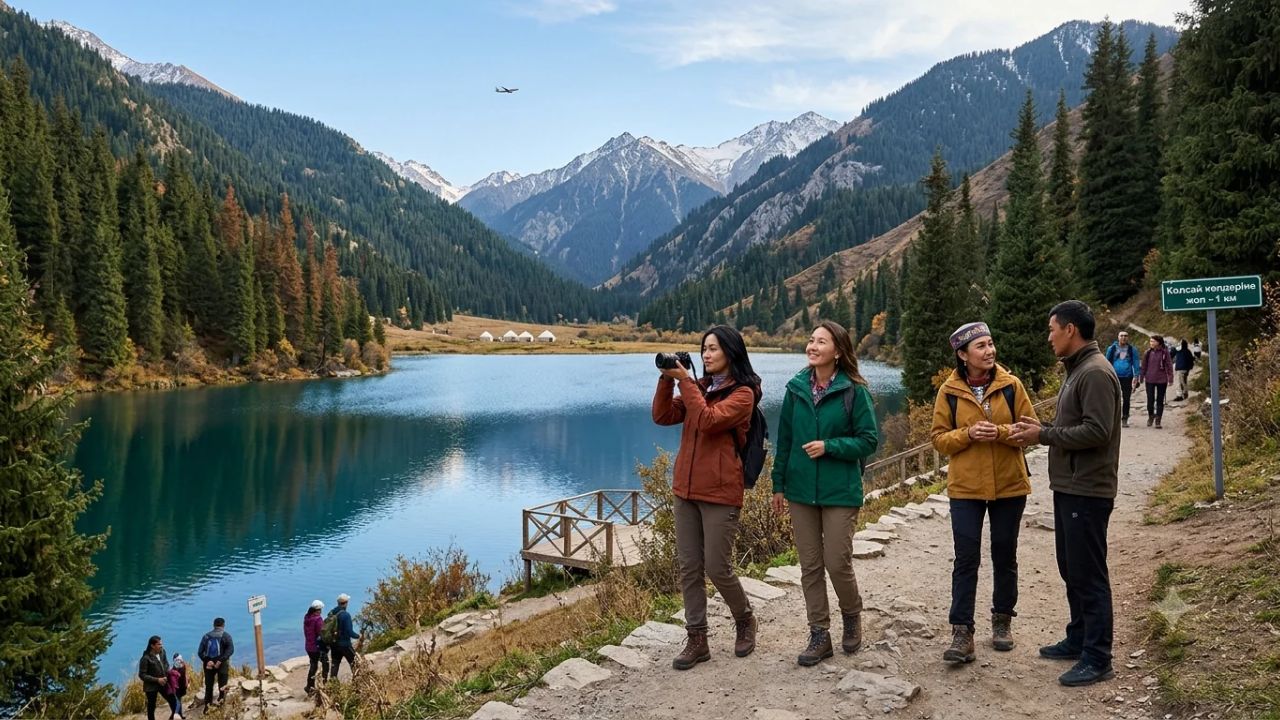
- Photogenic Nature Landscapes: The dramatic red sandstone formations of Charyn Canyon and the pristine turquoise waters of the Kolsai and Kaindy Lakes have become viral sensations on Chinese digital platforms like Xiaohongshu and Douyin.
- Modern Urban Architecture: The futuristic, Norman Foster-designed skyline of the national capital, Astana—including the Baiterek Tower, the Palace of Peace and Reconciliation, and the Khan Shatyr Entertainment Center—draws architecture enthusiasts and urban explorers.
For Kazakh inbound operators, catering to the Chinese travel market has involved adopting mobile digital payment platforms like WeChat Pay and Alipay across major urban hotels and shopping centers, while training Mandarin-speaking tour guides to lead excursions across southern Kazakhstan's heritage sites.
DRIVERS OF THE KAZAKH-CHINESE TOURISM CORRIDOR EXPANSION
| Column 1 |
|---|
| [ 30-Day Mutual Visa Exemption ] |
| Eliminates consular processing friction; enables spontaneous weekend & business travel. |
| v |
| [ Strategic Route Diversification ] |
| Direct non-stop flights inaugurated connecting Almaty/Astana to Shanghai & Guangzhou. |
| v |
| [ Social Media Amplification ] |
| Stunning visual assets (Kolsai, Charyn Canyon) trend across Xiaohongshu and Douyin. |
| v |
| [ 46.8% Inbound Growth Rate ] |
| Chinese arrivals cross 960,000 threshold; high per-capita shopping and hotel spend. |
European Connectivity: The EU Horizontal Aviation Pact and LOT Polish Expansion
Expanding long-haul visitor flows from Western and Central Europe has long represented a primary goal for Kazakh tourism authorities seeking to diversify source markets and increase average visitor spend. In 2026, two landmark aviation developments significantly reshaped connectivity between Kazakhstan and the European continent.
On 23 June 2026, the Republic of Kazakhstan and the European Union formally executed a comprehensive Horizontal Aviation Agreement in Brussels, covering 17 EU member states. The participating European nations include Poland, Germany, France, Austria, Belgium, the Netherlands, Italy, Hungary, and Finland.
The horizontal pact represents a vital legal modernization. Under traditional bilateral air service agreements, traffic rights between Kazakhstan and individual European nations were restricted strictly to the national flag carriers of the respective signatory countries.
The new agreement removes nationality-based restrictions, recognizing all EU airlines as Community carriers. This allows any European airline established within a signatory state to operate flights to Kazakhstan under existing bilateral route rights, establishing the regulatory foundation for expanded competition, code-sharing partnerships, and new city-pair connections.
EU HORIZONTAL AVIATION AGREEMENT: KEY STRUCTURAL HIGHLIGHTS
| Category / Entity | Details / Impact |
|---|---|
| Agreement Date & Location | Signed 23 June 2026 in Brussels, Belgium |
| Participating European States | 17 EU Member States (Germany, France, Poland, etc.) |
| Core Legal Reform | Dismantles bilateral nationality clauses for EU carriers |
| Regulatory Impact | Any EU airline can utilize traffic rights across members |
| Commercial Aviation Precedent | LOT Polish Airlines Warsaw–Almaty Launch (1 June 2026) |
| Existing Connecting Routes | Warsaw–Astana, Frankfurt–Astana/Almaty (Lufthansa/Air Ast) |
| Market Objective | Broaden European tourist access to Silk Road & Altai eco |
Simultaneously, commercial carriers are translating regulatory reform into physical airlift. On 1 June 2026, Polish national carrier LOT Polish Airlines formally inaugurated direct scheduled service connecting Warsaw Chopin Airport (WAW) with Almaty International Airport (ALA).
Operating multiple weekly rotations with modern Boeing 737 MAX and Boeing 787 Dreamliner aircraft, the new Almaty route complements LOT’s existing non-stop service between Warsaw and Astana.
The Warsaw gateway serves as a highly efficient transit bridge for travelers originating in Germany, the United Kingdom, Scandinavia, France, and North America. Rather than navigating circuitous Middle Eastern connections, European cultural tourists and adventure trekkers can reach the foothills of the Tian Shan mountains via a single streamlined transfer in Poland.
Civil aviation analysts note that while the EU Horizontal Agreement does not automatically guarantee new flight inaugurations, it establishes the essential legal architecture.
As demand for Central Asian overland travel accelerates, European leisure carriers and low-cost operators can readily deploy seasonal capacity into Kazakhstan without negotiating complex intergovernmental treaties.
Unlocking Remote Frontiers: Regional Airport Development in Katon-Karagai, Zaysan, and Kenderli
One of the persistent paradoxes of Kazakhstan’s tourism geography is that its most spectacular, ecologically pristine wilderness areas are situated thousands of kilometers away from the primary international gateways of Almaty and Astana.
Covering 2.7 million square kilometers as the world’s ninth-largest nation, traversing the country via conventional road or rail networks can require multiple days of travel.
To resolve this geographical bottleneck, the Kazakh Ministry of Transport and regional akimats (governments) have launched an ambitious regional airport infrastructure construction program, prioritizing three remote tourism clusters:
- Katon-Karagai Airport (East Kazakhstan): Situated in the heart of the Altai Mountains near the borders with Russia, Mongolia, and China, Katon-Karagai is renowned for its alpine meadows, dense Siberian cedar forests, mineral hot springs, and traditional maral (red deer) breeding estates. Previously accessible only via an arduous eight- to ten-hour overland drive from Ust-Kamenogorsk (Oskemen), the new regional airport will accommodate regional turboprop aircraft and charter jets, opening direct access to Mount Belukha and pristine eco-lodges.
- Zaysan Airport (East Kazakhstan): Located on the shores of Lake Zaysan, one of Central Asia’s oldest and largest freshwater lakes, framed by the Saur mountain ranges. The facility will facilitate nature-based tourism, sport fishing, birdwatching expeditions, and scientific research while improving logistics for local border communities.
- Kenderli Airport (Mangystau Region): Positioned along the warm, turquoise southern shores of the Caspian Sea, 210 kilometers south of Aktau. Kenderli is being developed as a major seaside resort city and beach tourism cluster, combining marine leisure with excursions into the surreal chalk-white canyons and limestone plateaus of the Ustyurt Nature Reserve. The dedicated airport will allow domestic and international charter flights to land directly at the resort zone.
STRATEGIC REGIONAL AIRPORT MODERNIZATION IN REMOTE NATURE ZONES
| Airport Project | Geographical Region | Primary Tourism Focus |
|---|---|---|
| Katon-Karagai Regional Airport | Altai Mountains, East KZ | Eco-tourism, alpine hiking |
| Near Mount Belukha | Maral deer wellness spas | |
| Zaysan Regional Airport | Lake Zaysan Basin, East KZ | Lake recreation, fishing |
| Saur Mountain Range | Cross-border eco-routes | |
| Kenderli Resort Airport | Caspian Sea Coast, Mangystau | Warm coastal beach breaks |
| Southern Aktau Peninsula | Ustyurt plateau canyons |
Aviation economists observe that constructing regional airports is only the first phase; establishing economically viable scheduled routes requires airline subsidies, marketing agreements with regional tour operators, and high-standard ground hospitality infrastructure.
Nevertheless, these new airstrips represent a transformative long-term asset that will distribute visitor spending directly into remote rural communities.
QazETA Digital Modernization: Phased Rollout and Border Streamlining
In tandem with physical runway development, Kazakhstan is overhauling its digital border infrastructure. On 1 November 2026, the Ministry of Internal Affairs, in coordination with the Ministry of Tourism and Sports, formally initiated the phased implementation of "QazETA"—the national Electronic Travel Authorisation system.
Designed to enhance national security while streamlining processing at border inspection checkpoints, QazETA applies to citizens of countries eligible for visa-free entry into Kazakhstan.
The system operates entirely online, allowing prospective international visitors to submit biographical data, passport scans, and travel itinerary details prior to departure.
Key operational characteristics of the QazETA framework include:
- Completely Free Application Process: Unlike electronic authorization systems in other jurisdictions that charge processing fees (such as the US ESTA, European ETIAS, or UK ETA), QazETA applications are processed entirely free of charge, ensuring that the system does not impose an unexpected financial barrier on travelers.
- Advance Submission Protocol: Travelers are instructed to submit their digital application at least 72 hours prior to scheduled arrival in Kazakhstan to allow sufficient time for automated data verification.
- Transition Grace Period: Recognizing that international travelers require time to adjust to new travel regulations, border authorities will not deny entry to eligible visa-free travelers during the initial transition period solely for lacking a QazETA authorization. Border guards will assist arriving passengers with on-site digital registration.
- Legal Distinctions: QazETA does not replace a consular visa for citizens of countries that require an entry visa, nor does an approved QazETA guarantee automatic entry into the country; final admission remains at the discretion of border control officers at ports of entry.
QAZETA DIGITAL ENTRY ROLLOUT SCHEDULE (2026–2027)
| Entity / Route | Metrics | Operational Status |
|---|---|---|
| Implementation Phase | Effective Date Range | Checkpoints Included |
| Phase 1: Pilot Launch | 1 November 2026 | Aktau International (SCO) |
| 4 Land Border Checkpoints | ||
| Phase 2: Main Air Gateways | 1 January 2027 | Astana Int'l (NQZ) |
| Almaty Int'l (ALA) | ||
| Phase 3: Regional Expansion | March 2027 | Secondary Regional Land |
| and Regional Air Borders | ||
| Phase 4: Full Mandatory Status | 1 July 2027 | Universal Enforcement for |
| Eligible Visa-Free Guests |
By staging the deployment across four distinct phases—beginning at Aktau, expanding to Astana and Almaty on 1 January 2027, and achieving mandatory status on 1 July 2027—Kazakhstan is avoiding the technical glitches and airport queues that frequently accompany overnight digital visa transitions.
Adventure Tourism & Protected Lands: The ATTA Accord, Almaty Cluster, and Charyn Canyon
Kazakhstan's long-term tourism strategy deliberately pivots toward high-value, low-impact adventure and nature tourism.
On 28 August 2026, the national tourism organization Kazakh Tourism signed a landmark cooperation agreement with the Adventure Travel Trade Association (ATTA), the world’s leading global network of adventure travel enterprises.
The ATTA partnership provides a structured framework to accelerate international standards across Kazakhstan’s outdoor sector:
- Destination Readiness Assessments: ATTA experts are evaluating safety protocols, trail maintenance, and waste management systems across premier national parks.
- Professional Guide Certification: Conducting international training programs for local mountaineering, trekking, and rafting guides, emphasizing wilderness first aid and leave-no-trace outdoor ethics.
- Global Trade Familiarization: Hosting international adventure travel buyers, specialized media, and expedition organizers to inspect trekking circuits in the Altai and Tian Shan ranges.
- Future Summit Hosting: Exploring the hosting of major international adventure travel conferences in Kazakhstan to showcase Central Asian outdoor assets.
The timing of this partnership aligns with surging public engagement in outdoor recreation. Official Ministry of Tourism figures show that visits to Kazakhstan’s protected natural areas and national parks reached 3.7 million in 2025, up significantly from 2.8 million in 2024—a 32 percent year-on-year increase.
KAZAKHSTAN PREMIER ADVENTURE & ECO-TOURISM CORRIDORS
| Entity / Route | Metrics | Operational Status |
|---|---|---|
| Natural Attraction | Geographic Location | Defining Landscape Assets |
| Charyn Canyon National Park | 200 km East of Almaty | Dramatic Red Sandstone; |
| Near Chinese Border | "Valley of the Castles" | |
| Kolsai & Kaindy Lakes | Northern Tian Shan Slopes | Turquoise Alpine Waters; |
| Almaty Region | Submerged Sunken Forest | |
| Altyn-Emel National Park | Ili River Basin | "Singing Dunes"; Aktau |
| Almaty Region | Chalk & Katutau Canyons | |
| Almaty Mountain Cluster | Trans-Ili Alatau Peaks | Shymbulak Ski Resort; |
| Directly South of Almaty City | 161 km of Planned Trails |
In the Almaty region, the government is executing the ambitious Almaty Mountain Cluster master plan. Designed to establish the city as Central Asia's premier year-round alpine destination, the multi-year development program outlines the installation of approximately 30 modern aerial cable car systems and the creation of 161 kilometers of interconnected hiking and ski trails.
These facilities aim to seamlessly connect existing ski resorts like Shymbulak with surrounding alpine valleys, allowing visitors to trek or ski across linked mountain ranges without returning to the city center.
Ancient Silk Road Heritage: Turkestan, Taraz, and Living Nomadic Traditions
Complementing its wild mountain geography, southern Kazakhstan possesses a rich reservoir of ancient Silk Road civilizational heritage. For millennia, caravan routes crisscrossed these river valleys, carrying silk, spices, paper, and philosophical ideas between the Roman, Persian, Chinese, and Islamic empires.
The undisputed spiritual and cultural crown jewel of this corridor is the city of Turkestan, situated in the southern plains. Turkestan is home to the UNESCO World Heritage-listed Mausoleum of Khoja Ahmed Yasawi, commissioned by the conqueror Timur (Tamerlane) between 1389 and 1405.
With its massive ribbed turquoise dome, monumental tiled portals (pishtaq), and intricate glazed brick mosaics, the complex represents one of the finest surviving examples of Timurid architecture in the world.
Recent state investments have transformed Turkestan into a modern cultural tourism hub, establishing luxury hotels, the "Karavan Saray" entertainment complex featuring artificial waterways and theatrical performances, and an international airport connecting the holy city directly with Istanbul, Dubai, and regional capitals.
Further east along the ancient trade route lies Taraz, a historic city celebrating more than 2,000 years of documented urban history. Visitors in Taraz explore archaeological excavation sites revealing ancient bathhouses, underground water pipes, caravanserais, and the exquisite 11th-century Aisha Bibi Mausoleum, renowned for its delicate terracotta tile carvings.
Beyond monumental brick architecture, Kazakhstan’s cultural appeal resides in its living nomadic heritage:
- Yurt Camp Living: Staying in authentic felt yurts (kiyiz uy) erected in the high mountain meadows (jailoo), where travelers experience traditional nomadic hospitality away from modern urban distractions.
- Equestrian Traditions: Witnessing demonstrations of legendary Central Asian horsemanship, including national sports like kokpar (equestrian polo), kyz kuu (horse racing courtship), and audaryspak (horseback wrestling).
- Nomadic Gastronomy: Savoring indigenous culinary specialties, including beshbarmak (boiled horsemeat or lamb served over hand-rolled pasta sheets with rich onion broth), delicate kazy sausages, fresh baursak fried breads, and traditional dairy beverages like kumis (fermented mare’s milk) and shubat (fermented camel’s milk).
RECOMMENDED 5-DAY CENTRAL ASIAN DISCOVERY ITINERARY: KAZAKHSTAN
| Column 1 |
|---|
| DAY 1: ALMATY CULTURAL & ALPINE INTRODUCTION |
| - 09:00: Stroll Panfilov Park; admire the timber, earthquake-proof Zenkov Cathedral. |
| - 11:30: Sample regional cheeses, dried fruits, and smoked horsemeat at the Green Bazaar. |
| - 14:00: Ride the modern Medeu cable car up to Shymbulak Mountain Resort (2,260m). |
| - 18:30: Sunset panoramic dinner at Kok Tobe hill overlooking the Almaty city lights. |
| DAY 2: CHARYN CANYON & KOLSAI LAKES OVERLAND |
| - 07:30: Depart Almaty for the dramatic sandstone gorge of Charyn Canyon. |
| - 10:30: Hike the 3 km "Valley of the Castles" trail down to the Charyn River. |
| - 13:30: Traditional Kazakh lunch at a local village guest home in Saty. |
| - 15:30: Continue to Lower Kolsai Lake; rent wooden rowing boats on pristine waters. |
| - 19:30: Overnight stay at an eco-lodge or comfortable wooden cabin in Saty village. |
| DAY 3: SUNKEN FOREST OF KAINDY & RETURN TO ALMATY |
| - 08:30: Transfer via Russian 4x4 UAZ vans through rugged terrain to Lake Kaindy. |
| - 10:00: Witness the ghostly submerged spruce trees rising out of crystal alpine waters. |
| - 13:00: Picnic lunch overlooking mountain passes; return drive to Almaty. |
| - 19:00: Board the clean, modern overnight high-speed Talgo train to Turkestan. |
| DAY 4: SPIRITUAL SILK ROAD TREASURES IN TURKESTAN |
| - 08:30: Arrive in Turkestan; check into a traditional heritage boutique hotel. |
| - 10:00: Guided tour of the UNESCO Mausoleum of Khoja Ahmed Yasawi & Friday Mosque. |
| - 13:00: Sample authentic southern Kazakh pilaf (palaw) and shashlik skewers. |
| - 15:00: Explore the ancient underground Hilvet mosque and botanical gardens. |
| - 18:30: Evening stroll through the Karavan Saray illuminated cultural complex. |
| DAY 5: ANCIENT OTRAR & CROSS-BORDER TRANSIT |
| - 08:30: Morning excursion to the archaeological mounds of ancient Otrar fortress. |
| - 11:30: Visit the revered Mausoleum of Arystan Bab, spiritual mentor to Yasawi. |
| - 14:00: Transfer to Shymkent for domestic flights back to Astana or Almaty, or proceed |
| south across the border into Tashkent, Uzbekistan, for extended Silk Road circuits. |
Strategic Guidance for International Travelers
Travelers planning an expedition to Kazakhstan in 2026 and 2027 should incorporate several practical considerations into their travel planning:
- QazETA Compliance: If traveling on a visa-free passport, verify whether your entry point falls under active QazETA phases (Aktau in Phase 1; Astana and Almaty beginning 1 January 2027). Submit your free online application via the official government portal at least 72 hours prior to departure, carrying a printed or digital copy of the approval confirmation.
- Optimal Seasonal Timing: For cultural Silk Road sightseeing, hiking in national parks, and lake excursions, the ideal travel seasons are late spring (May to June) and early autumn (September to October), when steppe temperatures are moderate. Alpine skiers and snowboarders should target December through March for pristine powder conditions at Shymbulak.
- Domestic Rail Mobility: Kazakhstan’s state railway network (KTZ) operates modern, Spanish-designed Talgo high-speed sleeper trains connecting all major cities. Booking overnight Talgo trains between Almaty, Astana, Shymkent, and Turkestan provides a comfortable, affordable alternative to domestic flights while allowing travelers to experience the rhythmic scale of the Kazakh steppe.
- Financial Transactions: While credit cards (Visa and Mastercard) and contactless mobile payments are universally accepted in major restaurants, shopping malls, and supermarkets in Almaty and Astana, cash in Kazakhstani Tenge (KZT) is essential for purchases at rural bazaars, taxi hires, and mountain village homestays.
Kazakhstan’s ambitious tourism expansion demonstrates that modernization and cultural authenticity can proceed hand in hand.
By investing over 2.2 trillion tenge in civil infrastructure, rolling out friction-free digital borders, and preserving its ancient Silk Road monuments, the heart of Central Asia is asserting its place on the global travel stage—inviting the world to discover its boundless landscapes.
Related Travel Guides
- Central Asia Silk Road Masterclass: Exploring Kazakhstan, Uzbekistan, and Kyrgyzstan
- Almaty and Tian Shan Adventure Guide: Hiking, Skiing, and Mountain Lakes
- Turkestan and Southern Kazakhstan Heritage: Timurid Architecture and Ancient Oases
- QazETA and Central Asia Visa Guide: Electronic Authorisations and Border Regulations
This article is for informational purposes. Flight routes, passenger regulations, visa rules, and transit advisories are subject to change by airlines and aviation authorities. Readers are advised to verify schedules and travel documentation with relevant carriers and border agencies before departure.
Related Stories

Sri Lanka Achieves Record October Arrivals as Winter Tourism Surge Puts Revised 2.7 Million Target in Sight

Cairns Confronts Domestic Tourism Contraction as Jet Fuel Spikes and Aviation Capacity Squeeze Queensland Holiday Budgets