US Air Travel Snarled by 1,510 Flight Delays and 71 Cancellations: Dallas, Seattle, and LAX Lead Nationwide Disruption

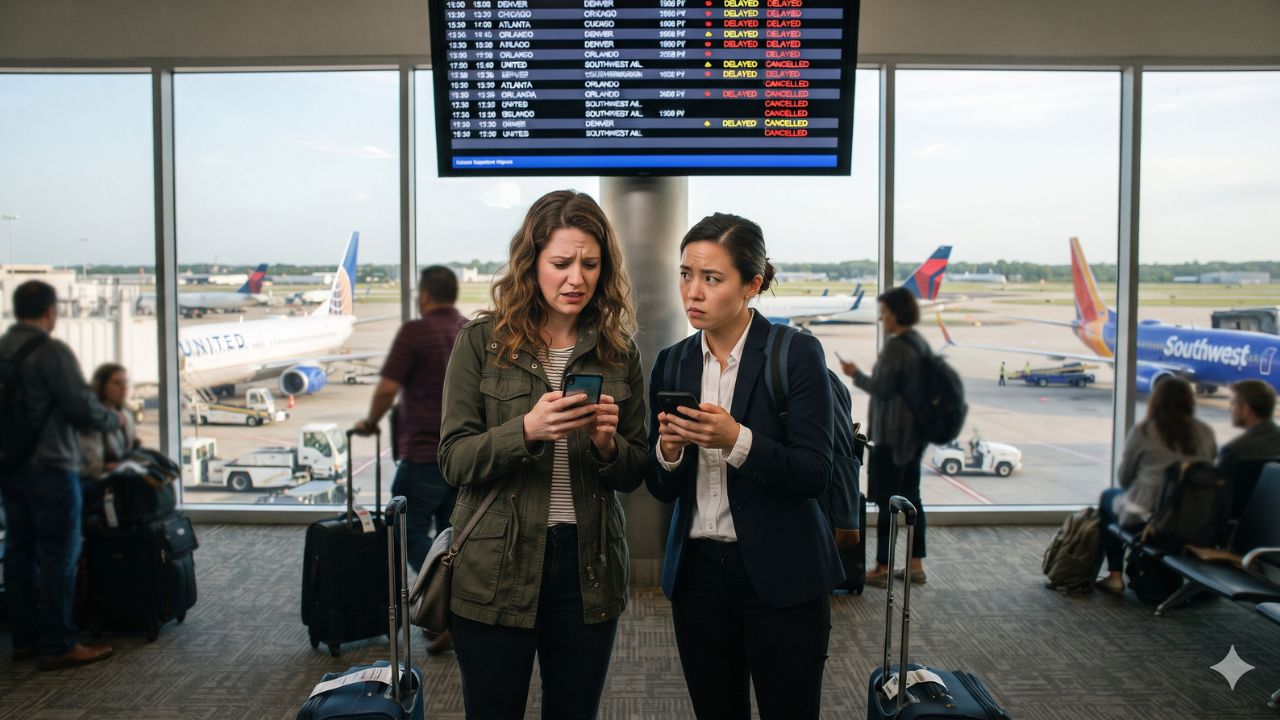
While millions of Americans prepared for autumn weekend getaways and holiday events on October 31, 2026, an abrupt cascade of scheduling friction swept across the continental United States, triggering 1,510 flight delays and 71 outright cancellations by early afternoon. Real-time tracking records compiled by FlightAware as of 2:13 pm ET documented compounding delays that penalized major crossroads from Texas to the Pacific Northwest. At Dallas-Fort Worth International Airport, 12 percent of all outbound departures fell behind schedule, while Seattle-Tacoma International Airport logged an identical 12 percent delay rate for incoming aircraft. With regional feeder SkyWest Airlines absorbing 190 delayed flights alongside mainline disruptions at Southwest, United, and Delta, travelers faced missed connecting banks, prolonged tarmac holds, and congested departure gates across the nation.
Cascading Gridlock Across Key US Aviation Hubs: The October 31 Disruption Breakdown
The multi-hub breakdown on 31 October revealed how operational friction in one corner of the National Airspace System quickly reverberates across distant terminals. Verified by industry analysts Somudranil Sarkar and reported by Ryan Rashid, the mid-afternoon data highlighted Dallas-Fort Worth (DFW) as the epicenter of domestic friction, recording 215 delayed flights. As the primary mega-hub for American Airlines, delays at DFW quickly radiated to downstream airports across the Midwest, Southeast, and Rocky Mountain regions.
On the West Coast, Seattle-Tacoma (SEA) absorbed 121 delays, where high arrival holding patterns forced inbound aircraft into holding stacks above Puget Sound. In California, Los Angeles International Airport (LAX) registered 103 delays, with a 6 percent departure delay rate and an 8 percent arrival delay rate, while San Francisco International Airport (SFO) recorded 81 delayed services. In the East, Hartsfield-Jackson Atlanta International Airport (ATL) logged 69 delays, followed by New York's John F. Kennedy International Airport (JFK) with 57 delays, Boston Logan (BOS) with 42, Detroit Metropolitan Wayne County (DTW) with 39, and Newark Liberty (EWR) recording 33 delays.
Airlines operating dense regional and domestic point-to-point networks absorbed the heaviest scheduling shocks. Regional powerhouse SkyWest Airlines led all tracked carriers with 190 delays, representing an 8 percent delay rate across its multi-carrier contract operations for Delta Connection, United Express, and American Eagle. Southwest Airlines followed closely with 143 delays (a 5 percent operational delay rate), while United Airlines recorded 118 delays (a 3 percent rate). Legacy peer Delta Air Lines logged 108 delayed flights, Pacific Northwest specialist Alaska Airlines recorded 62 delays, JetBlue Airways absorbed 51, and regional operator Endeavor Air registered 19 delays.
| Commercial Airport Hub | Location & State | Recorded Flight Delays | Recorded Delay Rates | Primary Operational Impact |
|---|---|---|---|---|
| Dallas-Fort Worth (DFW) | Dallas / Fort Worth, Texas | 215 delays | 12% departure delay rate | Heaviest delay volume nationwide; snarls mid-continent connection banks. |
| Seattle-Tacoma (SEA) | Seattle / Tacoma, Washington | 121 delays | 12% arrival delay rate | Extended inbound air traffic metering over Puget Sound. |
| Los Angeles (LAX) | Los Angeles, California | 103 delays | 6% departure / 8% arrival rate | Transcontinental departure holds and apron congestion. |
| San Francisco (SFO) | San Francisco, California | 81 delays | Paced arrivals | Flow control adjustments along coastal California corridors. |
| Atlanta Hartsfield-Jackson (ATL) | Atlanta, Georgia | 69 delays | Southeast regional metering | Connecting bank delays across the world's busiest airport. |
| New York (JFK) | Queens, New York | 57 delays | Runway approach spacing | International transatlantic bank sequencing and terminal metering. |
| Boston Logan (BOS) | Boston, Massachusetts | 42 delays | Northeast corridor flow | Regional commuter gate holds across New England routes. |
| Detroit Metropolitan (DTW) | Detroit, Michigan | 39 delays | Midwest connection pacing | Feeder aircraft turnaround holds across northern routes. |
| Newark Liberty (EWR) | Newark, New Jersey | 33 delays | New York metro airspace | Air traffic management adjustments in congested coastal skies. |
The disruptions similarly impacted regional networks and major trunk carriers across the country:
| Operating Airline | Recorded Flight Delays | Operational Delay Rate (%) | Carrier Network Scope & Fleet Profile |
|---|---|---|---|
| SkyWest Airlines | 190 delays | 8% delay rate | Major regional contractor operating for United, Delta, and American. |
| Southwest Airlines | 143 delays | 5% delay rate | Extensive point-to-point domestic fleet across Sunbelt and Midwest hubs. |
| United Airlines | 118 delays | 3% delay rate | Transcontinental and global trunk lines through Newark, Denver, and SFO. |
| Delta Air Lines | 108 delays | Standard operational pacing | Core hub operations centered at Atlanta, Detroit, and Minneapolis. |
| Alaska Airlines | 62 delays | Regional corridor impact | Heavy West Coast focus linking Seattle, Portland, and California. |
| JetBlue Airways | 51 delays | Northeast corridor focus | Transcontinental and East Coast flights focused on Boston and New York. |
| Endeavor Air | 19 delays | Regional feeder operations | Wholly owned regional subsidiary flying regional routes for Delta. |
What Makes Navigating Major US Megahubs Experientially Unique During System Shocks
Navigating American mega-airports during unexpected operational slowdowns requires an understanding of how distinct terminal architectures handle passenger surges. Dallas-Fort Worth, for instance, spans an immense footprint larger than Manhattan, configured into five semi-circular terminals (A, B, C, D, and E). When DFW records 215 delays, the elevated Skylink automated people mover—which circles the secure side of all five terminals every two minutes—becomes a traveler’s primary asset. Passengers rebooked onto alternate flights departing from opposite ends of the airfield can transfer between Terminals A and D in under ten minutes without clearing security again. Terminal D, the international concourse, features expansive public seating, high-speed charging bars, and tranquil spaces far removed from the overcrowded gate areas of older domestic concourses.
At Seattle-Tacoma International Airport, the physical layout presents a very different experience. Operating on a compact footprint constrained by Puget Sound and suburban sprawl, SEA funnels passengers through a central terminal flanked by two satellite concourses (North and South). When 121 flights suffer arrival delays, tarmac queueing on the airport's three parallel runways often leaves incoming planes waiting for occupied gates to open. Once inside, travelers can use the SEA Underground automated train to navigate between concourses, or escape terminal chaos by catching the Sound Transit Link light rail directly from the fourth floor of the parking garage straight into downtown Seattle.
Across Southern California, Los Angeles International Airport (LAX) operates as a horseshoe of nine individual passenger terminals. In recent years, the opening of airside connector bridges has made it possible to walk post-security between Terminal 1 through Terminal 8 and the Tom Bradley International Terminal (TBIT). During ground delay programs, savvy passengers at LAX migrate toward Tom Bradley’s soaring Great Hall, where cathedral-scale ceilings, natural light, and diverse dining options provide a peaceful sanctuary while waiting out departure delays.
Visitor Insider Tips: Terminal Navigation, Rebooking Strategies, and Local Transit Escapes
- Rebook via Airline Apps Instead of Terminal Customer Service Queues: When a flight is delayed or cancelled, customer service lines at gate podiums can quickly stretch dozens of passengers deep. Open your airline’s mobile application immediately. Most major carriers—including United, Delta, and Southwest—allow self-service rebooking directly on smartphones, frequently showing open seats on alternate flights hours before gate agents can process tickets manually.
- Understand Federal Refund Rights Under DOT Regulations: Under rules enforced by the US Department of Transportation (DOT), passengers whose flights are cancelled or significantly delayed and who choose not to travel are legally entitled to a full cash refund to their original form of payment—not merely an expiring travel credit or airline voucher.
- Monitor FAA National Airspace Status Directly: Skip unreliable third-party speculation and check official ground status updates published by the Federal Aviation Administration (FAA). The FAA’s operational status dashboard provides real-time information on ground stops, airport arrival delay programs, and airspace metering across the country.
- Escape Hub Congestion via Regional Rail Links: If an extended multi-hour layover strikes during daytime hours, consider stepping outside the airport via rapid transit. At Atlanta (ATL), the MARTA train station inside the domestic terminal reaches downtown attractions in 20 minutes. At San Francisco (SFO), the BART station connects straight to the Mission District and Embarcadero, providing fresh air and regional cuisine rather than expensive airport fast food.
- Carry Essential Medication and Phone Chargers in Personal Bags: Never pack prescription medications, infant essentials, laptop chargers, or a fresh change of clothes inside checked luggage. During cascade delays, aircraft frequently sit on remote taxiways with cargo holds sealed, meaning gate-checked bags may be inaccessible until you reach your final destination.
Cultural and Environmental Context: Air Traffic Strains and Passenger Rights in American Skies
The 1,510 delays recorded on October 31 illustrate the delicate equilibrium governing modern American aviation. Commercial air transport in the United States handles approximately 2.9 million passengers daily, operating near peak airspace capacity. When autumn seasonal weather shifts—such as early morning fog in the Pacific Northwest, gusty frontal passages across the Texas plains, or gusting coastal winds in the Northeast—air traffic controllers must expand separation standards between planes. Under strict safety rules mandated by federal law, these necessary precautions instantly reduce the number of aircraft an airfield can accept per hour.
In addition, flight disruptions place intense strain on human crews operating under strict duty-time limitations. Under FAA Part 117 flight duty regulations, commercial pilots and flight attendants are legally prohibited from exceeding maximum duty hours to ensure aviation safety. When delays push flight crews past their legal limits, airlines must locate standby reserve crews—a logistical puzzle that becomes particularly complex for regional contractors like SkyWest, whose aircraft fly multi-leg feeder routes into remote mountain and rural communities.
From an environmental standpoint, cascading delays compound carbon emissions across the continent. Hundreds of idling aircraft burning jet fuel on taxiways and holding in circling stacks above metropolitan airspace burn thousands of gallons of excess fuel. As federal aviation authorities work on NextGen satellite air traffic modernization, the resilience of regional communities and commercial travelers relies on balanced scheduling, transparent passenger protections, and modernized ground infrastructure that keeps air passengers moving safely toward their destinations.
FAQ: Traveling Through Disrupted US Flight Hubs 2026
How many flights were disrupted across the US on October 31, 2026?
FlightAware tracked 1,510 flight delays and 71 cancellations nationwide by 2:13 pm ET, with Dallas-Fort Worth, Seattle-Tacoma, and Los Angeles recording the highest delay volumes.
Which US airline experienced the highest number of delays?
SkyWest Airlines recorded 190 delays (an 8% delay rate), followed by Southwest Airlines with 143 delays, United Airlines with 118, and Delta Air Lines with 108.
Am I entitled to a refund if my US flight is cancelled or significantly delayed?
Yes. Under US Department of Transportation regulations, passengers whose flights are cancelled or significantly altered and who decline rebooking are entitled to a full cash refund.
What is the best way to handle a sudden airport delay?
Use your airline’s mobile app to check rebooking options immediately, monitor official FAA airspace status, and keep essential items and electronics chargers in your carry-on bag.
[When autumn skies test the limits of modern aviation, patience, local transit knowledge, and a fast mobile app remain a traveler's most reliable wings.]
Related Travel Guides
The Insider Guide to Navigating DFW Skylink, LAX Terminals, and Sound Transit at Sea-Tac, According To Reddit (Coming Soon)
This article is for informational purposes. Flight routes, passenger regulations, visa rules, and transit advisories are subject to change by airlines and aviation authorities. Readers are advised to verify schedules and travel documentation with relevant carriers and border agencies before departure.
Related Stories
Singapore and Manila Flights Face Disruptions as Philippine Airlines Revises November Schedules for ASEAN Summit
Asia Air Travel Hit by 371 Cancellations and 3,663 Flight Delays: Bangkok, Mumbai, and Shanghai Lead Gridlock