
Munich Airport vs Frankfurt Airport: Which German Hub is Best for Connections in 2026?
A detailed comparison of Munich and Frankfurt airports, analyzing flight networks, transfer efficiency, and passenger stress levels to help travelers choose the optimal German transit hub.

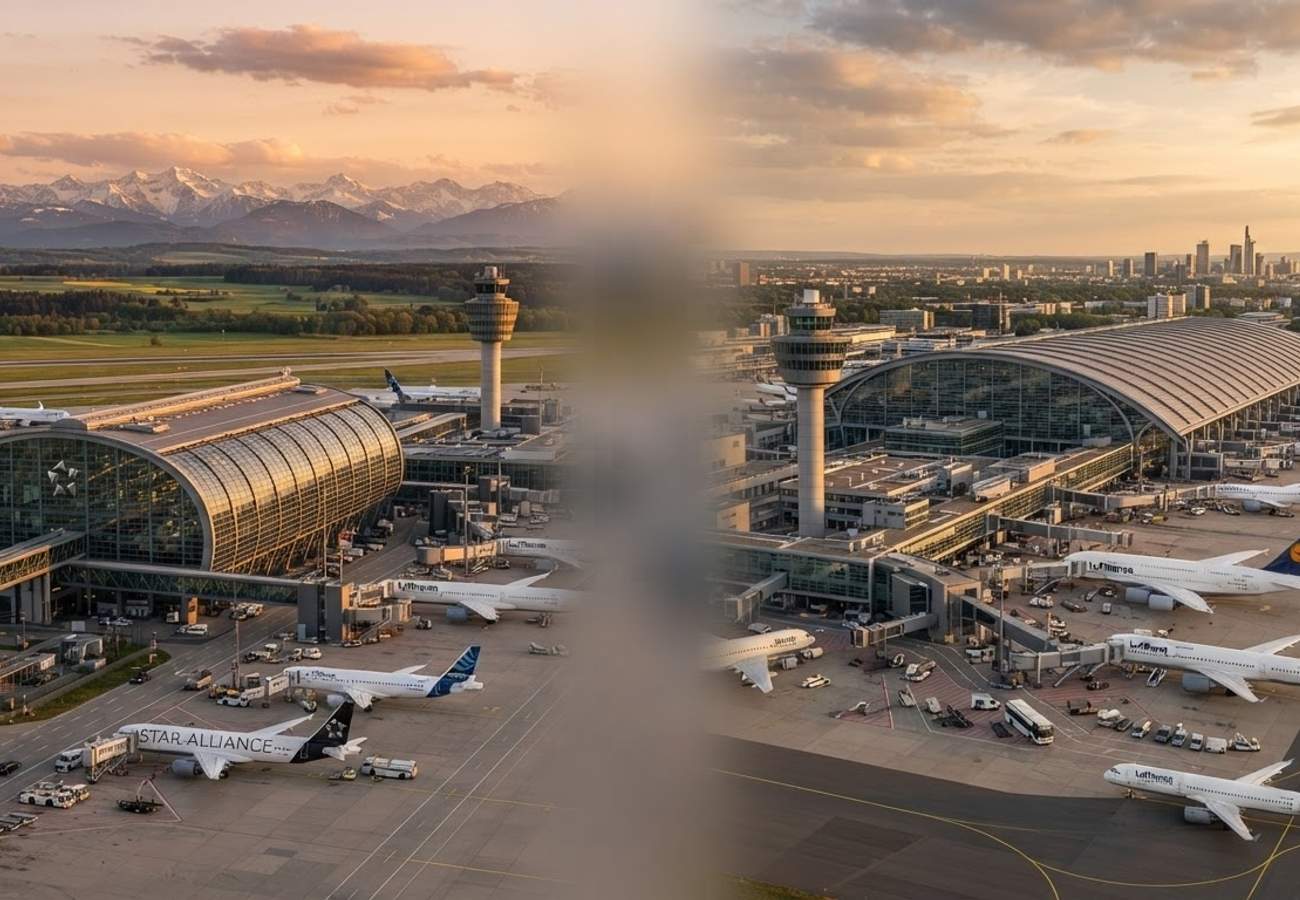
Image generated by AI
Choosing between Germany's two primary aviation gateways can be the difference between a seamless transit and a missed connection. While both serve as Lufthansa hubs, their operational scales and passenger experiences differ radically.
For the international traveler, the choice between Munich (MUC) and Frankfurt (FRA) often comes down to a trade-off between sheer connectivity and operational serenity. While Frankfurt offers a massive global reach, Munich provides a streamlined experience that frequently reduces traveler anxiety.
Comparing the Scale of Germany's Aviation Gateways
Frankfurt Airport stands as Germany's busiest international hub and one of the largest in Europe. It typically handles over 50 million passengers annually, serving as the primary global anchor for Lufthansa and a critical node for the Star Alliance network. This massive scale ensures an unparalleled density of long-haul flights to Asia, Africa, the Middle East, and North America.
Munich Airport operates on a slightly smaller scale, with annual traffic generally in the low-to-mid forty million range. As Lufthansa's second major hub, it has carved out a niche as a high-efficiency alternative. It is particularly dominant for connections into Southern and Eastern Europe and maintains strategic long-haul corridors to cities like Tokyo, Bangkok, Johannesburg, Los Angeles, and San Francisco.
While both facilities provide high-end shopping, diverse dining, and robust ground transportation, the primary differentiator is the "stress coefficient"—how the airport's layout and volume impact the passenger's journey.
Network Reach and Route Availability
Frankfurt remains the undisputed leader for sheer variety. For travelers heading to secondary cities in Eastern Europe or niche destinations in Africa, Frankfurt typically offers higher daily frequencies. A traveler flying from Chicago to Vilnius, for instance, will likely find multiple daily options via Frankfurt, whereas Munich may only offer one or none.
Munich’s strategy focuses on a curated selection of high-demand long-haul routes combined with a dense European feeder network. Recent data shows consistent year-round operations from Munich to São Paulo and Johannesburg, alongside major U.S. gateways like New York, Boston, and Washington.
For those prioritizing loyalty programs, Frankfurt often sees a higher concentration of Star Alliance partners. Carriers like Air Canada and United Airlines frequently funnel a larger volume of North American traffic through Frankfurt than Munich, which can influence decisions based on mileage accrual or specific carrier preferences.
Transfer Efficiency and Connection Risks
The physical experience of transferring varies significantly between the two hubs. Frankfurt's architecture is sprawling and segmented, utilizing a complex system of A, B, C, and Z gates. While official minimum connection times (MCT) can be as low as 45 to 60 minutes, the reality on the ground is often more volatile.
Reports from 2025 and 2026 indicate that passengers with 60 to 75-minute windows in Frankfurt have frequently missed flights. These delays are often attributed to:
- Bottlenecks at the new Entry/Exit System (EES) for non-EU nationals.
- Lengthy security queues when transitioning from non-Schengen arrivals to Schengen departures.
- The sheer walking distance between distant concourses.
Munich offers a more intuitive and compact layout, particularly within Terminal 2 and its satellite building. A 60 to 75-minute connection in Munich is generally viewed as achievable, even when switching from an intercontinental flight to a regional European leg. Frequent flyers often cite Munich as the preferred choice for tight connections due to shorter walking distances and fewer level changes.
Operational Reliability and Passenger Stress
While both airports are susceptible to European air traffic control restrictions and weather disruptions, Munich generally maintains a reputation for higher punctuality and lower chaos. Its smaller scale prevents the "ripple effect" of delays from escalating as quickly as they do in Frankfurt.
Frankfurt's high volume makes it more vulnerable to congestion. During peak summer Friday afternoons, the Z concourse—which handles many long-haul departures—often experiences extreme crowding. When arrival banks are delayed, the resulting backlog can lead to significant queues at security and gate areas.
The disparity in passport control efficiency is a recurring theme in traveler data:
- Munich: Intercontinental to Schengen transfers often take 15 to 25 minutes.
- Frankfurt: Experiences are polarized; while some breeze through, others (particularly non-EU nationals) report waits of 60 to 90 minutes.
Hub Comparison Summary
| Feature | Frankfurt Airport (FRA) | Munich Airport (MUC) |
|---|---|---|
| Annual Passenger Volume | 50 Million+ | Low-to-mid 40 Million |
| Primary Strength | Maximum global connectivity | Efficiency and ease of navigation |
| Network Focus | Global flagship; high frequency | Curated long-haul; Southern/Eastern Europe |
| Transfer Experience | Sprawling, higher stress, variable | Compact, intuitive, generally calmer |
| Connection Risk | Higher for windows < 75 mins | Lower; 60-75 mins often viable |
| Reliability | Prone to congestion ripple effects | Generally more punctual |
Final Verdict for Travelers
If your priority is the absolute shortest travel time or a specific, niche destination, Frankfurt is the logical choice. However, if you are traveling with children, checked luggage, or have a low tolerance for airport stress, routing through Munich is the superior strategic move.
For those connecting to once-daily flights to smaller destinations, the reliability of Munich reduces the risk of an unplanned overnight stay.
Choosing the right hub is not just about the flight time, but about the quality of the time spent on the ground.
Related Travel Guides
Disclaimer
This article is for informational and educational purposes only. It does not constitute legal, financial, or professional advice. While we strive to provide accurate and up-to-date information, travel policies, regulations, and conditions change rapidly. Always verify information with official sources before making travel decisions. Nomad Lawyer makes no representations about the accuracy, reliability, completeness, or suitability of the information provided. Readers should consult qualified professionals for advice specific to their circumstances. The views expressed in this article are those of the author and do not necessarily reflect the views of Nomad Lawyer.
Preeti Gunjan
Contributor & Community Manager
A passionate traveller and community builder. Preeti helps grow the Nomad Lawyer community, fostering engagement and bringing the reader experience to life.
Learn more about our team →