Middle East Aviation Shockwave: 108 Cancellations and 1,056 Delays Hit Jeddah, Dubai, and Gulf Hubs

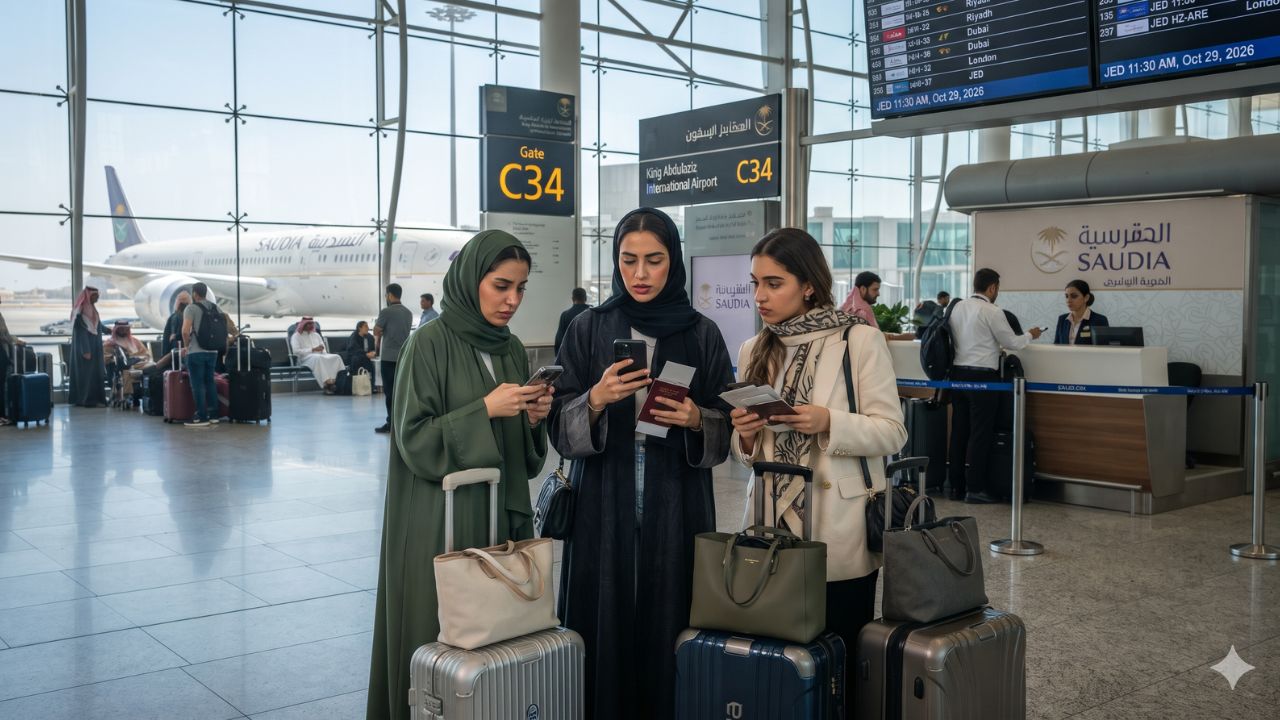
Image generated by AI
Between 8 and 25 October 2026, nearly half of all scheduled commercial flights across Saudi Arabia—exactly 45.1%, representing 7,802 departures—were grounded or classified as no-fly by Cirium data following severe regional security threats. That baseline crisis erupted into acute passenger bottlenecks on 29 October 2026, when real-time FlightAware monitoring recorded 108 flight cancellations and 1,056 delays across major Middle Eastern hubs, based on records analyzed at 4:59 pm ET on 28 October (12:59 am GST on 29 October). Driven by reported Houthi missile and drone threats, active airspace avoidance corridors, and sudden schedule suspensions by Gulf carriers, the disruption concentrated heavily on Saudi Arabia's principal coastal gateway in Jeddah, before sending schedule shockwaves into megahub terminals in Dubai, Doha, Abu Dhabi, and Bahrain.
The Epicenter in the Hejaz: Security Constraints and Suspended Routes
The operational brunt of this aviation disruption fell squarely on Saudi Arabian infrastructure. Across seven primary airports in the Kingdom, ground handlers and airlines recorded a collective total of 75 cancellations and 322 delays. King Abdulaziz International Airport (JED) in Jeddah suffered the single largest disruption in the region, registering 26 cancellations alongside 164 delays, with origin cancellations running at 2% and destination cancellations reaching 3%. As the main international arrival terminal for millions of religious pilgrims journeying to Mecca and the commercial gateway to the Red Sea, the bottleneck at Jeddah generated extensive passenger backlogs.
In the capital, King Khalid International Airport (RUH) in Riyadh logged 17 cancellations and 22 delays, with origin and destination cancellation rates mirroring Jeddah at 2% and 3% respectively. Along the Arabian Gulf coast, King Fahd International Airport (DMM) in Dammam reported seven cancellations and 49 delays. Secondary regional airports across Saudi Arabia experienced elevated cancellation percentages due to tightened defense perimeters: Prince Naif bin Abdulaziz Airport in Gassim (ELQ) recorded seven cancellations (6% origin, 5% destination) and 21 delays; Prince Mohammad bin Abdulaziz Airport in Madinah (MED) logged six cancellations (2% origin, 2% destination) and 35 delays; Abha Regional Airport (AHB) recorded seven cancellations (6% origin, 9% destination) and 20 delays; and Prince Sultan bin Abdulaziz Regional Airport in Tabuk (TUU) recorded five cancellations (9% destination) and 11 delays.
Regional airline reactions have prolonged transit times across the Gulf. Flagship carriers adjusted schedules to bypass sensitive air routes. Etihad Airways extended its cancellation of flights serving Riyadh and Dammam through 5 November 2026. flydubai suspended all services to Riyadh, Dammam, and Abha through 29 October, alerting passengers that circuitous rerouting paths would extend flight durations and lengthen layovers in Dubai. Qatar Airways maintained temporary route suspensions to Riyadh and Dammam initiated on 13 October, while reducing weekly flight frequencies into Jeddah. Meanwhile, Gulf Air operated at roughly 75% of its pre-conflict schedule, with Saudi corridors continuing to experience significant restrictions, and Kuwait Airways warned of short-notice schedule alterations across its network.
Beyond the Runway: Contrasting Ancient Gateways with Hyper-Modern Transit Hubs
Experiencing an aviation stall in the Middle East exposes the dramatic contrast between historic Red Sea trading centers and the glass-and-steel transit crossroads of the lower Gulf.
Jeddah is an ancient maritime crossroads where desert caravans historically met Indian Ocean trade dhows. When flights are grounded at King Abdulaziz International Airport, the Hejazi rhythm encourages stepping away from terminal lounges into historic Al-Balad, designated a UNESCO cultural sanctuary by the UNESCO World Heritage Centre. Built from rough-hewn Red Sea coral stones and adorned with delicate wooden rawasheen lattice balconies that catch coastal sea breezes, the quarter smells of frankincense, green cardamom, and roasting coffee. Sitting on low floor cushions in a local cafe to sip spiced Arabic gahwa while listening to calls to prayer echo over cobblestone alleys offers cultural calm that sterile departure gates cannot match, embodying the historic hospitality promoted by the Saudi Tourism Authority.
By contrast, Dubai International Airport (DXB) operates on a scale of relentless engineering and luxury consumerism. Logging 11 cancellations and 163 delays (second only to Jeddah for delayed operations), Dubai’s Terminal 3 acts as the central connecting lung between Europe, Asia, and Australasia. When connecting flights are held, passengers encounter indoor palm groves, duty-free retail boulevards, and sleepless concourses. Escaping the terminal reveals a futuristic desert metropolis where the ultra-clean Dubai Metro Red Line whisks travelers from the airport to traditional dhow wharves on Dubai Creek in under twenty minutes, where local water taxis (abras) cross between Deira and the spice souqs supported by the Dubai Department of Economy and Tourism.
Detailed Disruption Metrics Across Middle East Hubs and Carriers
The tables below provide verified operational figures for the airports and airlines most severely affected on 29 October 2026:
| Airport Facility | Code | Country | Cancellations | Delays | Cancellation Rates (Dep / Arr) |
|---|---|---|---|---|---|
| King Abdulaziz International | JED | Saudi Arabia | 26 | 164 | 2% origin / 3% destination |
| Dubai International | DXB | United Arab Emirates | 11 | 163 | 1% origin / 0% destination |
| Hamad International | DOH | Qatar | 3 | 146 | 0% origin / 0% destination |
| Istanbul Airport | IST | Türkiye | 2 | 119 | Minimal cancellation / Heavy delays |
| Zayed International | AUH | United Arab Emirates | 3 | 115 | 0% origin / Low cancellation |
| Istanbul Sabiha Gökçen | SAW | Türkiye | 1 | 81 | Low cancellation / Moderate delays |
| Ben Gurion International | TLV | Israel | 2 | 59 | Security delays across arrivals |
| King Fahd International | DMM | Saudi Arabia | 7 | 49 | 2% origin / 1% destination |
| Prince Mohammad bin Abdulaziz | MED | Saudi Arabia | 6 | 35 | 2% origin / 2% destination |
| Bahrain International | BAH | Bahrain | 9 | 31 | 3% origin / 4% destination |
| King Khalid International | RUH | Saudi Arabia | 17 | 22 | 2% origin / 3% destination |
| Prince Naif bin Abdulaziz | ELQ | Saudi Arabia | 7 | 21 | 6% origin / 5% destination |
| Abha Regional Airport | AHB | Saudi Arabia | 7 | 20 | 6% origin / 9% destination |
| Kuwait International | KWI | Kuwait | 2 | 20 | Schedule adjustments / Holds |
| Prince Sultan bin Abdulaziz | TUU | Saudi Arabia | 5 | 11 | 0% origin / 9% destination |
Airline operations across the region reflected these geographic strains:
| Airline Operator | Home Base | Flight Cancellations | Flight Delays | Percentage Impact |
|---|---|---|---|---|
| Saudia | Saudi Arabia | 25 | 116 | 4% cancelled / 18% delayed |
| Qatar Airways | Qatar | 3 | 131 | ~0% cancelled / 20% delayed |
| Pegasus Airlines | Türkiye | 1 | 126 | ~0% cancelled / 17% delayed |
| Turkish Airlines | Türkiye | 2 | 99 | ~0% cancelled / 6% delayed |
| Air Arabia | UAE | 1 | 58 | ~0% cancelled / 25% delayed |
| Gulf Air | Bahrain | 9 | 20 | 6% cancelled / 14% delayed |
| Mavi Gök Airlines | Türkiye | 2 | 2 | 8% cancelled / 8% delayed |
Visitor Insider Tips for Navigating Jeddah, Dubai, and Bahrain
Managing extended flight delays in the Gulf requires practical local knowledge to bypass congested terminal waiting areas:
- Bypassing Jeddah Terminal Delays via High-Speed Rail: If your flight from King Abdulaziz International (JED) is delayed by more than four hours, do not remain on crowded concourse seating. Terminal 1 connects directly to the Haramain High-Speed Railway station. In under twenty minutes on an air-conditioned electric train, you can reach central Jeddah or travel inland to holy sites if carrying appropriate permits. For dining, hail a licensed green taxi into the historic Al-Zulal district to order traditional saleeg (slow-cooked creamy broth rice topped with tender roasted chicken) at local family-run eateries.
- Navigating Dubai Connection Friction: When transiting Dubai International during schedule delays, note that Terminal 1 and Terminal 3 are linked airside, but walking between distant gates can take thirty minutes. If facing an overnight layover, board the Dubai Metro Red Line directly from Terminal 1 or 3 into Deira. Book a room in a restored heritage courtyard house in the Al Fahidi Historical Neighbourhood, where you can sample fresh cardamon-infused karak tea and warm date cake beside the wind towers.
- Bahrain International Layover Tactics: Bahrain’s compact terminal in Muharraq (BAH) makes escaping flight delays remarkably simple. An eight-minute taxi across the causeway brings you into Manama. Walk through Bab Al Bahrain into the historic Manama Souq to browse traditional spice merchants and sample warm halwa at Showaiter confectionery shops, returning with ample time before your rescheduled boarding call.
- Itinerary and Ticket Verification: If your booking includes separate tickets across different carriers—such as connecting from a European carrier onto Gulf Air or Saudia—airlines are not legally bound to protect downstream connections. Contact your issuing travel agent immediately to request synchronized rerouting before departure gates close.
Cultural and Environmental Context: Pilgrim Corridors and Desert Airspace Resilience
The aviation corridors spanning the Arabian Peninsula carry cultural responsibilities unmatched anywhere else in global transport. King Abdulaziz International Airport in Jeddah and Prince Mohammad bin Abdulaziz Airport in Madinah serve as sacred arrival points for millions of Muslim pilgrims undertaking Umrah and Hajj from across Africa, Central Asia, and Southeast Asia. Many of these travelers invest lifetime savings into their journeys. When flight cancellations disrupt these sacred corridors, airline station managers and Saudi authorities coordinate closely with local hospitality endowments (waqf) to provide emergency shelter, meals, and medical care in accordance with long-standing Hejazi traditions of pilgrim hospitality.
Simultaneously, the physical constraints of operating commercial aviation over vast, arid deserts create environmental and logistical challenges. Diverting flight tracks away from security conflict zones forces aircraft to carry substantial extra fuel reserves, flying longer routes over southern Oman or eastern Egypt. This increased fuel burn elevates carbon emissions across the Arabian desert ecosystem and strains regional air traffic control sectors already managing some of the world's densest international transit flows.
FAQ: Traveling Through Middle Eastern Hubs During Disruption 2026
What rights do passengers have for cancelled flights in Saudi Arabia? Under GACA consumer protection regulations, passengers whose flights are cancelled without sufficient prior notice are entitled to full ticket refunds, alternative transportation to their final destination, and complimentary meals and hotel accommodation for delays exceeding six hours.
Are flights to Dubai and Abu Dhabi safe to book despite regional alerts? Yes. Commercial operations at Dubai (DXB) and Abu Dhabi (AUH) maintain high safety standards. Disruptions at UAE hubs primarily involve delays stemming from regional aircraft rerouting around northern airspace, rather than direct local security closures.
How do I verify if my flight to Saudi Arabia is operating? Check your flight status directly via the airline’s mobile application or official website before departing for the airport. Do not rely solely on third-party aggregators during volatile regional airspace adjustments.
Can passengers leave the airport during long layovers in Jeddah or Dubai? Citizens of eligible visa-free or electronic visa countries can clear immigration to explore the city during long delays. In Jeddah, high-speed rail and taxis offer quick access to Al-Balad, while the Dubai Metro connects DXB directly to central districts.
Across the desert skies of the Arabian Peninsula, seasoned travelers know that patience, regional awareness, and local cultural curiosity are the truest safeguards against unexpected layovers.
Related Travel Guides
Kuwait Airways Connects Gulf Travelers Directly to Phuket and Tbilisi in 2026 Route Expansion
The 10 Best Historic Sites in Old Jeddah Al-Balad, According To Reddit
This article is for informational purposes. Flight routes, passenger regulations, visa rules, and transit advisories are subject to change by airlines and aviation authorities. Readers are advised to verify schedules and travel documentation with relevant carriers and border agencies before departure.
Related Stories
Middle East Flight Disruptions: Security Protocols and Airspace Halts Trigger 183 Cancellations and 1,274 Delays Across 13 Regional Hubs
Middle East Aviation Under Pressure: 109 Flight Cancellations and 1,224 Delays Ripple Across Riyadh, Dubai, and Istanbul