
Middle East Flight Disruptions: Security Protocols and Airspace Halts Trigger 183 Cancellations and 1,274 Delays Across 13 Regional Hubs
Escalating regional security protocols and hub congestion sparked 1,274 flight delays and 183 cancellations across 13 Middle Eastern airports, heavily impacting Riyadh, Jeddah, and Istanbul.

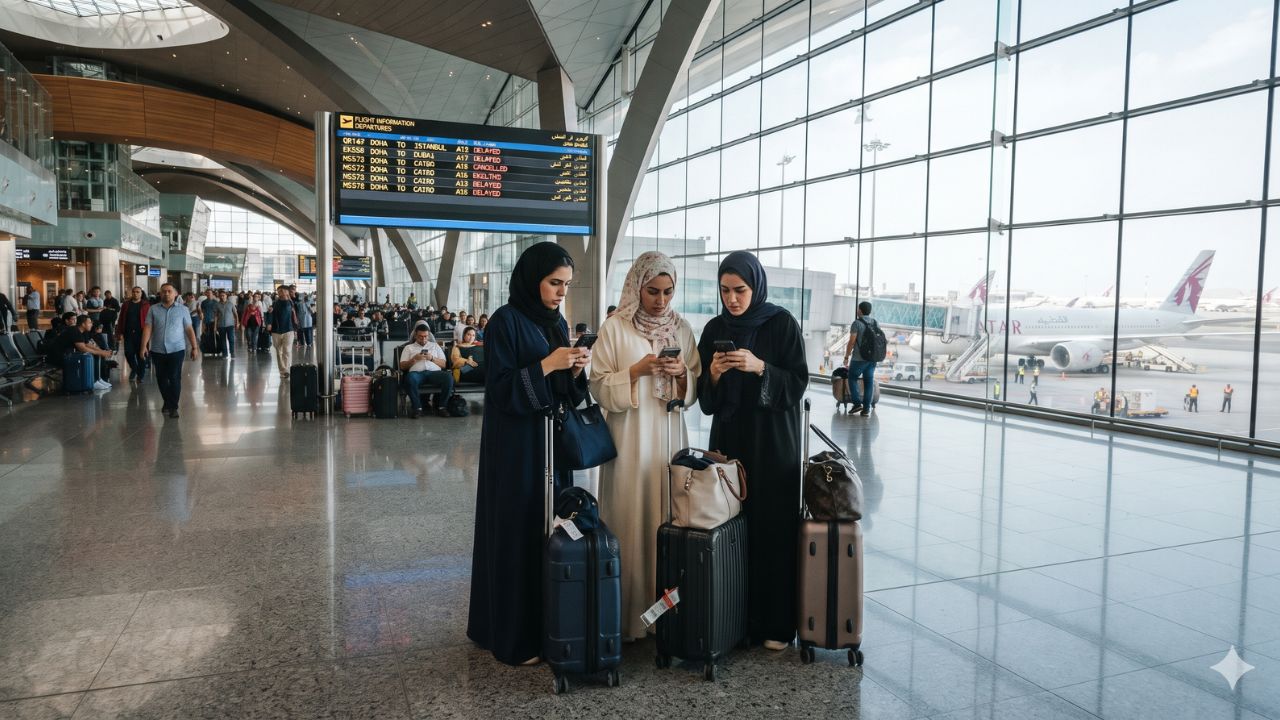
While Riyadh's King Khaled International Airport recorded a single departure delay on October 24, 2026, the Saudi capital absorbed the Middle East's most severe flight stoppage with 79 outright cancellations—illustrating how military security alerts instantly halt departures while ripple effects trigger 1,274 delays across 13 regional airports. Documented at 3:34 pm ET (1:04 am IST on October 25) through real-time FlightAware data, the operational gridlock grounded 183 flights across Saudi Arabia, Türkiye, the United Arab Emirates, Egypt, Qatar, and Jordan. At the core of the disruption, air corridors across the Arabian Peninsula faced urgent defensive realignments following missile and drone incursions launched by Iran-aligned Houthi forces targeting critical aviation and energy installations.
Beyond immediate security suspensions, the compounding pressure of air traffic control rerouting, crew scheduling expirations, and aircraft turnaround bottlenecks rippled through major east-west connecting hubs. From the Anatolian transit crossroads of Istanbul to the megahubs of the Persian Gulf, travelers undertaking long-haul voyages between Europe, South Asia, and Africa experienced extensive schedule fractures.
Security Protocols and Airspace Fractures: Anatomy of the Regional Gridlock
The geographic concentration of flight cancellations highlights the acute security environment across the Arabian Peninsula. In Saudi Arabia, civil aviation authorities coordinated with military defense commands to impose temporary air corridor closures, directly impacting commercial schedules. King Khaled International in Riyadh experienced 79 cancellations alongside just 1 delay, representing the single highest cancellation count of any airport in the region as carriers preemptively grounded departures to maintain fleet safety.
On the Red Sea coast, King Abdulaziz International Airport in Jeddah emerged as the regional delay leader, logging 205 delayed flights and 34 cancellations. Jeddah recorded an alarming 28% departure delay rate and a 29% arrival delay rate, stranding thousands of international voyagers and religious pilgrims in transit halls. In eastern Saudi Arabia, King Fahd International Airport in Dammam logged 52 delays and 17 cancellations, while southern gateways proximate to cross-border threat zones also restricted schedules: Abha Regional recorded 17 delays and 6 cancellations, and Prince Naif Bin Abdulaziz Regional in Buraidah registered 16 delays and 5 cancellations. Flight operations across the Kingdom followed strict contingency protocols supervised by the General Authority of Civil Aviation to protect passenger safety across commercial corridors.
Simultaneously, major connecting gateways across Türkiye absorbed substantial secondary delays as air traffic controllers managed congested northern diversion routes. Antalya Airport, a primary Mediterranean tourism hub, logged 194 delayed flights and 2 cancellations, recording a 24% departure delay rate and a 27% arrival delay rate. Istanbul Airport, the massive hub connecting five continents, posted 187 delays and 7 cancellations, with a 14% departure delay rate and an 11% arrival delay rate. On Istanbul's Asian side, Sabiha Gokcen Airport registered 121 delays and 6 cancellations with a 14% departure delay rate, as highlighted by Go Türkiye travel advisories monitoring transit passenger flows.
Across the Gulf and Levant, Dubai International Airport recorded 171 delays and 9 cancellations, running a 16% departure delay rate and a 17% arrival delay rate. Cairo International in Egypt logged 129 delays and 2 cancellations, marked by a 25% arrival delay rate. Hamad International in Doha posted 92 delays and 1 cancellation, Sharjah International registered 68 delays and 8 cancellations, and Queen Alia International in Amman, Jordan, recorded 21 delays alongside 7 cancellations.
Airline Operational Realities: Fleet Cascades Across Connecting Corridors
The burden of schedule adjustments fell unevenly across commercial airlines, exposing the operational vulnerability of hub-and-spoke networks when key transfer points face sudden airspace limits. Turkish Airlines registered the highest overall delay count among all carriers, reporting 161 delayed flights and 5 cancellations. With its primary fleet operating intensive rotational circuits through Istanbul, small departure holds on incoming flights from the Gulf rapidly multiplied into systemwide schedule adjustments across European and North American connections.
National flag carrier Saudia shouldered the heaviest cancellation burden in the region, recording 97 delays and 72 cancellations. Saudia's grounded flights accounted for nearly 40% of all cancellations across the Middle East on October 24, reflecting the airline's direct exposure to domestic security protocols at Riyadh, Jeddah, Dammam, and Abha. Qatar Airways maintained relative schedule stability at its Doha hub, recording 82 delays and only 1 cancellation.
Low-cost and emerging regional operators demonstrated varying resilience. Sharjah-based Air Arabia registered 62 delays and 8 cancellations, clocking the highest proportional delay rate among reported airlines at 25%. Amman-based Royal Jordanian recorded 11 delays and 9 cancellations. Riyadh Air logged 0 delays but suffered 6 cancellations, yielding the highest proportional cancellation rate in the region at 20%, as the carrier elected to ground operations entirely during peak security alerts rather than sustain cascading airborne holding patterns.
Middle East Aviation Disruption Breakdown: Hubs and Carrier Statistics
The tables below provide verified flight tracking records compiled from real-time operational feeds dated October 24, 2026, at 3:34 pm ET (October 25, 1:04 am IST), detailing performance metrics across all 13 affected airports and 6 leading carriers.
| Airport | Location | Flight Delays | Flight Cancellations | Delay Rates & Operational Standing |
|---|---|---|---|---|
| King Abdulaziz International | Jeddah, Saudi Arabia | 205 | 34 | 28% departure delay, 29% arrival delay; highest delay count in the region |
| Antalya Airport | Antalya, Türkiye | 194 | 2 | 24% departure delay, 27% arrival delay; extensive Mediterranean charter delays |
| Istanbul Airport | Istanbul, Türkiye | 187 | 7 | 14% departure delay, 11% arrival delay; significant intercontinental transit shifts |
| Dubai International | Dubai, UAE | 171 | 9 | 16% departure delay, 17% arrival delay; schedule holds across long-haul banks |
| Cairo International | Cairo, Egypt | 129 | 2 | 25% arrival delay rate; moderate delays across North African routes |
| Sabiha Gokcen | Istanbul, Türkiye | 121 | 6 | 14% departure delay rate; secondary Istanbul hub timetable compression |
| Hamad International | Doha, Qatar | 92 | 1 | Controlled transit delays; minimal route cancellations |
| Sharjah International | Sharjah, UAE | 68 | 8 | Elevated regional cancellations and moderate departure delays |
| King Fahd International | Dammam, Saudi Arabia | 52 | 17 | Severe Eastern Province cancellations due to regional airspace protocols |
| Queen Alia International | Amman, Jordan | 21 | 7 | Schedule realignments on regional and Gulf feeder services |
| Abha Regional | Abha, Saudi Arabia | 17 | 6 | Southern Saudi Arabia domestic route adjustments |
| Prince Naif Bin Abdulaziz | Buraidah, Saudi Arabia | 16 | 5 | Timetable suspensions across regional feeder routes |
| King Khaled International | Riyadh, Saudi Arabia | 1 | 79 | Highest cancellation count overall amid defensive airspace restrictions |
| Airline | Flight Delays | Flight Cancellations | Operational Disruption Summary |
|---|---|---|---|
| Turkish Airlines | 161 | 5 | Highest total delay count; rotational holds across European and Asian sectors |
| Saudia | 97 | 72 | Highest cancellation count across the Middle East; domestic airspace suspensions |
| Qatar Airways | 82 | 1 | Schedule holds absorbed through Doha hub; near-zero cancellations |
| Air Arabia | 62 | 8 | Highest proportional delay rate in the region at 25% |
| Royal Jordanian | 11 | 9 | Regional timetable changes centered on Amman operations |
| Riyadh Air | 0 | 6 | Highest proportional cancellation rate at 20%; zero delays recorded |
Visitor Insider Tips: Navigating Middle Eastern Hub Delays and Rerouting
Navigating complex flight disruptions across Middle Eastern transit hubs requires practical local knowledge and swift tactical rebooking:
- Bypass Jeddah Air Travel via High-Speed Rail: When domestic or regional flights connecting Jeddah, Mecca, and Medina encounter severe delay queues, avoid waiting for uncertain airline rebooking. The Haramain High Speed Railway connects King Abdulaziz International Airport Terminal 1 directly to central Medina and Mecca via 300 km/h electric trains. Rail tickets can be purchased on mobile apps, providing dependable transport that completely skirts airspace halts.
- Mastering Istanbul Dual-Hub Disconnections: If your flight into Istanbul Airport (IST) experiences arrival delays that imperil a connecting flight out of Sabiha Gokcen (SAW), do not attempt an express taxi transfer if your buffer is under five hours. Trans-Bosphorus highway traffic routinely gridlocks during afternoon hours. Instead, utilize the M11 metro line from IST toward Gayrettepe, connect via Marmaray rail across the Bosphorus, and transfer to the M4 metro line directly into Sabiha Gokcen.
- Dubai and Sharjah Strategic Rebooking: Travelers facing extended delays at Dubai International (DXB) should inquire whether their carrier can rebook them out of Sharjah International (SHJ) or Zayed International Airport in Abu Dhabi (AUH). An intercity taxi between Dubai and Sharjah takes approximately 35 minutes outside rush hours, often unlocking on-time regional departures while DXB works through extensive gate holding patterns.
- Know Saudi GACA Consumer Rights: Under updated aviation passenger protection regulations enforced by the General Authority of Civil Aviation in Saudi Arabia, passengers facing cancellations attributable to airline operational decisions are entitled to complimentary hotel accommodations, airport transfers, and immediate rebooking or full cash refunds. While military force majeure events modify compensation claims, carriers remain obligated to provide food, hydration, and communication access during terminal delays.
Cultural and Environmental Context: Holy Sanctuaries, Trade Crossroads, and Skyway Fragility
The airspace spanning the Red Sea, the Levant, and the Persian Gulf represents far more than commercial airways; it forms the sacred crossroads of global Islamic pilgrimage and the primary aerial trade corridor uniting the Eastern and Western hemispheres. King Abdulaziz International Airport in Jeddah functions as the essential threshold for millions of Umrah pilgrims journeying toward Mecca and the coastal heritage quarter of Historic Jeddah, a UNESCO World Heritage site renowned for its coral architecture and centuries-old merchant traditions. When flight banks collapse, the emotional and financial strain falls heavily on pilgrim delegations who travel on tightly budgeted group visas with non-refundable lodging reservations.
At the same time, geopolitical instability along the southern Red Sea corridor underscores the profound geographic vulnerability of Middle Eastern commercial aviation. When drone and missile incursions close civilian air routes over western and central Saudi Arabia, international airliners are forced into circuitous detours over Egypt, the Mediterranean, or central Iraq. These extended flight paths add hundreds of nautical miles to standard flight plans, sharply accelerating aviation fuel consumption and carbon output during an era of intensifying climate concern.
The ability of regional air hubs to maintain passenger safety while managing unpredictable security challenges reflects deep institutional coordination. However, for international travelers reliant on Gulf super-connectors, these periodic disruptions serve as a stark reminder that physical skyways remain deeply intertwined with regional geopolitics, requiring every voyaging nomad to carry contingency routes, secondary rail options, and patience.
FAQ: Traveling Through Middle Eastern Hubs 2026
What triggered the Middle East flight cancellations on October 24, 2026?
Precautionary airspace closures following cross-border drone and missile strikes by Houthi forces targeting Saudi aviation and energy infrastructure caused 183 cancellations, centered on Riyadh (79) and Jeddah (34).
How can stranded passengers in Jeddah travel to Mecca or Medina?
Travelers can take the Haramain High Speed Railway directly from King Abdulaziz International Airport Terminal 1, reaching Mecca in 54 minutes and Medina in under two hours without relying on domestic flights.
Which airlines experienced the worst delays and cancellations?
Turkish Airlines recorded the highest delay count with 161 flights, while Saudia posted the highest cancellation total with 72 flights. Air Arabia logged the highest delay rate at 25%.
Are travelers compensated for security-related flight cancellations in the Gulf?
Airlines must provide rebooking or full ticket refunds, alongside essential meals and hotel accommodations during extended layovers, although cash delay compensation is exempt under military security force majeure rules.
Staying informed through direct airline alerts, leveraging regional high-speed rail, and maintaining flexible transit windows remain the definitive strategies for navigating unpredictable Middle Eastern skies.
Related Travel Guides
Disclaimer
This article is for informational and educational purposes only. It does not constitute legal, financial, or professional advice. While we strive to provide accurate and up-to-date information, travel policies, regulations, and conditions change rapidly. Always verify information with official sources before making travel decisions. Nomad Lawyer makes no representations about the accuracy, reliability, completeness, or suitability of the information provided. Readers should consult qualified professionals for advice specific to their circumstances. The views expressed in this article are those of the author and do not necessarily reflect the views of Nomad Lawyer.
Naina Thakur
Contributor & Travel Specialist
Travel enthusiast and legal writer covering visa regulations, responsible tourism, and cultural journeys across global destinations.
Learn more about our team →