
Middle East Aviation Under Pressure: 109 Flight Cancellations and 1,224 Delays Ripple Across Riyadh, Dubai, and Istanbul
Security alerts, airspace adjustments, and infrastructure strikes prompt 109 cancellations and 1,224 delays across key Middle Eastern hubs in Saudi Arabia, UAE, and Türkiye.

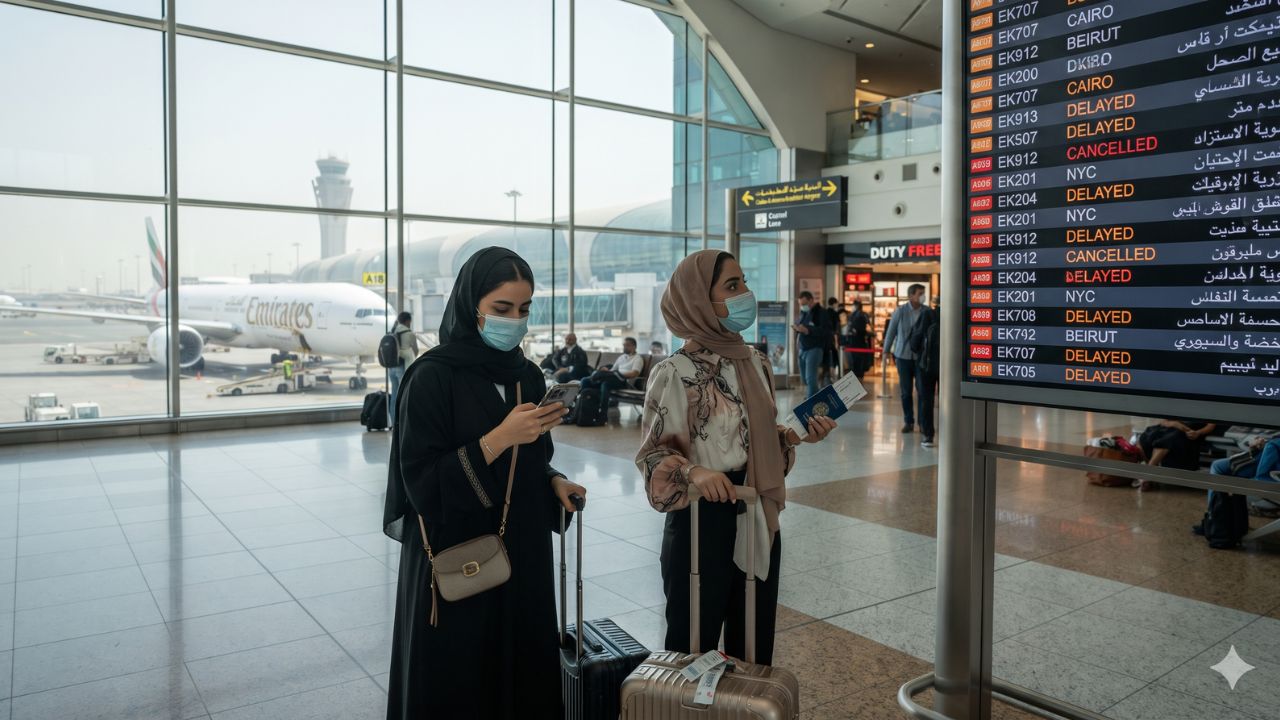
While intercontinental connecting passengers through Dubai and Istanbul faced massive waiting queues exceeding 360 combined delays, Saudi Arabian airfields suffered the heaviest concentration of outright cancellations, with 59 grounded departures led by Dammam where 7% of all flights were cancelled. Heightened regional security protocols, recent physical strikes targeting Saudi airport infrastructure, and sudden airspace restrictions forced commercial carriers across six nations to drastically compress flight schedules. Operational metrics verified on 22 October 2026 at 3:55 pm ET USA (11:55 pm GST) through FlightAware confirm that 109 commercial flights were cancelled outright and 1,224 delayed across Saudi Arabia, the United Arab Emirates, Türkiye, Jordan, Bahrain, and Egypt.
These cascading schedule adjustments reveal how fragile international connection banks become when core Gulf airspace corridors are constrained. King Abdulaziz International Airport in Jeddah emerged as Saudi Arabia's primary delay bottleneck with 202 delayed departures, while Istanbul Airport in Türkiye recorded the highest single-facility delay volume anywhere in the dataset at 218 delayed flights. For independent long-haul flyers transiting through the Middle East, understanding the underlying choke points across regional airfields is essential to avoiding days trapped in terminal transit zones.
The Regional Toll: Airport-by-Airport Breakdown
Flight disruptions split between two distinct operational realities: Saudi airfields absorb the highest percentage of cancellations due to defense alerts and route suspensions, whereas mega-hubs in Dubai and Istanbul experience heavy holding patterns and rolling air traffic control slot restrictions.
| Airport / Hub City | Country / Territory | Cancellations (Count / %) | Delays (Count) | Operational Role & Primary Disruption Pressures |
|---|---|---|---|---|
| King Abdulaziz International (JED) | Jeddah, Saudi Arabia | 22 (2% origin / 2% dest.) | 202 | Western province hub; Umrah passenger surges and slot rationing |
| King Fahd International (DMM) | Dammam, Saudi Arabia | 21 (7% origin / 7% dest.) | 72 | Eastern province hub; highest proportional cancellation rate |
| King Khalid International (RUH) | Riyadh, Saudi Arabia | 14 (2% origin / 2% dest.) | 4 | Capital gateway; security-mandated schedule trimming |
| Prince Abdulmohsin Bin Abdulaziz | Yanbu, Saudi Arabia | 2 (cancellations) | 0 | Regional Red Sea gateway; localized operational scrubbings |
| Dubai International (DXB) | Dubai, UAE | 11 (1% origin / 1% dest.) | 178 | Busiest regional hub; transfer bank delays and flow metering |
| Zayed International (AUH) | Abu Dhabi, UAE | 3 (0% origin / — dest.) | 135 | Capital terminal; long-haul intercontinental schedule adjustments |
| Sharjah International (SHJ) | Sharjah, UAE | 10 (3% origin / 3% dest.) | 84 | Low-cost carrier base; regional feeder route cancellations |
| Istanbul Airport (IST) | Istanbul, Türkiye | 6 (0% origin / 0% dest.) | 218 | European-Asian junction; highest total delays in the region |
| Sabiha Gökçen International (SAW) | Istanbul, Türkiye | 3 (0% origin / — dest.) | 143 | Anatolian hub; domestic and short-haul European delay chains |
| Queen Alia International (AMM) | Amman, Jordan | 13 (5% origin / 5% dest.) | 16 | Levant corridor; elevated border airspace avoidance measures |
| Bahrain International (BAH) | Manama, Bahrain | 2 (cancellations) | 36 | Gulf regional transit point; downline schedule pushbacks |
| Cairo International (CAI) | Cairo, Egypt | 2 (cancellations) | 136 | North African gateway; Nile corridor airway congestion |
Saudi Arabia: Grounded Flights and Route Trimming
Across Saudi Arabia's four monitored commercial airfields, airlines registered 278 delays alongside 59 cancellations. The General Authority of Civil Aviation oversaw rigorous security procedures following infrastructure threats that caused acute schedule retrenchment.
At King Fahd International Airport in Dammam, cancellations surged to 7% for both inbound and outbound movements, representing the highest cancellation ratio among all major regional gateways. In Jeddah, King Abdulaziz International saw 202 flights held up on taxiways and departure aprons, stranding thousands of international pilgrims and regional business travelers. King Khalid International in Riyadh recorded 14 cancellations and four delays, while Prince Abdulmohsin Bin Abdulaziz Airport logged two cancellations with zero delays.
The United Arab Emirates: Slot Metering Across the Emirates
The United Arab Emirates absorbed 397 delays and 24 cancellations across three primary gateways. According to data monitored through Dubai Airports, Dubai International Airport functioned as the focal point of logistical strain within the UAE, logging 178 delays and 11 cancellations (1% cancellation rate).
Zayed International Airport in Abu Dhabi recorded 135 delayed services and three cancellations, maintaining stable operations on primary trunk lines but enduring holdbacks on connecting spokes. In the neighboring emirate, Sharjah International Airport experienced 84 delays and 10 cancellations (3% cancellation rate), heavily impacting budget routes connecting to South Asia and the Levant.
Türkiye, Jordan, and North Africa
Türkiye's twin hubs in Istanbul accounted for a staggering 361 delays and nine cancellations. Istanbul Airport registered 218 delays and six cancellations, while Sabiha Gökçen on the city's Asian side added 143 delays and three cancellations. In Amman, Queen Alia International Airport weathered 13 cancellations (5% cancellation rate) and 16 delays, reflecting Jordan's sensitive geographic position bordering active regional conflict zones. In Cairo, Egypt's primary aviation gateway recorded 136 delays and two cancellations, while Bahrain International registered 36 delays and two cancellations.
Airline Fleets Under Operational Stress
Disruptions rippled unevenly through carrier schedules, with regional state flag carriers and localized budget operators experiencing distinct challenges:
- Saudia: The kingdom's national airline recorded 14 cancellations (2% of scheduled operations) and 126 delayed flights, impacting 24% of its active daily flying schedule.
- Royal Jordanian: Heavily exposed to Levant airspace restrictions, the Amman-based carrier cancelled 13 flights—representing 9% of its network—while recording one delay (0% after rounding).
- Air Arabia: Operating out of Sharjah and Ras Al Khaimah, the low-cost carrier posted 10 cancellations (4%) and 73 delays, affecting 31% of its reported flights.
- Jordan Aviation: The specialized charter and scheduled operator suffered severe proportional disruption, recording two cancellations (20%) and four delays (40%).
- Turkish Airlines: Managing extensive transfer banks through Istanbul, the Star Alliance member recorded two cancellations (0% rounded) but weathered 174 delays (11% of operations).
- Pegasus Airlines: Türkiye's low-cost carrier registered one cancellation (0% rounded) and 155 delays, affecting 21% of its scheduled network.
- EgyptAir: Egypt's flag carrier logged two cancellations (0% rounded) alongside 45 delayed flights (17% of scheduled operations).
Visitor Insider Tips
Experiencing flight cancellations or extended delays in Middle Eastern hubs requires decisive action and an understanding of regional infrastructure alternatives:
- Bypass Airway Stalls with the Haramain High-Speed Train: If your domestic flight between Jeddah (JED), Medina (MED), or Mecca is cancelled, do not wait for airline rebooking counters. Head directly to the integrated Haramain High-Speed Railway station inside Jeddah Airport Terminal 1. High-speed electric trains travel at 300 km/h, reaching Medina in approximately two hours and Mecca in under an hour, completely unaffected by airspace closures.
- Access Dubai Airport Snooze Lounges and Metro Connections: During rolling delays at Dubai International (DXB), avoid gate seating areas. Concourse A, B, and C feature sleep cabins (sleep 'n fly) that can be booked by the hour. If your layover stretches beyond six hours due to delays, clear passport control and take the Dubai Metro Red Line directly from Terminal 1 or Terminal 3 into downtown Dubai; trains run until midnight on weekdays and 01:00 on weekends.
- Leverage Digital Rebooking Desks in Riyadh and Abu Dhabi: When flights are cancelled at King Khalid International (RUH) or Zayed International (AUH), airport transfer desks quickly develop multi-hour queues. Use airport Wi-Fi to message airline customer care via official WhatsApp and mobile app channels, which frequently process re-routings faster than ground agents.
- Retain Detailed Boarding Passes and Meal Expense Receipts: Under consumer regulations set by civil aviation authorities in Saudi Arabia and the UAE, passengers facing delays exceeding three to four hours are entitled to refreshments and meals provided by the carrier. Keep digital photos of boarding passes and all dining receipts to claim statutory reimbursement.
Cultural and Environmental Context
Aviation represents the economic lifeblood of the modern Middle East. Cities like Dubai, Doha, Riyadh, and Istanbul transformed themselves from regional outposts into global crossroads specifically by engineering state-of-the-art aviation megahubs connecting Europe, Africa, Asia, and the Americas.
When geopolitical events force the sudden closing or narrowing of regional air corridors, the environmental and operational penalties are immediate. Aircraft must carry extra contingency fuel to navigate lengthy circumglobal diversions around sensitive borders, significantly increasing aviation carbon emissions. Concurrently, regional governments have prioritized transport diversification—investing heavily in high-speed rail networks across Saudi Arabia and the GCC railway project—to ensure domestic mobility endures even when airspace faces acute turbulence.
FAQ: Navigating Middle East Flight Disruptions 2026
What caused the widespread cancellations across Middle Eastern airports?
Disruptions were triggered by regional security concerns, infrastructure attacks affecting Saudi Arabian airfields, and resulting airspace safety adjustments that required flight diversions and schedule trimming.
Are passengers entitled to hotel accommodation during long transit delays?
Yes. If an airline-caused delay or cancellation requires an overnight stay or exceeds six hours, international carriers operating through Dubai, Abu Dhabi, Doha, and Saudi Arabia must provide hotel lodging and transfers.
What is the fastest ground alternative if flights between Jeddah and Medina are cancelled?
The Haramain High-Speed Railway connects King Abdulaziz International Airport in Jeddah directly to Medina in roughly two hours, operating electric bullet trains at speeds up to 300 km/h.
How can I check if my flight through Istanbul or Dubai is affected?
Monitor real-time flight tracking through your airline's official mobile application or FlightAware before departing for the airport, as gate changes and holding pattern delays update dynamically.
Across the desert hubs where east meets west, the journey demands patience, quick adaptation, and respect for the skies above.
Related Travel Guides
- Typhoon Champi Grounds Asian Skies: 754 Flight Cancellations and 6,264 Delays Strike Taoyuan, Naha, and Major Hubs
- Beyond the Summer Beach: Wizz Air Unlocks Málaga, Granada, and Asturias with £26.99 Winter Flights from London
- The PAMOJA Visa Revolution: How Tanzania, Kenya, and Uganda Are Uniting East African Travel for AFCON 2027
Disclaimer
This article is for informational and educational purposes only. It does not constitute legal, financial, or professional advice. While we strive to provide accurate and up-to-date information, travel policies, regulations, and conditions change rapidly. Always verify information with official sources before making travel decisions. Nomad Lawyer makes no representations about the accuracy, reliability, completeness, or suitability of the information provided. Readers should consult qualified professionals for advice specific to their circumstances. The views expressed in this article are those of the author and do not necessarily reflect the views of Nomad Lawyer.
Preeti Gunjan
Contributor & Community Manager
A passionate traveller and community builder. Preeti helps grow the Nomad Lawyer community, fostering engagement and bringing the reader experience to life.
Learn more about our team →