
Miami Airport Paralyzed as Severe Storms Trigger 304 Flight Delays Across Major Airlines
A massive severe weather system has completely severed vital flight corridors out of South Florida, stranding thousands of passengers bound for Europe, Canada, and Latin America.

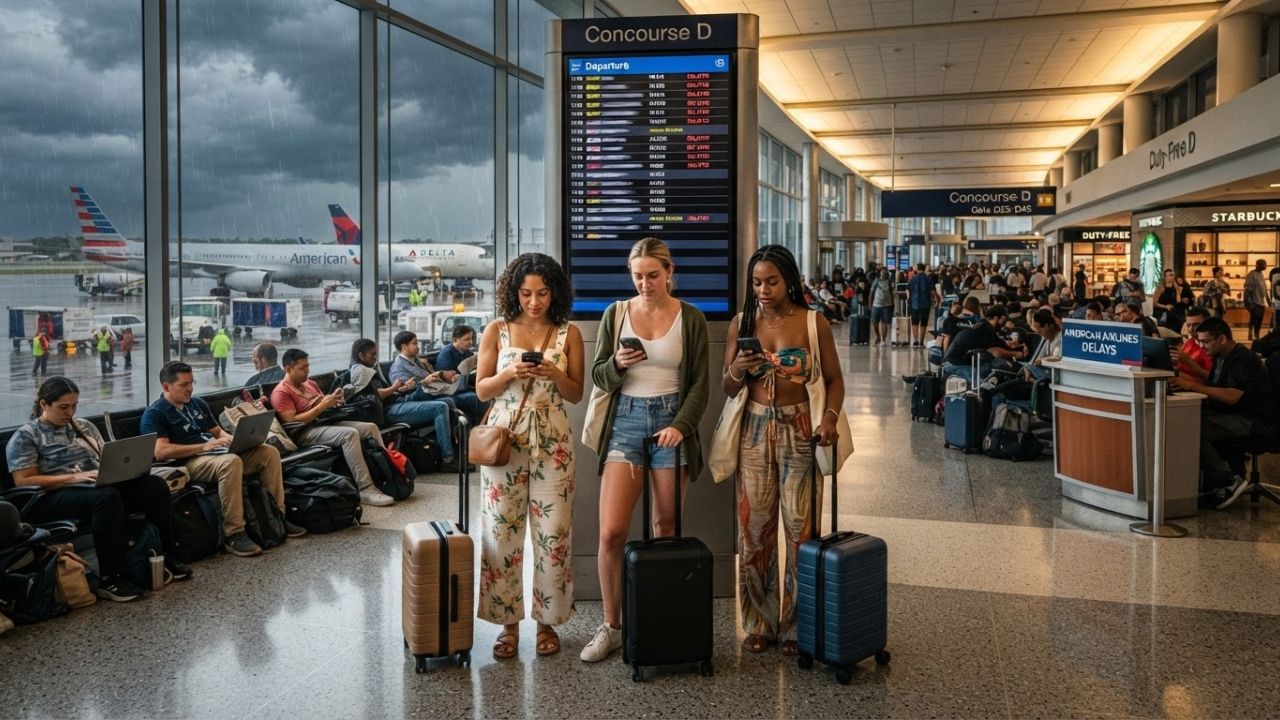
Image generated by AI
[Miami, July 3] — Miami International Airport (MIA) is currently experiencing a massive operational collapse. A fierce summer storm front has triggered cascading technical disruptions and severe air traffic control restrictions, effectively paralyzing one of the busiest aviation gateways in the United States. Flight tracking data currently reports a staggering 304 delayed flights and 6 outright cancellations across the terminal. This localized gridlock has rapidly severed critical international corridors linking South Florida to Canada, Venezuela, Colombia, and the United Kingdom. Furthermore, the bottleneck is heavily choking domestic networks, stranding thousands of passengers bound for core U.S. hubs including New York, Austin, and Atlanta. As ground crews battle to clear massive aircraft backlogs on the rain-soaked tarmac, airlines are urgently advising travelers to abandon physical customer service lines and utilize mobile applications for immediate digital rebooking.
American and Delta Absorb the Heaviest Operational Blows
An analysis of the localized flight data reveals a stark split between massive volume backlogs for legacy carriers and total gridlock for smaller international operators. Operating as the dominant hub carrier at MIA, American Airlines is shouldering the largest volume of disruptions, recording 187 total delays, which accounts for 29 per cent of its entire daily schedule. Its regional affiliate, Envoy Air, logged 15 delays (11 per cent) and registered 4 cancellations (3 per cent), effectively generating the vast majority of the terminal’s canceled flights.
Delta Air Lines is enduring an exceptionally brutal operational cycle in Miami, suffering 26 delays that represent a painful 41 per cent of its scheduled flights. Southwest Airlines similarly struggled, logging 11 delays (39 per cent). Conversely, United Airlines successfully insulated its operations, sustaining only 7 delays (21 per cent) and zero cancellations.
Transatlantic and Latin American Corridors Blocked
International flag carriers operating on highly compressed turnaround schedules are watching their logistics fall apart. KLM suffered the highest proportional disruption with a staggering 75 per cent delay rate across 3 flights. Air Canada Rouge endured a devastating double-hit, recording a 28 per cent delay rate (2 flights) alongside a 28 per cent cancellation rate (2 flights).
A massive cohort of global carriers—including LATAM Colombia (2 flights), Alaska Airlines (1 flight), British Airways (2 flights), Lufthansa (1 flight), Ethiopian Airlines (2 flights), Iberia (2 flights), Avianca El Salvador (4 flights), and Virgin Atlantic (2 flights)—each reported exactly 50 per cent of their scheduled MIA operations delayed.
The Geographic Impact of the Scheduling Collapse
The flight path data into and out of Miami highlights specific geographic zones where air traffic has ground to an absolute halt:
- Domestic Corridors: Inbound Northeast traffic is severely choked. Flights from New York’s JFK (7 delays, 53 per cent) and LaGuardia (7 delays, 46 per cent) are backed up, alongside Washington’s Reagan National (6 departures delayed at 54 per cent, 4 arrivals delayed at 36 per cent). In Texas, Austin-Bergstrom suffered a massive 71 per cent departure failure rate (5 flights) and a 57 per cent arrival delay rate (4 flights). Indianapolis (IND) completely stalled with 100 per cent of its departures (2 flights) delayed, while Dallas Love Field (DAL) saw its sole inbound flight delayed.
- Canadian and Caribbean Routes: Toronto Pearson International (YYZ) faces total collapse on the Miami routing. MIA arrivals from Toronto saw 16 per cent canceled and 33 per cent delayed; departing flights to Toronto were 100 per cent disrupted (75 per cent delayed, 25 per cent canceled). Simon Bolivar International (CCS) in Venezuela dropped 33 per cent of MIA arrivals (2 flights) and 28 per cent of departures (2 flights). Norman Manley International in Kingston, Jamaica, suffered an 80 per cent departure delay rate (4 flights).
- Transatlantic and Latin American Routes: Departures to Barcelona (1 flight), Frankfurt (1 flight), and Milan Malpensa (1 flight) suffered 100 per cent delay rates. London Heathrow recorded 60 per cent of arrivals (3 flights) and 40 per cent of departures (2 flights) running late. In Latin America, Comayagua, Honduras (XPL) hit a 100 per cent departure delay rate (2 flights) and a 66 per cent arrival delay rate (2 flights). Cali, Colombia (CLO) saw 100 per cent of its departures (3 flights) delayed, while Cozumel, Mexico (CZM) was entirely blocked with 100 per cent of inbound and outbound flights delayed.
Key Facts Breakdown
- Total Disruption: 304 flight delays and 6 cancellations at Miami International Airport.
- Primary Cause: Severe summer storm front triggering cascading technical delays.
- American Airlines Group: 187 delays for American; Envoy Air logged 15 delays and 4 cancellations.
- Delta Air Lines: 26 delays, representing 41 per cent of its daily MIA schedule.
- International Impact: KLM delayed 75% of flights; British Airways, Lufthansa, and Iberia all hit 50% delay rates.
- Domestic Chokepoints: Flights to/from JFK, LaGuardia, Reagan National, and Austin heavily restricted.
- Actionable Advice: Passengers are legally entitled to full cash refunds for outright cancellations under Department of Transportation rules.
Why This Matters
Our analysis of the flight data indicates that Miami International Airport remains highly vulnerable to rapid systemic contagion. Because MIA serves as the absolute primary gateway connecting North America to the Caribbean and Latin America, a localized weather event in South Florida instantly severs complex international supply chains and passenger routing across three continents. The massive 71 per cent departure failure rate to Austin and the 100 per cent departure disruption to Toronto highlight how fragile legacy carrier networks are when forced to operate without slack. When major international airlines like British Airways and Lufthansa suffer 50 per cent delay rates at a single U.S. node, the financial penalties compound massively as those widebody aircraft miss their highly rigid return slots in Europe, costing millions in missed connections.
Industry Outlook
Market trends suggest that airlines operating through the South Florida corridor will continue to face highly erratic scheduling challenges throughout the peak hurricane season. Because legacy carriers like American Airlines and Delta refuse to maintain expensive spare aircraft at MIA, any disruption guarantees rolling delays that stretch into the following operational day. Moving forward, expect international flag carriers to increasingly demand extended turnaround times at MIA to insulate their global networks from localized Florida weather events. Passengers currently stranded in Miami must aggressively utilize airline mobile apps to digitally force rebookings, as physical gate agents simply do not have the capacity to manually reroute 304 delayed flights. Furthermore, travelers should immediately demand meal vouchers from their carriers while monitoring the Department of Transportation dashboard to ensure their consumer refund rights are legally protected.
Related Travel Guides
- Ryanair Demands Immediate Suspension of EU Biometric Border Checks Amid Summer Travel Meltdown Fears
- Global Aviation Suffers 2.2% Passenger Collapse as Middle East Conflicts Fracture Key Flight Routes
- Foreign World Cup Fans Ditch Coastal Hubs for Authentic American Tailgates in the Heartland
- TSA Loopholes Revealed: How Passengers Are Legally Carrying Live Fish and Ice Blocks Through Airport Security
- DFW Airport Faces 1.75 Million Passenger Meltdown as July 4th Collides With FIFA World Cup
Disclaimer
This article is for informational and educational purposes only. It does not constitute legal, financial, or professional advice. While we strive to provide accurate and up-to-date information, travel policies, regulations, and conditions change rapidly. Always verify information with official sources before making travel decisions. Nomad Lawyer makes no representations about the accuracy, reliability, completeness, or suitability of the information provided. Readers should consult qualified professionals for advice specific to their circumstances. The views expressed in this article are those of the author and do not necessarily reflect the views of Nomad Lawyer.
Kunal K Choudhary
Co-Founder & Contributor
A passionate traveller and tech enthusiast. Kunal contributes to the vision and growth of Nomad Lawyer, bringing fresh perspectives and driving the community forward.
Learn more about our team →