
DFW Airport Faces 1.75 Million Passenger Meltdown as July 4th Collides With FIFA World Cup
Dallas-Fort Worth International Airport is fighting total operational paralysis as a massive influx of international World Cup fans collides with the domestic July 4th travel surge.

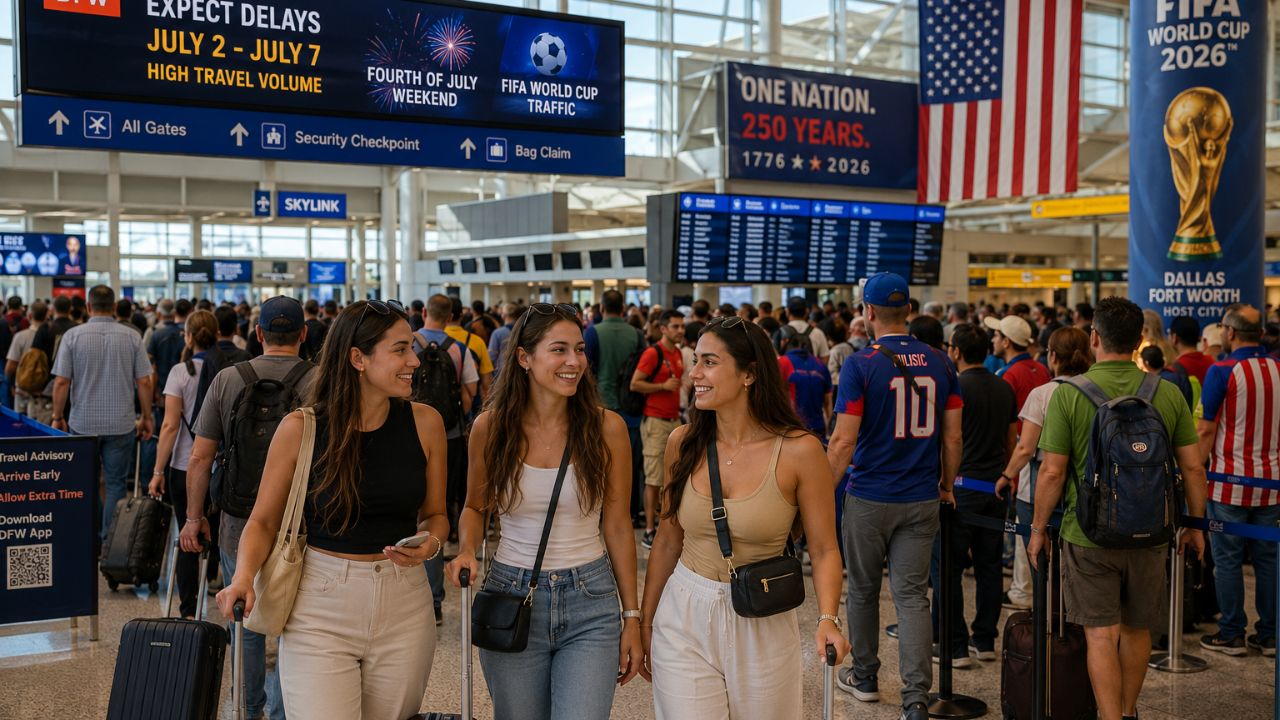
Image generated by AI
[Dallas, July 3] — Dallas-Fort Worth International (DFW) Airport is currently staring down an unprecedented logistical crisis. The traditional July 4th holiday rush has violently collided with massive international traffic generated by the ongoing 2026 FIFA World Cup and America’s 250th-anniversary celebrations. Airport officials confirm that a staggering 1.75 million travelers will push through the Texas aviation hub between July 2 and July 7. This historic convergence is triggering severe warnings regarding cascading flight delays, extreme security gridlock, and potential network failure.
The nationwide scale of this event is heavily compounding local pressure. According to recent data released by the Transportation Security Administration (TSA), an estimated 18.7 million passengers are currently moving through domestic checkpoints within a hyper-compressed seven-day window. Consequently, industry analysts have officially designated DFW Airport as the highest-risk major hub for missed connections in North America this summer. The sheer volume of simultaneous terminal traffic means that a single delayed departure could trigger a massive, uncontrollable domino effect across the broader U.S. aviation network.
World Cup Knockout Stages Severely Compound Regional Gridlock
The state of Texas is operating as the geographic epicenter of this summer's global sports tourism, hosting a tournament-high nine matches at Arlington’s stadium. This particular holiday weekend marks the brutal transition into the World Cup’s knockout rounds, instantly drawing hundreds of thousands of hyper-mobile international fans into North Texas. On Friday, July 3, a critical Round of 32 clash between Australia and Egypt will max out local venues, directly followed by another high-stakes match on Monday.
Flight tracking data confirms that regional transportation networks are being forced to process an extra 100,000 tournament-related travelers every single day. To prevent a total breakdown in terminal navigation, the Dallas-Fort Worth International Airport Board has rapidly deployed a massive ground force of nearly 500 volunteer ambassadors wearing bright orange jerseys. However, mixing these foreign arrivals with millions of domestic vacationers is pushing the airport's physical infrastructure to the breaking point.
Extreme Operational Defenses Deployed at DFW
To prevent the five-terminal complex from descending into total paralysis, DFW executives are executing aggressive structural and staffing countermeasures. The airport has rapidly opened nine brand-new passenger gates, heavily expanded its international ticket counters, and installed enhanced high-visibility digital signage at known bottlenecks. Concurrently, federal agencies have deployed specialized National Deployment Officers, highly trained K9 teams, and advanced screening technology to force passengers through security faster.
Local law enforcement agencies have established a highly visible, tactical presence across all terminals to maintain public order amid the chaos. Despite these massive structural upgrades, senior aviation executives are openly warning the public that adding this level of passenger density to a dynamic airport environment virtually guarantees systemic disruptions.
The Threat of 300-Minute Cascading Delays
Travelers navigating North Texas face a severe statistical probability of disrupted itineraries. Comprehensive summer trend analysis conducted by the aviation compensation firm AirAdvisor confirms that one in every six flights at DFW runs at least an hour late during peak summer operations. Alarmingly, when severe summer thunderstorms strike the region, DFW routinely suffers from cascading delays averaging over 300 minutes per disrupted flight.
Aviation analysts are forcefully advising all transit passengers to secure an absolute minimum buffer of 90 minutes between connecting flights. Missing a connection in Dallas this weekend carries catastrophic logistical consequences; alternative flight seats are virtually non-existent, and regional hotel inventory is completely zeroed out by World Cup tourists.
Texas Highway Grids and Love Field Face Parallel Crises
The severe operational strain inside the passenger terminals is causing massive spillover onto the surrounding highway networks. The Texas Department of Transportation has issued urgent advisories, warning motorists to anticipate extreme, bumper-to-bumper gridlock along all primary airport approach roads. Domestic holiday drivers are directly colliding with international fans utilizing rideshare services to bounce between downtown hotels and Arlington.
This crisis is not isolated to DFW. Nearby Dallas Love Field Airport is experiencing a parallel operational surge, officially projecting nearly 300,000 total passengers. Commuters are being heavily urged to abandon local toll plazas and utilize public transportation options, such as the DART rail network. Furthermore, airport parking lots are rapidly maxing out; travelers arriving without pre-booked parking reservations risk missing their flights entirely.
Severe Summer Heatwave Threatens Ground Operations
This unprecedented passenger volume is colliding with a brutal Texas heatwave, placing immense physical strain on ground operations. Ramp temperatures on the asphalt are routinely exceeding 40 degrees Celsius, exposing ground crews to highly dangerous working conditions while loading thousands of heavy bags.
Crucially, this extreme ambient heat directly degrades aircraft performance by reducing air density. This aerodynamic reality occasionally forces commercial airlines to restrict maximum take-off weights or abruptly alter fuel loads, leading to further logistical delays. Terminal air conditioning units and aircraft auxiliary power systems are running at absolute maximum capacity, while airport medical teams execute continuous patrols to treat vulnerable travelers suffering from heat exhaustion in severely crowded, un-ticketed zones.
Key Facts Breakdown
- Passenger Volume: DFW expects 1.75 million travelers between July 2 and July 7.
- National Context: TSA is screening 18.7 million passengers within a seven-day window.
- World Cup Impact: Arlington is hosting 9 matches, adding 100,000 daily travelers to the region.
- Key Match: Australia vs. Egypt (Round of 32) takes place on Friday, July 3.
- Operational Upgrades: DFW opened 9 new gates and deployed nearly 500 volunteer ambassadors.
- Delay Statistics: AirAdvisor reports 1 in 6 DFW flights run late; storm delays average 300+ minutes.
- Secondary Hubs: Dallas Love Field Airport expects nearly 300,000 passengers.
- Weather Hazard: Ramp temperatures exceeding 40 degrees Celsius are restricting aircraft take-off weights.
Why This Matters
Our analysis of the DFW operational matrix indicates that this weekend represents the ultimate stress test for the United States aviation network ahead of the 2028 Los Angeles Olympics. By attempting to process America 250 celebrations, standard July 4th domestic traffic, and the World Cup knockout stages simultaneously, DFW is exposing the extreme fragility of legacy hub-and-spoke models. If DFW suffers a major weather event this weekend, the resulting 300-minute cascading delays will not be contained to Texas; they will instantly paralyze connecting hubs in Atlanta, Chicago, and Denver. The deployment of 500 volunteer ambassadors proves that digital wayfinding is failing; physical human intervention is the only way to manage panicked international crowds navigating an unfamiliar domestic mega-hub.
Industry Outlook
Market trends suggest that the logistical trauma generated by this weekend's convergence will force a massive regulatory review of major event scheduling. Moving forward, expect the Federal Aviation Administration (FAA) to aggressively cap commercial flight slots at major hubs during overlapping international mega-events. Regional airports like Dallas Love Field must rapidly expand their heavy-rail transit connections, as the current reliance on rideshare apps is destroying the Texas highway grid. Finally, airlines operating out of DFW will likely be forced to permanently alter their summer load algorithms, baking in strict take-off weight restrictions to combat the increasing frequency of 40-degree Celsius ramp temperatures.
Related Travel Guides
- Thales and Visa Deploy D1 Platform Across Asia Pacific to Eradicate Payment Friction
- Saudi Arabia Unleashes 180-Day Digital Visa Waiver for UK Citizens
- Authentic Caribbean Beach Towns Hijack Summer Travel Boom From Legacy Mega-Resorts
- Visa Infinite Relaunches With AI-Driven Concierge Tech to Dominate Global Luxury Travel
- Astana Secures Massive 438 Billion Tenge Investment as Eurasia’s New Luxury Tourism Capital
Disclaimer
This article is for informational and educational purposes only. It does not constitute legal, financial, or professional advice. While we strive to provide accurate and up-to-date information, travel policies, regulations, and conditions change rapidly. Always verify information with official sources before making travel decisions. Nomad Lawyer makes no representations about the accuracy, reliability, completeness, or suitability of the information provided. Readers should consult qualified professionals for advice specific to their circumstances. The views expressed in this article are those of the author and do not necessarily reflect the views of Nomad Lawyer.
Kunal K Choudhary
Co-Founder & Contributor
A passionate traveller and tech enthusiast. Kunal contributes to the vision and growth of Nomad Lawyer, bringing fresh perspectives and driving the community forward.
Learn more about our team →