
Mexico City Links Tultitlán, Tultepec, Nextlalpan and Zumpango as AIFA Train Transforms Airport Travel: All You Need to Know
Mexico City Links Tultitlán, Tultepec, Nextlalpan and Zumpango as AIFA Train Transforms Airport Travel: All You Need to Know

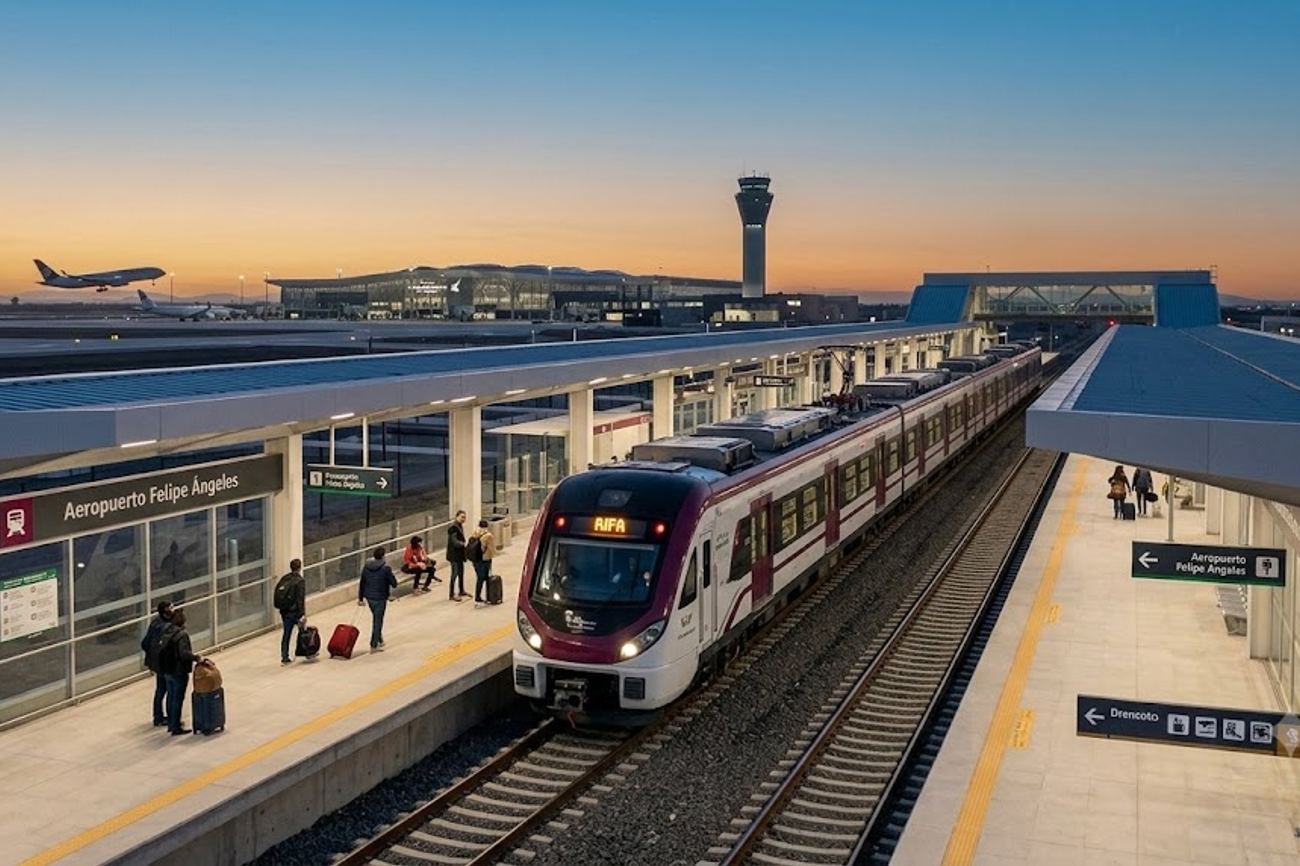
Image generated by AI
Commuter transit times from central Mexico City to AIFA have dropped from an initial 60-minute estimate to approximately 50 minutes in less than two months—a 16.6% efficiency gain that signals a rapid optimization of the new rail corridor. This acceleration is a critical data point for the broader aviation market, as the viability of Felipe Ángeles International Airport (AIFA) depends entirely on reducing the friction of ground access compared to the established Benitó Juárez International Airport (AICM).
The AIFA Rail Expansion in Numbers
The launch of the Tren Felipe Ángeles on 26 April 2026 has introduced a high-capacity transit artery designed to solve the "distance gap" that historically hindered AIFA's growth. The infrastructure consists of a 41.68-kilometre corridor featuring 12 passenger stops, structured as 10 stations and two terminals. A significant portion of this investment is concentrated in the Lechería–AIFA branch, which spans 22.94 kilometres.
From a throughput perspective, the system is engineered for scale. While the projected daily demand is 57,000 passengers, the infrastructure is built to sustain a maximum daily capacity exceeding 80,000 passengers. Individual train sets accommodate 719 passengers, but the system allows for coupled-train configurations, pushing single-service capacity above 1,400 passengers. This scalability is essential for managing the volatility of airport peak hours and seasonal travel surges.
The early adoption rates are aggressive. During the first week of operation, the line moved 206,515 passengers. The milestone of one million users was reached within approximately 45 days, and by 25 June 2026, total ridership had surpassed 1.5 million. This rapid uptake suggests that the market was severely underserved in terms of reliable, fixed-rail airport access.
Regional Mobility and Comparative Benchmarks
The Tren Felipe Ángeles is not merely an airport shuttle; it is a regional development tool. The corridor directly impacts four municipalities in the State of Mexico: Tultitlán, Tultepec, Nextlalpan, and Zumpango. According to official figures, 799,240 residents now have direct rail access to the capital and the airport, shifting the socioeconomic gravity of the northern metropolitan area.
When comparing this development to global airport rail standards—such as those tracked by IATA—the focus on "intermodality" is evident. The Buenavista terminal serves as a massive transit hub, linking the train to the Mexico City Metro, Metrobús Lines 1, 3, and 4, Ecobici, and the existing suburban railway to Cuautitlán. At the AIFA end, the rail terminal is integrated directly with the airport's intermodal ground-transport terminal.
The following table illustrates the performance gap between the initial launch projections and the current operational reality as of June 2026:
| Metric | Launch Projection (April 2026) | Operational Status (June 2026) | Variance/Trend |
|---|---|---|---|
| Journey Time (Buenavista-AIFA) | < 60 Minutes | ~ 50 Minutes | 10 Minute Reduction |
| Target Journey Time | 43 Minutes | 50 Minutes | 7 Minute Gap to Target |
| Daily Ridership Capacity | 80,000+ | 57,000 (Projected Demand) | 28.7% Surplus Capacity |
| Total Ridership | 0 | 1.5 Million+ | Rapid Adoption |
| Average Speed | 65 km/h | 65 km/h | Stable |
| Max Design Speed | 130 km/h | 130 km/h | Potential for Future Gains |
What This Means for Travelers
For the individual traveler, the introduction of this rail link fundamentally changes the risk calculus of booking flights into AIFA versus AICM. Previously, the reliance on buses or private transfers made AIFA a gamble in terms of timing. Now, with a 15-minute train interval and a 50-minute transit time from Buenavista, the predictability of the journey has increased significantly.
If you are planning a trip to Mexico City in the second half of 2026, consider the following data-driven booking strategies:
- Budget Optimization: The current introductory fare of MXN 45 for AIFA-bound trips is significantly lower than private airport transfers. However, these are explicitly labeled as "introductory," meaning travelers should expect a price correction upward as the system matures.
- Timing Your Arrival: With trains running from 05:00 to midnight (Monday-Friday), 06:00 to midnight (Saturday), and 07:00 to midnight (Sunday/Holidays), the rail link is viable for almost all flight schedules. However, for flights landing before 07:00 on Sundays, alternative transport remains necessary.
- Strategic Transfers: To avoid the congestion of central Mexico City, travelers can utilize the 12-stop network. If your accommodation is near Tlalnepantla or San Rafael, the train provides a direct bypass of the city's notorious road traffic.
Forward Projection: The Path to 43 Minutes
The current trajectory of the Tren Felipe Ángeles suggests a push toward the "designed target" journey time of 43 minutes. To shave off the remaining 7 minutes, the operator will likely need to optimize dwell times at the 12 stops or increase the average operating speed from 65 km/h toward the 130 km/h maximum design limit.
As ridership continues to climb beyond the 1.5 million mark, we can expect a shift in carrier behavior. Airlines typically increase frequency to airports that demonstrate reliable ground access. If the 57,000 daily passenger demand is met or exceeded, AIFA will likely see a surge in low-cost carrier (LCC) capacity, as these airlines prioritize airports with efficient, high-volume transit links.
The integration with Statista data on urban mobility trends suggests that "last-mile" connectivity will be the next frontier for this route. The current links to Mexibús and Ecobici are the first step; further expansion of these feeder systems will be required to move the "benefited population" from 799,240 to a larger percentage of the State of Mexico's residents.
FAQ: AIFA Rail Connectivity 2026
Will the train fares increase soon? Yes. The current MXN 45 fare is officially designated as "introductory." Travelers should budget for a price increase as the service moves out of its launch phase.
Is the train faster than a taxi to AIFA? During peak traffic hours, yes. While taxis are subject to road congestion, the rail link offers a consistent 50-minute journey from Buenavista, bypassing surface traffic.
Which stations are best for connecting to the city center? Buenavista is the primary hub, providing direct transfers to the Mexico City Metro and Metrobús Lines 1, 3, and 4.
Can the train handle peak holiday crowds? Yes. The system can utilize coupled trains to increase capacity to over 1,400 passengers per service, well above the standard 719-passenger limit.
The shift from road-dependency to rail-predictability is the single most important catalyst for AIFA's long-term market share.
#AIFA-Transit-Growth-2026 #Mexico-City-Rail-Metrics #Tren-Felipe-Angeles-Capacity #State-of-Mexico-Mobility-Shift #Airport-Intermodality-Data
Related Travel Guides
- Türkiye Rail Boom Accelerates as Istanbul Turns Into a Global Connectivity Hub in 2026
- Manchester Launches Free Bee Network Tram Travel for Students Through TfGM and Aviva Partnership in 2026
- Russian Railways Network Operates Twelve Longest Passenger Rail Journeys Worldwide Led by 10,214-Kilometer Moscow to Pyongyang Express Route in 2026
Disclaimer
This article is for informational and educational purposes only. It does not constitute legal, financial, or professional advice. While we strive to provide accurate and up-to-date information, travel policies, regulations, and conditions change rapidly. Always verify information with official sources before making travel decisions. Nomad Lawyer makes no representations about the accuracy, reliability, completeness, or suitability of the information provided. Readers should consult qualified professionals for advice specific to their circumstances. The views expressed in this article are those of the author and do not necessarily reflect the views of Nomad Lawyer.
Preeti Gunjan
Contributor & Community Manager
A passionate traveller and community builder. Preeti helps grow the Nomad Lawyer community, fostering engagement and bringing the reader experience to life.
Learn more about our team →