Korean Air Flight Operations and Incheon Airport Infrastructure Breakdown: Analyzing Causes Behind 2026 Flight Disruption and Cascading Layover Risks

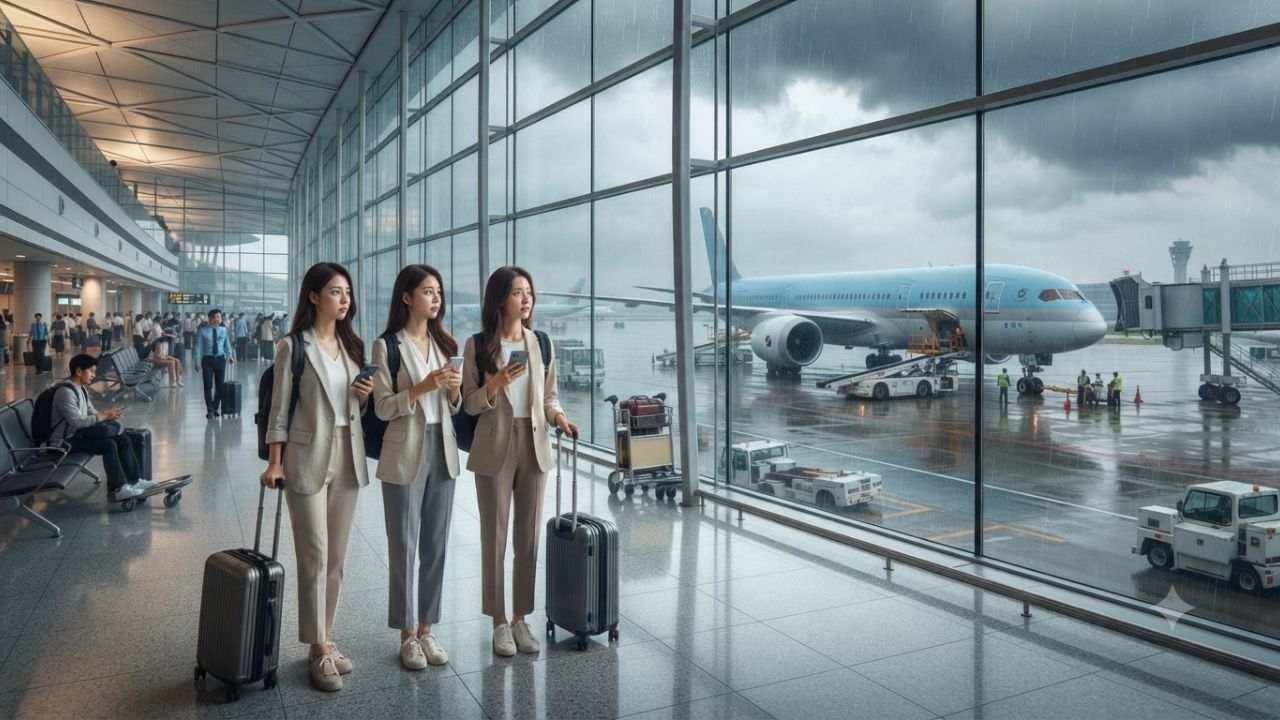
Image generated by AI
Flight schedule disruptions across Korean Air's network are driven by interconnected operational factors spanning air traffic congestion, seasonal weather patterns, late-arriving inbound aircraft, and turnaround constraints at Seoul Incheon International Airport.
As South Korea’s flag carrier and anchor tenant at Seoul Incheon (ICN), Korean Air operates inside one of East Asia’s densest aviation hubs. Official airport statistics document that Incheon handled 74.07 million passengers and 425,760 aircraft movements in 2025, while Korean Air transported 16.49 million passengers across its global network. Understanding the structural mechanics behind flight delays provides travelers with actionable strategies for booking connections and managing layovers.
Seoul Incheon Operating Metrics: Handling 74.07 Million Passengers
Analyzing Korean Air's flight punctuality requires examining the operating scale of Seoul Incheon International Airport. Incheon serves as a primary connecting hub between East Asia, North America, Europe, and Southeast Asia.
| Incheon Airport Metric | 2024 Official Figures | 2025 Official Figures | Year-on-Year Growth |
|---|---|---|---|
| Annual Passenger Traffic | 71.16 million | 74.07 million | +4.1% |
| Aircraft Movements | 413,200 | 425,760 | +3.0% |
| Annual Air Cargo Volume | 2.95 million tonnes | 2.95 million tonnes | Stable |
| August Peak Monthly Traffic | — | 37,553 movements / 6.60M passengers | Peak summer surge |
| December Peak Monthly Traffic | — | 37,318 movements / 6.57M passengers | Winter holiday rush |
| January Peak Monthly Traffic | — | 6.58 million passengers | New Year travel peak |
Operating at high capacity means minor delays during morning arrival banks can cascade across subsequent departure banks throughout the afternoon and evening.
Cascading Inbound Delay Mechanics & Air Traffic Bottlenecks
A late departure rarely originates at the departure gate itself. In commercial aviation, long-haul and regional aircraft operate multi-sector rotations, meaning an aircraft assigned to an outbound flight may be completing a previous international sector.
Data published by the U.S. Bureau of Transportation Statistics (BTS) illustrates the domino effect of late-arriving aircraft across international networks. In monthly data through June 2026, BTS recorded 32,942 late-arriving-aircraft operations, accounting for over 2.27 million total delay minutes.
Within the specific late-arriving aircraft category, BTS data attributes delay causes across four distinct operational factors:
| Late-Arriving Aircraft Delay Cause | Percentage Share of Category Delay Minutes | Operational Description |
|---|---|---|
| Air Carrier Operational Delay | 62.26% | Maintenance, ground servicing, catering, and crew scheduling |
| Air Volume / System Congestion | 12.82% | Airway sequencing, holding patterns, and airport slot metering |
| Standard Weather Impact | 10.69% | Rain, wind shifts, and low visibility below system thresholds |
| Extreme Weather Events | 7.92% | Severe blizzards, typhoons, and thunder cells halting ground work |
When an inbound aircraft touches down late, ground turnaround processes—including cabin cleaning, refueling, baggage unloading/reloading, catering restocking, and pre-flight safety checks—must be compressed. If turnaround time is exhausted, pushback is delayed, causing the aircraft to lose its assigned air traffic control (ATC) departure slot.
Seasonal Disruption Dynamics: Typhoons, Winter Weather & Peak Rush
Seasonal weather patterns across Northeast Asia represent an external variable affecting flight schedules:
- Summer Typhoon Exposure (July–September): Tropical cyclones tracking across the West Pacific, Japan, Taiwan, and the Korean Peninsula can alter flight routings, force oceanic holding patterns, or temporarily ground regional aircraft.
- Winter Freezing & Low Visibility (December–February): De-icing operations at Incheon and destination airports in North America or Northern Europe add mandatory 15-to-45-minute ground delays per aircraft prior to takeoff.
- National Holiday Traffic Surges: South Korea's major holiday periods—including Lunar New Year (Seollal) and Chuseok—coincide with international peak seasons. Incheon recorded over 6.58 million monthly passengers in January, 6.60 million in August, and 6.57 million in December 2025.
Federal Aviation Administration (FAA) National Airspace System tracking demonstrates that weather accounts for 74.26% of all system delays exceeding 15 minutes across major international corridors, with traffic volume accounting for 14.92%.
Korean Air has implemented revised operational protocols to mitigate systemic delays and enhance fleet reliability across its global network. Passengers seeking real-time updates on flight status and rescheduling options should consult the Korean Air official portal for the most accurate itinerary data.
Traveler Logistics Guide: Optimizing Incheon Transfers & Buffer Windows
For international passengers connecting through Seoul Incheon on Korean Air, implementing structured transit strategies minimizes disruption risks.
1. Connection Duration Thresholds & Risk Assessment
When booking connecting flights across long-haul networks, select connection windows based on delay thresholds:
| Layover Window Duration | Risk Assessment & Impact Matrix | Recommended Traveler Action |
|---|---|---|
| Under 60 Minutes | High Risk. 15-to-30-minute inbound delay risks missed connection. | Avoid for interline flights or final daily connections. |
| 60 to 90 Minutes | Moderate Risk. Standard Minimum Connection Time (MCT) at ICN. | Suitable for single-ticket same-terminal transfers. |
| 90 to 180 Minutes | Low Risk. Optimal buffer for international-to-international transfers. | Recommended for long-haul routes (e.g., US/Europe to SE Asia). |
| 180+ Minutes | Minimal Risk. Allows buffer for major 2-hour inbound delays. | Ideal when transferring across separate tickets or airlines. |
2. Utilizing "Incheon Airport Preview" Digital Tools
Korean Air integrated an Incheon Airport Preview feature into its mobile application. The tool utilizes real-time Incheon International Airport Corporation (IIAC) public data, allowing passengers to inspect terminal departure gate congestion, security checkpoint wait times, and parking availability prior to arriving at the airport.
3. Streamlining US Transfers: International Remote Baggage Screening
For passengers flying Korean Air from Incheon to the United States, a partnership between Korean Air and Delta Air Lines introduced International Remote Baggage Screening on selected Incheon–Atlanta (ATL) flights in August 2025. The technology transmits digital baggage security images directly to U.S. Customs and Border Protection (CBP) prior to flight landing, accelerating onward baggage re-check procedures by approximately 20 minutes for connecting passengers at Atlanta Hartsfield-Jackson.
4. Baggage & Rebooking Protection Rules
Always ensure international connecting itineraries are ticketed under a single Passenger Name Record (PNR). Under IATA interline rules, if a Korean Air flight is delayed due to weather or air traffic control restrictions causing a missed connection, the issuing carrier is obligated to rebook the passenger onto the next available flight, provide meal vouchers, and arrange hotel accommodations for overnight layovers.
Macroeconomic & Airline Network Management Outlook
Managing flight punctuality across a global hub carrying 16.49 million annual passengers requires continuous coordination between airlines, air traffic controllers, and airport authorities:
- Integrated Hub Operations: Korean Air's joint venture with Delta Air Lines concentrates transatlantic transfer traffic through Incheon Terminal 2, reducing transit times between connecting flights.
Incheon International Airport continues to upgrade its smart-terminal infrastructure to better manage passenger surges and reduce cascading layover risks. Travelers can find detailed guides on transit facilities and airport services through the Incheon International Airport Corporation website. 2. Passenger Flow Digitization: Mobile queue tracking, biometric boarding gates, and pre-arrival baggage screening offset surface congestion during peak departure banks. 3. Network Resilience Strategy: Prioritizing buffer time on high-demand routes—such as Korean Air's top international leisure route to Tokyo—ensures regional aircraft rotations remain resilient against unexpected weather disruptions.
FAQ: Korean Air & Incheon Airport Operations 2026
What are the main causes of flight delays on Korean Air?
Flight delays on Korean Air are primarily caused by late-arriving inbound aircraft from previous flight sectors, air traffic control congestion, peak departure bank volume at Seoul Incheon, and seasonal weather events such as winter de-icing or summer typhoons.
How many passengers did Seoul Incheon Airport handle in 2025?
Seoul Incheon International Airport handled 74.07 million passengers and 425,760 aircraft movements in 2025, representing a 4.1% increase in passenger traffic compared to 2024.
What is International Remote Baggage Screening on Korean Air flights?
Introduced in August 2025 on Korean Air and Delta flights between Incheon and Atlanta, International Remote Baggage Screening sends digital luggage images to U.S. Customs and Border Protection prior to arrival, reducing transfer procedures by about 20 minutes.
What is the recommended layover time for connecting at Seoul Incheon Airport?
For international-to-international connections, a layover window of 90 to 180 minutes is recommended to absorb potential 30-to-60-minute inbound flight delays without risking a missed connection.
Related Travel Guides
- Breaking Airline News: Emirates Triggers Travel Chaos by Massively Reducing International Flights by 14% Amid Skyrocketing Fuel Prices
- SalamAir Launches Direct Muscat to Mogadishu Flights Unlocking East African Connectivity
- 290 Flights Delayed, 35 Canceled Across Middle East: Emirates, Flydubai, EgyptAir Grounded
This article is for informational purposes. Flight routes, passenger regulations, visa rules, and transit advisories are subject to change by airlines and aviation authorities. Readers are advised to verify schedules and travel documentation with relevant carriers and border agencies before departure.
Related Stories

Auckland to Shanghai Route Marks 20 Years: Aviation History and Cultural Travel Guide

Sydney to Cape Town Nonstop: Qantas Launches Historic Boeing 787-9 Route Unlocking Direct Access to South Africa's Western Cape in 2027