
KLM Flight KL642 Crosses Atlantic in 5 Hours 43 Minutes: New York to Amsterdam Dash and Schiphol Guide
KLM flight KL642 dashes from New York to Amsterdam in just 5 hours and 43 minutes on a Boeing 787-10 Dreamliner, arriving 97 minutes ahead of schedule.

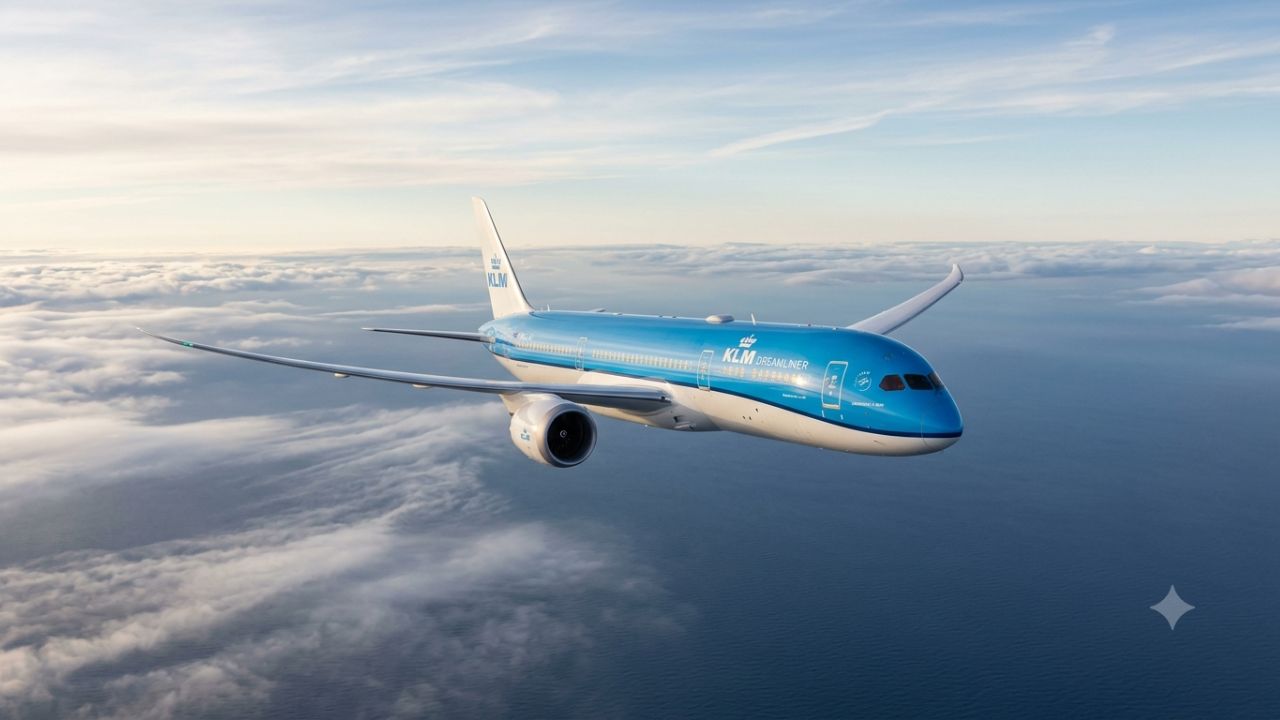
KLM flight KL642 completed its transatlantic flight from New York to Amsterdam in 5 hours and 43 minutes on October 8–9, 2026.
While commercial flight schedules typically allocate approximately 7 hours and 20 minutes to cross from New York to the Dutch capital, KLM Royal Dutch Airlines flight KL642 dashed across the North Atlantic in an astonishing 5 hours and 43 minutes on 8 October 2026. Propelled by powerful high-altitude tailwinds that swept the wide-body Boeing 787-10 Dreamliner across the ocean, the aircraft touched down at Amsterdam Airport Schiphol a full 1 hour and 37 minutes ahead of schedule—slashing 97 minutes off published flying times and demonstrating how seasonal atmospheric currents can dramatically alter intercontinental journeys.
The Transatlantic Sprint: Inside the 343-Minute Crossing
According to historical tracking records published by Flightradar24, flight KL642 departed John F. Kennedy International Airport (JFK) at 21:26 UTC on 8 October 2026. Following an expedited oceanic track across the North Atlantic, the twin-engine wide-body touched down on the runways of Amsterdam Airport Schiphol at 03:09 UTC on 9 October (05:09 local Dutch time). The total elapsed airborne journey measured exactly 5 hours and 43 minutes.
Aviation analysis outlet Aeronews promptly highlighted the crossing as a remarkable benchmark. However, aviation historians note that comprehensive long-term data comparisons are still required to confirm whether this specific flight represents an absolute, all-time operational record for commercial passenger airliners on the JFK–AMS city pair.
For travelers, published timetable schedules represent operational planning windows rather than rigid flight commitments. Airlines routinely build buffer margins into their timetables to accommodate terminal taxiing delays, ground holds, airspace congestion, and seasonal headwind variations. Consequently, while flight KL642 arrived 97 minutes early, travelers should not expect future eastbound bookings to replicate this exceptional crossing consistently.
Atmospheric Engines: Jet Streams and Dreamliner Technology
The primary atmospheric catalyst behind such swift eastbound crossings is the North Atlantic jet stream—a high-altitude ribbon of fast-moving westerly winds circulating in the upper troposphere. According to the Federal Aviation Administration (FAA), jet streams can reach velocities exceeding 275 miles per hour during peak seasonal shifts. When an eastbound aircraft aligns its flight path directly within this high-velocity core, its groundspeed increases substantially while its airspeed through the surrounding atmosphere remains well within safe aerodynamic limits.
The aircraft operating this specific service was a Boeing 787-10 Dreamliner registered under tail number PH-BKD. Designed for long-haul intercontinental passenger routes, the composite-airframe aircraft features advanced aerodynamics, raked wingtips, and high-bypass General Electric GEnx-1B engines.
With an overall length of 68.3 metres, a wingspan of 60.1 metres, and a maximum operating range of 12,000 kilometres, the 787-10 maintains a published cruising speed of 903 kilometres per hour. KLM configures this flagship aircraft to accommodate up to 344 passengers across four cabin products: World Business Class (arranged in a 1-2-1 direct-aisle layout), Premium Comfort (2-3-2), Economy Comfort, and standard Economy (3-3-3).
Transatlantic Flight and Fleet Matrix: KL642 vs Standard Operations
The operational metrics comparing flight KL642's crossing against standard published airline schedules are detailed below:
| Flight Parameter | Recorded Flight Metric (8 Oct 2026) | Standard Published Benchmark | Practical Operational Impact |
|---|---|---|---|
| Elapsed Flight Duration | 5 hours 43 minutes (343 minutes) | ~7 hours 20 minutes (440 minutes) | Shaved 1 hour 37 minutes (97 minutes) off published duration. |
| Departure Window | 21:26 UTC from New York JFK | Scheduled evening departure bank | Smooth departure clearance and direct oceanic routing. |
| Arrival Timing | 03:09 UTC at Amsterdam AMS | ~04:46 UTC scheduled gate arrival | Touched down at 05:09 local time, well before morning congestion. |
| Aircraft Type & Registration | Boeing 787-10 Dreamliner (PH-BKD) | Standard KLM long-haul wide-body fleet | High composite fuel efficiency and advanced noise reduction. |
| Maximum Passenger Capacity | 344 passenger seats | Standard multi-class configuration | World Business (1-2-1), Premium Comfort (2-3-2), Economy (3-3-3). |
| Aircraft Cruising Speed | 903 km/h published cruising speed | High-altitude groundspeed aided by winds | Tailwinds exceeded typical oceanic averages across the Atlantic. |
| Jet Stream Velocity Factor | High-velocity North Atlantic core | Jet stream peaks exceed 275 mph (FAA) | Boosted ground velocity without increasing aerodynamic airspeed. |
What Makes an Early Amsterdam Arrival Different
Landing at Amsterdam Airport Schiphol at 05:09 local time presents an entirely different travel dynamic than arriving during mid-morning peak banks. Schiphol operates as Europe's primary low-lying aviation hub, situated four meters below sea level in a reclaimed polder lake bed.
An early arrival brings distinct advantages for international travelers. Arriving passengers clear the Royal Marechaussee border control checkpoints before the main wave of long-haul flights from Asia, Africa, and North America floods the terminal. Passengers continuing onto European connections with KLM or SkyTeam partners gain generous transfer windows, avoiding gate-running scrambles across Piers B through F.
For those terminating their journey in the capital, an early morning arrival allows travelers to experience Amsterdam before the crowds wake up. Stepping out into the Seventeenth-Century Canal Ring Area of Amsterdam inside the Singelgracht, inscribed on the World Heritage List through the UNESCO World Heritage Centre, reveals mist drifting over the quiet waters of the Herengracht and Prinsengracht. Traditional gabled merchant canal houses reflect across undisturbed waterways, delivery barges maneuver quietly under arched brick bridges, and the city's famous cycling commuters begin filling dedicated bike lanes.
Visitor Insider Tips for Arriving at Amsterdam Schiphol
- Direct Train to Central Station: Never hire a street taxi from Schiphol Plaza into the city center. Walk directly beneath the central terminal plaza to the underground train platforms. Nederlandse Spoorwegen (NS) double-decker trains run every 10 to 15 minutes directly to Amsterdam Centraal Station, reaching the historic center in just 14 to 17 minutes for roughly €5.90. Tap in and out using contactless payment cards or smartphones.
- Managing Pre-Dawn Arrival Luggage: Most Amsterdam boutique hotels and canal houses do not open check-in desks until 14:00 or 15:00. Store heavy bags at Schiphol's lower-level baggage storage lockers near the arrivals hall, or utilize luggage storage lockers at Amsterdam Centraal Station to explore the city unencumbered.
- Morning Coffee and Dutch Breakfast Etiquette: Before museums open at 09:00 or 10:00, seek out traditional neighborhood bakeries and brown cafes (bruine kroegen) near the Jordaan. Order an uitsmijter—two or three fried eggs sunny-side up over thick slices of Dutch bread with melted Gouda cheese and ham—paired with a strong black coffee (koffie verkeerd).
- Early Access to the Museum Quarter: If visiting the Rijksmuseum, Van Gogh Museum, or Stedelijk Museum, book designated 09:00 morning entry time slots online several weeks in advance. The earliest morning slots let you view Rembrandt's The Night Watch and Vermeer's The Milkmaid in tranquil gallery rooms before tour groups arrive.
Cultural and Environmental Context: Sustainable Aviation and City Limits
While high-speed jet streams offer fascinating travel records, the broader context of transatlantic aviation remains closely tied to environmental sustainability and municipal capacity.
The Dutch government and Schiphol Airport authorities continue to enforce stringent annual flight caps and noise mitigation quotas designed to limit the environmental footprint on surrounding residential communities. Modern wide-body aircraft like KLM's Boeing 787-10 Dreamliner play an important role in this transition: its lightweight carbon-fiber composite fuselage and advanced engine architecture generate 20% lower carbon dioxide emissions and significantly less perceived community noise compared to earlier-generation wide-body airliners.
At the destination level, Amsterdam is managing visitor density by enforcing strict caps on holiday home-sharing rentals and curbing new hotel developments across historic canal neighborhoods. By promoting early-morning dispersals, sustainable rail transit, and mindful urban exploration, the city seeks to maintain peaceful living conditions for local residents while continuing to welcome responsible global travelers.
FAQ: Flying and Visiting Amsterdam 2026
What caused KLM flight KL642 to arrive 97 minutes early?
The flight encountered exceptionally strong high-altitude tailwinds within the North Atlantic jet stream, which substantially increased the aircraft's groundspeed over the ocean without requiring excessive engine thrust.
Should travelers plan future transatlantic itineraries based on 5-hour crossings?
No. Standard scheduled durations of approximately 7 hours and 20 minutes remain the reliable planning benchmark. Wind speeds and weather patterns fluctuate daily, and airlines build timetables to account for diverse operating conditions.
How do I travel from Schiphol Airport into downtown Amsterdam?
Direct Nederlandse Spoorwegen (NS) passenger trains run 24 hours a day from the platforms beneath Schiphol Plaza directly to Amsterdam Centraal Station, taking approximately 15 minutes.
What are the peak visiting hours to avoid crowds in central Amsterdam?
The busiest hours along central canal routes and the Museumplein occur between 11:00 and 16:00. Explore historic canals during early morning hours (07:00 to 09:00) or early evening when day-trippers disperse.
Related Travel Guides
Disclaimer
This article is for informational and educational purposes only. It does not constitute legal, financial, or professional advice. While we strive to provide accurate and up-to-date information, travel policies, regulations, and conditions change rapidly. Always verify information with official sources before making travel decisions. Nomad Lawyer makes no representations about the accuracy, reliability, completeness, or suitability of the information provided. Readers should consult qualified professionals for advice specific to their circumstances. The views expressed in this article are those of the author and do not necessarily reflect the views of Nomad Lawyer.
Kunal K Choudhary
Co-Founder & Contributor
A passionate traveller and tech enthusiast. Kunal contributes to the vision and growth of Nomad Lawyer, bringing fresh perspectives and driving the community forward.
Learn more about our team →