
Kazakhstan's Singing Dunes and Silk Road Trails Spark Global Rise in Central Asian Sonic Tourism
Kazakhstan's Altyn-Emel Singing Dunes, Uzbek Timurid mosques, Pamir mountain chasms & Kyrgyz yurt acoustic trails spark a global surge in sonic travel.

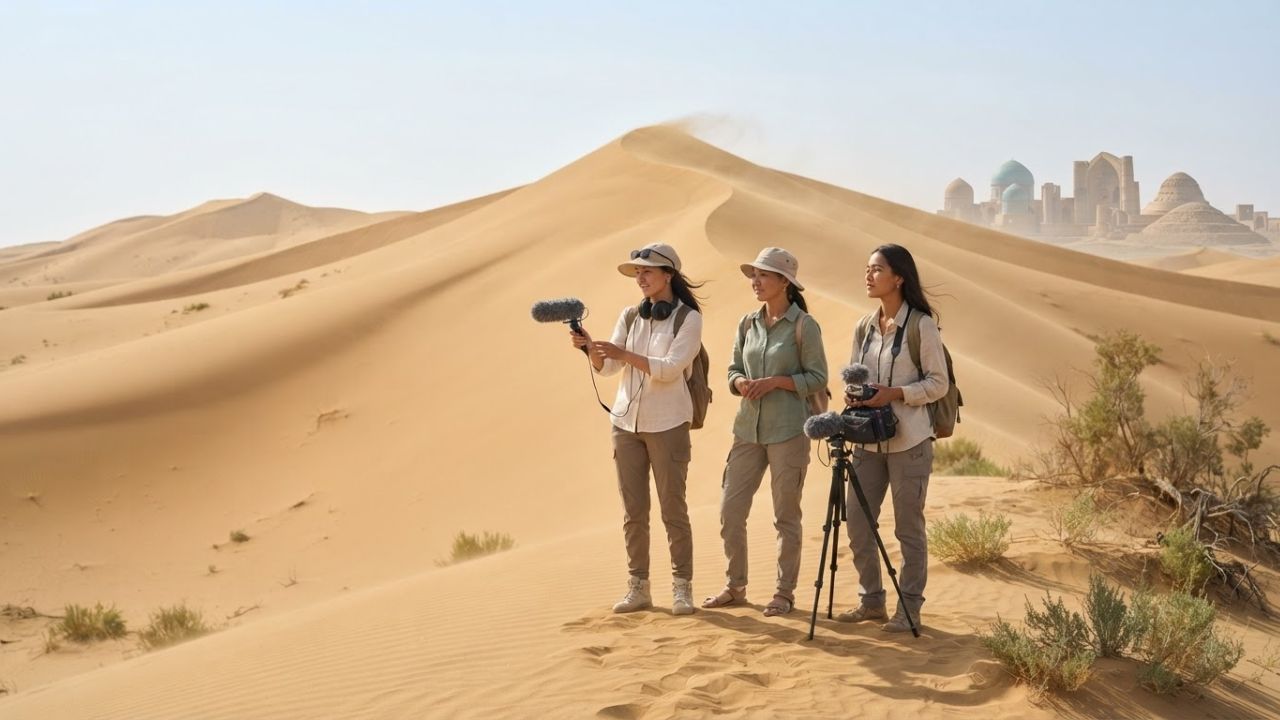
Image generated by AI
Acoustic travel is emerging as a major trend across Central Asia, where field audio creators and travelers are mapping ancient Silk Road trails to record the geological vibrations of Kazakhstan’s Singing Dunes, the reverberations of Uzbek mosques, and the mountain winds of the Pamirs.
ALMATY, Kazakhstan — Central Asia is experiencing a surge in acoustic travel, a specialized segment of immersive tourism where travelers focus on documenting natural environments and historical soundscapes. Driven by a desire to capture rare auditory phenomena before modern urban noise pollution permanently alters them, soundscape enthusiasts are traveling across Kazakhstan, Uzbekistan, Tajikistan, and Kyrgyzstan along ancient Silk Road trade corridors.
From the deep organ-like hum of desert sand dunes to the whispering galleries inside medieval Timurid mausoleums, Central Asia offers a diverse collection of natural and architectural acoustic environments.
Kazakhstan's Altyn-Emel Singing Dunes Produce Low-Frequency Desert Organ Harmonies
A primary focus of Central Asian acoustic tourism is the famous Singing Dunes located within Altyn-Emel National Park in Kazakhstan. Extending over three kilometers and reaching heights of 150 meters, these massive sand dunes generate a low-frequency hum when dry sand grains slide down steep slopes during windy conditions.
The resulting acoustic vibration produces a subterranean rumble resembling a pipe organ or a distant jet engine. Field recordists utilize specialized low-frequency microphone setups and vibration sensors to record these desert harmonies, which require dry atmospheric conditions and specific wind velocities to manifest.
Because industrial noise and increased vehicle traffic threaten fragile desert silence worldwide, Altyn-Emel has become a vital stop for environmental audio preservationists.
Summary of Central Asian Acoustic Highway Destinations and Soundscapes
The table below outlines the primary locations, architectural sites, acoustic phenomena, and field recording requirements across the Central Asian sound tourism circuit:
| Country | Primary Destination / Landmark | Acoustic Phenomenon & Natural Feature | Recording Focus & Audio Equipment |
|---|---|---|---|
| Kazakhstan | Altyn-Emel National Park (Singing Dunes) | Low-frequency desert sand vibration & hum | Low-frequency microphones & wind protection |
| Uzbekistan | Samarkand & Bukhara Timurid Mosques | Geometric dome acoustics & long reverberation | High-definition directional field microphones |
| Tajikistan | Pamir Highway & Mountain Passes | High-altitude gorge wind resonance & sub-bass | Wind-shielded stereo binaural setups |
| Kyrgyzstan | High-altitude Alpine Yurt Camps | Eco-acoustic silence, campfire & komuz music | Binaural head setups for 3D spatial audio |
Geometric Reverberation and Whispering Galleries in Samarkand and Bukhara Mosques
In Uzbekistan, sonic tourism centers on the medieval Timurid architecture of Samarkand and Bukhara. Built during the 14th and 15th centuries, grand mosques and mausoleums were engineered with precise geometric proportions, high tiled domes, and vaulted alcoves designed to naturally amplify sacred recitations.
The intricate mosaic tilework reflects soundwaves rather than absorbing them, producing exceptionally long reverberation times. Visitors placing high-definition directional microphones near interior arches can experience whispering galleries, where quiet vocalizations travel across vast prayer halls along curved ceramic surfaces.
Field audio recordists document these sacred acoustic spaces to study how medieval builders integrated structural acoustics into religious architecture to create immersive spiritual environments.
Pamir Highway Canyons in Tajikistan Serve as Natural Alpine Wind Instruments
In Tajikistan, the high-altitude Pamir Highway presents a stark natural contrast. Traversing massive granite chasms and alpine mountain passes exceeding 4,000 meters above sea level, the Pamir landscape functions as a colossal natural wind instrument.
Fierce alpine winds rushing through narrow rock canyons generate deep sub-bass resonance and whistling atmospheric tones. Recording in these remote mountain passes requires heavy-duty wind suppression gear to capture untamed natural acoustics without distortion.
The raw acoustic dynamics of wind moving across high-altitude rock faces provide field recordists with pure, unpolluted environmental soundscapes rarely found in urbanized regions.
Kyrgyz Nomadic Yurts Offer Eco-Acoustic Silence and Komuz Lute Melodies
In Kyrgyzstan, acoustic travelers seek the quiet environment of high-altitude yurt camps situated near lakes like Song-Kul and Issyk-Kul.
The felt walls of traditional nomadic tents naturally absorb external echo, creating a quiet micro-acoustic space ideal for binaural 3D audio recording. Sound artists record natural pastoral sounds, including galloping horses on alpine turf, crackling campfires, and the delicate plucking of the three-stringed komuz, Kyrgyzstan’s traditional wooden lute.
This combination of open mountain silence and subtle acoustic melodies offers travelers a peaceful auditory contrast to modern city noise.
Preserving Endangered Soundscapes Against Industrialization and Urban Noise
The rise of acoustic tourism reflects growing concern over the global loss of natural quiet. Rapid urbanization, highway construction, mining developments, and air traffic continue to encroach upon once-isolated acoustic environments.
Field audio researchers emphasize that natural soundscapes represent an intangible aspect of cultural and ecological heritage. Documenting the acoustic signatures of Kazakhstan’s desert dunes, Uzbek mosques, Pamir mountain passes, and Kyrgyz pastures creates a digital archive for future generations before modern noise pollution permanently transforms these environments.
As a result, national tourism agencies across Central Asia are beginning to promote quiet travel zones and eco-acoustic tours that encourage low-impact travel.
Why This Matters for Central Asian Explorers and Field Audio Enthusiasts
For travelers visiting Central Asia, incorporating soundscape recording adds a sensory dimension to historical exploration. Rather than relying solely on visual photography, listening to how sound interacts with centuries-old mosaic domes or vast desert dunes creates a deeper personal connection with Silk Road history.
For regional tourism boards in Almaty, Tashkent, and Bishkek, promoting sonic tourism supports sustainable, low-impact travel. Audio-focused travelers typically stay longer in local communities, hire local guides, and prioritize environmental conservation over heavy infrastructure development.
Furthermore, field audio archives recorded along the Silk Road provide valuable resources for acoustic researchers, musicologists, and documentary filmmakers worldwide.
Field Travel Guidance: Preparing for a Central Asian Sonic Expedition
Travelers planning an acoustic recording expedition across Central Asia should follow these practical recommendations:
- Invest in Quality Wind Protection: Equip all field microphones with heavy-duty fur windscreens (deadcats) to handle high-velocity winds in the Pamir Mountains and Altyn-Emel dunes.
- Use Binaural Microphones for Spatial Depth: Utilize binaural in-ear or head-mounted microphone setups to capture 3D spatial audio that replicates human hearing.
- Respect Sacred Architectural Sites: Obtain permission from local caretakers before setting up recording gear inside active mosques or mausoleums in Samarkand and Bukhara.
- Travel During Optimal Weather Windows: Visit Kazakhstan’s Singing Dunes during dry summer and autumn months when sand friction is highest for maximum acoustic resonance.
FAQ
What causes the Singing Dunes in Kazakhstan to produce sound?
The Singing Dunes in Altyn-Emel National Park produce a low-frequency hum when dry sand grains slide down steep dune slopes during windy conditions, creating acoustic friction that sounds like a pipe organ or distant aircraft.
Which countries are included in the Central Asian Silk Road sonic tourism circuit?
The acoustic travel route covers Kazakhstan (Altyn-Emel Singing Dunes), Uzbekistan (Samarkand and Bukhara mosque architecture), Tajikistan (Pamir Highway wind chasms), and Kyrgyzstan (alpine yurt camps and komuz lute music).
Why do medieval mosques in Samarkand have unique acoustics?
Timurid mosques in Samarkand were engineered with precise geometric dome proportions and glazed mosaic tilework that reflect soundwaves, creating long reverberation times and whispering gallery effects.
What equipment is required for field audio recording in Central Asia?
Field recordists recommend portable multi-track digital recorders, binaural microphones for 3D spatial audio, low-frequency vibration sensors for sand dunes, and heavy-duty fur windscreens for alpine wind suppression.
Related Travel Guides
Disclaimer
This article is for informational and educational purposes only. It does not constitute legal, financial, or professional advice. While we strive to provide accurate and up-to-date information, travel policies, regulations, and conditions change rapidly. Always verify information with official sources before making travel decisions. Nomad Lawyer makes no representations about the accuracy, reliability, completeness, or suitability of the information provided. Readers should consult qualified professionals for advice specific to their circumstances. The views expressed in this article are those of the author and do not necessarily reflect the views of Nomad Lawyer.
Raushan Kumar
Founder & Lead Developer
Full-stack developer with 11+ years of experience and a passionate traveller. Raushan built Nomad Lawyer from the ground up with a vision to create the best travel and law experience on the web.
Learn more about our team →