
Kazakhstan Reopens Pink Lake Kobeituz Under Strict Eco-Tourism Framework

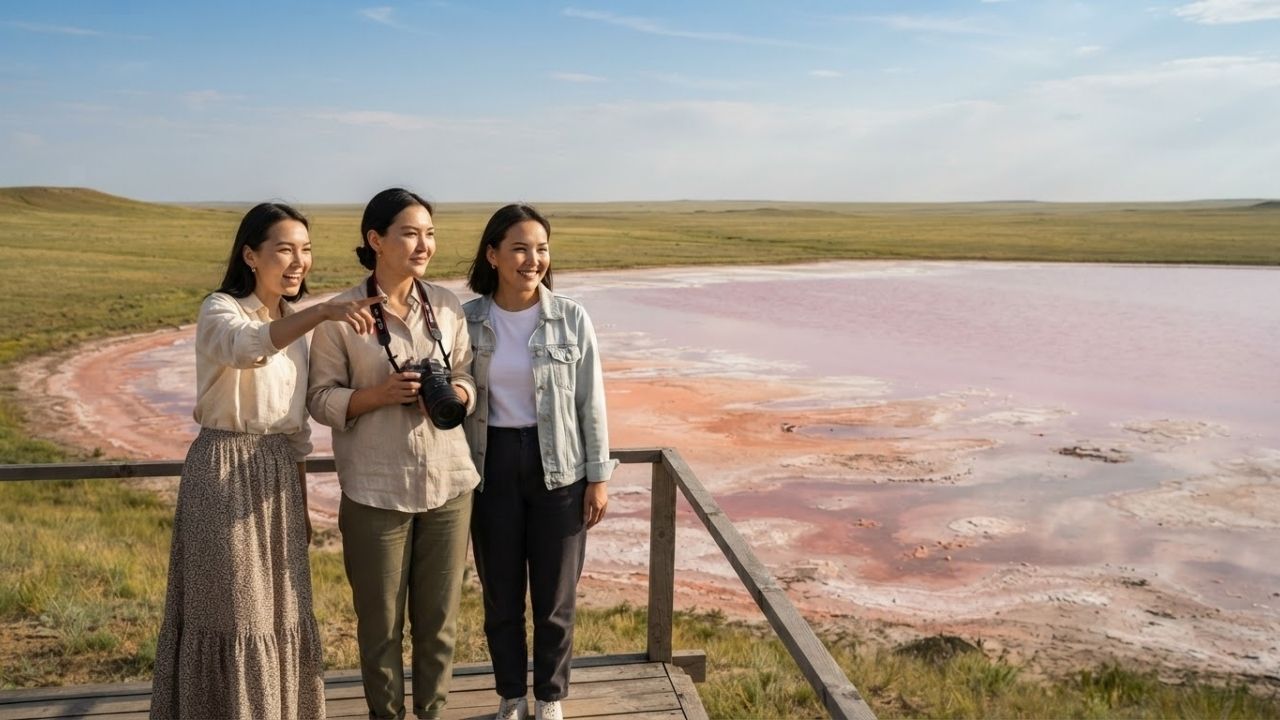
Image generated by AI
Kazakhstan's rare pink water body, Lake Kobeituz, has reopened to visitors under a heavily monitored eco-tourism framework following a multi-year environmental rehabilitation closure.
[ASTANA, Kazakhstan, Sept. 1, 2026] — Environmental authorities in the Akmola region of Kazakhstan have instituted a regulated visitation model for Lake Kobeituz, a shallow hyper-saline lake located 160 kilometers northeast of the capital city of Astana. Renowned for its periodic transformation into a vivid rose-pink hue, the delicate basin had suffered severe ecological damage during an earlier period of unregulated social media popularity, prompting state officials to enforce a total public closure to restore its fragile lakebed.
The newly implemented oversight policy marks a transition from mass-scale tourism toward sustainable ecological stewardship. Visitors to Lake Kobeituz must now adhere to designated pedestrian walkways, restricted vehicular parking zones positioned far from the shoreline, and strict prohibitions against removing mineral mud or salt sediment.
The Biological Science Behind Lake Kobeituz's Vibrant Pink Transformation
Located near the town of Ereimentau, Lake Kobeituz derives its name from the Kazakh words kobei (to multiply) and tuz (salt), describing its natural salt-multiplying basin. The lake's shallow depth and extreme salinity create a specialized micro-ecosystem.
Scientific research confirms the natural mechanics behind the lake's color change:
- Dunaliella Salina Pigmentation: The vivid pink hue is produced by Dunaliella salina, a salt-tolerant single-celled micro-alga that thrives in high-salinity water.
- Solar Exposure Reaction: When exposed to intense mid-summer sunlight and high evaporation rates, the micro-algae synthesize protective red beta-carotene pigments, tinting the water.
- Seasonal Fluctuation: Color intensity varies unpredictably depending on annual rainfall, ambient temperatures, and water evaporation rates.
While similar biological phenomena occur in hyper-saline lakes globally, Kobeituz's shallow water column leaves its biological crust exceptionally vulnerable to physical disturbance.
Policy Shift: Comparing Unregulated Viral Influx with 2026 Eco-Protections
The current management strategy represents a complete overhaul compared to previous tourist policies.
During a prior viral social media boom, thousands of unguided visitors drove off-road vehicles directly onto the dry lakebed, causing deep tyre ruts and compacting fragile sediment layers. Furthermore, widespread commercial extraction of mineral mud and salt crystals severely depleted the lake's natural crust.
In response, Akmola regional authorities enacted a multi-phase restoration strategy:
- Phase 1 (Environmental Closure): Complete ban on public access to allow natural salt crust regeneration and alga population recovery.
- Phase 2 (Infrastructure Buildout): Construction of organized perimeter parking lots and elevated timber viewing platforms away from the shoreline.
- Phase 3 (Monitored Reopening): Formal protected status enforcement, active ranger patrols, and daily capacity limits to prevent crowd congestion.
Driving Routes and Practical Logistics from Astana
Reaching Lake Kobeituz requires independent transport, as public bus networks do not service the remote steppe region. Travelers typically drive from Astana, following the Astana–Pavlodar highway east toward Ereimentau.
Key navigation markers and route requirements include:
- Highway Junctions: Drivers exit the main highway at the Korzhynkul station junction and pass through the highway tunnel near the Akzhol roadside complex before navigating rural dirt tracks.
- Vehicle Parking Rules: Vehicles must park in designated parking zones located several hundred meters from the water line. Driving onto the steppe basin incurs heavy fines.
- Observation Guidelines: Swimming and wading are discouraged due to shallow water depths and fragile mud layers. Visitors are advised to focus on elevated photography and perimeter walking.
Comprehensive Data Breakdown: Lake Kobeituz Parameters and Regulatory Evolution
The table below outlines geographical, biological, and navigation metrics for Lake Kobeituz:
| Operational & Geographic Metric | Official Field Data Parameter | Strategic Environmental Significance |
|---|---|---|
| Location & Distance | Akmola Region, 160 km from Astana | Central Asian steppe salt basin ecosystem |
| Linguistic Meaning | Kazakh: kobei (multiply) + tuz (salt) | Reflects natural hyper-saline geological formation |
| Biological Pigment Agent | Dunaliella salina micro-algae | Produces red beta-carotene under heat & high salinity |
| Primary Route Highway | Astana–Pavlodar Highway | Access via Korzhynkul junction & Akzhol complex |
| Peak Color Visibility Window | Mid-summer heat (July–August) | Dependent on high solar intensity & water evaporation |
The table below contrasts historical unregulated access with the 2026 eco-tourism policy framework:
| Management Parameter | Past Unregulated Tourism Period | 2026 Monitored Eco-Tourism Framework |
|---|---|---|
| Vehicular Access | Off-road driving onto fragile lakebed | Vehicles restricted to distant designated parking lots |
| Sediment Protection | Uncontrolled mud & salt extraction | Strict ban on mud digging and salt harvesting |
| Visitor Infrastructure | Zero tourist facilities or paths | Elevated timber viewing platforms & marked walkways |
| Environmental Oversight | Unmonitored crowds & viral degradation | Active ranger patrols & daily capacity limits |
Why This Matters: Essential Takeaways for Central Asia Travelers
For international tourists and naturalists planning visits to Kazakhstan's pink lake, these updated regulations establish essential travel guidelines:
- Verify Mid-Summer Timing: The pink coloration is not permanent. Plan visits during peak mid-summer heatwaves (July and August) when water evaporation concentrates salinity levels and activates alga pigmentation.
- Check Regional Permit Policies: Access rules can change based on ecological monitoring. Always verify current entry guidelines with local tour providers in Astana before departing.
- Prepare Independent Transport and GPS: Lack of road signage along the final rural tracks past the Akzhol roadside complex requires offline GPS maps and high-clearance vehicles.
- Practice Leave-No-Trace Ecotourism: Stay strictly on timber boardwalks and designated viewing areas to protect the delicate Dunaliella salina ecosystem for future visitors.
Frequently Asked Questions
Where is Lake Kobeituz located and how far is it from Astana?
Lake Kobeituz is located in the Akmola region of Kazakhstan, approximately 160 kilometers northeast of the capital city, Astana.
Why does Lake Kobeituz turn pink?
The pink color is caused by Dunaliella salina, a salt-resistant micro-alga that synthesizes red beta-carotene pigments when exposed to high saline concentrations and intense sunlight.
Are visitors allowed to swim or collect mud at Lake Kobeituz?
Direct swimming and mud collection are strictly prohibited under current conservation rules to protect the lake's shallow, fragile lakebed from physical degradation.
How has management of the lake changed in 2026?
Following a multi-year environmental closure, the lake operates under a monitored framework featuring perimeter parking, elevated viewing platforms, and strict bans on off-road driving.
Related Travel Guides
Disclaimer
This article is for informational and educational purposes only. It does not constitute legal, financial, or professional advice. While we strive to provide accurate and up-to-date information, travel policies, regulations, and conditions change rapidly. Always verify information with official sources before making travel decisions. Nomad Lawyer makes no representations about the accuracy, reliability, completeness, or suitability of the information provided. Readers should consult qualified professionals for advice specific to their circumstances. The views expressed in this article are those of the author and do not necessarily reflect the views of Nomad Lawyer.
Raushan Kumar
Founder & Lead Developer
Full-stack developer with 11+ years of experience and a passionate traveller. Raushan built Nomad Lawyer from the ground up with a vision to create the best travel and law experience on the web.
Learn more about our team →