Japan’s Railway Travel Turns Historic as Furano-Biei Norokko Ends Before Kushiro Wetland Final Run

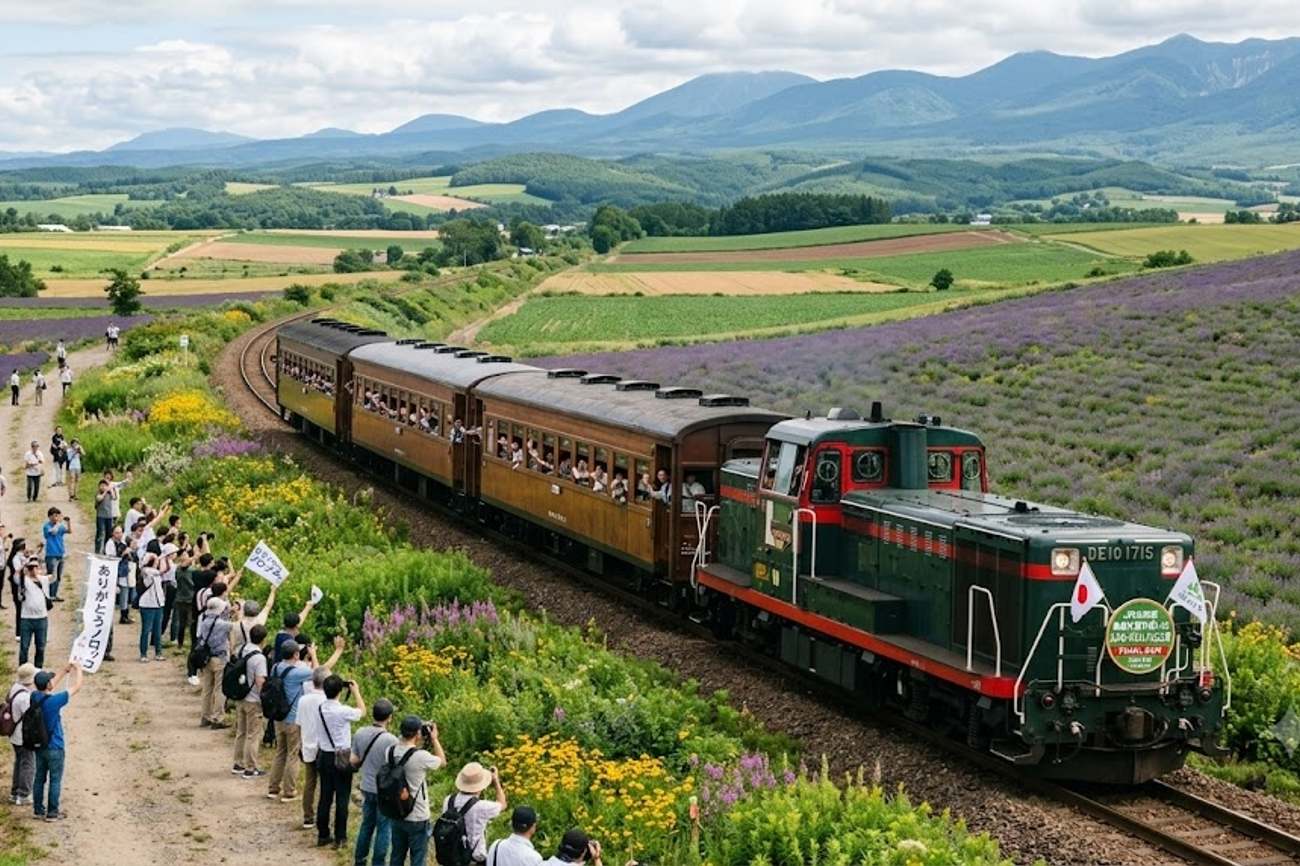
Image generated by AI
[Kushiro, September 20, 2026] — JR Hokkaido has launched the final operating season of the Sunset Norokko, triggering a three-week phased retirement of the region's legacy sightseeing rail fleet. The transition begins today in Kushiro and will culminate in the total withdrawal of the Norokko brand by October 10, 2026, as the operator pivots toward a high-premium tourism model.
The decommissioning process involves two primary corridors: the Kushiro-Toro line and the Asahikawa-Furano route. This strategic wind-down is the result of severe equipment degradation, with locomotives now exceeding 45 years of age and passenger coaches surpassing 40 years. According to JR Hokkaido, the fleet has reached a critical point where the production of essential replacement components has ceased, making further operation of the legacy trains impossible.
The Fleet Retirement Timeline
The exit of the Norokko fleet is not a single event but a compressed sequence of farewell journeys. The schedule is designed to maximize final passenger volumes across eastern and central Hokkaido.
The immediate focus is the Sunset Norokko, which operates between Kushiro and Toro. Starting today, September 20, the service will run for 11 consecutive days through September 30. The daily itinerary is strictly limited to one return journey:
- Kushiro Departure: 15:23, arriving at Toro at 16:07 via Higashi-Kushiro, Kushiro-Shitsugen, and Hosooka.
- Toro Return: 17:02, arriving back in Kushiro at 17:48.
Simultaneously, the Furano-Biei Norokko is entering its final days. This service, a staple of the region since 1998, will make its absolute final journey on September 23. For this closing date, the operator has abandoned the standard schedule in favor of two special return journeys between Asahikawa and Furano:
- Morning Service: Departs Asahikawa at 09:14, arrives Furano at 11:36; returns at 12:06, arrives Asahikawa at 14:12.
- Afternoon Service: Departs Asahikawa at 14:34, arrives Furano at 16:04; returns at 16:14, arrives Asahikawa at 17:46.
- Note: Services 5 and 6 are cancelled for the final day.
The broader Kushiro Shitsugen Norokko program will follow a staggered exit:
- October 4: Conclusion of the regular operating phase on the Senmo Line.
- October 9: Final extended-route return journey for the Norokko Kawayu-Onsen.
- October 10: The final official run of the Kushiro Shitsugen Norokko between Kushiro and Toro.
Who Is Affected
The transition impacts a wide range of travelers, from budget-conscious international tourists to luxury rail enthusiasts. Because these trains are fully reserved, the final days are expected to see extreme demand.
| Route | Current Status | Final Date | Fare Structure (Current) |
|---|---|---|---|
| Kushiro $\rightarrow$ Toro | Final Sunset Season | Sept 30 / Oct 10 | ¥680 base + ¥1,000 reservation |
| Asahikawa $\rightarrow$ Furano | Final Operations | Sept 23 | ¥1,380 base + ¥1,000 reservation |
| Kushiro $\rightarrow$ Kawayu-Onsen | Farewell Run | Oct 9 | Varies by distance |
International visitors face a significant logistical hurdle: JR-EAST Train Reservation is not compatible with the Furano-Biei or Kushiro Shitsugen Norokko services. Travelers must secure tickets through alternative channels or at the station, which may be difficult given the "farewell" nature of these trips.
What This Means for Travelers
For the average passenger, this is not a simple equipment upgrade; it is a fundamental shift in how sightseeing rail is priced and accessed in Hokkaido.
1. The End of "Accessible" Scenic Rail The Norokko trains were designed as accessible sightseeing products. With a combined cost of roughly ¥1,680 to ¥2,380, they allowed a broad demographic to experience the Kushiro Wetlands and the Biei hills. Once these retire, there is no direct "budget" equivalent for these specific scenic corridors.
2. A Massive Price Jump The coming "Star" trains represent a move toward luxury tourism. The price gap is stark:
- Furano Corridor: The current ¥2,380 total for the Norokko will be replaced by the "Blue Star" service, with planned one-way pricing of approximately ¥5,000.
- Kushiro Corridor: The current ¥1,680 trip will be replaced by the "Red Star," with prices jumping to between ¥10,000 and ¥30,000 depending on the package.
3. Limited Availability The new model prioritizes high-yield passengers over volume. For the Red Star, JR Hokkaido plans to allocate only 15 seats for "ride-only" sales. The remaining 60 seats will be tied to meal-based luxury products or travel-agent accommodation packages.
The Bridge to 2027: Red Star and Blue Star
The current farewells are the result of a calculated "bridge" strategy. These legacy trains were originally slated for retirement in FY2025. However, JR Hokkaido delayed the decommissioning by one year to ensure there was no gap in service while the Red Star and Blue Star trains were finalized.
The Red Star is scheduled to begin service from late April to mid-July 2027, operating one return journey daily between Kushiro and Shiretoko-Shari. This service will be a "luxury-class" product, featuring slower speeds at scenic vistas and integrated dining.
The Blue Star will take over the Asahikawa-Furano corridor with two return journeys daily. While the Red Star focuses on extreme luxury, the Blue Star is positioned as a "premium-class" service. Both represent a shift away from the high-volume, low-cost model of the Norokko era toward a curated, high-margin experience.
FAQ: Hokkaido Rail Transition 2026
Can I book the final Norokko trains online via JR-East? No. JR Hokkaido has confirmed that the JR-EAST Train Reservation system cannot be used for the Furano-Biei or Kushiro Shitsugen Norokko. You must use other booking methods or purchase tickets locally.
Why are these trains being retired now? The rolling stock is obsolete. Locomotives are over 45 years old and coaches are over 40 years old. Many critical replacement parts are no longer manufactured, making them unsafe or impossible to maintain.
What is the difference between the Red Star and Blue Star trains? The Red Star (Kushiro–Shiretoko-Shari) is a luxury-class product with meal packages and very few ride-only seats. The Blue Star (Asahikawa–Furano) is a premium-class service with a lower price point than the Red Star but higher than the legacy Norokko.
When will the new luxury trains be available? The Red Star is planned to begin operations in late April 2027. Specific dates for the Blue Star have not been finalized but are aligned with the 2027 tourism strategy.
The era of affordable scenic rail in Hokkaido ends this October, making way for a new age of luxury transit.
Tags: #JRHokkaido #KushiroShitsugenNorokko #FuranoBieiNorokko #RedStarTrain #BlueStarTrain #HokkaidoRail2026
Related Travel Guides
This article is for informational purposes. Flight routes, passenger regulations, visa rules, and transit advisories are subject to change by airlines and aviation authorities. Readers are advised to verify schedules and travel documentation with relevant carriers and border agencies before departure.
Related Stories

Dubai Reveals Why True Travel Passion Never Fades As Miraculous Hotel Occupancy Defies The Scorching Desert Heat

The Fern Hotels & Resorts Unlocks New Hospitality Opportunities in Gujarat with The Fern Residency Somnath, Series by Marriott