Japan Overhauls Duty-Free Shopping: New Airport Tax Refund Rules at Narita, Haneda, and Kansai 2026

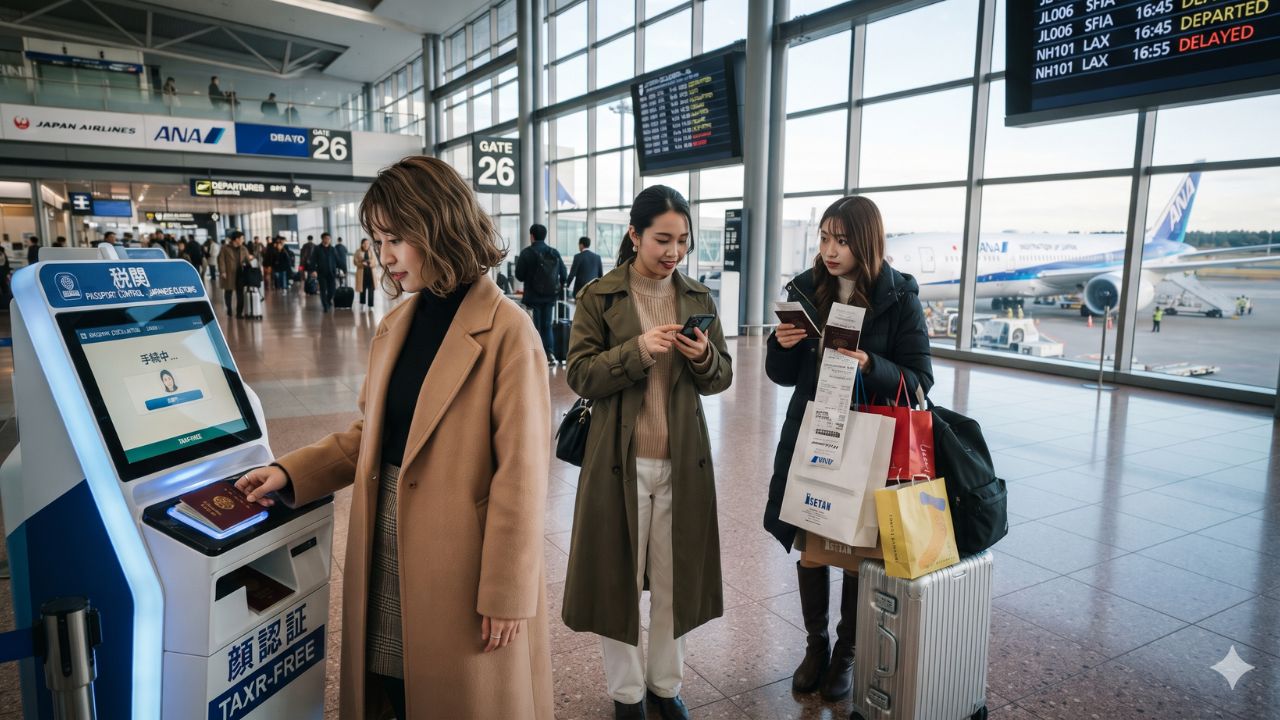
For decades, international travelers in Japan enjoyed instant cash-register tax exemptions, but as of 1 November 2026, foreign shoppers must pay the full 10% consumption tax upfront at stores and can only reclaim their money at airport customs kiosks before surrendering checked luggage. Under Japan's comprehensive airport tax refund reform rolled out across seven major international gateways—including Narita, Haneda, Kansai, Chubu Centrair, Fukuoka, New Chitose, and Naha—travelers who pack tax-free purchases into checked bags before completing digital customs verification risk forfeiting their entire refund, coordinated through official procedures detailed by the Japan National Tourism Organization.
This structural transition alters one of the defining rituals of visiting Japan. From department stores in Ginza and electronics emporiums in Akihabara to shopping arcades in Osaka's Shinsaibashi, foreign tourists previously presented a passport at checkout to deduct the consumption tax immediately. The Japanese National Tax Agency and customs authorities introduced the new airport-centered verification model to prevent widespread fraudulent domestic resales and black-market diversions of tax-exempt luxury goods, bringing Japan's duty-free system into alignment with European export refund standards.
Why Japan Restructured Its Consumption Tax Exemption System
The driving motivation behind the 1 November 2026 policy reform centers on tax integrity and export enforcement. Under the historic store-level exemption model, authorities faced significant administrative hurdles in verifying whether goods purchased tax-free actually departed the country. Audits revealed recurring patterns where commercial intermediaries hired short-term foreign visitors to purchase millions of yen in high-end watches, cosmetics, and consumer electronics without tax, only to resell the merchandise domestically at commercial retail margins.
Under the updated framework, the retail transaction and the export verification are decoupled. When purchasing eligible items at participating tax-free stores, visitors pay the complete retail price, which includes Japan's standard 10% consumption tax (or the reduced 8% rate applied to eligible food and beverage products). The retailer registers the transaction electronically with the National Tax Agency.
To recover the paid tax, the traveler must transport the merchandise to an authorized international departure gateway, complete digital customs verification, and export the items within 90 days of the purchase date. The minimum spend requirement remains 5,000 yen (excluding tax) at a single merchant on the same day. For example, an item priced at 10,000 yen before tax costs 11,000 yen at the register; following successful airport customs approval, the traveler receives the 1,000 yen tax refund, minus any processing commission charged by commercial refund service providers.
The Seven Major Gateways and Terminal Kiosk Infrastructure
The national customs verification network operates across seven primary international airports that integrate official Visit Japan Web processing, while commercial cash operators expand regional access:
Tokyo Gateways: Haneda and Narita
At Tokyo Haneda Airport, customs infrastructure is tailored to international passenger traffic across two terminals:
- Terminal 2: Features eight digital customs-processing kiosks operating daily from 6:00 a.m. until 2:00 a.m., complemented by five automated cash-refund machines located post-security operating from 6:45 a.m. to 1:30 a.m.
- Terminal 3: The primary round-the-clock long-haul facility hosts thirteen customs-processing kiosks and five post-security cash-refund machines functioning 24 hours a day.
At Narita International Airport (NRT) in Chiba Prefecture, customs confirmation facilities operate across Terminals 1, 2, and 3, allowing travelers to scan their passports and link registered purchase manifests before queuing for airline ticket counters.
Western Japan, Central Hubs, and Island Gateways
Beyond the capital, the system connects Japan's key economic and tourism regions:
- Kansai International Airport (KIX): The primary western hub serving Osaka, Kyoto, and Nara, where substantial duty-free shopping occurs. KIX is integrated with both the national Visit Japan Web system and Cash Japan's commercial refund network.
- Chubu Centrair International Airport (NGO): Serving Nagoya and the central Chubu industrial region with dedicated terminal kiosks.
- Fukuoka Airport (FUK): The main aviation bridge to Kyushu, processing significant duty-free confectionery, cosmetic, and craft purchases.
- New Chitose Airport (CTS): Processing international departures from Hokkaido, where regional seafood, confections, and winter apparel are popular.
- Naha Airport (OKA): Ensuring visitors departing Okinawa's subtropical islands can verify purchases directly without routing through Tokyo.
- Kobe Airport (UKB): Included in a progressive commercial cash-refund rollout by Cash Japan from 1 November 2026, though travelers must note that Kobe is not among the seven airports officially equipped for Visit Japan Web online customs verification.
Japan Airport Tax Refund Infrastructure and Terminal Operations: 2026
| Airport & Primary Region | Terminal Facility Coverage | Customs Kiosks & Service Hours | Cash Refund Machines (Post-Security) | Key Operational & Baggage Requirement |
|---|---|---|---|---|
| Tokyo Haneda (HND) | Terminal 2 & Terminal 3 | T2: 8 kiosks (6:00 AM – 2:00 AM); T3: 13 kiosks (24 hours) | T2: 5 units (6:45 AM – 1:30 AM); T3: 5 units (24 hours) | Must verify at pre-security kiosks before checking bags containing goods |
| Tokyo Narita (NRT) | Terminals 1, 2, and 3 | Terminal departure lobbies; operates during all flight banks | Available after security in participating departure concourses | Dedicated commercial refund service counters operating alongside kiosks |
| Kansai Osaka (KIX) | Terminals 1 and 2 | International departure lobby kiosks before check-in | Automated refund stations in international airside lounges | High volume hub for Kyoto and Osaka souvenirs; allow 45 extra minutes |
| Chubu Centrair (NGO) | Terminal 1 International | Central departure customs verification counters | Post-security international commercial refund stations | Supports digital confirmation via Visit Japan Web on airport Wi-Fi |
| Fukuoka (FUK) | International Terminal | Departure concourse kiosks before baggage screening | Airside refund collection facilities | Physical inspection queues common during morning departure waves |
| New Chitose (CTS) | International Terminal | Level 3 international departure check-in hall | International departures lounge refund stations | Confectionery and alcohol must be inspected before baggage drop |
| Naha Okinawa (OKA) | International Terminal | Pre-check-in customs confirmation area | Designated departure terminal refund provider counters | Direct international flights to Asian regional hubs verified on-site |
| Kobe (UKB) | Passenger Terminal | Commercial rollout by Cash Japan (progressive) | Subject to commercial operator schedule | Not on Visit Japan Web network; verify counter availability in advance |
Visitor Insider Tips: Avoiding Baggage Traps and Securing Refunds
Adapting to Japan's revised departure protocol requires strategic packing and terminal timing:
- Complete Customs Verification Before Checking Your Luggage: This is the single most important rule under the new system. If eligible purchases—such as Japanese kitchen knives, bulk cosmetics, or bottled sake—are packed inside your checked suitcase, you must bring that suitcase to the customs kiosk before dropping it at the airline check-in desk. If the digital kiosk displays a red screen requiring physical inspection, customs officers must view the items. If your luggage is already on the conveyor belt, customs will deny verification, and your refund is permanently forfeited.
- Understand the Screen Signals at Kiosks: When scanning your passport at airport kiosks, a Green Screen indicates that your digital transaction records match your export declaration, granting immediate clearance to proceed to check-in. A Red Screen indicates that the customs system has flagged your transaction for random or value-based physical verification, requiring you to report to the adjacent customs officer counter with the physical merchandise and store receipts.
- Do Not Break Tamper-Evident Consumable Seals: Consumable merchandise—including snacks, skincare, health supplements, and alcohol—is packaged by retailers in sealed plastic duty-free bags. If these bags are torn or opened while inside Japan, the items are considered consumed domestically and lose refund eligibility under regulations maintained by Japan Customs.
- Pre-Register Purchases on Visit Japan Web: Connect your personal mobile device to official airport Wi-Fi and access the Visit Japan Web portal. Linking your tax-free digital tokens ahead of time allows faster processing at designated kiosks and avoids manual receipt scanning bottlenecks.
- Allow an Additional 30 to 45 Minutes at the Airport: Because tax verification now occurs at the terminal rather than in stores, morning and evening departure banks at Haneda Terminal 3 and Kansai experience heavy passenger queues at customs kiosks. Arrive at least three hours before international flights to complete verification, baggage drop, and security screening comfortably.
Cultural and Environmental Context: Shopping Culture, Black Markets, and Digital Governance
Shopping represents an integral component of cultural tourism in Japan, woven deeply into the tradition of omiyage (bringing back regional gift items for friends, family, and colleagues). Foreign visitors have long treasured Japanese retail for its meticulous customer service, unique regional crafts, and high product standards. However, the sheer volume of international arrivals—exceeding 30 million visitors annually—placed unintended friction on community retailers, who found themselves burdened by complex compliance documentation and exposed to organized tax-evasion rings.
By transferring export compliance from shopkeepers to international airport customs facilities, the Japanese government protects neighborhood merchants while modernizing national digital governance. Local boutique owners in historic cultural quarters such as Kyoto's Gion or Kanazawa's Higashi Chaya can focus on hospitality and craftsmanship rather than policing foreign passport statuses.
From an economic perspective, the new policy safeguards billions of yen in public revenue that supports national infrastructure, healthcare, and historic preservation across Japan's prefectures. The transition toward paperless, digital verification via kiosks and mobile portals also eliminates millions of paper receipts previously stapled into visitor passports, reducing material waste and streamlining terminal passenger flow. For conscious travelers, understanding and respecting these administrative reforms honors Japanese civic trust while ensuring a fair, sustainable shopping environment for everyone.
FAQ: Japan Airport Tax Refunds 2026–2027
When did Japan's new airport tax refund system take effect?
The revised system officially took effect on 1 November 2026 across seven major Japanese international airports, ending immediate cash-register exemptions and moving verification to airport departure terminals.
What is the minimum purchase amount to qualify for a tax refund in Japan?
Travelers must spend a minimum of 5,000 yen (excluding consumption tax) at a single participating tax-free merchant within a single calendar day, and the goods must be exported within 90 days.
Can I pack tax-free purchases in my checked suitcase?
Yes, but you must complete customs verification at the airport kiosks before surrendering your suitcase at airline check-in. If your transaction is flagged for inspection, you must physically show the items to customs officers.
Which airports support digital customs confirmation through Visit Japan Web?
Seven airports officially support the digital system: Tokyo Narita (NRT), Tokyo Haneda (HND), Kansai (KIX), Chubu Centrair (NGO), Fukuoka (FUK), New Chitose (CTS), and Naha (OKA).
Mastering Japan's updated departure procedures ensures your duty-free savings remain intact while enjoying an effortless journey home.
Related Travel Guides
- US CDC Enforces Mandatory Ebola Attestation for India–USA Flights: 21-Day Health Rule and Boarding Guide 2026
- Canada Immigration Issues Strict Work Directives for International Students: IRCC 24-Hour Off-Campus Cap and Permit Guide 2026–2027
- Japan High-Speed Rail Guide: Mastering the Shinkansen and SmartEX App in 2027 (Upcoming)
This article is for informational purposes. Flight routes, passenger regulations, visa rules, and transit advisories are subject to change by airlines and aviation authorities. Readers are advised to verify schedules and travel documentation with relevant carriers and border agencies before departure.
Related Stories
Vietnam Airlines Expands Osaka–Hanoi Route: New Afternoon Flights, Europe Connections, and Bilateral Travel Guide 2026–2027

British Airways Resumes Dubai Flights: Unlocking Heritage Tourism, Licensed Guides, and Al Fahidi Hidden Treasures