
Breaking Airline News: Japan Airlines Deploys 'Sky Wider' Boeing 787 Cabin to Shield Passengers from Extreme Global Travel Chaos
Breaking airline news: Amidst a terrifying era of severe operational fragility, Japan Airlines aggressively deploys its 'Sky Wider' Boeing 787 and 777 cabins, launching a devastating strike against extreme long-haul travel chaos.

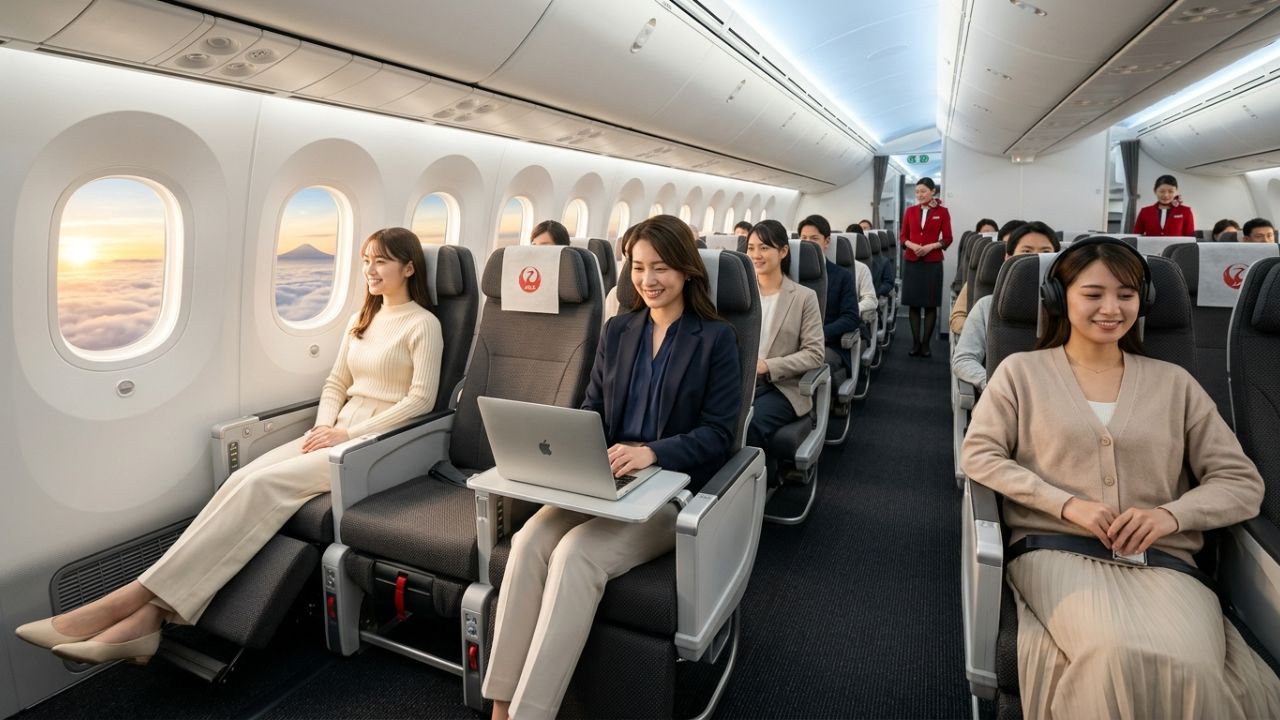
Image representing the intense strategic battle as Japan Airlines desperately deploys massive 'Sky Wider' architectural infrastructure on its Boeing fleets, aggressively combating the physical toll of extreme travel chaos.
Breaking Airline News: Japan Airlines Deploys 'Sky Wider' Boeing 787 Cabin to Shield Passengers from Extreme Global Travel Chaos
As paralyzing terminal bottlenecks, terrifying tarmac congestion, and severe operational fragility violently threaten to completely shatter passenger mobility across the globe, Japan Airlines (JAL) has executed a massive infrastructural strike to defend its passengers. In a harrowing battle against the physical and psychological toll of regional gridlock, JAL has aggressively deployed its highly acclaimed “Sky Wider” economy seat across its long-haul fleets. While rival carriers are violently packing ten seats across the Boeing 777 or squeezing nine across the Boeing 787 Dreamliner to maximize revenue amidst severe flight cancellations, JAL has taken a devastatingly bold stance. By explicitly refusing to compromise human comfort, the Japanese carrier has transformed its aircraft into fortified survival capsules, designed specifically to shield vulnerable international travelers from the agonizing stiffness and exhaustion that perfectly define modern, extreme travel chaos.
In a brutal demonstration of how aggressively modern airlines must fight back against legacy cabin failures, the strategic deployment of the Sky Wider configuration promises to fundamentally overhaul how passengers endure fractured travel networks. Because massive airport disruptions routinely force passengers to endure agonizing delays before even boarding a ten-hour flight, an uninterrupted, highly stable, and spacious seating environment is widely recognized as the absolute core prerequisite for passenger survival. By dedicating unprecedented spatial geometry to legroom and shoulder width, Japan Airlines guarantees that travelers arrive at their destination physically resilient and refreshed, rather than utterly destroyed by the terrifying realities of modern aviation congestion.
Expanded Overview: The Massive Scale of the Tactical Deployment
The terrifying crisis of overwhelming passenger stress currently gripping global aviation brutally exposes the severe limitations of legacy airlines attempting to absorb modern travel demands by cramming more bodies into tight fuselages. Recognizing that aggressively pushing exhausted passengers into claustrophobic 17-inch seats leads directly to mid-air physical breakdown, JAL established a master architectural schedule of rapid interior expansion. For travelers navigating the terrifying threat of sudden airport disruptions, the difference between a total transit meltdown and a survivable journey comes down to two absolute metrics: pitch and width. By aggressively targeting these numbers on key routes, JAL is dropping a massive capacity bomb directly onto the Asian and transpacific aviation markets, fundamentally proving that economy travel does not have to be a torturous experience.
Section-Wise Breakdown: The Operational Realignment
Shattering the Industry Standard: The Sky Wider Extraction
To survive the terrifying surge of ultra-competitive long-haul routing, JAL initiated a highly aggressive, deeply demanding architectural overhaul of its long-haul cabins. Instead of following the terrifying industry trend of violently cramming nine seats across the Boeing 787 Dreamliner fuselage, JAL executes a massive tactical retreat to an eight-abreast, 2-4-2 configuration. This calculated reduction in sheer volume creates a terrifyingly large personal envelope for each traveler. Seat width reaches an astonishing near 19 inches, violently overshadowing competitors who routinely trap passengers in 17-inch dimensions. Furthermore, the massive seat pitch is deployed at 33 to 34 inches, granting passengers the critical ability to cross their legs or deploy a laptop to aggressively monitor ongoing flight cancellations across their onward itineraries.
Deploying the Capacity Fortress: Tactical Cabin Geometry
While the raw dimensions provide massive relief, the expansive cabin infrastructure itself has achieved a terrifying state of technical perfection. JAL doesn’t just add inches; it violently redesigns the geometry of human transit. Highly obtrusive seatback entertainment boxes and power cables have been aggressively ripped out of the footwell space. Net-style seat pockets successfully prevent passenger items from bulging violently into knee space. Sculpted armrests construct a definitive physical barrier for elbow room, while larger overhead bins, contoured sidewalls, and high-capacity storage keep the environment feeling heavily fortified yet expansive.
Operational Armor: Defeating Ultra-Long-Haul Fatigue
To sustain passengers through massive global delays, JAL has weaponized the granular details of its interior systems. Extreme comfort is deployed via adjustable headrests, highly supportive well-cushioned seats, and a calculated, modest recline mechanism. Electronic survival is guaranteed through high-definition screens loaded with Japanese and international intelligence, heavily integrated USB ports, and massive power outlets. Some aircraft even deploy tactical smartphone holders at eye level. While carriers like Cathay Pacific, Qatar Airways, and Singapore Airlines execute massive service protocols, JAL’s unique distinction comes from violently balancing both exceptional seat width and massive legroom on the 787, offering a product that feels terrifyingly close to premium economy.
Japan Airlines Sky Wider Operational Matrix
To fully comprehend the massive logistical and strategic deployment of this terrifyingly efficient cabin infrastructure, corporate travel managers and industry analysts must review the exact operational metrics defining the capacity injection. The following matrix provides a granular breakdown of the specific, officially verified statistical data driving this massive development.
| Operational Defense Metric | Verified Infrastructure Data |
|---|---|
| Aviation Operator | Japan Airlines (JAL) |
| Primary Aircraft Hardware | Boeing 787 Dreamliner & Boeing 777 |
| Tactical Economy Product | "Sky Wider" Seat |
| Boeing 787 Configuration | 8-Abreast (2-4-2 Layout) |
| Industry Standard 787 Layout | 9-Abreast (Abandoned by JAL) |
| Maximum Seat Pitch | Up to 34 inches (ranges 33 to 34 inches) |
| Maximum Seat Width | Nearly 19 inches |
| Competitor Seat Width Average | 17 inches |
| In-Flight Survival Tech | HD Screens, USB Ports, Power Outlets, Smartphone Holders (select aircraft) |
| Primary Regional Rivals | Cathay Pacific, Qatar Airways, Singapore Airlines |
Passenger Impact: Surviving the Hub Transition
For the millions of global tourists and executives forced to navigate the rapidly deteriorating transit environment of major international hubs, this massive comfort injection represents a highly critical rescue operation. The brutal reality of enduring paralyzing delays at airports inflicts intense psychological stress—leaving the passenger entirely trapped in overcrowded terminals and violently missing connections.
What This Means for Global Transit Survival
Travelers desperately preparing to navigate the highly volatile global network will soon have a massive new weapon:
- Violent Reduction in Physical Trauma: The immediate deployment of the Sky Wider cabin will brutally sever the physical exhaustion currently crippling passengers on 10+ hour flights.
- Weaponizing the Rebooking Strategy: If your initial flights suffer massive flight cancellations, aggressively targeting a rebooking onto a JAL 787 guarantees that your recovery flight will feature enough physical space to work and recuperate.
- Maintaining Absolute Flexibility: As airlines violently alter their cabin geometries to pack more passengers, locking in a JAL itinerary ensures you are protected by the 34-inch pitch barrier against severe travel chaos.
Industry Analysis: The Economics of the Megacabin
From a strategic aviation perspective, the travel turmoil currently threatening legacy networks highlights the terrifying vulnerability of relying on cramped, high-density fuselages. Industry analysts confirm that the massive decision to deploy 8-abreast 787s is a highly aggressive tactical response designed to maintain absolute pricing power. Reclaiming this massive market share of high-yield leisure travelers and corporate road warriors—who will aggressively pay to avoid cramped 17-inch seats—is absolutely essential for Japan Airlines' economic dominance against rivals who only focus on business class perfection.
Conclusion: A Strategic Offense to Ensure Aviation Dominance
As the extremely critical travel network across the globe continues to face terrifying strain from operational bottlenecks and sudden airport disruptions, the massive Sky Wider deployment executed by Japan Airlines represents a massive warning to rival transit operators. The aggressive retention of 34-inch pitch and 19-inch width proves that surviving modern aviation requires terrifyingly ambitious infrastructure, not just in the terminal, but in the cabin. By launching this architectural masterpiece, Japan Airlines will violently absorb the market of exhausted travelers desperate to escape the extreme travel chaos currently devastating international long-haul routes.
Key Takeaways
- Massive Tactical Deployment: Japan Airlines has aggressively deployed the "Sky Wider" economy seat on its Boeing 787 Dreamliner and Boeing 777 fleets.
- Total Architectural Overhaul: JAL utilizes a spacious 8-abreast (2-4-2) configuration on the 787, completely rejecting the cramped 9-abreast industry standard.
- Severe Spatial Injection: Passengers are protected by up to 34 inches of seat pitch and nearly 19 inches of seat width, dwarfing the competitor average of 17 inches.
- Infrastructure Enhancements: The cabin features massive overhead bins, sculpted armrests, removed entertainment boxes, and integrated USB/power outlets for electronic survival.
- Traveler Advisory: In an era defined by severe airport disruptions and flight cancellations, securing a ticket in a JAL Sky Wider cabin is the ultimate tactical defense against long-haul physical exhaustion.
Related Travel Guides
Disclaimer
This article is for informational and educational purposes only. It does not constitute legal, financial, or professional advice. While we strive to provide accurate and up-to-date information, travel policies, regulations, and conditions change rapidly. Always verify information with official sources before making travel decisions. Nomad Lawyer makes no representations about the accuracy, reliability, completeness, or suitability of the information provided. Readers should consult qualified professionals for advice specific to their circumstances. The views expressed in this article are those of the author and do not necessarily reflect the views of Nomad Lawyer.
Kunal K Choudhary
Co-Founder & Contributor
A passionate traveller and tech enthusiast. Kunal contributes to the vision and growth of Nomad Lawyer, bringing fresh perspectives and driving the community forward.
Learn more about our team →