
JAL Autonomous Drones Cut Aircraft Inspection Time By 60% In Major Aviation Safety Upgrade
JAL Autonomous Drones Cut Aircraft Inspection Time By 60% In Major Aviation Safety Upgrade

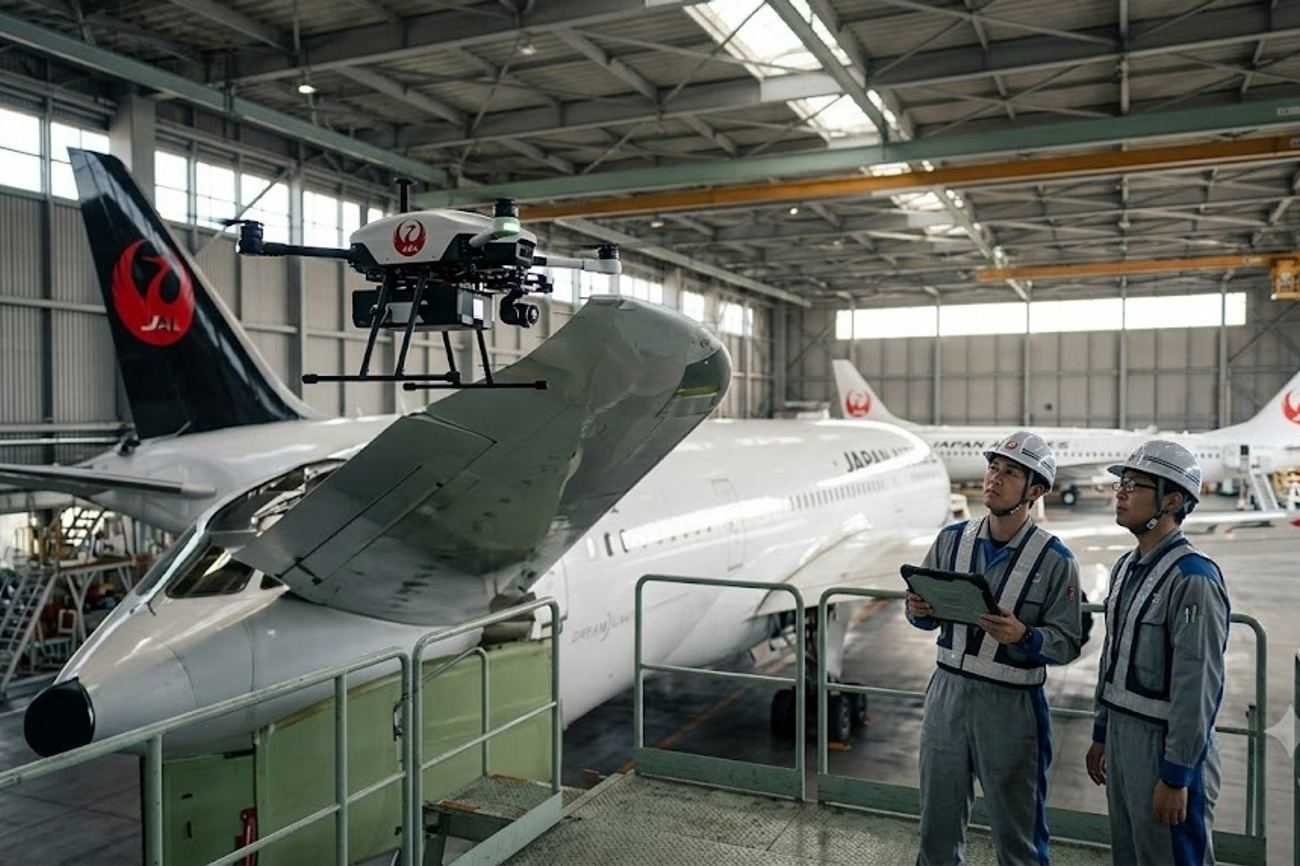
Image generated by AI
A 60% reduction in aircraft inspection man-hours is the central metric driving Japan Airlines' (JAL) latest pivot toward autonomous maintenance technology. By integrating specialized drone imagery into their exterior verification protocols, the carrier is attempting to solve a looming crisis in aviation: the widening gap between increasing flight volumes and a shrinking pool of qualified maintenance technicians.
The Shift Toward Autonomous Verification
The partnership between Japan Airlines (JAL) and the French aerospace technology firm Donecle marks a fundamental transition in how aircraft are vetted for airworthiness. For decades, the General Visual Inspection (GVI)—the routine process of scanning an aircraft's skin for cracks, corrosion, or paint deterioration—has been a labor-intensive manual task. Engineers have historically relied on physical proximity, often utilizing scaffolding or elevated platforms to reach the vertical stabilizers and upper fuselage.
This manual approach is not only slow but introduces human variability. The new project replaces the physical climb with the Iris GVI, a fully autonomous drone. Unlike consumer drones that require a pilot, the Iris GVI follows pre-programmed flight paths approved by manufacturer maintenance manuals, ensuring that every square inch of the aircraft is captured with mathematical precision. This represents the first practical implementation of fully autonomous, manual-approved drone inspections within the Japanese aviation sector.
Quantifying the Efficiency Gain
The transition from human-led scanning to digital capture has resulted in a dramatic collapse of the time required to clear an aircraft for service. While traditional inspections typically demand between 5 and 10 hours per aircraft, the drone-integrated workflow—including the preparation of the flight and the subsequent review of images—slashes that window to just 2 to 3 hours.
The following data breaks down the operational shift in maintenance logistics:
| Metric | Traditional Manual Inspection | Autonomous Drone Inspection |
|---|---|---|
| Time Expenditure | 5–10 hours per aircraft | 2–3 hours (inc. prep/review) |
| Staffing Needs | 2 to 4 personnel | 2 for operation; 1 for review |
| Physical Requirements | Scaffolding & elevated platforms | Ground-based autonomous flight |
| Documentation | Limited manual notes | 24-megapixel digital records |
| Consistency | Subject to individual experience | Standardized flight paths |
The hardware facilitating this shift, the Iris GVI, is a compact unit weighing 3.7 kg (including battery) with dimensions of 855 mm in length and width and a height of 245 mm. Its core capability lies in its laser positioning and obstacle detection systems, which allow it to navigate the complex geometry of a commercial jet without human intervention.
Expert Analysis: The Macro-Economics of Maintenance
For the average traveler, a "maintenance delay" is a frustrating inconvenience. However, from a systemic perspective, these delays are often symptoms of a global shortage of licensed aircraft maintenance engineers (LAMEs). The aviation industry is currently facing a demographic cliff; as senior technicians retire, there are not enough new recruits to fill the gap.
The direct consequence of JAL's adoption of the Iris GVI is the decoupling of inspection volume from headcount. By reducing the man-hours required for a GVI by 60%, JAL is essentially "creating" capacity without needing to hire more staff. This allows the existing workforce to shift their focus from the tedious act of finding a defect (scanning) to the high-value act of fixing a defect (analysis and repair).
Furthermore, the shift to digital records creates a "digital twin" history for every aircraft in the fleet. Instead of relying on a technician's handwritten note that a specific panel looked "satisfactory," the airline now has a 24-megapixel timestamped image. This enables predictive maintenance—the ability to track the growth of a microscopic crack over several months—rather than reactive maintenance, where a part is replaced only after it fails or is flagged during a manual check. This transition significantly lowers the risk of unplanned groundings, which are the primary drivers of cascading flight cancellations.
Key Takeaways
- Time Compression: Total inspection windows have dropped from a maximum of 10 hours to as little as 2 hours per aircraft.
- Labor Optimization: The process reduces the necessary personnel from a potential team of four down to a streamlined three-person workflow (two for operation, one for analysis).
- Standardization: The use of International Air Transport Association (IATA) aligned safety standards is bolstered by autonomous flight paths that eliminate human oversight errors during visual scans.
- Workforce Hedge: The technology acts as a strategic buffer against the forecasted global shortage of aviation maintenance technicians.
- Enhanced Documentation: High-resolution digital imagery replaces subjective manual logs, allowing for better long-term structural health tracking.
FAQ: JAL Drone Inspections 2026
Will drones replace aircraft mechanics? No. The drones handle the data collection (the "looking"), but licensed engineers are still required to analyze the images and perform the actual physical repairs. The technology supports the mechanic; it does not replace the certification.
Does this technology make flights safer? Yes. By using standardized flight paths and 24-megapixel imagery, the process removes the risk of human fatigue or oversight that can occur during a manual 10-hour inspection of a large aircraft.
Will this reduce flight delays for passengers? Potentially. Faster turnaround times for routine inspections mean aircraft can return to service more quickly, reducing the likelihood of maintenance-related schedule disruptions.
What happens if the drone finds a crack? The drone identifies the location via high-resolution imagery. A human mechanic then performs a targeted physical inspection of that specific area to determine the necessary repair, as drones cannot perform physical fixes.
The era of the clipboard and scaffolding is ending; the future of aviation safety is being written in pixels.
Tags: Japan Airlines, Donecle, Iris GVI, Aviation Maintenance Automation, Aircraft Safety 2026, Tokyo Haneda Maintenance
Related Travel Guides
Disclaimer
This article is for informational and educational purposes only. It does not constitute legal, financial, or professional advice. While we strive to provide accurate and up-to-date information, travel policies, regulations, and conditions change rapidly. Always verify information with official sources before making travel decisions. Nomad Lawyer makes no representations about the accuracy, reliability, completeness, or suitability of the information provided. Readers should consult qualified professionals for advice specific to their circumstances. The views expressed in this article are those of the author and do not necessarily reflect the views of Nomad Lawyer.
Naina Thakur
Contributor & Travel Specialist
Travel enthusiast and legal writer covering visa regulations, responsible tourism, and cultural journeys across global destinations.
Learn more about our team →