
Bypassing the Kansai Crush: How Trinity Airways’ Daily Incheon–Kobe Route Unlocks Japan’s Secret Port City
Launching December 18 with afternoon daily round trips, Trinity Airways’ new Incheon–Kobe connection bypasses crowded Osaka terminals, delivering travelers straight into historic hot springs, Meiji merchant mansions, and world-class beef cellars.

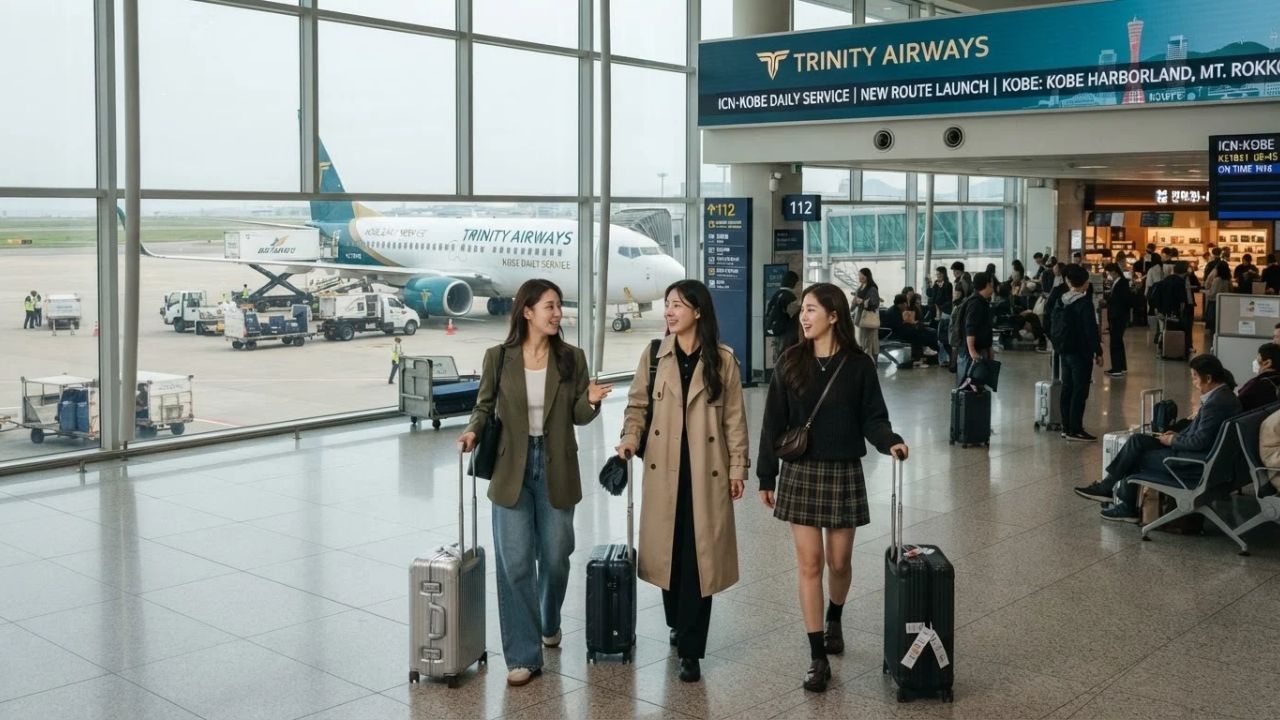
Daily flights connecting Seoul Incheon directly to Kobe Airport provide an effortless alternative gateway to western Japan, cutting transit times across the Kansai region
While millions of international travelers visiting western Japan spend hours shuffling through winding customs lines and crowded train platforms at Kansai International Airport, an artificial island runway sits quiet and tranquil just eighteen minutes by automated monorail from downtown Kobe. Beginning December 18, 2026, Trinity Airways will introduce a new daily non-stop flight linking Seoul’s Incheon International Airport directly with Kobe Airport. Operating once every day, this afternoon connection bypasses the chronic transit bottlenecks of Osaka Bay, delivering independent voyagers directly into a refined maritime enclave framed by Mount Rokko and centuries of international trade.
For experienced travelers navigating East Asia, this new air bridge is a logistical breakthrough. By pairing South Korea’s premier international flight hub with Kobe’s user-friendly regional terminal, the route transforms how visitors enter the broader Kansai basin. Rather than spending an entire afternoon navigating overcrowded rail links out of southern Osaka, travelers can touch down, collect their bags, and sit down to an authentic teppanyaki dinner or soak in historic geothermal hot springs before twilight settles over the bay.
The Bypass Strategy: How Kobe Airport Reshapes Kansai Aviation
The debut of Trinity Airways’ Incheon–Kobe service represents a calculated move to meet surging travel demand between South Korea and Japan while providing direct access to western Japan's cultural heartland. The daily timetable has been engineered for effortless convenience: the outbound flight departs Incheon International Airport at 2:10 pm and touches down at Kobe Airport at 3:55 pm. Following a swift turnaround on the tarmac, the return flight leaves Kobe at 4:55 pm, arriving back at Incheon at 6:55 pm.
This schedule enables business travelers and vacationers to enjoy a relaxed morning in Seoul, board an early afternoon flight across the Korea Strait, and arrive in Hyogo Prefecture in time for hotel check-in and evening cultural activities. Unlike the sprawling terminals of major international gateways, Kobe Airport features a compact single-terminal design where immigration and customs clearance typically take only a few minutes.
Backing this network expansion, Trinity Airways is accelerating its fleet development strategy with plans to introduce Airbus A330-900neo widebody aircraft alongside Boeing 737-8 narrowbody jets within the year. The addition of the larger A330-900neo provides expanded passenger capacity for high-demand international routes, while the efficient Boeing 737-8 supports flexible operations on medium-haul corridors. By scaling its aircraft capabilities, the carrier is positioning Kobe as a key stepping stone in its broader Asian route network, linking South Korea with the diverse regional attractions of western Japan.
What Makes Kobe and Hyogo Prefecture Different
Nestled tightly between the verdant ridge of Mount Rokko and the sheltered coastline of Osaka Bay, Kobe possesses a distinct identity that sets it apart from its Kansai neighbors. While Osaka pulsates with neon-lit commercial districts and Kyoto draws crowds to ancient imperial temples, Kobe offers an elegant blend of nineteenth-century cosmopolitan heritage and mountain serenity.
Following the Meiji Restoration in 1868, Kobe was one of the first Japanese ports opened to foreign commerce. That international legacy remains preserved along Kitano Ijinkan Street, where foreign diplomats, merchants, and sea captains built ornate Western-style wooden residences on the hillside slopes overlooking the harbor. Today, visitors can tour preserved estates like the red-brick Weathercock House and the pastel-green Moegi House, experiencing an architectural dialogue unique to early modern Japan.
Rising directly behind the city, the slopes of Mount Rokko offer immediate access to nature. The Nunobiki Herb Garden, accessible via a scenic ropeway from Shin-Kobe Station, features extensive botanic terraces, alpine flower gardens, and walking trails that provide sweeping panoramic vistas over the port. Further up and over the mountain ridge lies Arima Onsen, celebrated as one of Japan’s three oldest hot spring settlements. Tucked into a quiet mountain valley, Arima is renowned for its therapeutic geothermal waters: the iron- and salt-rich Kinsen (Gold Spring), which stains stone baths a distinctive reddish-brown, and the clear, carbonic Ginsen (Silver Spring).
Of course, no exploration of Kobe is complete without experiencing its celebrated culinary pride: authentic Kobe beef. Sourced exclusively from purebred Tajima-gyu cattle raised under rigorous standards across Hyogo Prefecture, the meat is famed for its dense, snowflake-like intramuscular marbling. Across the harbor at Kobe Harborland, waterfront promenades offer tranquil evening strolls along Meriken Park, where illuminated maritime installations and views of the harbor provide a relaxed alternative to metropolitan bustle.
Furthermore, Kobe’s strategic rail connections make it an exceptional base for exploring the wider region. High-speed Sanyo Shinkansen trains from Shin-Kobe reach Himeji Castle—a masterpiece recognized by the UNESCO World Heritage Centre—in just twenty-nine minutes, while rapid trains whisk travelers into Osaka in twenty minutes and central Kyoto in under an hour.
Visitor Insider Tips
To make the most of this direct gateway into western Japan, take advantage of these local travel insights:
- The Port Liner Rail Transit: Skip expensive taxis from Kobe Airport. Step straight from the terminal onto the automated Port Liner monorail, which reaches Sannomiya—the city’s central transit hub—in precisely eighteen minutes for just 340 yen. Tap any major Japanese contactless IC card, such as ICOCA or Suica, at the gate.
- Arima Onsen Travel Tactics: When visiting Arima Onsen, avoid hauling large rolling suitcases on mountain trains. Forward heavy luggage directly to your subsequent hotel in Osaka or Kyoto using Japan's dependable takkyubin delivery service. From Sannomiya or Shin-Kobe Station, board direct highway express buses that reach the hot spring village in forty-five minutes.
- Lunchtime Kobe Beef Strategy: Authentic teppanyaki dinners at accredited Kobe beef establishments in Sannomiya and Motomachi can easily exceed 20,000 yen per person. For exceptional value, book a lunchtime seating, when premier steakhouses offer identical cuts of certified A5 Tajima beef on set menus at roughly half the evening price.
- Exploring the Nada Sake Breweries: Take the local Hanshin Railway five stops east to Mikage or Uozaki to explore the historic Nada-Gogo brewing district. Blessed with pure Miyamizu mineral spring water and premium Yamada Nishiki rice, this district produces nearly a quarter of Japan’s sake. Visit traditional timber kura like Hakutsuru and Shu-Shin-Kan for complimentary tastings of unpasteurized namazake.
- Mount Rokko Sunset Timing: Ride the Shin-Kobe Ropeway up to Nunobiki Herb Garden around 3:30 PM. Wander through the upper glasshouses and gardens, then secure an outdoor terrace seat before dusk to watch Kobe’s famed "ten-million-dollar night view" illuminate across Osaka Bay.
Cultural and Environmental Context
The launch of international flights into Kobe Airport reflects a broader push toward sustainable destination management across Japan, supported by insights from the Japan National Tourism Organization and regional bureaus like Feel Kobe. Over the past several years, popular Kansai hubs like Kyoto’s historic Gion district have struggled with severe overtourism, overcrowding on municipal bus lines, and strain on local residents.
Directing international air traffic into secondary coastal gateways like Kobe helps decentralize visitor foot traffic. It distributes economic benefits more evenly across family-owned ryokans, independent craftsmen, and neighborhood eateries in Hyogo Prefecture, while offering travelers a significantly calmer, more authentic encounter with Japanese daily life.
At Arima Onsen, local ryokan associations and municipal environmental bodies work in close partnership to safeguard natural geothermal aquifers. Strict zoning guidelines prohibit large-scale resort development that might disrupt the delicate mineral balance of the springs, preserving the intimate village character that has drawn pilgrims and poets for over a thousand years.
Additionally, Trinity Airways’ strategic fleet investment in fuel-efficient Boeing 737-8 and Airbus A330-900neo aircraft brings quieter engine acoustics and reduced fuel burn over coastal Osaka Bay. By combining modern aviation efficiency with sensitive regional tourism dispersal, the route models a more balanced approach to international connectivity.
FAQ: Visiting Kobe and Kansai 2026
What is the flight schedule for Trinity Airways’ Incheon–Kobe route? Starting December 18, 2026, the daily flight departs Incheon at 2:10 pm and arrives at Kobe at 3:55 pm. The return flight leaves Kobe at 4:55 pm, touching down in Incheon at 6:55 pm.
How do I travel from Kobe Airport to central Osaka and Kyoto? Take the Port Liner monorail eighteen minutes to Sannomiya Station. From Sannomiya, JR Special Rapid trains reach Osaka Station in twenty-one minutes and Kyoto Station in fifty-two minutes.
Do I need a reservation to experience Arima Onsen’s hot springs? Day visitors can access public bathhouses like Kin no Yu and Gin no Yu without reservations. However, overnight stays at traditional ryokans with multi-course kaiseki dining should be booked several months in advance.
Can I visit Himeji Castle as a day trip from Kobe? Yes. Himeji is located just thirty to forty minutes west of Kobe via the JR Sanyo Line or less than twenty minutes aboard the Sanyo Shinkansen from Shin-Kobe Station.
When international travelers trade crowded arrival gates for an island runway framed by mountain peaks, Japan’s timeless rhythms feel immediate and effortlessly close.
Related Travel Guides
- Mastering the Roaring Forties: How Air New Zealand’s August Reliability Surge Unlocks Aotearoa’s Wildest Corners
- Direct to the Cultural Gulf: How the Return of Chandigarh–Sharjah Flights Connects Modernist India With Historic Arabia
- Echoes of Runway 13: How Kai Tak’s Rebirth and Cathay’s 80-Year Milestone Reveal Hong Kong’s Living Neighborhood Soul
Disclaimer
This article is for informational and educational purposes only. It does not constitute legal, financial, or professional advice. While we strive to provide accurate and up-to-date information, travel policies, regulations, and conditions change rapidly. Always verify information with official sources before making travel decisions. Nomad Lawyer makes no representations about the accuracy, reliability, completeness, or suitability of the information provided. Readers should consult qualified professionals for advice specific to their circumstances. The views expressed in this article are those of the author and do not necessarily reflect the views of Nomad Lawyer.
Raushan Kumar
Founder & Lead Developer
Full-stack developer with 11+ years of experience and a passionate traveller. Raushan built Nomad Lawyer from the ground up with a vision to create the best travel and law experience on the web.
Learn more about our team →