Iberia Equips Entire Airbus A321XLR Fleet with Free Starlink Wi-Fi: Transatlantic Routes, LEO Satellite Technology, and Fleet Plan 2030 Analysis

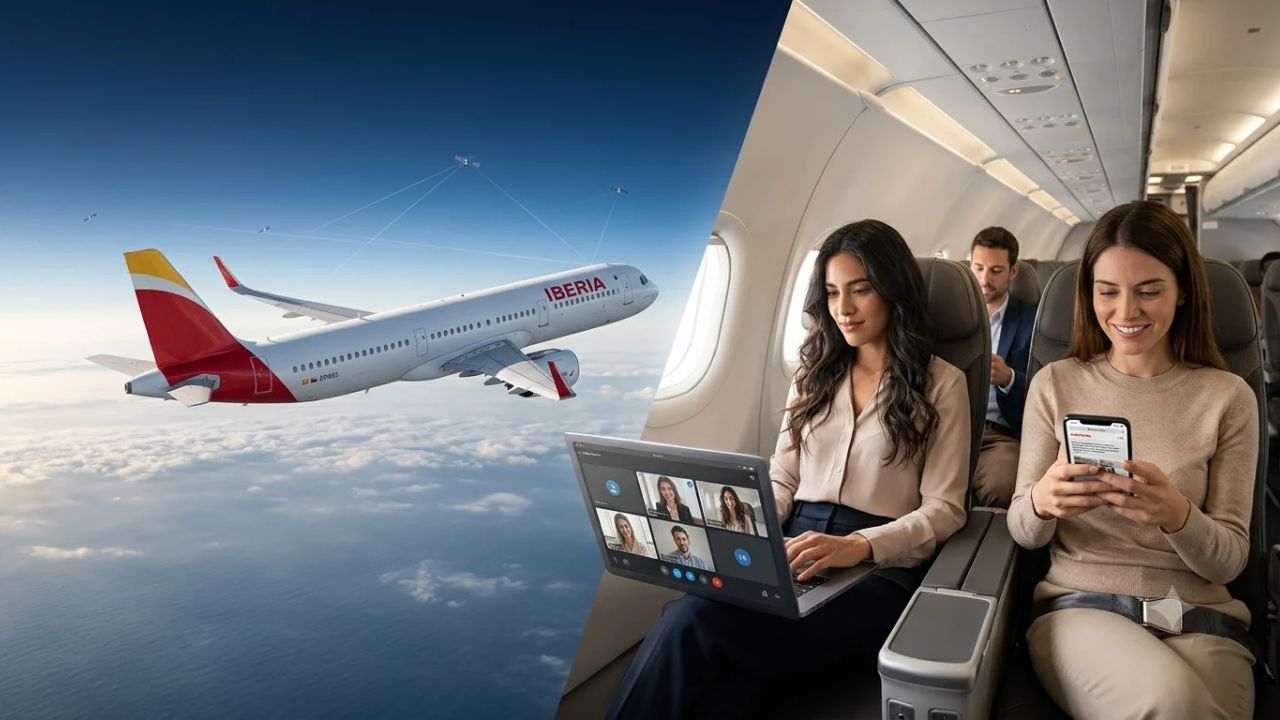
Spanish flag carrier Iberia has completed the deployment of high-speed Starlink satellite internet across 100 percent of its Airbus A321XLR fleet, providing complimentary gate-to-gate broadband to all passengers traveling on long-haul routes connecting Madrid with the Americas.
The milestone was achieved following the successful installation and certification of the satellite hardware on aircraft EC-OIL, the eighth and final Airbus A321XLR delivered to the carrier, at Iberia’s primary maintenance, repair, and overhaul (MRO) base in La Muñoza, adjacent to Adolfo Suárez Madrid-Barajas Airport (MAD). Unlike conventional commercial inflight connectivity models that restrict access behind paywalls or reserve complimentary browsing for premium-cabin passengers and top-tier frequent flyers, Iberia is offering the low-latency, satellite-delivered service free of charge to every traveler in both Business and Economy cabins.
Delivering advertised speeds of up to 500 Mbps via SpaceX’s Low Earth Orbit (LEO) satellite constellation, the technology enables real-time 4K video streaming, cloud-based productivity, and high-definition video conferencing across transoceanic sectors. The fleet-wide rollout represents a pivotal operational component of Iberia’s €6 billion "Flight Plan 2030" transformation strategy, which also encompasses widebody aircraft upgrades, airport lounge expansions, and artificial intelligence-driven customer service systems.
IBERIA A321XLR STARLINK CONNECTIVITY ROLLOUT: MASTER SUMMARY
| Program Metric | Operational Specification | Strategic Significance |
|---|---|---|
| Fleet Coverage | 100% of Active A321XLR Fleet | All 8 aircraft fully retrofitted |
| Final Aircraft Mod | Registration: EC-OIL | Completed at La Muñoza MRO, Madrid |
| Passenger Pricing | 100% Free of Charge | Available across ALL cabin classes |
| Maximum Bandwidth | Up to 500 Mbps per Aircraft | Supports streaming, VPNs, and gaming |
| Latency Standard | 20–40 milliseconds (Low Earth Orbit) | Eliminates traditional GEO delay |
| Constellation Type | Starlink LEO Satellite Mesh | Orbital altitude ~550 km |
| Primary Route Focus | Transatlantic Long-Haul Corridors | Madrid (MAD) to North & South Amer. |
| Corporate Framework | Iberia Flight Plan 2030 (€6B Plan) | Fleet expanding from 43 to ~70 jets |
The Airbus A321XLR Fleet: Redefining Long-Haul Transatlantic Aviation
Iberia’s introduction of free Starlink Wi-Fi is inextricably linked to its position as the global launch operator of the Airbus A321XLR (Extra Long Range). The single-aisle aircraft represents one of the most consequential commercial aviation innovations of the current decade, fundamentally altering the economics of point-to-point long-distance flying.
IBERIA AIRBUS A321XLR TECHNICAL SPECIFICATIONS & CABIN MATRIX
| Aircraft Dimension | Operational Metric | Passenger Product Details |
|---|---|---|
| Maximum Range | Up to 4,700 nautical miles (8,700km) | Non-stop transatlantic capability |
| Engine Configuration | CFM International LEAP-1A | Up to 30% lower fuel burn per seat |
| Total Seating Capacity | 182 Passengers | Two-class premium long-haul layout |
| Business Class Cabin | 14 Full-Flat Private Suites | 1-1 layout; direct aisle access; 4K |
| Economy Class Cabin | 168 Ergonomic Recaro Seats | 3-3 layout; USB-A/C; Bluetooth audio |
The Single-Aisle Long-Haul Revolution
Historically, transoceanic travel required widebody, twin-aisle aircraft such as the Airbus A330, A350, or Boeing 777, carrying between 250 and 350 passengers. While efficient on high-density corridors connecting financial megahubs like London, Paris, and New York, widebody jets are economically unviable on "thin" long-haul routes where passenger demand cannot consistently fill 300 seats year-round.
The A321XLR bridges this structural gap:
- Extended Fuel Capacity: Equipped with a permanent Rear Center Tank (RCT) integrated directly into the aircraft fuselage, the A321XLR holds 12,900 liters of additional kerosene, enabling missions of up to 11 hours without intermediate refueling stops.
- Point-to-Point Network Flexibility: Iberia can deploy the 182-seat aircraft to establish direct, non-stop connections between secondary American cities and Madrid, bypassing congested mega-hubs.
- Environmental and Fuel Efficiency: By burning up to 30 percent less fuel per seat than preceding generations of widebody aircraft, the A321XLR reduces operational carbon footprints while preserving route profitability.
TRANSATLANTIC ROUTE OPERATIONAL ECONOMICS
[Traditional Widebody (300 Seats)]  ---> Requires massive hub-and-spoke feed (MAD-MIA-BOG)
                 vs.
[Airbus A321XLR (182 Seats)]        ---> Unlocks direct point-to-point routes (MAD-BOS / MAD-REC)
                                         Lower trip cost; 100% Starlink connectivity across cabins
Technical Anatomy: How Starlink LEO Technology Transforms Inflight Broadband
The deployment of Starlink onboard commercial airliners represents an architectural departure from legacy inflight connectivity systems that have frustrated air travelers for two decades.
INFLIGHT SATELLITE CONNECTIVITY: LEO VS. GEO COMPARISON
| Architectural Metric | Traditional Geostationary (GEO) | SpaceX Starlink Low Earth Orbit (LEO) |
|---|---|---|
| Orbital Altitude | ~35,786 kilometers above Earth | ~550 kilometers above Earth |
| Signal Round-Trip Time | 600 to 800 milliseconds | 20 to 40 milliseconds |
| Total Aircraft Pipe | 10 to 50 Mbps (Shared per plane) | Up to 500 Mbps per aircraft |
| User Experience | Text messaging & slow page loading | High-definition streaming & gaming |
| Corporate VPN Support | Frequent timeouts and disconnects | Stable real-time encrypted tunneling |
| Polar & Oceanic Caps | Coverage voids at high latitudes | Continuous global satellite mesh |
Eliminating the High-Latency Penalty
The fundamental constraint of legacy inflight Wi-Fi systems—powered by satellites in geostationary orbit (GEO)—is orbital distance. Positioned at 35,786 kilometers above the equator, a data signal transmitted from an aircraft cabin must travel over 71,000 kilometers round-trip simply to reach the satellite and return to a ground telehub. This physics barrier introduces an unavoidable transmission delay (latency) of 600 to 800 milliseconds.
While high latency is tolerable for passive web page loading or sending basic text messages, it makes interactive, modern digital tools impossible:
- Corporate Virtual Private Networks (VPNs) frequently reject connection attempts due to latency timeouts.
- Real-time cloud documents (Google Workspace, Microsoft 365) stutter and generate synchronization errors.
- Video calls on Zoom or Microsoft Teams suffer disorienting audio lags.
- Online gaming is entirely unplayable.
The Low Earth Orbit (LEO) Advantage
Operating at an altitude of approximately 550 kilometers, Starlink’s constellation is more than 65 times closer to Earth than conventional GEO satellites. Consequently:
- Ultra-Low Latency: Latency drops to between 20 and 40 milliseconds, matching terrestrial home and office fiber-optic broadband performance.
- Electronically Steered Phased-Array Antennas: Installed on the crown of the aircraft fuselage at La Muñoza, the low-profile aerodynamic antenna maintains multiple simultaneous connections with passing satellites, electronically steering data beams in microseconds without mechanical moving parts.
- Inter-Satellite Laser Links: Starlink satellites communicate with each other via optical laser crosslinks in space, transmitting data across oceanic voids where ground ground stations do not exist, eliminating dead zones during mid-Atlantic crossings.
SIGNAL PROPAGATION PATHWAY: GEO VS. LEO
[GEO Satellite: 35,786 km Altitude] <----------------------------+
       |                                                         | Latency: 600–800ms
       |                                                         | Buffering / Drops
[Aircraft Cabin at 35,000 ft]                                    |
       |                                                         |
[Starlink LEO Satellite: 550 km Altitude] <----+                 |
       |                                       | Latency: 20–40ms|
       v                                       | Instant 500 Mbps|
[Terrestrial Internet Backbone] <--------------+-----------------+
Transatlantic Route Network: Destinations Benefiting from Starlink Connectivity
Iberia has strategically positioned its newly retrofitted A321XLR aircraft on key transatlantic city pairs connecting Adolfo Suárez Madrid-Barajas Airport with secondary North American, South American, and Caribbean destinations.
IBERIA A321XLR TRANSATLANTIC ROUTE NETWORK FROM MADRID (MAD)
| Destination Gateway | Country / Territory | Flight Duration | Primary Commercial Segment |
|---|---|---|---|
| Boston Logan (BOS) | United States | ~7h 45m | Academic, biotech, corporate |
| Washington (IAD) | United States | ~8h 30m | Diplomatic, government, business |
| New York (JFK) | United States | ~8h 15m | High-yield premium, leisure |
| Toronto Pearson (YYZ) | Canada | ~8h 20m | Financial, diaspora, tourism |
| Recife (REC) | Brazil | ~7h 30m | Northeastern Brazil commercial hub |
| Fortaleza (FOR) | Brazil | ~7h 45m | Coastal resort, emerging trade |
| Santo Domingo (SDQ) | Dominican Republic | ~8h 45m | Caribbean commerce, diaspora |
| San Juan (SJU) | Puerto Rico | ~8h 15m | US Caribbean trade & leisure |
Deepening Latin American Connectivity
For travelers departing Spain, the deployment of the A321XLR to Recife and Fortaleza in Brazil represents a significant regional enhancement. Previously, reaching Northeastern Brazil required domestic connections through congested southern hubs like São Paulo Guarulhos (GRU) or Rio de Janeiro Galeão (GIG), adding four to six hours to total journey times. Direct A321XLR non-stop services, combined with high-speed Starlink Wi-Fi, provide executive business travelers and eco-tourists with a direct seven-hour gateway to Brazil’s rapidly developing northeastern economic corridor.
Strengthening North American Transatlantic Links
On North American sectors into Boston Logan (BOS) and Washington Dulles (IAD), the complimentary Starlink connection gives Iberia a distinct competitive advantage over rival transatlantic carriers. Business executives traveling on the daytime westbound flight can work continuously throughout the eight-hour crossing, attending corporate video conferences, executing real-time financial trades, and communicating with global teams without incurring expensive inflight data surcharges.
Fleet Expansion Beyond the A321XLR: A350, A330, and Widebody Retrofits
While the Airbus A321XLR represents the first fleet type to achieve 100 percent Starlink deployment, Iberia’s connectivity roadmap extends across its entire long-haul widebody network.
IBERIA FLEET CONNECTIVITY & RETROFIT PROGRESSION (LATE 2026)
| Fleet Category | Total Aircraft Count | Starlink Retrofit Status | Operational Scope |
|---|---|---|---|
| Airbus A321XLR | 8 Aircraft In-Fleet | 100% COMPLETE (8 of 8) | Transatlantic single-aisle |
| Airbus A350-900 | 22 Aircraft In-Fleet | Active Retrofit Program | Flagship long-haul routes |
| Airbus A330-200/300 | 21 Aircraft In-Fleet | Staged Engineering Cycle | Latin America & US routes |
| Total Long-Haul Fleet | 51 Aircraft Active | Ongoing Fleetwide Upgrade | Heading to 70 jets by '30 |
The Widebody Retrofit Challenge
Installing satellite connectivity hardware on widebody twin-aisle aircraft like the Airbus A350-900 and Airbus A330-300 involves significant engineering complexity compared to newly delivered aircraft:
- Structural Radome Reinforcement: Technicians at La Muñoza must cut precision fuselage access points, install structural reinforcement doublers, and mount aerodynamic protective radomes engineered to withstand transoceanic cruising stresses.
- Cabin Wiring Distribution: High-bandwidth fiber-optic cables and multiple internal wireless access points (WAPs) must be threaded through overhead luggage bins and cabin sidewalls to ensure that 350 passengers on an A350 do not experience local Wi-Fi signal attenuation.
- MRO Scheduled Maintenance Sync: To avoid disruptive aircraft groundings, widebody installations are phased during scheduled heavy maintenance checks (C-Checks), ensuring steady, incremental progress without sacrificing daily schedule integrity.
Flight Plan 2030: The €6 Billion Strategic Transformation
The fleet-wide rollout of Starlink inflight internet is a core deliverable of Flight Plan 2030, Iberia’s long-term strategic master plan backed by €6 billion in dedicated capital expenditure.
IBERIA FLIGHT PLAN 2030: FOUR STRATEGIC PILLARS
| Entity / Route | Metrics | Operational Status |
|---|---|---|
| Transformation Pillar | Capital Allocation Focus | Tangible Passenger Deliverables |
| 1. Fleet Modernization | Acquisition of next-gen A321XLR and | Fleet growth from 43 to 70 aircraft; |
| & Expansion | A350-900 aircraft; eco-efficiency | 30% reduction in per-seat emissions |
| 2. Digital & AI | Starlink satellite connectivity; | Free high-speed Wi-Fi; predictive |
| Infrastructure | generative AI customer service tools | disruption rebooking & chat systems |
| 3. Premium Ground | Expansion of VIP lounge facilities | 2,500+ sqm Emerald Sorolla Lounge |
| Experience | at Madrid-Barajas Hub Terminal 4 | at Madrid T4 with fine dining & spas |
| 4. Onboard Product | Comprehensive widebody cabin | Ergonomic lie-flat suites; 4K IFE; |
| Refurbishment | retrofit program & dining upgrades | upgraded Spanish gastronomic menus |
Fleet Expansion Toward 70 Aircraft
Under Flight Plan 2030, Iberia has expanded its active operating fleet from 43 aircraft at the inception of the program to 51 aircraft in late 2026, with confirmed delivery schedules establishing a path toward approximately 70 aircraft by 2030. This expansion reinforces Madrid-Barajas as Southern Europe’s undisputed aviation bridge to the Western Hemisphere, enabling increased frequencies to existing capitals and opening secondary transatlantic routes.
Premium Ground Infrastructure: The Emerald Sorolla Lounge
Complementing its onboard connectivity upgrades, Iberia recently unveiled its flagship Emerald Sorolla Lounge at Terminal 4 of Adolfo Suárez Madrid-Barajas Airport:
- Spanning more than 2,500 square meters, the lounge accommodates over 400 travelers simultaneously.
- Features include private relaxation suites, shower facilities, workstations with enterprise-grade fiber internet, and a culinary showcase highlighting regional Spanish gastronomy and curated DO wines.
- The lounge integrates biometric boarding gates, allowing premium passengers to transition from lounge to aircraft without presenting physical boarding passes.
Artificial Intelligence Integration
Iberia is actively deploying enterprise artificial intelligence across its customer care architecture:
- Predictive Disruption Management: Automated algorithms detect incoming air traffic control or weather delays hours in advance, automatically generating rebooking options and digital hotel vouchers directly to passenger smartphones before flights land.
- Conversational AI Concierge: Multi-lingual digital assistants on WhatsApp and the Iberia mobile app resolve ticketing adjustments, special baggage requests, and seat assignments in seconds.
Competitive Paradigm: The Global Race for Free Inflight Broadband
Iberia’s deployment of complimentary Starlink connectivity reflects an accelerating competitive shift in commercial aviation. For years, airlines treated inflight Wi-Fi as an ancillary revenue center, outsourcing systems to third parties and charging passengers steep hourly fees of $15 to $30 for sluggish, bandwidth-capped connections.
GLOBAL AIRLINE INFLIGHT BROADBAND COMPETITIVE LANDSCAPE
| Airline Carrier | Satellite Partner & Technology | Access Model & Passenger Pricing |
|---|---|---|
| Iberia | SpaceX Starlink (Low Earth Orbit) | 100% FREE for ALL passengers on XLR |
| Qatar Airways | SpaceX Starlink (Low Earth Orbit) | 100% FREE fleetwide rollout (B777) |
| United Airlines | SpaceX Starlink (Low Earth Orbit) | Free for MileagePlus on 1,000+ jets |
| Air France | SpaceX Starlink (Low Earth Orbit) | Free for Flying Blue loyalty members |
| Delta Air Lines | Viasat (Geostationary GEO) | Free for SkyMiles members |
| Lufthansa Group | European Aviation Network / Viasat | Tiered paid access; free messaging |
The Transition to Internet as a Basic Utility
Consumer expectations are reshaping airline service baselines. Today's travelers view high-speed internet as an indispensable travel utility rather than a luxury upgrade:
- Loyalty Driver: Frequent business travelers increasingly select airlines based on reliable inflight Wi-Fi capabilities, favoring carriers where working days are not lost during ocean crossings.
- Democratization of Inflight Connectivity: By removing loyalty program barriers and credit card paywalls, Iberia eliminates passenger friction, establishing an inclusive product standard that pressures European legacy competitors (including Air France-KLM and the Lufthansa Group) to accelerate their own free Wi-Fi initiatives.
Passenger Travel Guide: Maximizing Starlink Onboard Iberia's A321XLR
For travelers preparing to fly on Iberia’s Airbus A321XLR aircraft across the Atlantic, following standard connection practices ensures optimal performance throughout the flight.
PASSENGER CHECKLIST: CONNECTING TO IBERIA STARLINK WI-FI
| Entity / Route | Metrics | Operational Status |
|---|---|---|
| Step | Recommended Action | Operational Detail |
| 1. Aircraft Check | Verify aircraft type on itinerary | Confirm Airbus A321XLR on booking; |
| or mobile boarding pass | aircraft substitutions may occur | |
| 2. Device Settings | Switch device to Airplane Mode; | Keep Wi-Fi and Bluetooth activated; |
| enable Wi-Fi connection | select "Iberia_WiFi" network | |
| 3. Browser Redirect | Open browser to captive portal page | Navigate to wifi.iberia.com; click |
(wifi.iberia.com) |
"Connect Free" (No payment needed) | |
| 4. Power Management | Utilize in-seat USB-C or AC power | Continuous high-speed streaming can |
| outlets at your seat | rapidly drain mobile device batteries |
Practical Traveler Recommendations
-
Verify Your Scheduled Aircraft Type:
- Check the aircraft model listed on your reservation confirmation or the Iberia mobile app 24 hours prior to departure. If your flight is operated by an Airbus A321XLR, your aircraft is guaranteed to feature Starlink.
- Note that unexpected operational disruptions or aircraft swaps may occasionally result in substitution with an Airbus A330 or A350 where Starlink installation is still progressing under the wider retrofit schedule.
-
Stream Effortlessly Without Heavy Local Downloads:
- Because Starlink provides unthrottled gate-to-gate bandwidth, passengers no longer need to spend hours pre-downloading bulky movies or television series to tablets prior to departing for the airport.
- You can stream live high-definition content directly through Netflix, YouTube, Apple TV+, or Disney+ at 35,000 feet just as you would on home fiber broadband.
-
Audio Etiquette on Long-Haul Sectors:
- While Starlink’s high bandwidth easily supports voice and video calls via WhatsApp, FaceTime, and Teams, common airline cabin etiquette and carrier rules discourage open voice calling in shared passenger cabins to maintain a quiet, restful cabin environment.
- Utilize high-quality noise-canceling headphones paired via Bluetooth directly to personal devices or seatback IFE monitors.
-
Keep Device Chargers Accessible in Carry-On Baggage:
- Sustained high-speed data transmission and video streaming draw substantial power from smartphones, laptops, and tablets.
- Every passenger seat on Iberia’s A321XLR is equipped with high-wattage USB-A and USB-C fast-charging ports, while Business Class suites feature universal international AC power sockets. Keep charging cords in personal cabin bags rather than stowing them in overhead lockers.
Frequently Asked Questions
Is Starlink Wi-Fi really free for all passengers on Iberia's A321XLR?
Yes. Iberia provides Starlink satellite internet completely free of charge to 100 percent of passengers traveling on its Airbus A321XLR aircraft. Access is available across all cabin classes (both Business Class and Economy), with no credit card paywalls, no bandwidth caps, and no requirement to belong to the Iberia Plus loyalty program.
Which routes currently feature Iberia's A321XLR with free Starlink?
Iberia operates its Airbus A321XLR fleet on long-haul routes connecting Adolfo Suárez Madrid-Barajas Airport (MAD) with destinations across North America, South America, and the Caribbean. Key scheduled destinations include Boston (BOS), Washington Dulles (IAD), New York (JFK), Toronto (YYZ), Recife (REC), Fortaleza (FOR), Santo Domingo (SDQ), and San Juan (SJU).
What internet speeds can passengers expect from Starlink on Iberia?
Starlink's Low Earth Orbit (LEO) satellite network delivers advertised speeds of up to 500 Mbps per aircraft with ultra-low latency between 20 and 40 milliseconds. This enables travelers to stream 4K video, conduct video conference calls, access enterprise corporate VPNs, and play online multiplayer games without buffering delays.
Will Starlink be installed on Iberia's other long-haul aircraft?
Yes. Iberia has already begun installing Starlink satellite antennas across its widebody fleet of Airbus A350-900 and Airbus A330-200/300 aircraft. While the A321XLR fleet is 100 percent complete, retrofits across the widebody fleet are progressing during scheduled major maintenance intervals.
How does Low Earth Orbit (LEO) Wi-Fi differ from traditional airline satellite internet?
Traditional inflight Wi-Fi relies on geostationary (GEO) satellites orbiting 35,786 kilometers away, causing high latency (600 to 800 milliseconds) and slow data transfer. Starlink satellites orbit in Low Earth Orbit at approximately 550 kilometers altitude—over 65 times closer to Earth—reducing latency to 20–40 milliseconds and delivering broadband speeds comparable to terrestrial fiber connections.
What is Iberia's Flight Plan 2030?
Flight Plan 2030 is Iberia's strategic corporate development program backed by a €6 billion investment. The plan focuses on expanding the airline's fleet from 43 to approximately 70 aircraft, rolling out free Starlink satellite connectivity, deploying artificial intelligence for customer care, retrofitting widebody cabins, and opening premium ground facilities like the Emerald Sorolla Lounge at Madrid-Barajas Terminal 4.
Related Travel Guides
- Australia and Pacific Nations Showcase Monumental Rock Formations: A Comprehensive Guide to Deep-Time Geotourism and Indigenous Custodianship
- Poland and Emerging Destinations Reshape Europe's Winter Tourism: ETC Report Analyzes Surging 2026–2027 Travel Demand
- United States and Emerging Asian Markets Propel Philippines Tourism Past 5 Million Arrivals: 2026 Target Analysis
- US Strengthens Airline Passenger Rights Amid Ebola Travel Restrictions: DOT Refund and Voucher Mandates Explained
This article is for informational purposes. Flight routes, passenger regulations, visa rules, and transit advisories are subject to change by airlines and aviation authorities. Readers are advised to verify schedules and travel documentation with relevant carriers and border agencies before departure.
Related Stories

United Airlines Blocks Unauthorized Third-Party AI Flight Bookings for 2026 Holiday Season

easyJet Launches Direct Liverpool to Reykjavik Flights: Inside the North West's New Winter Gateway to Iceland