
Hundreds Of Passengers Affected Throughout Europe As Frankfurt, Paris, And 10 More Airports Face 1,601 Delays And 60 Cancellations, Disrupting Air Travel
Hundreds Of Passengers Affected Throughout Europe As Frankfurt, Paris, And 10 More Airports Face 1,601 Delays And 60 Cancellations, Disrupting Air Travel

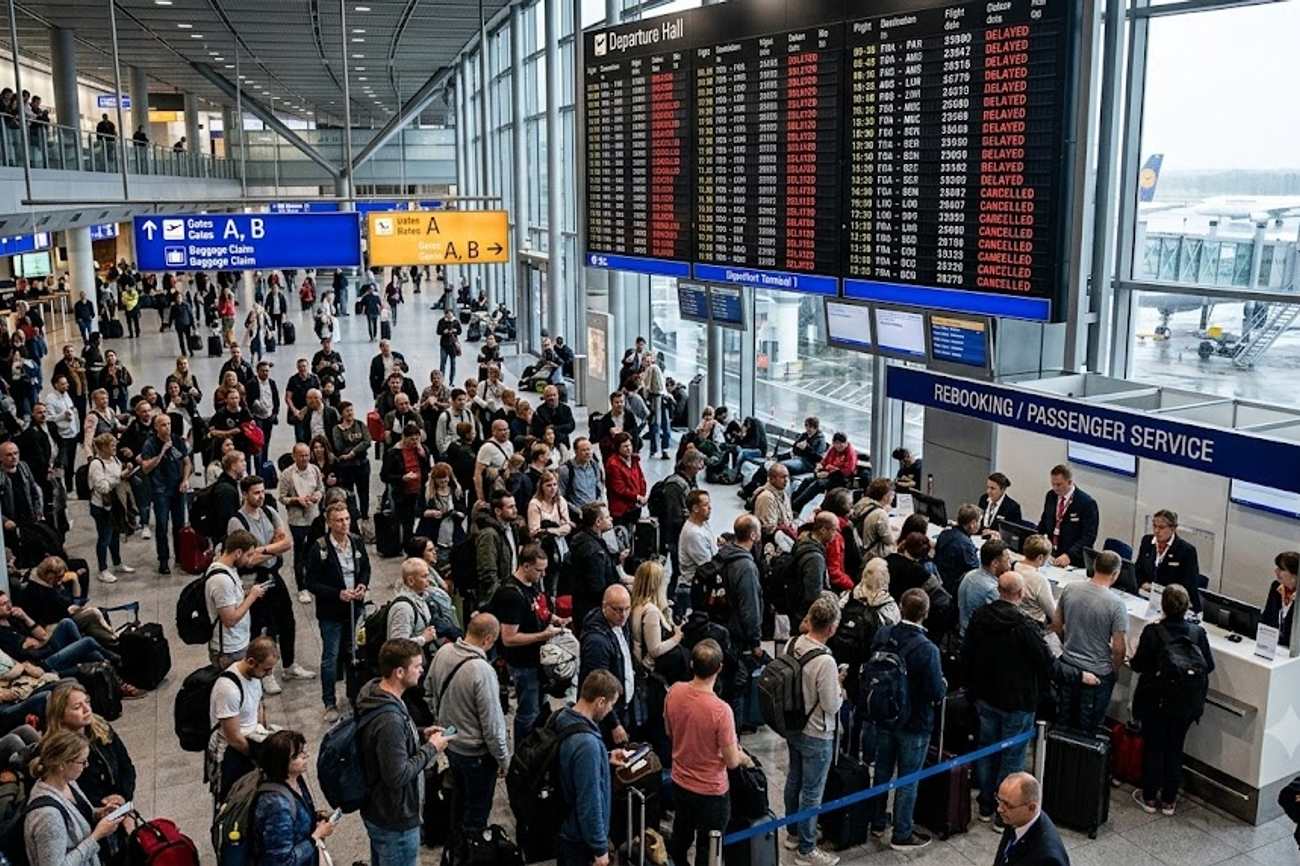
Image generated by AI
1,601 flight delays and 60 cancellations across nine European nations signal a systemic instability in the continent's primary aviation hubs. This data reveals a concentrated failure of reliability within the "Big Four" hubs—Amsterdam, Frankfurt, London, and Paris—where operational friction is not merely an occasional glitch but a recurring structural reality for the modern traveler. When nearly 1,700 flights are disrupted simultaneously across Germany, Sweden, Italy, Spain, Norway, Denmark, France, the United Kingdom, and the Netherlands, the issue ceases to be about isolated weather events and becomes a question of capacity management and carrier resilience.
The Hub-and-Spoke Fragility
The current disruption patterns highlight a dangerous reliance on a few mega-hubs. The data shows that Amsterdam Schiphol, Frankfurt, London Heathrow, and Paris Charles de Gaulle/Roissy are the epicenters of instability, collectively recording 896 delays. This concentration suggests that any minor operational hiccup at these primary nodes creates a ripple effect across the entire European network.
The volatility is most acute at Amsterdam Schiphol, which emerged as the most disrupted airport with 289 delays and 16 cancellations. The data indicates a specific vulnerability for passengers using KLM, which accounted for 145 of those delays and 14 of the cancellations. With a 19% delay rate for both arriving and departing flights at Schiphol, nearly one in five passengers experienced a schedule shift, transforming the hub into a bottleneck rather than a gateway.
Quantitative Breakdown of European Disruptions
The following data outlines the scale of instability across the most affected airports and the carriers most responsible for these failures.
| Airport | Delays | Cancellations | Primary Carrier Impact |
|---|---|---|---|
| Amsterdam Schiphol | 289 | 16 | KLM (145 delays / 14 cancellations) |
| Frankfurt | 214 | 5 | Lufthansa (82 delays) |
| London Heathrow | 200 | 4 | British Airways (127 delays) |
| Paris CDG | 193 | 3 | Air France (85 delays) |
| Oslo Gardermoen | 112 | 6 | Norwegian (38 delays / 6 cancellations) |
| Copenhagen | 99 | 8 | SAS (40 delays) |
| Berlin-Brandenburg | 94 | 4 | easyJet (24 delays / 2 cancellations) |
| Ibiza | 94 | 2 | Ryanair (20 delays) |
The airline-specific data reveals a tiered system of failure. KLM leads the disruption rankings with 164 total delays and 20 cancellations. British Airways follows with 140 delays, and Lufthansa recorded 130. While Air France (97), SAS (84), and easyJet (57) reported lower totals, the impact remains significant when viewed through the lens of passenger experience. In terms of total flight deletions, Norwegian Air Shuttle recorded 11 cancellations, followed by Vueling Airlines with six and Air Dolomiti with five.
Expert Analysis: The Domino Effect of European Airspace
For travelers booking routes through the European mainland, the direct consequence of this data is a heightened risk of "cascading failure." The operational factors cited—crew scheduling, aircraft availability, and air traffic management—are not independent variables; they are interdependent. When a flight is delayed at London Heathrow, the aircraft is not available for its next sector in Ibiza or Paris. This is evidenced by the 32% delay rate in Ibiza, one of the highest percentages in the dataset, despite having fewer total delays than the major hubs.
The pricing pressure this creates is subtle but real. As reliability drops, the "cost" of a ticket is no longer just the fare, but the potential loss of productivity or hotel nights associated with a 19% delay probability at Schiphol or a 17% rate at Paris CDG. Furthermore, the high concentration of delays among flag carriers like Lufthansa and British Airways suggests that the very airlines designed to provide the most stability are currently the most susceptible to system-wide shocks.
From a regulatory perspective, these numbers place immense pressure on the International Air Transport Association (IATA) and national aviation authorities to address airport congestion. The fact that Berlin-Brandenburg recorded a 16% departure delay rate and a 15% arrival delay rate suggests that even newer infrastructure is struggling to keep pace with current demand and operational constraints. For the nomad lawyer or high-frequency traveler, this data necessitates a shift in strategy: avoiding tight connections at the "Big Four" hubs and prioritizing carriers with lower cancellation-to-delay ratios.
Key Takeaways
- Hub Risk: Amsterdam Schiphol is currently the highest-risk airport for disruptions, featuring a 19% delay rate and the highest volume of cancellations (16).
- Carrier Volatility: KLM is the most unstable major carrier in this dataset, recording the highest totals for both delays (164) and cancellations (20).
- Regional Hotspots: Ibiza represents a significant outlier in terms of percentage, with a 32% delay rate, indicating severe operational friction in leisure-heavy routes.
- Systemic Failure: The combined 896 delays across the four primary hubs (AMS, FRA, LHR, CDG) indicate that European aviation instability is centralized in its core infrastructure.
- Passenger Recourse: Travelers are advised to maintain digital copies of all boarding passes and receipts, as these are mandatory for claiming expenses under European passenger rights regulations.
FAQ: European Flight Disruptions 2024
What should I do if my flight is cancelled at a major European hub? Immediately check the airline's app and airport monitors. Contact the carrier to discuss rebooking or refund options. Ensure you keep all boarding passes and receipts for food or hotels, as these are required for reimbursement claims.
Which European airport currently has the highest delay probability? Based on recent data, Ibiza has the highest percentage of delays at 32%. However, Amsterdam Schiphol handles the highest volume of disruptions, with 289 total delays and a 19% delay rate.
Which airlines are currently experiencing the most cancellations? KLM recorded the highest number of cancellations at 20, followed by Norwegian Air Shuttle with 11 and Vueling Airlines with six.
Why are so many flights being delayed across different countries simultaneously? Disruptions are usually caused by a "domino effect" involving crew scheduling, aircraft availability, and air traffic control restrictions. A delay in one city often affects the aircraft's subsequent flights in other cities.
When the hubs fail, the entire network trembles.
Tags: KLM, Lufthansa, Amsterdam Schiphol, London Heathrow, European Aviation 2024, Flight Disruption Analysis
Related Travel Guides
- Bolivia Medical Travel Insights, Analyzing Legal Frameworks For Cross-Border Surgery In Cochabamba And Santa Cruz, All You Need To Know
- The Zetter Collection to Open First European Hotel in Amsterdam in Early 2027
- Why Are Silent Biometric Surveillance Cameras Tracking Every Single Passenger And Changing The Future Of Travel In Jackson County, Find Out Now
Disclaimer
This article is for informational and educational purposes only. It does not constitute legal, financial, or professional advice. While we strive to provide accurate and up-to-date information, travel policies, regulations, and conditions change rapidly. Always verify information with official sources before making travel decisions. Nomad Lawyer makes no representations about the accuracy, reliability, completeness, or suitability of the information provided. Readers should consult qualified professionals for advice specific to their circumstances. The views expressed in this article are those of the author and do not necessarily reflect the views of Nomad Lawyer.
Preeti Gunjan
Contributor & Community Manager
A passionate traveller and community builder. Preeti helps grow the Nomad Lawyer community, fostering engagement and bringing the reader experience to life.
Learn more about our team →