
Gulf Air Travel Disrupted as Riyadh, Jeddah, and Dubai Face 75 Flight Cancellations and 1,262 Delays
Airspace restrictions and operational bottlenecks trigger 75 flight cancellations and 1,262 delays across Saudi Arabia, the UAE, Kuwait, and regional Gulf gateways.

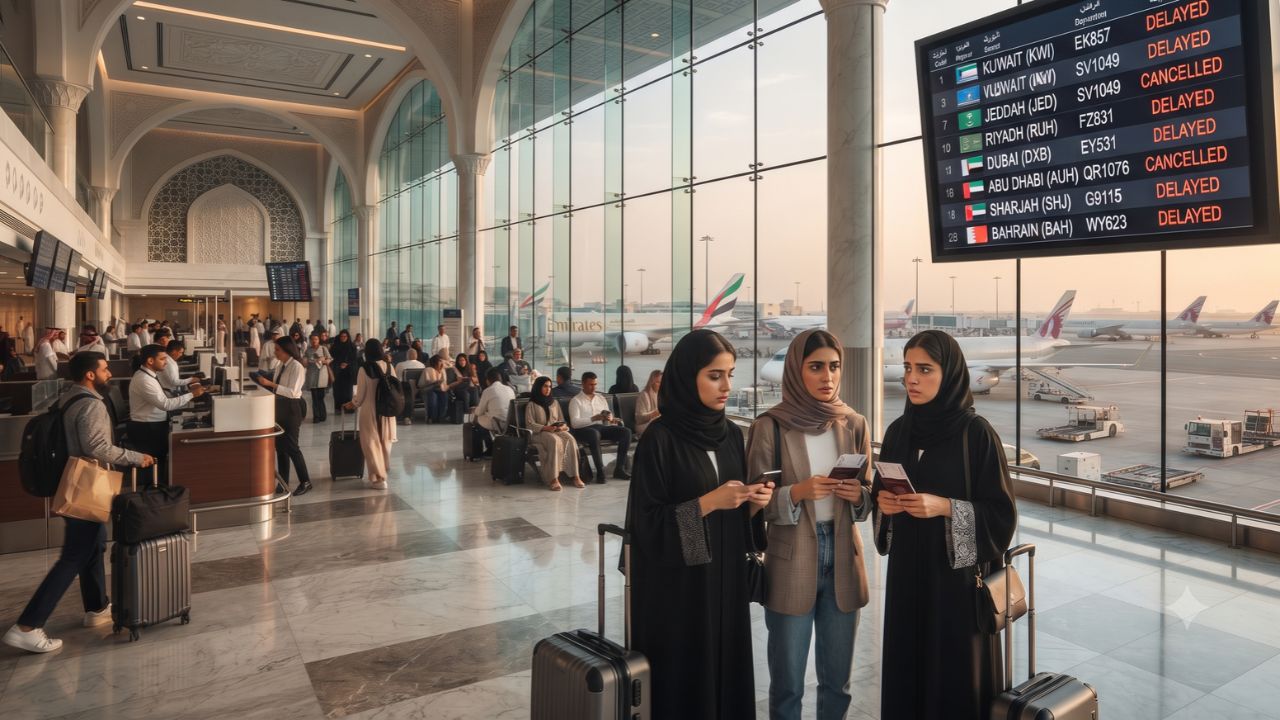
Image generated by AI
While primary mega-hubs like Riyadh and Dubai absorbed hundreds of delayed connections, domestic outstations in Saudi Arabia saw half their daily schedules wiped out, with Najran logging a 50% origin cancellation rate and Yanbu registering a 50% destination cancellation rate. Real-time aviation tracking logged on 5 October 2026 at 5:28 pm ET (6 October 2026 at 1:28 am Gulf Standard Time) recorded 75 cancellations and 1,262 delayed flights stretching across Saudi Arabia, the United Arab Emirates, Bahrain, Kuwait, Egypt, Jordan, and Israel.
Tighter regional airspace corridors and tactical flight reroutings have funneled commercial traffic into narrow transit channels, creating cascading delay waves that affect travelers connecting between Europe, Asia, and the Arabian Peninsula.
Airspace Pressures and Cascading Delays Across Gulf Gateways
The operational strain was felt unevenly across national networks. Saudi Arabia experienced the heaviest overall disruption, with bottlenecks distributed across international gateways and regional desert airstrips. King Khalid International Airport (RUH) in Riyadh emerged as the most delayed facility in the dataset, recording 222 delays and 11 cancellations (1% origin, 1% destination cancellation rate). King Abdulaziz International Airport (JED) in Jeddah followed with 129 delays and eight cancellations (1% origin, 1% destination rate).
Regional Saudi hubs registered acute localized impact: Abha Regional Airport (AHB) posted 32 delays and four cancellations (4% origin, 5% destination cancellation rate), while Gizan Regional recorded four cancellations. Specialized domestic routes saw point cancellations: Najran Domestic (EAM) recorded four cancellations with a 50% origin cancellation rate, and Yanbu Domestic (YNB) registered four cancellations with a 50% destination cancellation rate.
Across the United Arab Emirates, disruptions affected all three commercial hubs monitored under Dubai Airports and northern Emirates authorities. Dubai International Airport (DXB) recorded 146 delays and 10 cancellations. Abu Dhabi International Airport (AUH) registered 99 delays and five cancellations (1% origin cancellation rate), while Sharjah International Airport (SHJ) recorded 54 delays and two cancellations.
In Bahrain and Kuwait, distinct disruption profiles emerged. Bahrain International Airport (BAH) logged 22 delays and eight cancellations (4% origin, 4% destination cancellation rate). Kuwait International Airport registered 14 delays and two cancellations. Beyond the immediate Gulf, Ben Gurion International (TLV) in Tel Aviv recorded 173 delays and five cancellations (1% origin cancellation rate), Istanbul Airport (IST) recorded 166 delays and two cancellations, Cairo International (CAI) logged 93 delays and one cancellation, Antalya Airport (AYT) recorded 85 delays and one cancellation, Queen Alia International (AMM) in Amman posted 25 delays and one cancellation, and Ramon Airport (ETM) recorded two delays and three cancellations (20% destination cancellation rate).
Gulf Airline Performance and Operational Impact
| Airline | Delays Recorded | Delay Share (%) | Cancellations | Cancellation Share (%) | Primary Operating Base |
|---|---|---|---|---|---|
| Saudia | 138 | 27% | 17 | 3% | Riyadh & Jeddah |
| Turkish Airlines | 129 | 8% | 1 | 0% | Istanbul |
| Etihad Airways | 77 | 23% | 1 | 0% | Abu Dhabi |
| flydubai | 60 | 20% | 1 | 0% | Dubai |
| Israir | 39 | 50% | 4 | 5% | Tel Aviv |
| Gulf Air | 15 | 11% | 8 | 5% | Manama, Bahrain |
| Royal Jordanian | 8 | 6% | 1 | 0% | Amman |
| Yemenia – Yemen Airways | 3 | 14% | 1 | 4% | Aden & Sana'a |
| Kuwait Airways Corporation | 1 | 1% | 2 | 2% | Kuwait City |
Aviation figures verified via live operational tracking streams in coordination with FlightAware and the General Authority of Civil Aviation - Saudi Arabia.
The figures demonstrate why examining absolute figures and percentage shares together provides a clearer operational picture. While Saudia logged the largest absolute disruption with 138 delays and 17 cancellations, regional carrier Israir recorded a 50% delay rate across its measured schedule, meaning half of its scheduled departures departed behind timetable.
What Makes Middle Eastern Air Corridors Distinct
Aviation geography across the Arabian Peninsula relies on tightly managed waypoint corridors connecting East-West intercontinental traffic. When airspace over adjacent regions faces tactical closures or rerouting mandates, dozens of widebody jetliners must share identical civilian air corridors over the Persian Gulf and Red Sea.
This compression increases separation buffers between aircraft. Ground controllers in Riyadh, Jeddah, and Dubai must hold departing aircraft at the gate with engines off to prevent fuel waste on taxiways, causing departure delays that ripple into late-evening rotations in Cairo, Amman, and Istanbul.
Visitor Insider Tips
- Re-Check Connections Before Boarding First Sector: If transiting through Riyadh, Jeddah, or Dubai with an onward connection under two hours, verify whether your incoming aircraft has arrived on time. Request an gate agent to rebook tight transfers onto later evening rotations before leaving your point of origin.
- Navigating Jeddah Airport Terminals: King Abdulaziz International Airport operates distinct passenger terminals, including the modern Terminal 1 and the North Terminal. Allow at least 60 minutes for terminal transfers, and utilize the automated people mover inside Terminal 1 rather than shuttle buses when changing gates.
- Ground Transit Alternatives in the UAE: If a domestic or regional shuttle flight between Dubai and Abu Dhabi faces severe ground delays, consider taking an express overland taxi or coach along the E11 highway (Sheikh Zayed Road), which takes approximately 75 minutes city-to-city.
- Document Airline Care Entitlements: When delays exceed three hours at Gulf airports, major national carriers are required by civil aviation charters to provide meal vouchers and lounge or hotel accommodation. Obtain a stamped written delay confirmation from customer service desks before exiting the airside concourse.
Cultural and Environmental Context
The Arabian Peninsula is experiencing rapid tourism expansion under national diversification initiatives like Saudi Vision 2030, which has dramatically increased domestic and regional travel to heritage destinations such as AlUla, Diriyah, and the Red Sea coast.
Managing large-scale air travel across harsh desert climates requires extensive airfield infrastructure planning. Modern terminals in Riyadh and Dubai integrate thermal energy conservation systems, solar shading, and reduced-emission ground support equipment to minimize environmental footprints during operational ground holds. Supporting local rail connections, such as the Haramain High-Speed Railway linking Jeddah, Mecca, and Medina in under two hours, offers a sustainable and delay-proof alternative to regional air hops.
FAQ: Navigating Gulf Air Travel Disruptions 2026
How do I check if my flight through Dubai or Riyadh is on schedule? Monitor your specific flight number on the airline's mobile app or airport website rather than general terminal arrival boards, as gate assignments and boarding times update continuously.
What rights do passengers have for delayed flights in Saudi Arabia? Under GACA passenger protection regulations, travelers experiencing flight delays exceeding three hours are entitled to complimentary refreshments, meals, and overnight lodging if the delay extends past six hours.
Are regional train alternatives available between major Saudi cities? Yes. The Haramain High-Speed Railway connects Jeddah Airport directly with Mecca, Medina, and King Abdullah Economic City, operating regular daily frequencies immune to airspace delays.
Can I leave the transit area during an extended layover in Dubai? Eligible passport holders with visa-free or visa-on-arrival status can enter Dubai during extended delays. Ensure you return through security at least 90 minutes before your rescheduled departure.
When flight corridors across the Gulf tighten, smart transit buffers and high-speed ground links keep your journey moving forward.
Related Travel Guides
The 10 Best Transit Strategies for Middle East Flight Layovers, According To Reddit
Disclaimer
This article is for informational and educational purposes only. It does not constitute legal, financial, or professional advice. While we strive to provide accurate and up-to-date information, travel policies, regulations, and conditions change rapidly. Always verify information with official sources before making travel decisions. Nomad Lawyer makes no representations about the accuracy, reliability, completeness, or suitability of the information provided. Readers should consult qualified professionals for advice specific to their circumstances. The views expressed in this article are those of the author and do not necessarily reflect the views of Nomad Lawyer.
Preeti Gunjan
Contributor & Community Manager
A passionate traveller and community builder. Preeti helps grow the Nomad Lawyer community, fostering engagement and bringing the reader experience to life.
Learn more about our team →