
Grosseto Joins Cecina and More Italian Cities Face Unusual Severe Lightning as Mesocyclone Developed Over Tuscany with Over 200 Emergency Interventions
Grosseto Joins Cecina and More Italian Cities Face Unusual Severe Lightning as Mesocyclone Developed Over Tuscany with Over 200 Emergency Interventions

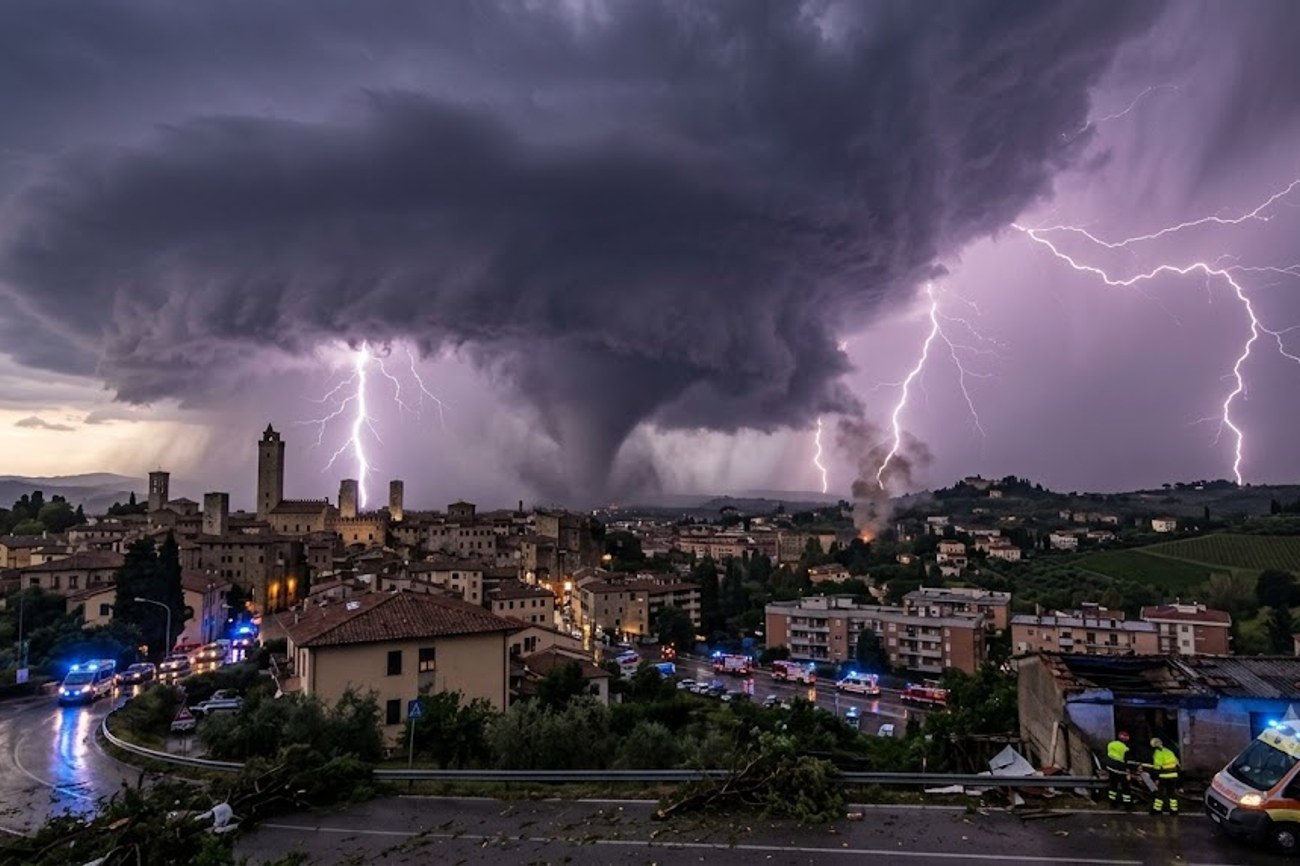
Image generated by AI
63,000 lightning strikes detonated across Tuscany in a mere 12-hour window, signaling a violent atmospheric shift that paralyzed one of Italy's most vital tourism corridors. This was not a standard seasonal storm but a concentrated meteorological event characterized by the development of a mesocyclone—a rotating supercell—that unleashed torrential rain and tornado-like phenomena across central Italy.
The Mechanics of the Tuscan Mesocyclone
The weather event of September 9–10, 2026, was defined by its intensity and geographic breadth. While lightning was the most visually striking element, the structural cause was a mesocyclone that intensified over the Tuscany region. This rotating storm system created a cascade of failures across urban and rural infrastructure. The impact was most acute in Grosseto, where rainfall totals hit approximately 115 millimetres, leading to the inundation of basements, residential flats, and critical underpasses.
The volatility of the system meant that the damage was not localized to a single city. The storm's path of destruction stretched from the coastal areas of Viareggio and Elba to the inland hubs of Florence and Sinalunga. In Sinalunga, the atmospheric instability culminated in a tornado or tornado-like event, which resulted in severe structural damage and one fatality. This pattern of "cell-based" destruction—where specific pockets of a region experience catastrophic failure while others remain relatively untouched—creates a logistical nightmare for emergency responders and travelers alike.
Infrastructure Collapse and Casualty Data
The scale of the crisis required more than 200 emergency interventions as crews struggled to clear fallen trees and rescue motorists trapped in rising waters. The human cost of the wider weather system extended beyond Tuscany into northern Italy, claiming two lives. In Friuli-Venezia Giulia, specifically within Latisana, an 83-year-old woman drowned after her vehicle became trapped in a flooded underpass.
The disruption extended deep into the transport and leisure sectors. Because the storm hit the "tourism golden triangle" of Florence, Siena, and the Tuscan coast, the economic ripple effects were immediate. The following table outlines the specific closures and suspensions that halted visitor movement:
| Location/Asset | Status | Impact Type |
|---|---|---|
| Boboli Gardens (Florence) | Closed | Public Safety/Infrastructure |
| Royal Stables Gardens (Florence) | Closed | Public Safety/Infrastructure |
| Florence Regulated Gardens/Parks | Closed | Public Safety/Infrastructure |
| Arno Riverside Cycle Paths | Closed | Flood Risk |
| Cascine T1 Tram Stop | Suspended | Transit Disruption |
| Viareggio Passeggiata | Temporarily Closed | Coastal Hazard |
| Chianti Outdoor Events | Cancelled | Weather Volatility |
| Tuscany Regional Parks/Archaeological Sites | Temporarily Closed | Safety Risk |
Beyond these specific closures, the Italian Civil Protection Department issued high-level alerts across a broad swathe of the country, including Lombardy, Veneto, Emilia-Romagna, Liguria, and Friuli-Venezia Giulia. This regional synchronization of severe weather meant that rail networks in northern Italy faced significant delays, complicating multi-city itineraries for international visitors.
Expert Analysis: The "Volatility Tax" on Luxury Tourism
For the seasoned traveler and the hospitality operator, this event highlights a growing "volatility tax" affecting the Mediterranean basin. Tuscany is not merely a destination; it is a high-yield economic engine for Italy. When a mesocyclone shuts down the Boboli Gardens or suspends the T1 tram in Florence, the loss is not just in ticket sales, but in the operational fluidity of the entire region.
For travelers booking these routes, the direct consequence is a shift in the reliability of "last-mile" logistics. While international flights into hubs like Florence or Pisa may remain operational, the regional rail and private transfer networks—which connect visitors to rural villas and vineyards—are the first to fail during these events. The reliance on rental cars in Tuscany becomes a liability when underpasses in cities like Grosseto flood rapidly, as seen with the 115mm rainfall spike.
The pricing pressure created by these events often manifests in "surge" demand for remaining open attractions or a sudden spike in private transport costs as public options like the T1 tram fail. Furthermore, the closure of archaeological sites and regional parks indicates that the Ministry of Culture is increasingly prioritizing risk mitigation over tourist access. We are seeing a transition where "shoulder season" travel is no longer a guarantee of stability, but a gamble against increasingly erratic atmospheric patterns.
Key Takeaways
- Extreme Atmospheric Activity: 63,000 lightning strikes in 12 hours and a mesocyclone caused widespread disruption across Tuscany on September 9–10, 2026.
- Critical Infrastructure Failure: Over 200 emergency interventions were required to manage flooding, fallen trees, and tornado damage, particularly in Grosseto (115mm rain) and Sinalunga.
- Widespread Closures: Major Florence landmarks, including Boboli Gardens and the Arno cycle paths, were shuttered, while the T1 tram service faced suspensions.
- Regional Contagion: The weather system affected six major regions, including Lombardy and Veneto, leading to rail disruptions and two fatalities in Latisana and Sinalunga.
- Traveler Risk: Rental car users are particularly vulnerable to flash flooding in underpasses, while outdoor-centric itineraries in Chianti and Viareggio are subject to sudden cancellation.
FAQ: Tuscany Severe Weather 2026
Are flights to Florence and Pisa still operating? Yes, the disruption was primarily regional and ground-based. While local transport and specific attractions closed, major airports typically remain operational unless wind speeds exceed safety thresholds. Check your carrier's app for real-time updates.
Can I still visit the museums in Florence? Indoor museums generally remain open, but outdoor sites like the Boboli Gardens and Royal Stables Gardens were closed for safety. Always verify the current status of "regulated gardens" via official city portals.
Is it safe to drive a rental car in Tuscany during these alerts? Exercise extreme caution. With rainfall reaching 115mm in some areas, underpasses and low-lying roads flood rapidly. Avoid flood-prone zones and follow directions from the Italian State Police.
How do I check for rail delays in Northern Italy? Regional rail disruptions were reported across Lombardy and Veneto. Use the official Trenitalia or Italo apps to monitor real-time delays and cancellations for multi-city journeys.
When the atmosphere turns violent, the luxury of a curated itinerary vanishes, leaving only the raw necessity of logistical agility.
Tags: Tuscany Storm 2026, Florence Infrastructure, Mesocyclone Italy, Grosseto Flooding, Italian Civil Protection, Sinalunga Tornado
Related Travel Guides
- New Zealand Travel Boom As Overseas Visitors Beat Pre COVID Records For First Time In July 2026
- Brazil Joins Colombia and More as Vive Lima 2026 Targets Longer Stays and Stronger Peru Urban Tourism Growth: What You Need to Know
- US Overtakes Other Countries as Dominican Republic Tourism Boom Reaches Record 8.5 Million Visitors in 2026
Disclaimer
This article is for informational and educational purposes only. It does not constitute legal, financial, or professional advice. While we strive to provide accurate and up-to-date information, travel policies, regulations, and conditions change rapidly. Always verify information with official sources before making travel decisions. Nomad Lawyer makes no representations about the accuracy, reliability, completeness, or suitability of the information provided. Readers should consult qualified professionals for advice specific to their circumstances. The views expressed in this article are those of the author and do not necessarily reflect the views of Nomad Lawyer.
Preeti Gunjan
Contributor & Community Manager
A passionate traveller and community builder. Preeti helps grow the Nomad Lawyer community, fostering engagement and bringing the reader experience to life.
Learn more about our team →