Germany Issues Strict Travel Advisory for Poland and Portugal: Border Checks, Infrastructure Laws, and Weather Warnings

Germany's Federal Foreign Office has issued a comprehensive, dual-focused travel advisory for travelers journeying across Central and Southern Europe, placing heightened scrutiny on cross-border transits into Poland and severe weather disruptions alongside urban theft risks in Portugal. Released on November 11, 2026, the diplomatic bulletin warns European travelers, cross-border commuters, commercial logistics haulers, and dual nationals that conventional frictionless travel across Schengen zones is temporarily superseded by systematic internal border controls, stringent national security statutes, and atmospheric crises. In Poland, dynamic border enforcement along the German and Lithuanian frontiers coincides with massive Independence Day demonstrations in Warsaw, strict bans on critical infrastructure photography, and tight controls along external frontiers with Ukraine and Belarus. Concurrently in Portugal, top-tier red weather warnings have paralyzed metropolitan transit and shuttered schools across Lisbon, while tourist property crime and complex post-Brexit United Kingdom airport transit regulations present serious logistical hurdles. Travelers moving across both regions must maintain strict document compliance, exercise heightened vigilance, and adapt their itineraries to emerging security and environmental directives.
The diplomatic alert released by Berlin's Auswärtiges Amt underscores a fundamental shift in European regional mobility. As geopolitical friction, domestic celebrations, and volatile meteorological systems converge, the operational realities of intra-European transit require thorough preparation. Travelers can no longer rely on unexamined open-border transit corridors or informal travel practices. From mandatory identification checks for minors to strict prohibitions on capturing images of transport junctions and banking headquarters, the German advisory establishes precise guidelines to protect travelers from legal sanctions, transit delays, and personal vulnerabilities.
GERMANY TRAVEL ADVISORY: KEY OPERATIONAL HIGHLIGHTS
| Entity / Route | Metrics | Operational Status |
|---|---|---|
| REGION | CORE ADVISORY FOCUS | PRIMARY RISKS & RESTRICTIONS |
| Poland | Internal Schengen Checks | Dynamic police inspections on German/Lithuanian |
| Independence Day Rallies | borders; Warsaw road closures; drone/firework ban | |
| Critical Infrastructure Ban | Strict criminal ban on photographing bridges/rail | |
| Eastern Border Limitations | Limited crossings to Belarus; weight caps Ukraine | |
| Portugal | Maximum Red Weather Alerts | Tagus ferries suspended; highway/rail washouts |
| Urban Property Crime | Pickpocketing in Lisbon/Porto; rental car thefts | |
| Consular Document Rules | 1957 Council treaty vs. airline photo ID mandates | |
| UK Transit Connection Risks | Passports required for UK transit; no ID cards |
Germany Updates European Travel Advisories Amid Heightened Security and Regional Crises
The German Federal Foreign Office routinely coordinates with international diplomatic missions, intelligence bodies, and transport ministries to evaluate travel safety across the European continent. The November 11, 2026 advisory stands out because it addresses two distinct geographical and regulatory challenges within the European Union: Central European security adjustments in Poland and acute environmental and urban safety hazards in Portugal.
In Central Europe, Poland has emerged as a focal point of regional administrative and security enforcement. The Polish state is managing overlapping demands, including major public holiday rallies in Warsaw, ongoing migration control measures, critical infrastructure protection mandates, and tight surveillance along its eastern boundaries facing Belarus and Ukraine. The German advisory makes clear that German citizens, EU residents, and international tourists must respect local statutes, observe municipal restrictions, and carry non-negotiable legal documentation across every transit sector.
Simultaneously, Portugal faces an acute double challenge on the southwestern edge of the continent. Atmospheric river patterns and deep Atlantic depressions have forced Portuguese authorities to issue maximum red weather warnings across the central and coastal provinces, closing public administrative offices, canceling river ferries, and severing key rail segments. In parallel, consular authorities highlight persistent property crime in high-density tourist centers across Lisbon and Porto, alongside serious documentation complications for travelers booking return flights that transit through airports in the United Kingdom following Brexit.
Polish Independence Day Mobilization: Warsaw Rallies, Route Closures, and Public Safety Mandates
On Wednesday, November 11, 2026, Poland commemorates its National Independence Day (Narodowe Święto Niepodległości), marking the restoration of Poland's sovereignty in 1918 after 123 years of partition. The holiday triggers nationwide patriotic demonstrations, official military ceremonies, and mass civilian marches across all major Polish municipalities. The primary focal point of these public gatherings is the capital city of Warsaw, where municipal authorities and national security services deploy comprehensive crowd control and public security protocols.
Central March Routing and Temporal Windows
The headline event of the holiday is the annual Warsaw Independence March (Marsz Niepodległości), which draws tens of thousands of participants from across the country and abroad. The procession follows a fixed urban route and operating timeline:
- Assembly and Launch: Demonstrators begin assembling during the late morning around the central perimeter of the Palace of Culture and Science (Pałac Kultury i Nauki) and Plac Defilad. The official procession starts marching at approximately 2:00 PM.
- Transit Axis: The march proceeds east along Aleje Jerozolimskie, moving past major central rail and commercial hubs.
- Vistula Crossing: The procession crosses the Vistula River via the Poniatowski Bridge (Most Poniatowskiego), which is closed entirely to civilian vehicular and public transport traffic.
- Culmination Point: The march concludes at the PGE Narodowy (National Stadium) complex on the eastern bank of the river between 5:30 PM and 6:00 PM, where musical performances, speeches, and patriotic gatherings continue well into the evening hours.
WARSAW INDEPENDENCE DAY MARCH CORRIDOR (NOV 11, 2026)
| Column 1 |
|---|
| [Palace of Culture & Science] ---> [Aleje Jerozolimskie] ---> [Poniatowski Bridge] ---> [PGE Narodowy] |
| (Assembly: 11:00 AM - 1:30 PM) (March Window: 2:00 PM) (Bridge Closed: Full Day) (Arrival: 5:30 PM) |
Urban Transit Gridlock and Municipal Security Regulations
The execution of the Independence March and related state ceremonies generates severe municipal transport disruptions throughout central Warsaw. Arterial boulevards, including Marszałkowska, Świętokrzyska, and Aleje Jerozolimskie, experience extended vehicular blockades. The Warsaw Public Transport Authority (ZTM) implements sweeping detours, truncations, and suspensions across urban bus routes and tram corridors connecting the eastern and western districts of the capital. Commuters and travelers attempting to reach Warszawa Centralna railway station or Warsaw Chopin Airport (WAW) are strongly advised to utilize the underground Metro line (Metro Warszawskie), which operates with reinforced frequency while bypassing surface street gridlock.
To ensure public safety throughout the mass gatherings, Warsaw municipal authorities and Polish internal security agencies enforce strict administrative prohibitions:
- Complete Pyrotechnic and Weapons Ban: The possession, open carriage, or ignition of flares, smoke canisters, firecrackers, and any pyrotechnic devices is strictly illegal along the procession route and across surrounding public squares. Weapons, replica firearms, and sharp tactical implements are fully prohibited.
- Airspace and Drone Restrictions: The Polish Air Navigation Services Agency (PANSA) and municipal police enforce a total exclusion zone for unauthorized unmanned aerial vehicles (UAVs) and hobbyist drones across the entire urban expanse of Warsaw. Unauthorized flights risk electronic signal interception, physical downing, and criminal prosecution.
- Real-Time Municipal Information: Travelers in Warsaw, Kraków, Poznań, Wrocław, and Gdańsk should monitor Polish municipal media, the Warsaw Municipal Contact Center (Miejskie Centrum Kontaktu Warszawa 19115), and official police social channels for live alerts regarding spontaneous road closures and crowd concentrations.
Reinforced Internal Schengen Borders: Polish-German and Polish-Lithuanian Checkpoint Operations
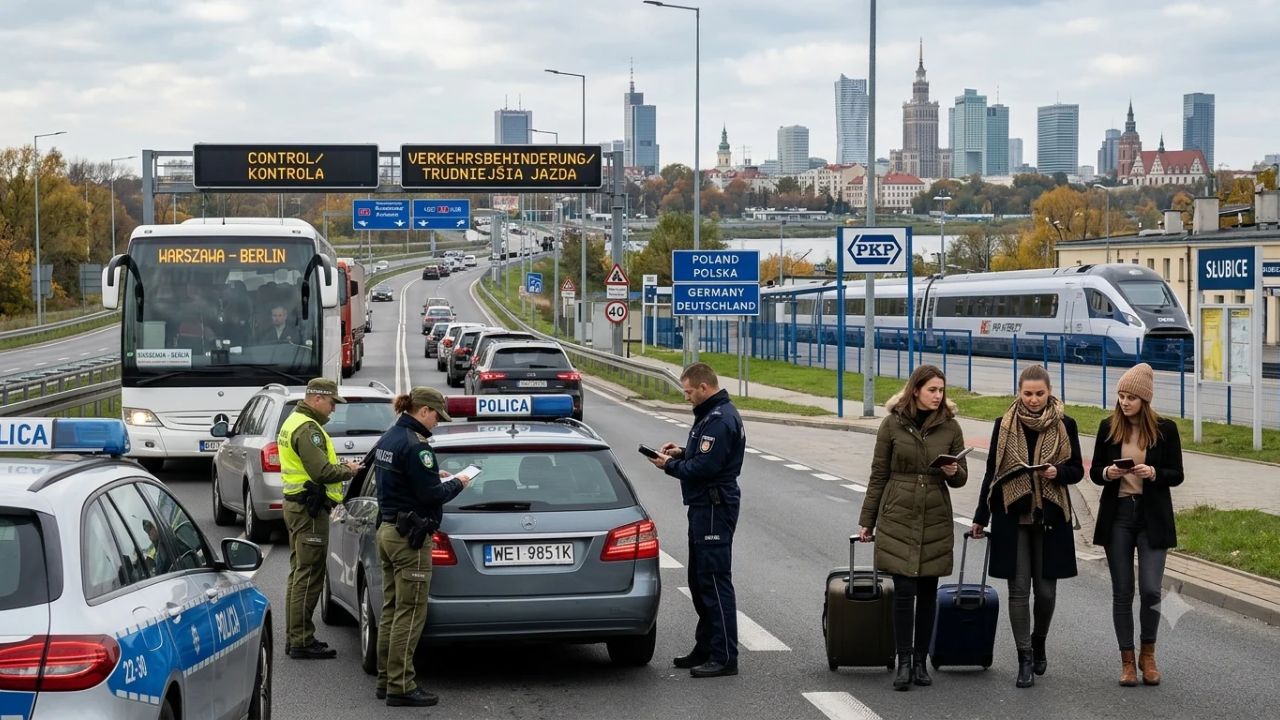
While the Schengen Agreement traditionally provides for border-free travel between participating European nations, European Union regulations permit member states to reintroduce temporary internal border controls in response to serious threats to public policy or internal security. Since July 2025, Poland has maintained systematic border control operations along its internal European frontiers with Germany and Lithuania.
Dynamic, Unscheduled Police Enforcement
Enforcement along the Polish-German and Polish-Lithuanian borders does not follow fixed, predictable timetables. Instead, the Polish Border Guard (Straż Graniczna), operating in close coordination with the German Federal Police (Bundespolizei) and Lithuanian authorities, deploys mobile and flexible screening units:
- Geographic Deployment: Inspections take place directly on major motorway border crossing points—such as the A2 motorway crossing at Świecko/Frankfurt (Oder), the A4 crossing at Jędrzychowice/Görlitz, and the A6 corridor at Kołbaskowo/Pomellen—as well as on secondary regional roads, international rail services, and long-distance cross-border buses.
- Spot-Check Methodology: Border officials utilize targeted, risk-based vehicle profiling and random interception tactics. Commercial freight vehicles, passenger vans, and private automobiles are directed into specialized inspection bays, causing variable traffic congestion and delays ranging from twenty minutes to several hours during peak transit periods.
POLISH INTERNAL SCHENGEN BORDER MONITORING FRAMEWORK
| SECTOR | CHECKPOINT EXAMPLES | ENFORCING AGENCIES | TYPICAL DELAYS |
|---|---|---|---|
| Polish-German | Świecko / Frankfurt (Oder) | Straż Graniczna & | 30 to 180 mins |
| Frontier | Jędrzychowice / Görlitz | Bundespolizei | (Peak freight) |
| Kołbaskowo / Pomellen | Mobile Inspection Units | ||
| Polish-Lithuanian | Budzisko / Kalvarija | Straż Graniczna & | 20 to 90 mins |
| Frontier | Ogrodniki / Lazdijai | Lithuanian Border Police | (Targeted checks) |
Mandatory Personal Identification and Vehicle Documents
A widespread traveler misconception is that the absence of permanent physical border booths allows individuals to travel without formal travel credentials. German authorities emphasize that internal Schengen border checks require mandatory identification for every person entering or exiting Polish territory:
- Individual Documentation: Every single passenger in a vehicle, including infants, children, and teenagers, must possess a currently valid passport or government-issued national identity card (Personalausweis). Driver's licenses, student cards, health insurance cards, and digital phone scans are not accepted as valid legal identity credentials at border checkpoints.
- Vehicle Papers: Drivers must carry their valid domestic driver's license, the original vehicle registration certificate, and proof of third-party motor liability insurance. If operating a leased, rented, or company-owned vehicle, the driver should carry an official written authorization letter from the registered owner or leasing agency permitting cross-border use.
Severe Criminal Sanctions for Facilitating Unauthorized Transit
Polish statutory law imposes severe criminal penalties on individuals who assist, facilitate, or organize the unauthorized crossing of state borders. Under Article 264 of the Polish Penal Code (Kodeks karny), anyone who organizes or aids others in illegally crossing the Polish border faces custodial sentences of up to eight years of imprisonment:
- Warning Against Hitchhikers: International drivers, vacationers, and commercial truckers are expressly warned against picking up unknown hitchhikers, stranded individuals, or informal travelers near border sectors or highway service plazas.
- Legal Responsibility: If a driver transports foreign nationals who lack valid legal entry credentials or Schengen visas across the border, law enforcement authorities may classify the act as human smuggling or facilitation of irregular transit. This triggers immediate vehicle impoundment, extensive police interrogation, heavy monetary fines, and formal criminal indictments.
Poland's Critical Infrastructure Photography Prohibition: Legal Statutes, Enforced Zones, and Penalties
A major legal reform enacted by the Polish government in April 2025 has altered the regulatory environment for tourists, photographers, railway enthusiasts, and transit operators. Under amended national defense and counter-intelligence statutes, capturing photographs, video recordings, or detailed technical imagery of designated critical and strategic infrastructure across Polish territory is strictly prohibited.
POLISH CRITICAL INFRASTRUCTURE PHOTOGRAPHY RESTRICTIONS
| FACILITY CATEGORY | EXAMPLES OF RESTRICTED SITES | STATUTORY PENALTIES |
|---|---|---|
| Defense & Security | Military bases, barracks, test sites | Equipment confiscation |
| Strategic reserve supply depots | Immediate police detention | |
| Maritime & Logistics | Commercial seaports (Gdańsk, Gdynia) | Substantial monetary fines |
| Rail junctions, classification yards | Formal criminal records | |
| Transportation Networks | Bridges, viaducts, highway tunnels | Custodial prison terms under |
| Border checkpoint structures | State Security Legislation | |
| Financial Institutions | National Bank of Poland (NBP) sites | Questioning by Internal Security |
| Bank Gospodarstwa Krajowego (BGK) | Agency (Agencja Bezpieczeństwa W.) |
Broad Scope of Restricted Facilities
The statutory prohibition covers an extensive inventory of public and industrial installations across the country:
- Military and Strategic Reserves: All active military barracks, training grounds, radar installations, munitions depots, defense manufacturing facilities, and strategic material reserve storehouses managed by the Governmental Strategic Reserves Agency (RARS).
- Logistics and Freight Hubs: Major commercial seaports—including terminal facilities at Gdańsk, Gdynia, Szczecin, and Świnoujście—international freight distribution hubs, railway classification yards, fuel pipeline terminals, and central pumping stations.
- Transport Infrastructure: Strategic river bridges, railway viaducts, highway tunnels, border security installations, signaling control towers, and international passenger rail platforms.
- Financial and Government Centers: Key administrative headquarters, including operational vaults and regional distribution offices of the National Bank of Poland (Narodowy Bank Polski - NBP) and the state development bank, Bank Gospodarstwa Krajowego (BGK).
Signage Vulnerabilities and Legal Enforcement
Under the governing legislation, facilities subject to the photography prohibition should display an official standardized warning sign depicting a crossed-out camera surrounded by formal legal statutory references. However, the German advisory alerts travelers that practical field conditions present serious risks:
- Subtle and Weathered Markings: In many regional areas, warning signs are modest in size, weathered by exposure, partially obscured by vegetation, or affixed only to primary administrative entrance gates rather than along continuous perimeter fencing.
- Risk for Unwitting Travelers: A tourist standing on a public river embankment photographing a scenic city bridge, or a passenger filming out of a train window approaching a major railway junction, may unintentionally capture restricted installations.
- Immediate Enforcement: Polish law enforcement agencies, military police (Żandarmeria Wojskowa), and internal security agents enforce the statute strictly. Individuals observed photographing restricted facilities face immediate detention, on-the-spot confiscation of cameras, smartphones, and memory storage media, substantial financial penalties, and criminal investigations for potential espionage or unauthorized intelligence gathering. Travelers are strongly advised to keep cameras and recording devices stored away whenever in the vicinity of industrial, transport, or administrative installations.
Transit Realities on Poland's Eastern Perimeters: Ukraine and Belarus Border Regimes
Poland's external borders represent the eastern boundary of both the European Union and the Schengen Area. The operational protocols governing crossings into Ukraine and Belarus differ sharply, reflecting regional geopolitical realities and European sanctions frameworks.
Ukrainian Border Corridors: High Traffic and Technical Restrictions
The Polish-Ukrainian border continues to function as an active corridor for passenger transit, commercial trade, and humanitarian logistics. Checkpoints such as Korczowa/Krakovets, Dorohusk/Yahodyn, Medyka/Shehyni, and Hrebenne/Rava-Ruska maintain round-the-clock operations in both directions:
- Queue Variations: Wait times at major border crossings fluctuate significantly based on cargo processing volumes, power outages, and customs procedures. Passenger buses and private cars should anticipate processing windows ranging from two to ten hours.
- Gross Vehicle Weight Enforcement: Polish customs and transport authorities enforce strict structural weight-limit classifications. Vehicles exceeding specified gross axle weight ratings or permissible total weight limits (Dopuszczalna Masa Całkowita - DMC) are barred from regional secondary checkpoints and rerouted exclusively to dedicated heavy-freight terminals.
POLAND - BELARUS ACTIVE BORDER CROSSING CORRIDORS
| Entity / Route | Metrics | Operational Status |
|---|---|---|
| CHECKPOINT NAME | TRAFFIC CATEGORY ALLOWED | SPECIAL RESTRICTIONS & LEGAL CONDITIONS |
| Terespol | Passenger cars & Scheduled buses | Primary active passenger crossing hub |
| Bobrowniki | Commercial freight & Passengers | Reopened with restricted throughput lanes |
| (EU/EEA/EFTA/CH trucks only) | Non-EU registered commercial trucks banned | |
| Kuźnica | Passenger cars only | Strictly closed to bus & coach operations |
| Kukuryki | Heavy commercial freight | Operational for all eligible cargo haulers |
Belarusian Border Closures and Concentrated Checkpoints
Transit across the Polish-Belarusian frontier is subject to extensive diplomatic, sanctions, and security measures. A significant majority of historic border crossing points remain suspended, channeling all passenger and commercial movements through a minimal number of heavily fortified facilities:
- Passenger Flow Concentration: Civilian passenger traffic is restricted to three operational checkpoints: Terespol, Bobrowniki, and Kuźnica. Travelers must note that Kuźnica is closed entirely to passenger buses and coach services, leaving Terespol as the primary conduit for international coach routes.
- Freight Bottlenecks: Commercial freight movement is routed through the Kukuryki terminal (connecting with Kozłowicze on the Belarusian side) for broad commercial cargo, and the Bobrowniki crossing, which is legally restricted to commercial transport trucks registered within member states of the European Union, the European Economic Area (EEA), the European Free Trade Association (EFTA), and Switzerland.
Sanctions Compliance for Belarus- and Russian-Registered Vehicles
Stringent sanctions protocols govern the entry of private motor vehicles originating from eastern non-EU states:
- Belarus-Registered Passenger Vehicles: In compliance with tightened anti-circumvention measures introduced in 2024, personal passenger cars bearing Belarusian license plates may cross into Polish territory only if the registered individual owner is physically present inside the vehicle. Third-party driving authorizations, commercial leases, and corporate loan agreements are invalid for border entry.
- Total Ban on Russian-Registered Passenger Vehicles: In accordance with coordinated EU sanctions implemented in 2023, motor vehicles registered in the Russian Federation are barred from entering Poland. Polish border guards refuse entry to all Russian-plated passenger vehicles, regardless of the nationality, residency status, or visa credentials of the driver, subject only to narrowly defined statutory consular exemptions.
Poland Customs, Monetary Declarations, and Motor Vehicle Re-Registration Rules
Entering Poland from Germany involves specific administrative regulations governing acceptable travel documentation, monetary holdings, cultural goods, and long-term vehicular operation.
Document Standards and Dual Nationality Provisions
German citizens traveling to Poland may enter using any of the following valid documents:
- Standard National Passport (Reisepass)
- Temporary Passport (Vorläufiger Reisepass)
- Standard National Identity Card (Personalausweis)
- Temporary Identity Card (Vorläufiger Personalausweis)
- Official Child Passport (Kinderreisepass)
Every travel document must remain valid for the entire duration of the planned visit. Expired identity documents are invalid for entry into Poland.
POLAND CUSTOMS, CURRENCY, AND EXCISE SUMMARY
| Entity / Route | Metrics | Operational Status |
|---|---|---|
| CATEGORY | LEGAL REGULATION / ALLOWANCE | COMPLIANCE REQUIREMENT |
| Currency Reporting | Threshold: €10,000 or equivalent | Mandatory written customs form |
| Pre-1945 Cultural Goods | Works of art, books, furniture | Official permit from Heritage Min. |
| Intra-EU Tobacco Inbound | Re-entry to Germany from Poland | Maximum 800 cigarettes per adult |
| Non-EU Border Tobacco | Inbound Poland via Kaliningrad | Strictly capped at 40 cigarettes |
| Non-EU Border Spirits | Inbound Poland via Kaliningrad | Maximum 1 liter exceeding 22% ABV |
A critical legal nuance highlighted by the German Foreign Office involves dual German-Polish citizens. Under Polish citizenship statutes, an individual who holds Polish citizenship is treated exclusively as a Polish citizen on Polish soil. Dual nationals cannot invoke their German citizenship to circumvent Polish administrative or legal obligations. When entering Poland, clearing border controls, or interacting with Polish law enforcement, dual nationals must carry and present valid Polish identity documentation (Polish passport or dowód osobisty).
Financial Declarations, Antiquities, and Excise Limits
Cross-border travelers must comply with EU financial monitoring and cultural heritage export controls:
- Cash Declaration Mandate: Any individual entering or leaving Poland while carrying €10,000 or more in physical currency, banknotes, traveler's checks, or readily negotiable securities must submit a written currency declaration to customs officials upon arrival.
- Antiquities and Historic Objects: Under Polish heritage protection laws, cultural artifacts, antique furniture, rare manuscripts, historical books, and works of art created prior to 1945 require dedicated official export permits issued by the Polish Ministry of Culture and National Heritage before they can be legally transported out of Poland.
- Excise Allowances: When returning to Germany after purchasing goods in Poland, travelers may transport up to 800 cigarettes under intra-EU personal consumption guidelines. However, if a traveler enters Poland directly from a non-EU territory (such as across the border from the Kaliningrad exclave), the duty-free allowance drops sharply to 40 cigarettes and one liter of distilled spirits with an alcohol content exceeding 22% ABV.
Long-Term Motor Vehicle Licensing Requirements
German citizens who relocate to Poland for extended periods—such as for university studies, contractual employment, or permanent residency—must formalize their vehicle status. A foreign-registered passenger car may only be operated on foreign plates on a temporary, visiting basis:
- Mandatory Re-Registration: Once an individual establishes habitual residency in Poland, their vehicle must be registered at the appropriate district vehicle licensing office (Wydział Komunikacji) to obtain Polish license plates.
- Documentation Retained: During the re-registration process, the local Polish licensing authority permanently retains Part I of the German vehicle registration document (Zulassungsbescheinigung Teil I).
- Mandatory Insurance: The vehicle owner must provide verifiable proof of Polish third-party civil liability motor insurance (ubezpieczenie odpowiedzialności cywilnej - OC), as foreign policies without valid international endorsements are insufficient for domestic registration.
Portugal Under Maximum Weather Warnings: Storm Disruptions, Inundations, and Atlantic Surges
While Central Europe addresses border operations and national security legislation, Portugal faces severe environmental disruption on the Atlantic coast. The Portuguese Institute for Sea and Atmosphere (Instituto Português do Mar e da Atmosfera - IPMA) has issued its highest alert level—a maximum Red Weather Warning (Aviso Vermelho)—across multiple central and coastal districts, encompassing the metropolitan capital region of Lisbon.
PORTUGAL MAXIMUM WEATHER ALERT IMPACT MATRIX
| Entity / Route | Metrics | Operational Status |
|---|---|---|
| SECTOR | OPERATIONAL DISRUPTION | PUBLIC SAFETY INSTRUCTION |
| Public Administration | Schools, universities, government | Citizens advised to remain indoors |
| & Education | offices closed across red zones | Remote administrative services only |
| River & Maritime Transit | Tagus River ferries suspended | Commuters diverted to bridge rail; |
| (Cacilhas, Seixal, Montijo routes) | Avoid all riverbank perimeters | |
| Heavy Rail & Highways | Urban train tracks flooded; | Significant scheduling cancellations |
| Coastal highways closed by mud | Seek elevated inland detours | |
| Ocean Perimeters | 7-10 meter storm waves; | Absolute exclusion zone for beaches |
| Severe rip currents and surges | Stay clear of promenades/sea walls |
Inundations, Public Closures, and Urban Transport Breakdown
The severe weather system has brought torrential rainfall and wind gusts exceeding 110 kilometers per hour, overwhelming municipal drainage systems across Lisbon, Setúbal, and the central coastline:
- Institutional Closures: Regional civil protection authorities have enacted emergency protocols, ordering the closure of public schools, universities, municipal daycare centers, and public administrative offices across the affected red-alert districts.
- Waterway Transit Suspensions: Commuter ferry services connecting Lisbon to the southern bank of the Tagus River—operated by Transtejo Soflusa across routes including Cacilhas, Seixal, Barreiro, and Montijo—have been suspended due to hazardous water conditions and gale-force docking turbulence.
- Rail and Road Waterlogging: Suburban rail services operated by Comboios de Portugal (CP) and Fertagus face extensive cancellations and speed restrictions as low-lying tracks experience flash flooding. Coastal highway links and riverfront roadways, including segments of Lisbon's Avenida 24 de Julho and Avenida Ribeira das Naus, have been closed due to standing water and falling debris.
Marine Hazards and Atlantic Ocean Surges
The Portuguese National Authority for Emergency and Civil Protection (ANEPC) has issued an urgent warning to international visitors and residents concerning ocean hazards:
- Rogue Waves and Ocean Swells: Deep ocean depressions are generating coastal waves between seven and ten meters in height. These conditions create dangerous rogue waves capable of sweeping bystanders off rocky outcroppings, sea walls, and harbor jetties.
- Coastal Exclusion: Tourists in Cascais, Cabo da Roca, Peniche, Nazaré, and the Algarve coastline are urged to avoid sandy beaches, coastal hiking paths, and shoreline viewing decks. Approaching the water's edge for photography during red alert conditions poses an immediate risk to life.
Urban Property Crime and Nightlife Security in Lisbon and Porto
In addition to weather-related hazards, the German Foreign Office advisory highlights street crime and property theft targeting foreign visitors in Portugal's major urban centers. Although violent crime remains rare throughout the country, professional pickpocketing syndicates and opportunistic theft networks operate actively across popular tourist districts in Lisbon and Porto.
PORTUGAL TOURIST THEFT & CRIME RISK PROFILE
| Entity / Route | Metrics | Operational Status |
|---|---|---|
| CITY / DISTRICT | HIGH-RISK ZONES | COMMON THEFT MODUS OPERANDI |
| Lisbon | Baixa, Chiado, Alfama, | Pickpocketing in packed tram carriages |
| Metropolitan Area | Praça do Comércio, Tram 28 | Distraction theft at outdoor dining tables |
| São Jorge Castle quarter, Metro | Luggage theft at airport metro connections | |
| Porto | Ribeira riverfront district, | Bag snatching in narrow alleys |
| Historic Center | São Bento Railway Station, | Thefts from patrons at open-air wine bars |
| Clérigos Tower surroundings | Station platform pickpocketing | |
| Coastal & Scenic | Beach car parks (Cascais/Sintra) | Vehicular smash-and-grab break-ins |
| Viewpoints | Miradouro overlooks, Algarve | Theft from rental villas & ground-floor apts |
Lisbon's High-Density Theft Centers
In Lisbon, organized pickpocketing rings operate in transit hubs and crowded historic districts:
- Historic Tram Lines: The celebrated historic Tram 28 (Eléctrico 28) and Tram 15 remain prime operational territory for skilled pickpockets. Thieves work in coordinated teams of three or four, using artificial crowding during boarding and exiting to lift wallets, smartphones, and passports from jackets and unzipped backpacks.
- Commercial Squares and Metros: High concentrations of opportunistic theft occur around Praça do Comércio, Rossio, Rua Augusta, and the steep alleys of Alfama and the São Jorge Castle quarter. Metro stations—particularly Baixa-Chiado, Cais do Sodré, and Martim Moniz—experience regular luggage and purse snatching incidents.
Porto Old Town Vulnerabilities
In northern Portugal, the city of Porto shows similar theft patterns across its historic core:
- Ribeira and Riverside Hubs: The narrow alleys and crowded riverfront promenades of the Ribeira district, along with outdoor seating areas near the Dom Luís I Bridge, are frequented by distraction thieves.
- Transit Terminals: São Bento Railway Station and Campanhã Station see frequent thefts targeting travelers carrying luggage or boarding intercity trains.
Nightlife Spiking Hazards and Vehicular Break-Ins
Travelers in recreational and nightlife hubs face additional safety considerations:
- Drink Tampering and Overcharging: In nightlife districts such as Lisbon's Bairro Alto and Cais do Sodré (Pink Street), as well as Porto's Galerias de Paris, travelers should never leave beverages unattended. Instances of beverage spiking with incapacitating substances (date rape drugs) have been reported, followed by robbery or sexual assault. In addition, certain late-night bars engage in fraudulent overcharging, manipulating handheld payment terminals to charge exorbitant sums to intoxicated patrons.
- Rental Car Smash-and-Grabs: Rental vehicles are easily identifiable by registration barcodes and model types. Thieves target parked vehicles near coastal beaches (such as Costa da Caparica, Guincho, and Sintra's beaches), scenic viewpoints (miradouros), and open public lots. Leaving bags, jackets, phone charging cords, or GPS mounts in view invites rapid vehicular break-ins.
- Vacation Rental Burglaries: Unattended ground-floor tourist apartments, private holiday villas, and short-term vacation rentals in coastal resort areas are vulnerable to daylight burglaries through unsecured terrace doors and windows.
Consular Entry Nuances, Document Rules, and Post-Brexit UK Transit Pitfalls for Portugal
Entry requirements for German citizens visiting Portugal are governed by multilateral agreements and domestic border policies. While travel within the EU is generally straightforward, specific document and transit rules require careful attention.
The 1957 Council of Europe Agreement and Document Validity
Under the European Agreement on Regulations Governing the Movement of Persons between Member States of the Council of Europe (1957), German citizens can enter Portugal with:
- Standard National Passport (Reisepass)
- Temporary Passport (Vorläufiger Reisepass)
- Standard National Identity Card (Personalausweis)
- Temporary Identity Card (Vorläufiger Personalausweis)
- Legacy Child Passport (Kinderreisepass)
PORTUGAL ENTRY DOCUMENT REGULATIONS FOR GERMAN TRAVELERS
| DOCUMENT TYPE | TREATY VALIDITY RULE | AIRLINE BOARDING PREREQUISITE |
|---|---|---|
| Standard German Passport | Accepted if expired within past | Airlines demand strictly valid, |
| (Reisepass) | 12 months (1957 Treaty) | unexpired photo identification |
| Standard German ID Card | Accepted if expired within past | Airlines demand strictly valid, |
| (Personalausweis) | 12 months (1957 Treaty) | unexpired photo identification |
| Temporary ID Card | Must be strictly valid; | Airlines demand strictly valid, |
| (Vorläufiger Perso.) | No expiration grace period | unexpired photo identification |
| Child Passport | Issuance halted Jan 2024; legacy | Must remain unexpired at time |
| (Kinderreisepass) | documents honored until expiry | of commercial flight boarding |
A distinctive provision of the 1957 treaty allows German standard passports and national identity cards that have expired within the preceding 12 months to remain legally valid for entry into Portugal. However, two critical caveats apply:
- Temporary ID Cards Excluded: Temporary identity cards (Vorläufige Personalausweise) must be valid at the time of entry; the 12-month extension does not apply to them.
- Discontinued Child Passports: Germany ceased issuing new Child Passports (Kinderreisepässe) in January 2024, replacing them with standard biometric passports. However, previously issued child passports remain legally recognized across Portugal until their recorded expiration date.
Airline Boarding Conflicts and Lost Documents
While Portuguese border immigration authorities recognize expired passports under the 1957 Council of Europe agreement, commercial airlines operate under private carriage contracts and International Air Transport Association (IATA) rules:
- Commercial Airline Denials: Commercial carriers operating flights between Germany and Portugal routinely demand strictly valid, unexpired photo identification at boarding gates. Travelers attempting to fly on an expired document are frequently denied boarding.
- Consular Emergency Documents: If a traveler loses their identification while in Portugal, the German Embassy in Lisbon or honorary consulates in Porto, Faro, Funchal, and Ponta Delgada can issue an Emergency Travel Certificate (Reiseausweis als Passersatz) solely for the direct return journey to Germany.
The Post-Brexit UK Transit Pitfall
One of the most consequential warnings in the German Foreign Office advisory concerns return flight routings through the United Kingdom. Many budget-conscious travelers book indirect return flights connecting through London Heathrow (LHR), London Gatwick (LGW), or Manchester (MAN):
THE POST-BREXIT UK TRANSIT LOGISTICAL TRAP
| [Lisbon Airport / LIS] =====> [London Heathrow / LHR] =====> [Frankfurt Airport / FRA] |
|---|
| CRITICAL BORDER CHECK: |
| * Post-Brexit UK law requires a full international PASSPORT for transit. |
| * German National Identity Cards (Personalausweis) are REJECTED at UK transit gates. |
| * German Embassy in Lisbon CANNOT issue same-day temporary passports for missed flights. |
| TRAVEL MANDATE: Carry a valid PASSPORT from the outset if booking any flight via the UK. |
Following the withdrawal of the United Kingdom from the European Union, the UK government no longer accepts national identity cards (including the German Personalausweis) for entry or transit through British airports. Every international passenger transiting through a UK airport—even when staying airside on a single through-ticket—must possess a full, valid international passport:
- Boarding Denials in Portugal: Ground handling staff at Lisbon, Porto, and Faro airports systematically deny boarding to passengers holding only identity cards for flights routed through the UK.
- Consular Limitations: The German Embassy in Lisbon cannot issue temporary passports (Vorläufige Reisepässe) on short notice to accommodate missed connecting flights or airline ticketing oversights. Travelers booking flights involving UK transit hubs must carry a valid passport from the beginning of their journey.
COMPARATIVE REGULATORY MATRIX: POLAND VS. PORTUGAL
| Entity / Route | Metrics | Operational Status |
|---|---|---|
| REGULATORY ASPECT | POLAND SPECIFICS | PORTUGAL SPECIFICS |
| Border Status | Internal Schengen police checks | Open Schengen borders; |
| active since July 2025 | Routine aviation security only | |
| Identification Threshold | Valid passport or ID card mandatory | 1957 Council treaty permits up |
| for all occupants; no expired docs | to 12-month expiry on passports | |
| Infrastructure Photography | Criminal prohibition on bridges, | Unrestricted in public spaces; |
| Restrictions | ports, rail yards, NBP/BGK banks | Standard privacy laws apply |
| Primary Public Hazard | Mass rallies & traffic gridlock | Red weather alerts; flash floods; |
| in Warsaw; pickpocketing at hubs | high surf; urban tourist theft | |
| Third-Country Transit Risk | Belarus crossings restricted; | UK connecting flights require full |
| Russian passenger cars banned | passport; ID cards rejected |
Strategic Travel Protocols: Cross-Border Preparation and Safety Checklist
To travel safely through Central and Southern Europe under current advisory conditions, individuals and logistics operators should adopt systematic travel protocols:
- Digital and Physical Documentation Redundancy: Maintain secure, password-protected digital scans and offline photographic copies of passports, identity cards, driving permits, vehicle registrations, and international insurance certificates. Keep physical photocopies stored separately from primary wallets and luggage.
- Payment Security and Currency Reserves: Avoid carrying large sums of physical cash. Distribute financial resources across multiple payment cards stored in separate locations. When transacting in nightlife venues or open dining areas, keep payment cards in view and inspect handheld POS terminals before confirming payments.
- Defensive Vehicle Management: Never leave bags, jackets, loose coins, or electronic cords visible inside parked vehicles. When stopping at highway rest stops or in the event of an unexpected minor collision or breakdown, keep vehicle doors locked and contact local emergency dispatch (112) before stepping outside.
- Respect for Security and Infrastructure Zones: Refrain from photographing bridges, railway junctions, port facilities, border checkpoints, or government banking institutions throughout Poland to avoid severe legal sanctions under critical infrastructure defense legislation.
- Transit Planning for Indirect Air Routes: Verify the transit document requirements of every layover country on your flight itinerary. If transiting through the United Kingdom or other non-EU states, carry a full international passport rather than relying solely on a national identity card.
- Active Weather and Civil Alert Tracking: Continuously monitor official warning channels—including Poland's Rządowe Centrum Bezpieczeństwa (RCB) SMS alert network and Portugal's IPMA weather portal—adjusting daily travel plans to account for emergency closures and high-risk environmental conditions.
Frequently Asked Questions
Can I travel between Germany and Poland with an expired national identity card or driver's license?
No. Polish border authorities and German federal police enforce mandatory identification standards across all border sectors. Every traveler—including children and infants—must carry a valid passport, temporary passport, or national identity card (Personalausweis). An expired document or a driver's license is not accepted as valid legal proof of identity at Polish borders, and travelers presenting expired credentials face refusal of entry or administrative fines.
What are the legal penalties for photographing bridges or railway stations in Poland?
Under Polish national defense and counter-intelligence amendments enacted in April 2025, taking photographs or video recordings of designated strategic and critical infrastructure is a criminal offense. Facilities include bridges, viaducts, railway junctions, seaports, military installations, and state banks such as the NBP and BGK. Penalties include immediate confiscation of photographic equipment and smartphones, substantial financial fines, and custodial prison sentences under state security statutes.
How does the 12-month document expiration rule apply when traveling to Portugal?
Under the 1957 European Agreement on Regulations Governing the Movement of Persons between Member States of the Council of Europe, German standard passports and national identity cards that expired within the preceding 12 months are legally accepted for entry by Portuguese border authorities. However, commercial airlines operating flights between Germany and Portugal routinely require strictly valid, unexpired photo identification for boarding under private carriage rules. Travelers flying to Portugal should carry unexpired documents to prevent being denied boarding at the departure gate.
Why cannot I use my German national identity card to transit through the United Kingdom on my return flight from Portugal?
Following Brexit, the United Kingdom no longer belongs to the European Union and does not accept EU national identity cards for entry or transit through its airports. All international passengers transiting through UK airports—such as London Heathrow, Gatwick, or Manchester—must present a full, valid international passport. German consular missions in Portugal cannot issue emergency temporary passports on short notice for missed connecting flights, making a passport essential for any itinerary routed through the UK.
Related Travel Guides
- China Inbound Tourism Expansion: Visa-Free Reforms, Viral Creator Campaigns, and $470 Billion Target
- Top South America Winter Destinations for 2026: Machu Picchu, Cartagena, Quito, and Buenos Aires
- Caribbean Winter Vacation Rentals: Price Drops in Montego Bay and Puerto Plata for 2026
- Spain Nationwide Transport Strike Shuts Down Air and Rail Corridors in Madrid and Barcelona
This article is for informational purposes. Flight routes, passenger regulations, visa rules, and transit advisories are subject to change by airlines and aviation authorities. Readers are advised to verify schedules and travel documentation with relevant carriers and border agencies before departure.
Related Stories
France Riots Travel Alert: Lyon, Nice, Paris, and Marseille Face Tourism Uncertainty as Hotel Bookings Slow in October 2026