Germany and Key European Markets Propel Greek Tourism to €18.2B as Mykonos and Cyclades Face Infrastructure Reckoning

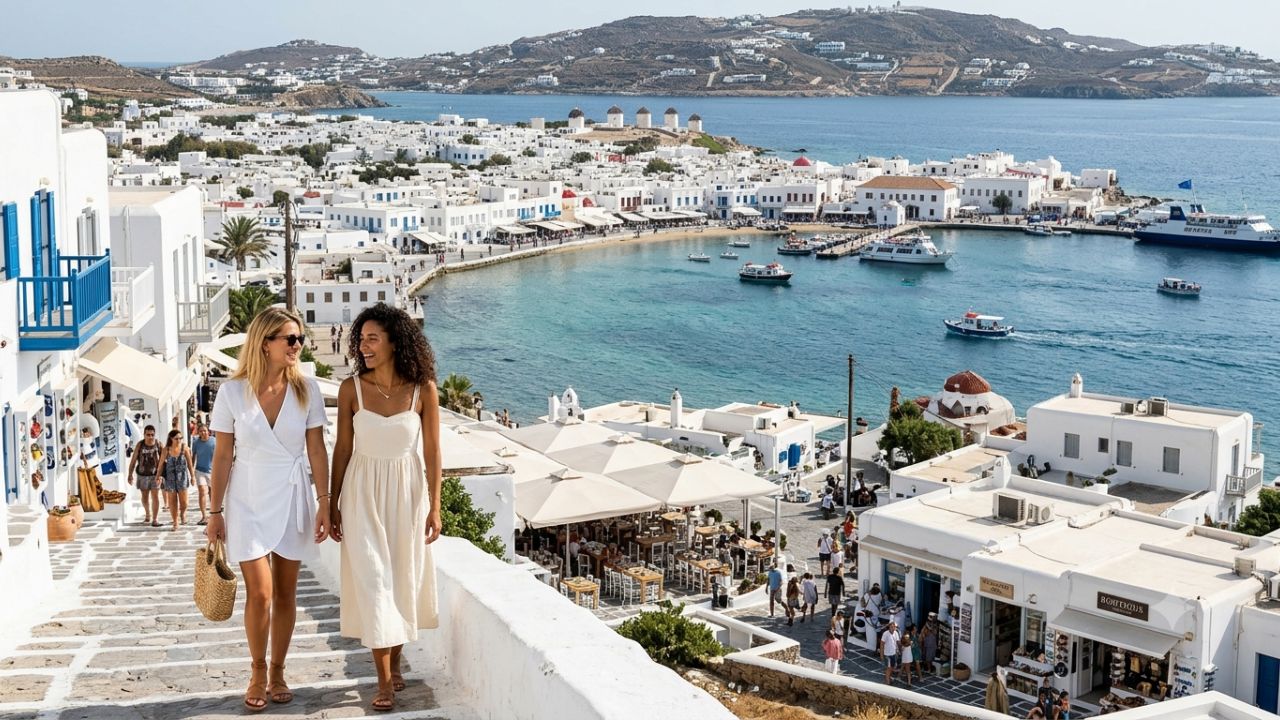
ATHENS, Greece — Propelled by surging demand from Germany, the United Kingdom, and Italy, Greece’s national tourism economy expanded to historic heights during the first eight months of 2026, welcoming 28.51 million international visitors and generating €18.20 billion in travel receipts. Yet beneath these buoyant macroeconomic figures, the country’s most celebrated island destinations—led by the global glamour capital of Mykonos and the caldera cliffs of Santorini—are confronting a profound infrastructure reckoning. As acute water deficits, overloaded electrical grids, congested road corridors, and rapid commercial overdevelopment collide with record-breaking visitor arrivals, the Greek government has initiated sweeping Local and Special Urban Plans across seven prominent Aegean islands. However, emerging academic research from the University of West Attica warns that critical data gaps and central planning blind spots threaten to undermine these essential regulatory interventions, exposing the delicate balance between limitless economic yield and fragile island carrying capacity.
+----------------------------------------------------------------------------------------------------+ | KEY TAKEAWAYS: GREECE TOURISM EXPANSION & THE CYCLADIC INFRASTRUCTURE TURNING POINT | +----------------------------------------------------------------------------------------------------+ | - Record Inbound Performance: Greece welcomed 28.51 million international travelers from January | | to August 2026 (+10.0% YoY), generating €18.20 billion in foreign travel receipts (+9.4% YoY). | | - Germany as Growth Anchor: Maintained top market standing with 4.21 million arrivals (+8.1% YoY) | | and €2.86 billion in expenditure (+7.2% YoY), providing indispensable liquidity across resorts. | | - Dynamic European Corridors: United Kingdom contributed 3.40 million arrivals (€2.67B spend), while| | Italy emerged as the fastest-growing market with arrivals surging 22.1% and receipts up 31.7%. | | - High-Yield US Market: American arrivals edged down 1.5% to 1.06 million, yet US traveler spend | | leaped 21.0% to €1.47 billion, demonstrating extraordinary spending power per visitor. | | - Mykonos & Santorini Crossroads: Overwhelming seasonal peak demand is exhausting island water | | desalination capacity, wastewater processing plants, road access, and resident housing stocks. | | - Seven-Island Urban Plans: Comprehensive zoning and construction limits drafted for Mykonos, | | Santorini, Tinos, Andros, Kea, Poros, and Spetses under national spatial planning directives. | | - Academic Red Flags: University of West Attica research highlights three major planning flaws: | | unreliable local tourism data, minimal community consultation, and absent destination expertise. | +----------------------------------------------------------------------------------------------------+
   GREECE'S TOURISM CAPACITY PARADOX: MACRO BOOM VS. ISLAND STRAIN
   ==============================================================
   [Macroeconomic Surge: Jan–Aug 2026]
   - 28.51M Total International Visitors (+10.0% YoY)
   - €18.20B Inbound Travel Receipts (+9.4% YoY)
            │
            ├──► Germany:  4.21M Visitors | €2.86B Spend (+7.2% YoY)
            ├──► UK:       3.40M Visitors | €2.67B Spend (+5.0% YoY)
            ├──► Italy:    1.92M Visitors | €1.26B Spend (+31.7% YoY)
            └──► US:       1.06M Visitors | €1.47B Spend (+21.0% YoY)
            │
            ▼
   [Microeconomic Reality: Cycladic Infrastructure Crisis]
   - Severe Groundwater Depletion & Desalination Overload
   - Roadway Bottlenecks & Overwhelmed Waste Processing
   - Residential Displacement & Skyrocketing Local Living Costs
            │
            ▼
   [Policy Response: Special Urban Plans (EPS) for 7 Islands]
   Mykonos | Santorini | Tinos | Andros | Kea | Poros | Spetses
Macroeconomic Surge: Deconstructing Greece’s €18.2 Billion Inbound Boom
The statistical bulletin released by the Bank of Greece for the January–August 2026 period paints a picture of exceptional commercial vigor across the Hellenic travel sector. International inbound travel expanded by a robust 10.0 percent year-on-year, pushing cumulative arrivals across air, maritime, and land frontiers to 28.51 million. Concurrently, gross travel receipts rose by 9.4 percent to reach €18.20 billion, supplying vital foreign exchange earnings that anchor Greece’s national current account balance and support hundreds of thousands of hospitality jobs.
An examination of transit channels highlights the changing operational dynamics of Mediterranean travel. While international airport arrivals expanded by a steady 5.7 percent, passenger movements through road border checkpoints registered an extraordinary 22.6 percent surge. This overland boom reflects growing regional travel flows originating from neighboring Balkan and Central European nations—including Bulgaria, Romania, and Serbia—whose travelers increasingly drive directly to northern Greek coastal regions like Halkidiki, Pieria, and Thassos, circumventing volatile European airfares.
The financial bedrock of the Greek tourism miracle remains firmly anchored in established Western European and North American source markets. Germany retained its undisputed position as Greece’s premier economic partner in tourism. During the first eight months of 2026, German arrivals expanded by 8.1 percent to reach 4.21 million visitors, while German expenditure rose 7.2 percent to €2.86 billion. This consistent influx of German vacationers provides indispensable base occupancy for Greek hoteliers, resort operators, car rental fleets, and family taverns across both mainland regions and maritime archipelagos.
The United Kingdom followed closely as Greece’s second most valuable inbound market, generating 3.40 million arrivals (up 3.9 percent) and contributing €2.67 billion in travel receipts (up 5.0 percent). British holidaymakers demonstrated remarkable financial resilience, sustaining consistent demand for organized package holidays, family beach resorts, and multi-generational villa rentals across Crete, Rhodes, Corfu, and the Ionian islands.
| Key Source Market | Jan–Aug 2026 Arrivals | YoY Arrival Growth | Jan–Aug 2026 Receipts | YoY Spend Growth | Strategic Market Dynamics |
|---|---|---|---|---|---|
| Germany | 4.21 million | +8.1% | €2.86 billion | +7.2% | Primary volume and liquidity anchor across mainland and islands |
| United Kingdom | 3.40 million | +3.9% | €2.67 billion | +5.0% | Heavy uptake of all-inclusive packages and family resorts |
| Italy | 1.92 million | +22.1% | €1.26 billion | +31.7% | Explosive growth driven by expanded ferry routes and island hopping |
| United States | 1.06 million | -1.5% | €1.47 billion | +21.0% | Premium long-haul luxury, private charters, and high per-day yield |
| France | 1.35 million | -5.4% | €932 million | -8.1% | Contraction reflecting domestic economic caution and airfare sensitivity |
| Total Inbound Market | 28.51 million | +10.0% | €18.20 billion | +9.4% | All-time historic high for eight-month performance |
Beyond the two traditional leaders, Italy emerged as the standout European growth engine of 2026. Italian arrivals jumped by an astonishing 22.1 percent to 1.92 million, while Italian travel receipts accelerated at an even faster pace, leaping 31.7 percent to reach €1.26 billion. Supported by expanded direct ferry services from Adriatic ports like Bari, Brindisi, and Ancona to western Greece and the Cyclades, Italian holidaymakers fueled double-digit occupancy gains across coastal destinations.
Conversely, the French market exhibited notable softness, contracting by 5.4 percent in arrivals (1.35 million) and 8.1 percent in expenditure (€932 million). This divergence illustrates that European economic performance is increasingly fractured, requiring Greek tourism authorities to maintain diversified marketing portfolios rather than assuming uniform continent-wide expansion.
Outside the European Union, the United States market delivered an extraordinary demonstration of high-yield tourism. Although American arrival numbers dipped slightly by 1.5 percent to 1.06 million, total spending by US travelers rocketed by 21.0 percent to €1.47 billion. American visitors demonstrated unmatched purchasing power, reserving luxury five-star suites, chartering private catamarans, purchasing fine jewelry, and dining in high-end gastronomic establishments across Athens, Mykonos, and Santorini, confirming that high-value tourism yield can outpace raw arrival headcounts.
Mykonos at the Crossroads: The Anatomy of Island Infrastructure Exhaustion
While national macroeconomic statistics celebrate record-breaking revenues, on the ground in Mykonos the mood is decidedly more complex. For more than half a century, this 86-square-kilometer Cycladic island has reigned as the world’s most iconic playground for global jet-setters, celebrities, and lifestyle vacationers. However, the relentless expansion of luxury villa compounds, beach clubs, and boutique suites has pushed the island’s physical carrying capacity to the brink of collapse.
The most acute crisis confronting Mykonos is freshwater scarcity. Traditionally reliant on rainwater cisterns and modest groundwater wells, the island’s water table has been severely depleted and contaminated by saltwater intrusion caused by excessive extraction. To satisfy the voracious water demands of luxury tourism—where private plunge pools, lush landscaped gardens, and high-pressure spa showers are standard amenities—the island relies heavily on energy-intensive mobile desalination plants. During peak July and August weeks, municipal desalination facilities operate at maximum capacity around the clock. Any mechanical breakdown or electrical power fluctuation threatens to leave entire settlements without running water, forcing luxury hotels to pay exorbitant sums for emergency water deliveries by maritime tanker trucks.
Transportation infrastructure faces similar gridlock. Mykonos possesses a narrow, winding road network originally constructed for agricultural carts and small motor scooters. During midsummer peaks, these two-lane rural roads become paralyzed by thousands of rental cars, quad bikes, luxury chauffeur vans, delivery trucks, and public buses attempting to navigate between Mykonos Town (Chora), the international airport, the new cruise port at Tourlos, and southern beach clubs like Psarou, Paraga, and Super Paradise. Traffic jams stretching for kilometers are common, delaying emergency medical services and frustrating visitors who pay thousands of euros per night for luxury seclusion.
Wastewater and solid waste management present equally severe ecological threats. The island’s municipal sewage treatment plants were engineered for a permanent resident population of roughly 10,000 citizens. During peak summer weekends, the island’s temporary population swells past 150,000 people. The sheer volume of wastewater frequently overwhelms treatment capacity, creating persistent odors and environmental hazards in surrounding coastal bays. Solid waste collection faces comparable logistical bottlenecks, with local landfills operating beyond capacity and recycling initiatives struggling against the immense daily output of disposable packaging, glass bottles, and food waste generated by hospitality venues.
Simultaneously, the hyper-commercialization of tourism has triggered severe residential displacement. Rental rates on Mykonos have escalated to astronomical heights, pricing out the very professionals required to keep civic society functioning. Schoolteachers, hospital doctors, police officers, and seasonal service workers find it nearly impossible to secure affordable housing, often forced to sleep in windowless basements, shipping containers, or communal dormitory rooms. This social strain has eroded community cohesion, fostering local resentment toward unchecked tourism expansion.
   MYKONOS CRITICAL RESOURCE DEPLETION PROFILE
   ===========================================
   [Freshwater]       ──► Aquifers depleted; 100% reliance on strained desalination
   [Road Network]     ──► Narrow rural lanes gridlocked by chauffeur vans & quad bikes
   [Waste Management] ──► 10,000-resident capacity overwhelmed by 150,000 summer peak
   [Power Grid]       ──► Submarine cables operating at maximum load during heatwaves
   [Social Housing]   ──► Local doctors, teachers & staff priced out by short-term rentals
The Seven-Island Urban Planning Overhaul: Cyclades and Saronic Gulf
Recognizing that unmanaged growth threatens to destroy the very environmental and aesthetic qualities that attract international visitors, the Greek Ministry of Environment and Energy, collaborating with the Ministry of Tourism, has initiated an ambitious spatial planning intervention. The government has commissioned comprehensive Local Urban Plans and Special Urban Plans for seven iconic islands spanning the Cyclades and the Saronic Gulf: Mykonos, Santorini, Tinos, Andros, Kea, Poros, and Spetses.
This regulatory initiative represents a historic departure from decades of laissez-faire development. For generations, Greek land-use laws permitted widespread off-plan construction, known locally as ektos schediou. Under these legacy loopholes, property developers could purchase agricultural land outside designated town boundaries and construct massive commercial tourist villas, provided the plot exceeded minimum acreage thresholds. This practice led to urban sprawl that fragmented rural landscapes, scarred pristine hillsides with concrete access roads, and placed impossible burdens on municipal utility networks.
The new urban plans establish definitive, legally binding boundaries for construction and economic activity across all seven target destinations. On Mykonos, the proposed Special Urban Plan introduces strict construction moratoria across protected rural zones, enforces rigid building coefficient reductions, and caps the maximum footprint of new hotel accommodations. It also delineates clear municipal zones where short-term vacation rentals are restricted, preserving residential pockets for permanent island residents.
On Santorini, where the community confronts severe cliffside erosion, traffic congestion between Fira and Oia, and an overwhelming influx of cruise ship passengers, the plan prioritizes landscape preservation. It proposes halting all new hotel construction along the fragile caldera rim, establishing strict carrying capacity limits for cruise passenger arrivals, and protecting traditional vineyards cultivated in ancient basket-weave vines from real estate encroachment.
On Tinos and Andros, which sit adjacent to Mykonos, the planning focus centers on preventing speculative spillover development. These larger, more traditional islands have experienced intense investment pressure as developers seek alternatives to Mykonos. The planning directives channel new lodging into designated coastal settlements while safeguarding traditional stone pigeon houses, historic walking paths, and centuries-old agricultural terraces from commercial bulldozers.
In the western Cyclades and Saronic Gulf, Kea, Poros, and Spetses confront their own specialized challenges. Kea’s plan establishes strict limits on sprawling vacation home construction to protect ancient oak forests and delicate coastlines. On Poros, the plan focuses on preserving the historic neoclassical waterfront and regulating yacht marina expansion along the narrow naval channel. On Spetses, where private motor vehicles are strictly banned, the planning framework reinforces traditional captain-mansion architecture, limits motorized commercial deliveries, and protects pine-covered hills from real estate development.
   THE SEVEN-ISLAND URBAN PLANNING MATRIX
   ======================================
   [Mykonos]    ──► Construction moratoria in rural zones, villa footprint caps
   [Santorini]  ──► Caldera rim building freeze, cruise ship passenger quotas
   [Tinos]      ──► Protection of marble-craft villages & agricultural terraces
   [Andros]     ──► Coastal zoning controls to prevent speculative mega-sprawl
   [Kea]        ──► Stringent off-plan building caps & oak forest conservation
   [Poros]      ──► Waterfront architectural preservation & naval channel protection
   [Spetses]    ──► Strict vehicular bans & traditional captain mansion heritage
Academic Research Exposes Critical Gaps in Greece’s Island Planning
While the Greek government has promoted these urban plans as a visionary framework for sustainable development, emerging academic scholarship has raised serious questions regarding their foundational methodology. In an evaluation presented at the University of West Attica, Associate Professor Efthymia Sarantakou—a leading European specialist in tourism spatial planning—identified three profound structural flaws that threaten to undermine the effectiveness of the initial planning phase.
The first major weakness identified by Professor Sarantakou concerns the reliability, granularity, and completeness of the tourism data utilized by government planning teams. Planners have relied almost exclusively on broad macroeconomic statistics compiled at national or regional levels, which capture aggregate arrival numbers and financial receipts but fail to measure micro-level island realities. Essential data points—such as the actual daily consumption of municipal water per hotel bed, peak-hour wastewater discharge volumes, localized traffic bottlenecks, and real-time residential vacancy rates—are largely absent from the analytical models. By formulating long-term land-use policies based on incomplete or generic data, the plans risk miscalculating actual carrying capacity thresholds, either imposing ineffective restrictions or stifling responsible, sustainable local businesses.
The second major gap involves the pronounced disconnect between central planning proposals and the lived realities of local island communities. Sarantakou’s research reveals that the formulation of preferred development scenarios was conducted through centralized, bureaucratic mechanisms in Athens with minimal participatory consultation involving local municipal councils, agricultural cooperatives, civic associations, and permanent residents. When spatial planning is imposed from above without meaningful local consensus, it invariably triggers widespread community resistance, legal challenges before the Council of State, and non-compliance on the ground. Island residents express justified fear that rigid zoning blueprints drafted by mainland consultants will restrict their ancestral property rights while granting special development exceptions to powerful multinational hotel conglomerates.
The third fundamental flaw lies in the lack of specialized tourism destination management expertise among the professional teams drafting the plans. Under current public procurement procedures, urban planning contracts are awarded primarily to generalist architectural and civil engineering consultancies. While these firms possess technical competence in land surveying and structural zoning, they lack deep expertise in tourism economics, visitor flow management, hospitality operations, and environmental carrying capacity modeling. Without specialized destination management input, the resulting urban plans treat tourism as a static construction activity rather than a dynamic, complex socio-economic ecosystem, failing to anticipate how global travel trends, airline schedules, and digital booking platforms interact with local island resources.
The National Spatial Framework: Saturated Red Zones vs. Sustainable Growth
The debates unfolding across Mykonos and Santorini are directly linked to the broader National Spatial Planning Framework for Tourism, which was formally approved by the Greek government in August 2026. This comprehensive policy blueprint establishes a structured national classification system that divides Greek territory into distinct categories based on visitor density, economic reliance, and carrying capacity pressure.
Under this national framework, municipalities are categorized into distinct operational tiers that determine future investment rules. In the Red Zones, designated as saturated tourism destinations, the state enforces strict limits on new hotel bed creation, prohibits the conversion of residential buildings into short-term holiday rentals, mandates rigorous environmental building standards, and introduces punitive infrastructure fees on commercial operators. Mykonos, Santorini, and select districts in Rhodes and Corfu fall squarely into this high-pressure category.
In the Blue Zones, defined as mature destinations with controlled growth potential, local authorities focus on modernization and qualitative upgrading rather than raw physical expansion. Regions like Crete’s northern coast, Halkidiki, and Kos are encouraged to invest in renewable energy integration, water desalination improvements, and four-season operational models that extend employment across spring and autumn.
In the Green Zones, representing developing and undiscovered regions across the Greek mainland and outer archipelagos, the government provides financial incentives, tax credits, and infrastructure subsidies to attract boutique eco-lodges, agricultural tourism initiatives, and hiking trail networks. By channeling capital into these underdeveloped rural areas, the state aims to distribute tourism wealth more equitably across the nation.
To reinforce these spatial controls, the Greek government has moved forward with targeted regulatory instruments. Prime Minister Kyriakos Mitsotakis announced the introduction of a dedicated cruise passenger levy of up to €20 per passenger during peak summer months for visitors disembarking at Mykonos and Santorini. The proceeds from this fee are earmarked directly for local municipal infrastructure budgets, funding seawater desalination upgrades, road widening projects, and waste treatment modernization.
Simultaneously, major Aegean cruise ports are implementing computerized berth allocation systems that limit the number of cruise mega-ships permitted to drop anchor simultaneously. By spreading cruise passenger arrivals across staggered morning and afternoon time slots, maritime authorities aim to eliminate the chaotic human surges that regularly paralyze the narrow caldera lanes of Fira and Oia, ensuring that island infrastructure is not overwhelmed by thousands of day-trippers arriving at the same moment.
These regulatory controls reflect broader analytical warnings issued by the Bank of Greece and its Climate Change Impacts Study Committee. In economic evaluations submitted to national policymakers, the central bank underscored that overtourism cannot be evaluated solely through aggregate arrival figures. When regional destinations exceed their carrying capacities, the resulting degradation of cultural landscapes, municipal utilities, and resident goodwill causes long-term reputational damage that diminishes the country's premium brand equity. Preserving destination competitiveness requires establishing strict equilibrium between private sector investment returns and public environmental conservation.
| Strategic Policy Tool | Target Destination Tier | Operational Mechanism | Intended Environmental & Economic Outcome |
|---|---|---|---|
| Cruise Passenger Levy (€20/pax) | Saturated Red Zones (Mykonos, Santorini) | Per-passenger charge collected at disembarkation during peak months | Direct funding for municipal desalination, roads, and waste plants |
| Berth Allocation Scheduling | High-Traffic Aegean Cruise Ports | Mandatory digital booking slots for incoming cruise liners | Eliminates synchronized passenger surges in fragile historic centers |
| Building Coefficient Reductions | Off-Plan Rural Zones (Ektos Schediou) | Strict cuts to maximum permissible villa square footage | Prevents agricultural land fragmentation and protects scenic ridgelines |
| Short-Term Rental Moratoria | Historic Town Cores & Overheated Urban Centers | Freezes on new Airbnb licenses in designated municipal zones | Restores long-term rental housing supply for local essential workers |
| Green Spatial Subsidies | Developing Green Zones (Mainland & Outer Islands) | Tax incentives for agritourism, eco-chalets, and trail networks | Disperses international tourist spending to underdeveloped rural areas |
Practical Implications for International Travelers and the Tourism Industry
The structural turning point facing Greek island tourism carries practical ramifications for international travelers planning holidays to the Aegean. Importantly, these new spatial planning frameworks and infrastructure controls do not represent travel bans or entry prohibitions. Greece remains open, welcoming, and eager to host international guests. However, travelers should prepare for an evolving regulatory and financial environment designed to safeguard destination quality:
   TRAVELER CHECKLIST: PLANNING AN AEGEAN ISLAND EXPEDITION
   ========================================================
   [ ] Budget for Climate Resilience Fees: Factor in the updated national climate resilience
       tax applied to hotel stays, which scales higher during the peak April–October season.
   [ ] Prepare for Cruise Port Surcharges: Expect cruise itineraries stopping at Mykonos and
       Santorini to incorporate the new peak-season disembarkation levies into ticket pricing.
   [ ] Respect Island Water Restrictions: Practice conscious water conservation in luxury villas
       and hotels, avoiding unnecessary towel washing and swimming pool water waste.
   [ ] Consider Island-Hopping to Secondary Gems: Explore pristine, uncrowded alternatives like
       Tinos, Andros, Naxos, Sifnos, or Milos, which offer authentic culture with less congestion.
   [ ] Pre-Book Ground Transport Early: Arrange private transfers or vehicle rentals months in
       advance to avoid severe shortages and inflated prices during peak Cycladic travel windows.
   [ ] Embrace Spring and Autumn Travel: Plan visits in May, June, September, or October to enjoy
       warm swimming waters, uncrowded archaeological sites, and significantly lower lodging rates.
For the international hospitality investment community, the era of unchecked real estate speculation in the Cyclades has definitively closed. Institutional investors, hotel developers, and luxury brands must realign their development strategies around rigorous sustainability criteria. Projects that incorporate comprehensive on-site wastewater recycling, solar photovoltaic microgrids, architectural heritage preservation, and dedicated staff housing facilities will receive streamlined regulatory approvals, while speculative developments that rely on unpermitted off-plan construction will face insurmountable legal and administrative hurdles.
By confronting its infrastructure constraints with courage, scientific rigor, and transparent community engagement, Greece has the opportunity to transform its Aegean islands into global benchmarks for sustainable destination management. Preserving the timeless white-and-blue beauty of the Cyclades ensures that these legendary islands will continue to captivate the world’s imagination for generations to come.
Related Travel Guides
- Greece Crowned Top Family Holiday Destination at UK Travel Awards: Arrivals Reach 4.89M
- Slovenia Unveils 2027 Wellness Tourism Vision at WTM London: UK Arrivals Surge 32.5%
- US Outranks All Other Countries in Powering Resurgence of Costa Rica Ecotourism
- Canada Imposes CAD 1.5M Extraterritorial Fines for Visa Fraud: How Europe Faces IRCC Enforcement
This article is for informational purposes. Flight routes, passenger regulations, visa rules, and transit advisories are subject to change by airlines and aviation authorities. Readers are advised to verify schedules and travel documentation with relevant carriers and border agencies before departure.
Related Stories
Greece Crowned Top Family Holiday Destination at UK Travel Awards: How British Arrivals Reached 4.89M as Travel Receipts Hit €3.74B
Greece Targets DACH Markets with Samos Tourism Expansion: Logistics Guide for 2026