Germany And More Countries Drive Europe’s Multi-Modal Luxury Travel Boom as River Droughts Reshape Rhine and Danube Tourism

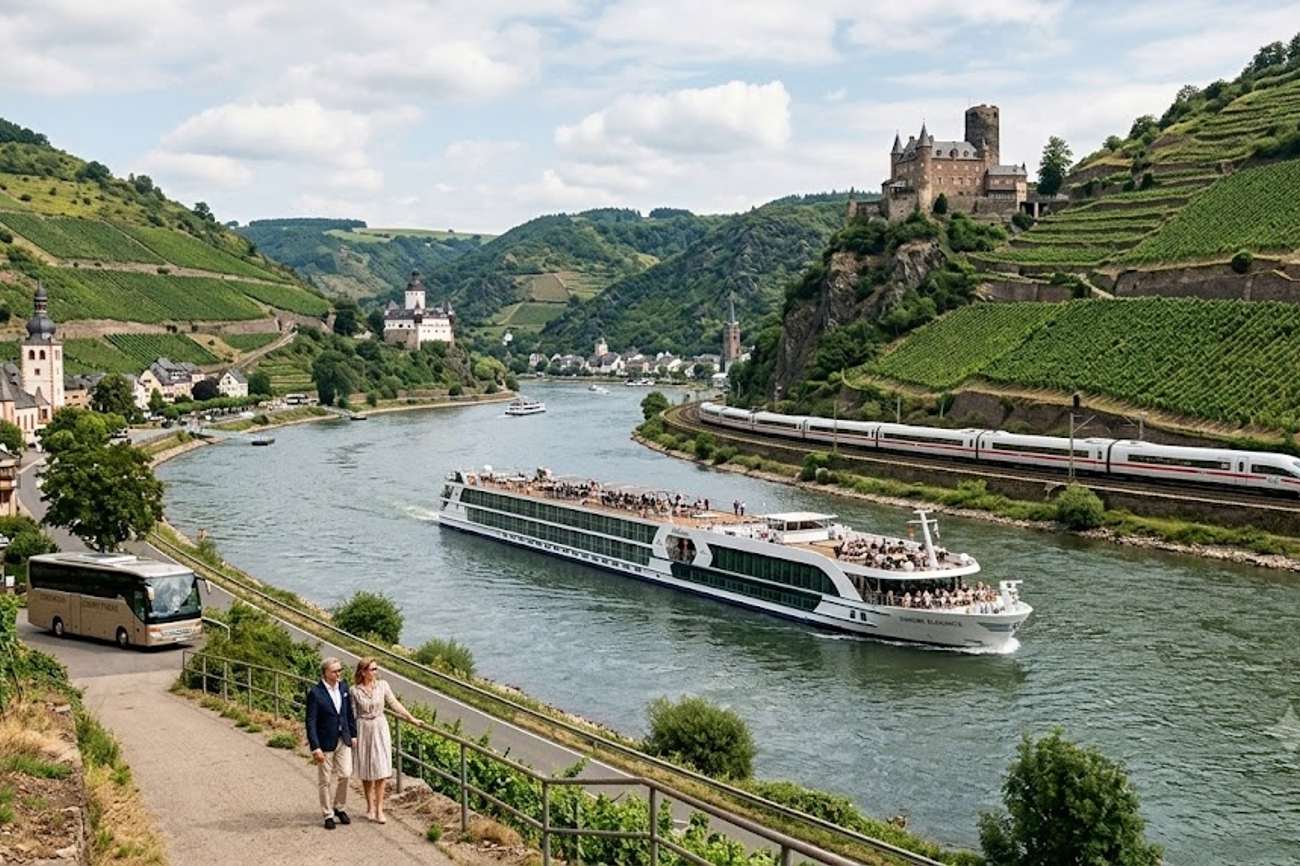
Image generated by AI
The European river cruise sector currently generates €3.54 billion in annual gross ticket revenues, yet this financial peak is colliding with a hydrological floor; while passenger volume has reached 1.39 million, the operational drafts of standard vessels (1.50m to 1.75m) are increasingly incompatible with summer water levels. This disconnect signals a transition from a period of predictable seasonal sailing to an era of "navigational fragility," where climate-driven droughts are no longer anomalies but structural risks.
The Hydrological Breaking Point in Numbers
The economic engine of European river cruising is heavily dependent on a specific demographic: overseas travelers from the United States and Canada. While these passengers constitute only 41% of the total volume, they drive 71% of the industry's total revenue. This concentration of wealth in premium suites creates a high-stakes environment where operational failures—such as being stranded or diverted to emergency coaches—result in significant brand erosion and financial loss.
The physical constraints of the fleet exacerbate this vulnerability. Most luxury vessels measure between 110 and 135 meters in length. Unlike freight barges, which can offload cargo to reduce their draft, passenger ships have fixed weights due to steel multi-deck structures, propulsion plants, and luxury amenities. This means that when water levels drop, operators face a binary outcome: complete cancellation or the risk of grounding on submerged rock shelves.
Data from the Central Commission for the Navigation of the Rhine (CCNR) and the Commission for the Hydrology of the Rhine Basin (CHR) indicates a grim trajectory. Streamflow volumes during seasonal low-flow periods are projected to decrease by 10% to 20% over the coming decades. This shift transforms the operational calendar, as depleted alpine snowpacks and summer heatwaves cause low-water episodes to begin earlier in the spring and persist deeper into the autumn.
Comparative Navigational Bottlenecks
The risk is not uniform across Europe; it is concentrated in specific geographical chokepoints where riverbed geology and infrastructure gaps create "breaking points." The most critical of these is the Kaub Gauge (Rhein-km 546) on the Middle Rhine. Under the GlW 2022 benchmark, a reading of 77 cm is the reference plane for a 1.90-meter fairway depth. However, recent droughts have seen readings plummet to between 10 and 28 cm. A 28 cm reading results in a fairway depth of approximately 1.40 meters; once the mandatory 30-centimeter safety margin (Flottwasser) is removed, the usable draft is only 1.10 meters—well below the 1.50m to 1.75m required for luxury cruise ships.
The following table compares the critical thresholds across the three primary European river basins:
| River Basin | Primary Gauge/Location | Operational Draft Requirement | Critical Disruption Threshold | Primary Navigational Hazard |
|---|---|---|---|---|
| Middle Rhine | Kaub Gauge (km 546) | 1.50m – 1.75m | < 35cm – 40cm | Narrow rock fairways & slate topography |
| Upper Danube | Pfelling Gauge (km 2305) | 1.40m – 1.60m | < 220cm | Free-flowing unimpounded stretches |
| Wachau Danube | Kienstock / Krems | 1.50m – 1.70m | < 1.70m clearance | Dynamic gravel shoals |
| Saxon Elbe | Dresden Gauge (km 55.6) | 0.80m – 1.20m | < 60cm | Severe sandbars & exposed hunger stones |
Practical Traveler Advisory and Strategic Insights
For the high-net-worth traveler, the "romantic illusion" of the river cruise is now subject to hydrological volatility. The data suggests that the traditional peak summer window is becoming the highest-risk period for itinerary disruptions.
If you are booking a luxury river cruise for the Rhine or Danube, the following data-driven adjustments are recommended:
- Shift the Booking Window: Avoid the peak drought months of July and August. Data from the World Tourism Organization (UNWTO) and regional hydrological reports suggest that shoulder seasons (late spring or early autumn) may offer more stable water levels, though the "low-water window" is expanding.
- Verify Vessel Specifications: Inquire specifically about the "operational draft" of the ship. Vessels with lower draft requirements (closer to 1.40m) have a statistically higher chance of completing their itinerary during a drought than those requiring 1.75m.
- Audit Contingency Plans: Because ships are frequently stranded on the "wrong side" of sandbars, ask operators for their specific "emergency coach" protocols. Ensure your travel insurance explicitly covers "itinerary deviation due to environmental conditions," as standard policies may not cover hydrological disruptions.
Germany's luxury travel sector is experiencing a significant boost, driven by the country's efficient multi-modal transportation network, which includes high-speed trains and modern airports, such as Frankfurt Airport, a major hub for international flights. As river droughts affect traditional Rhine and Danube cruise routes, tourists are exploring alternative travel options, including scenic train journeys and river cruises on less affected waterways. This shift is supported by the German National Tourist Board, which provides travelers with up-to-date information on destinations and activities. 4. Diversify Transportation Modes: Expect "hybrid" itineraries. The industry is moving toward multi-modal luxury travel—combining short cruise segments with luxury rail or coach transfers—to bypass bottlenecks like the Kaub Gauge.
Forward Projection: The 2030s Horizon
The industry is currently in a race between climate degradation and infrastructure engineering. The German BMDV has initiated the Abladeoptimierung Mittelrhein project to structurally increase the fairway depth to 2.10 meters. However, the timeline for this is sluggish; environmental review hearings for sectors like St. Goar are slated to continue through 2026, meaning full completion will not occur until the 2030s.
In the interim, we expect a market shift toward "shallow-draft" luxury vessel design. The current fleet of 408 vessels is largely optimized for historical water levels. Future capital expenditure will likely favor ships that can maintain luxury standards while reducing their displacement. Furthermore, we anticipate a rise in "dynamic routing," where IATA and maritime coordinators integrate real-time hydrological data to reroute passengers via air or rail before a ship becomes stranded.
The reliance on North American markets (71% of revenue) means that if the "luxury experience" continues to be marred by emergency coach transfers, we may see a capital flight from river cruising toward more stable luxury segments, such as small-ship coastal cruising or high-end rail expeditions.
FAQ: European River Cruise Trends 2024-2030
Will cruise prices increase due to low water levels? Yes. Operators are facing higher operational costs due to emergency logistics (coaches/hotels) and the need for fleet redesign. Expect "climate surcharges" or higher base fares to offset the risk of itinerary failures.
Is it still a good time to book a Rhine or Danube cruise? Yes, but only if you avoid the peak summer drought window. Booking for May or September reduces the statistical likelihood of encountering the critical <40cm readings at the Kaub Gauge.
Which airlines or carriers are expanding to support these disruptions? While not airlines, luxury coach and rail providers are seeing increased demand. Operators like Viking and Tauck are increasingly integrating multi-modal transport to ensure passengers reach their destinations when ships cannot.
Are all European rivers equally affected? No. The Rhine's Middle Valley is a primary chokepoint. The Elbe is even more fragile due to its unimpounded natural riverbed, often prohibiting even shallow-draft vessels when the Dresden Gauge drops below 60cm.
The era of the guaranteed river itinerary has ended; the era of the hydrological gamble has begun.
Related Travel Guides
This article is for informational purposes. Flight routes, passenger regulations, visa rules, and transit advisories are subject to change by airlines and aviation authorities. Readers are advised to verify schedules and travel documentation with relevant carriers and border agencies before departure.
Related Stories
Nox Mobility Launches Flight-Style Night Trains from Hamburg to Munich in 2027
European Mass Protests Disrupt Travel Across France, Italy, Belgium, and Turkey in 2026