
Falkland Islands Cruise Travel 2026: New £50 Passenger Tax and High-Wind Closure Risks
The Falkland Islands face a critical 18.1% gap between booked cruise capacity and actual arrivals for 2026–27, compounded by a new £50 passenger tax and strict 30-knot wind closure rules.

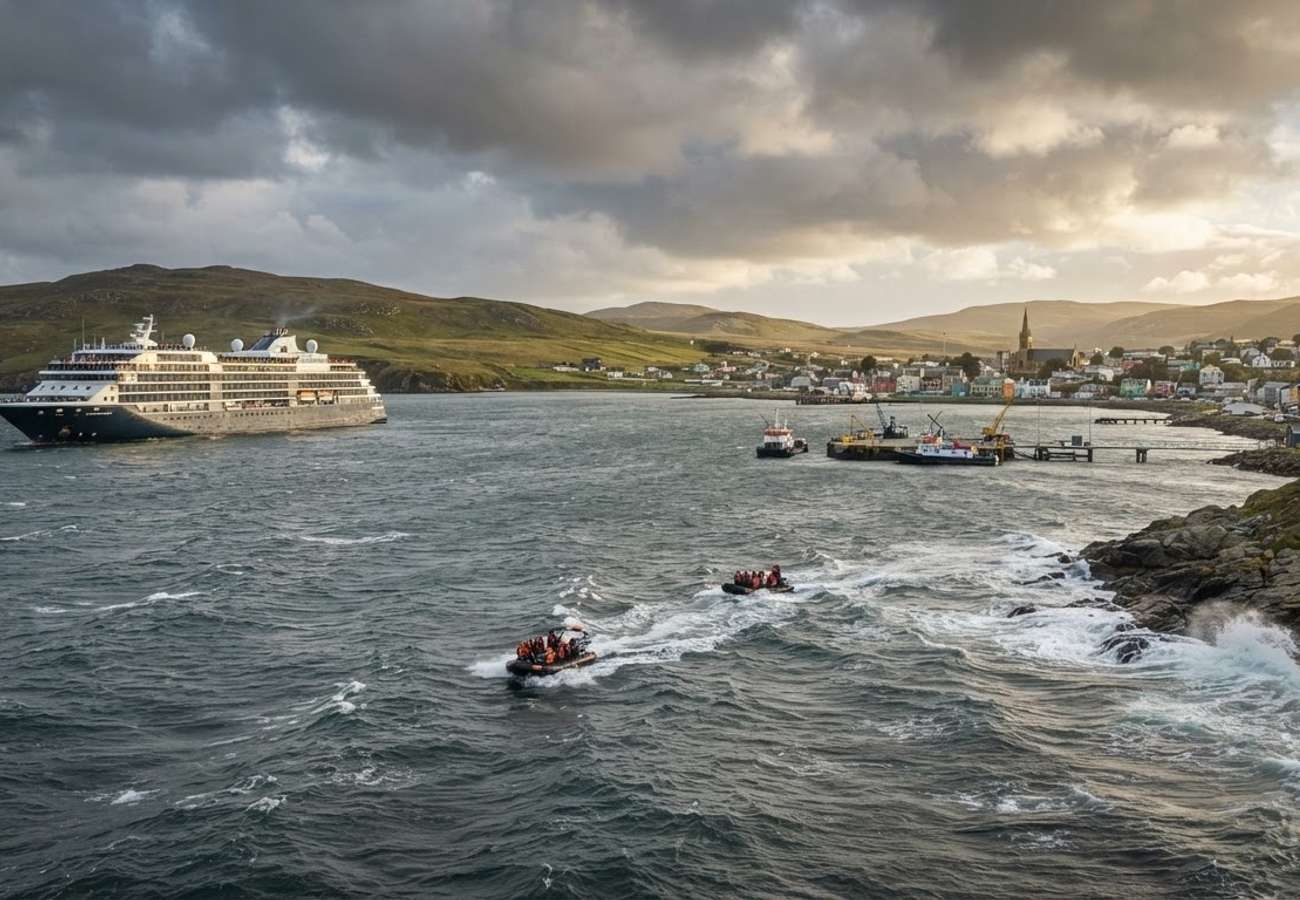
Image generated by AI
A staggering 18.1% gap now exists between potential cruise bookings and projected actual arrivals in the Falkland Islands for 2026–27. With a new £50 passenger tax and rigid weather-based port closures, the region is seeing a shift in how cruise capacity converts to actual economic impact.
The Conversion Gap: Potential vs. Reality
For the 2026–27 season, the Falkland Islands Tourist Board (FITB) recorded potential bookings of 80,000 passengers, assuming vessels sailed at full capacity. However, the latest Tourism Quarterly 42 forecast paints a more conservative picture, projecting only 65,523 actual arrivals. This creates an analytical gap of 14,477 passengers.
This discrepancy highlights a significant "conversion risk." In the remote South Atlantic, a booking on a cruise itinerary does not guarantee a landing. Actual footfall is dictated by a volatile mix of occupancy rates, vessel deployment, and the unforgiving maritime conditions of the region.
The economic stakes are high. Data from the 2025–26 season shows that while arrivals fell from 71,278 (2024–25) to 65,197, direct passenger expenditure plummeted by 31.9% to £5,013,649. With an average spend of just £76.90 per passenger, any missed landing opportunity removes critical revenue from local transport, retail, and excursion providers.
2026–27 Cruise Performance Indicators
| Stanley Cruise Indicator | Official Figure | Change / Measure | Business Impact |
|---|---|---|---|
| 2025–26 Cruise Arrivals | 65,197 | Down 8.5% YoY | Baseline passenger base |
| 2025–26 Direct Expenditure | £5,013,649 | Down 31.9% | Spending drops faster than volume |
| 2026–27 Max Booked Capacity | 80,000 | Potential Max | Theoretical ceiling |
| 2026–27 Forecast Arrivals | 65,523 | Up 0.5% | Expected realized volume |
| Capacity-to-Forecast Gap | 14,477 | 18.1% Difference | Planning buffer for local vendors |
| 2027–28 Forecast Arrivals | 73,386 | Up 12% | Rebound expected via Norwegian Cruise Line |
The 30-Knot Rule: Weather as a Product Risk
For the visitor, the real impact of the Falklands' geography is the "30-Knot Rule." According to the Falkland Islands Maritime Authority, Stanley Harbour closes to all cruise vessels and tenders when sustained winds reach 30 knots and are rising.
Because Stanley Harbour is narrow—approximately 4 nautical miles long and only 0.3 nautical mile wide—it is highly exposed. When visibility drops below 0.1 nautical mile, tender operations are suspended entirely, except in rare, risk-assessed cases involving a single vessel.
The infrastructure at FIPASS further complicates matters. With a berthing face of only 200 metres and a displacement limit of 10,000 tonnes, the majority of modern cruise ships cannot berth and must rely on tendering. If the wind hits 30 knots, the "port call" effectively vanishes from the passenger's experience.
New Fiscal Pressures: The £50 Passenger Tax
Effective 1 July 2026, the Falkland Islands Government implemented a new cruise passenger tax. This introduces a higher cost base for operators and potentially passengers.
- Standard Rate: Increased from £37 to £50 per passenger.
- Reduced Rate: Increased from £16 to £25 for passengers who spend at least US$15 visiting privately owned land in "Camp" (the countryside).
- Future Outlook: Rates are scheduled to rise by another 3% on 1 July 2027, reaching £51.50 and £25.75 respectively.
This tax structure is designed to incentivize "Camp" visits, pushing tourists away from the concentrated hub of Stanley and into the local rural economy to support community-led tourism.
Regional Competition: The Rise of Ushuaia and Punta Arenas
Stanley does not operate in a vacuum. It is part of a wider South Atlantic and Patagonian circuit where competitors are investing heavily in infrastructure.
In Argentina, Ushuaia remains the dominant Antarctic gateway, recording 155,000 cruise passengers in the 2025–26 season. Buenos Aires saw 407,000 passengers, while Puerto Madryn handled nearly 43,000.
Chile is also gaining ground. The Magallanes Region recorded 176 cruise calls and nearly 64,700 passengers in 2025–26. Notably, Punta Arenas has upgraded its facilities, allowing a 285-metre cruise vessel to berth directly at Arturo Prat, removing the weather-dependency and logistical friction associated with tendering—a luxury Stanley currently lacks.
Visitor Insider Tips
- The "Camp" Discount: To save £25 on your passenger tax, book an excursion to the Falklands' countryside (Camp). Ensure the operator provides a receipt for at least US$15 to qualify for the reduced rate.
- Weather Window: The most stable weather typically occurs in the mid-summer window (December to February), though the 30-knot rule can apply any time. Always have a "Plan B" for your shore excursions.
- Local Dining: Skip the hotel buffets and seek out local wool shops and small cafes in Stanley for authentic regional flavors and direct support of the local economy.
- Tender Patience: Because ships over 10,000 tonnes cannot berth at FIPASS, expect long queues for tenders. Allow at least 90 minutes for the disembarkation process.
Tourism Outlook
The long-term viability of Stanley as a cruise hub depends on its ability to bridge the 18.1% capacity gap. While the return of Norwegian Cruise Line in 2027–28 is expected to boost arrivals to 73,386, the region must balance increased volume with environmental conservation. The shift toward "Camp" visits via tax incentives suggests a move toward higher-value, lower-impact tourism that benefits rural communities rather than just the port center.
Navigating the South Atlantic requires a balance of fiscal planning and meteorological luck.
Related Travel Guides
Disclaimer
This article is for informational and educational purposes only. It does not constitute legal, financial, or professional advice. While we strive to provide accurate and up-to-date information, travel policies, regulations, and conditions change rapidly. Always verify information with official sources before making travel decisions. Nomad Lawyer makes no representations about the accuracy, reliability, completeness, or suitability of the information provided. Readers should consult qualified professionals for advice specific to their circumstances. The views expressed in this article are those of the author and do not necessarily reflect the views of Nomad Lawyer.
Preeti Gunjan
Contributor & Community Manager
A passionate traveller and community builder. Preeti helps grow the Nomad Lawyer community, fostering engagement and bringing the reader experience to life.
Learn more about our team →