
Emirates Replaces A380 with Boeing 777-300ER on Dubai-Prague and Dubai-Glasgow Summer 2026 Routes
Emirates is swapping its flagship Airbus A380 for Boeing 777-300ER aircraft on Dubai to Prague and Glasgow routes for Summer 2026, impacting seat capacity and cabin configurations.

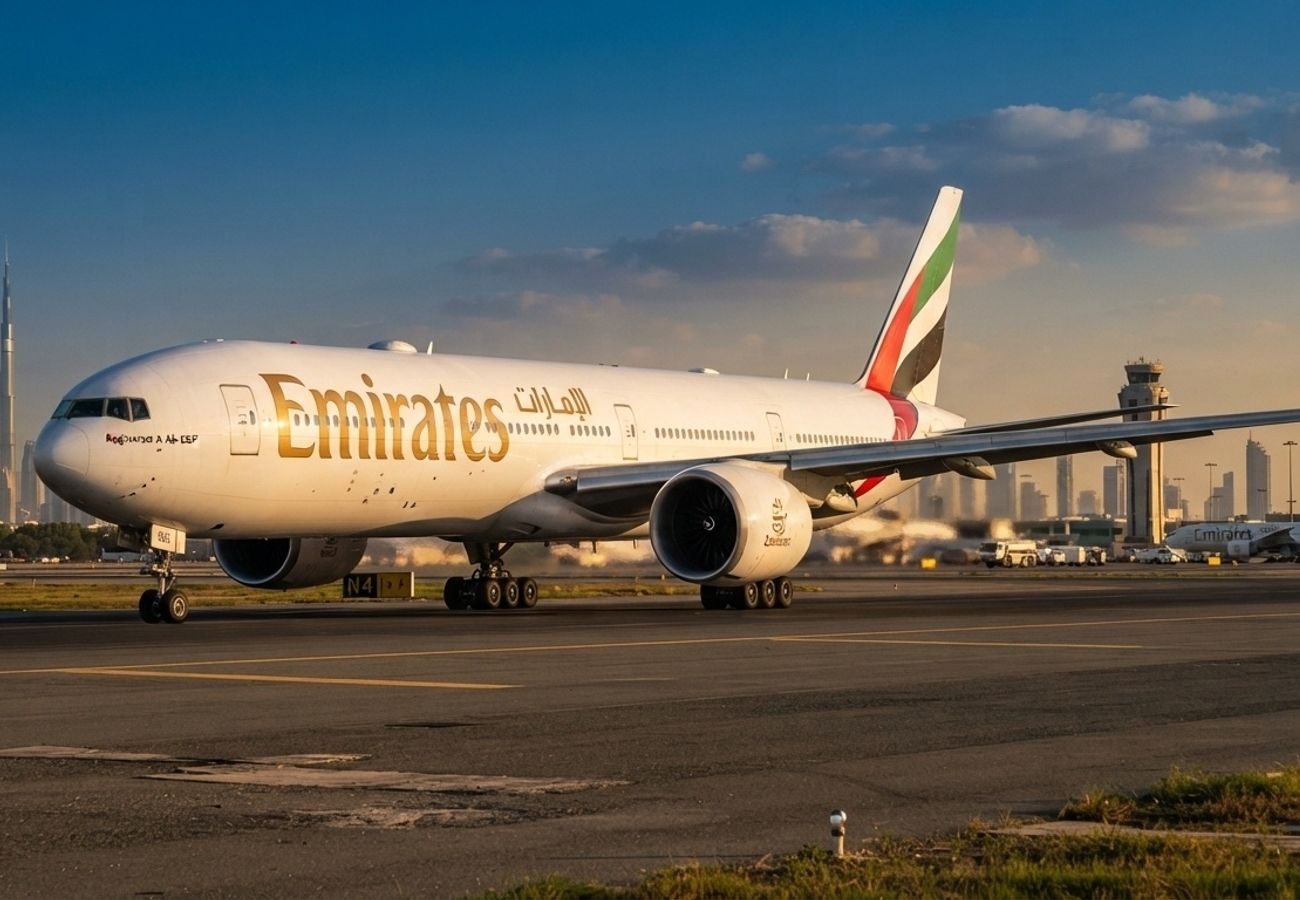
Image generated by AI
Emirates has adjusted its summer 2026 flight schedule, removing the Airbus A380 from the Dubai–Prague and Dubai–Glasgow corridors. The airline is replacing the double-decker aircraft with the smaller Boeing 777-300ER for the peak travel window.
This shift is part of a broader strategic recalibration of the carrier's superjumbo deployment. While flight frequencies remain stable, the change significantly alters the onboard product and total seat availability for travelers heading to the Gulf.
Operational Shifts for Q3 2026
Industry schedule data confirms that from 1 July to 30 September 2026, Emirates will operate Dubai–Prague and Dubai–Glasgow services exclusively using Boeing 777-300ER aircraft. Both routes will maintain their once-daily rotation, but the capacity reduction is immediate.
This follows a series of timetable changes implemented in June 2026, which saw the A380 withdrawn from various European and Asia-Pacific destinations.
Key Fleet Changes at a Glance
- Affected Routes: Dubai (DXB) to Prague (PRG) and Dubai (DXB) to Glasgow (GLA).
- Timeline: 1 July 2026 through 30 September 2026.
- Aircraft Swap: Airbus A380 replaced by Boeing 777-300ER.
- Frequency: Remains at one flight daily per route.
- Primary Driver: Large-scale fleet retrofit program and operational balancing.
Capacity and Cabin Configuration Impact
The transition from the A380 to the 777-300ER creates a discrepancy in total seat counts, particularly within premium cabins. The A380 typically offers a higher-density layout and the distinct upper-deck experience, which is absent on the Boeing 777.
The impact on the passenger experience depends largely on the specific aircraft assigned:
- Premium Economy: While some A380s feature the new four-class layout, an increasing number of 777s are being upgraded to include Premium Economy.
- Cabin Quality: Passengers may experience either an upgrade or a downgrade depending on whether a newly refurbished 777 or an older model is deployed.
- Availability: With fewer seats per departure, business class availability may tighten during high-demand summer dates.
The Retrofit Strategy and Fleet Logistics
The withdrawal of A380s from these routes is a direct result of Emirates' multi-year interior overhaul. The scale of this project is substantial:
- A380 Retrofits: 60 aircraft are slated for refurbishment.
- Boeing 777 Retrofits: Over 50 aircraft are undergoing updates.
- Current Status: High-density two-class A380 retrofits were completed earlier this year, with further work continuing through the end of 2026.
Because these refurbishments take aircraft out of service for several weeks, Emirates is utilizing its 777-300ER fleet to maintain network coverage. This interim strategy serves as a bridge until the introduction of the new-generation Boeing 777X, which is currently undergoing certification and testing.
Route Capacity Summary
| Route | Original Aircraft | Summer 2026 Aircraft | Frequency | Period |
|---|---|---|---|---|
| Dubai $\leftrightarrow$ Prague | Airbus A380 | Boeing 777-300ER | Daily | July 1 – Sept 30 |
| Dubai $\leftrightarrow$ Glasgow | Airbus A380 | Boeing 777-300ER | Daily | July 1 – Sept 30 |
Why This Matters: Industry Analysis
From a logistical perspective, this move signals that Emirates no longer views the A380 as a mandatory requirement for maintaining "prestige" on secondary European routes. Instead, the superjumbo is being repositioned as a surgical tool for high-density trunk routes.
For travelers on these routes, the real impact is the loss of the A380's quieter cabin and specific premium amenities. However, the decision to maintain daily frequencies ensures that the connectivity to Dubai’s global hub—and onward to Asia, Africa, and Oceania—remains intact.
Our analysis suggests that the capacity reduction could lead to higher fare volatility on the Prague and Glasgow routes during August. With fewer seats available on the 777-300ER compared to the A380, the supply-demand imbalance will likely favor the airline's pricing power during the peak holiday window.
Forward Outlook
Expect continued volatility in aircraft assignments across the European network through the end of 2026. As more A380s exit the retrofit hangars, they will likely be redeployed to higher-priority markets first. Passengers should treat seat maps as provisional and verify the aircraft type 48 to 72 hours before departure to confirm cabin configurations.
The shift from superjumbos to twins marks a pragmatic era of fleet flexibility for the Gulf carrier.
Related Travel Guides
Disclaimer
This article is for informational and educational purposes only. It does not constitute legal, financial, or professional advice. While we strive to provide accurate and up-to-date information, travel policies, regulations, and conditions change rapidly. Always verify information with official sources before making travel decisions. Nomad Lawyer makes no representations about the accuracy, reliability, completeness, or suitability of the information provided. Readers should consult qualified professionals for advice specific to their circumstances. The views expressed in this article are those of the author and do not necessarily reflect the views of Nomad Lawyer.
Preeti Gunjan
Contributor & Community Manager
A passionate traveller and community builder. Preeti helps grow the Nomad Lawyer community, fostering engagement and bringing the reader experience to life.
Learn more about our team →